

Why Do Newborns Cry in Their Sleep (And When to Pick Them Up)
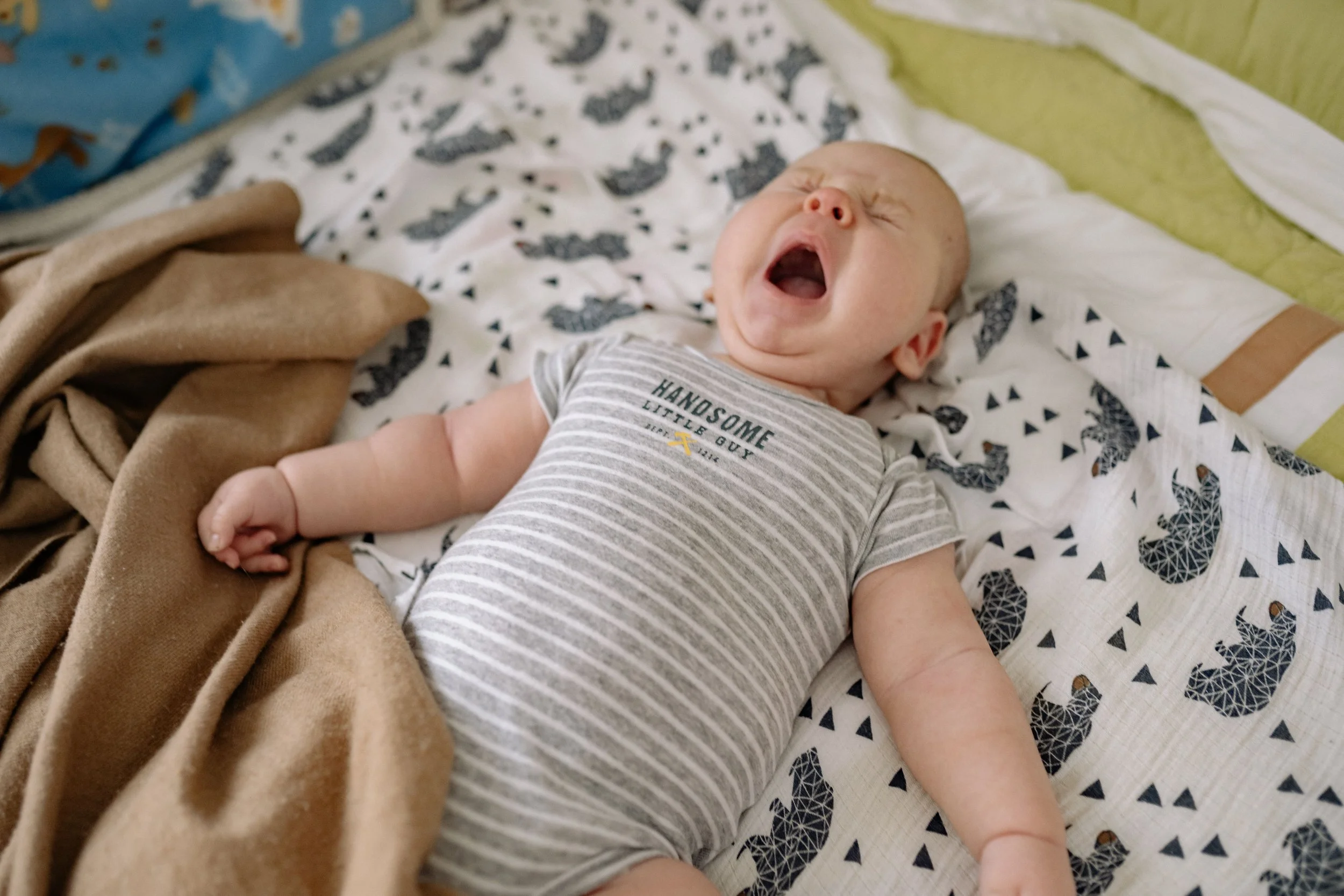
Newborns cry in their sleep because half of their sleep is active REM and their nervous system is still raw. Their muscles don't lock down during REM like adults do. They twitch, grunt, and yelp without actually waking up.
It is 2:14 AM. You closed your eyes ten minutes ago. A sharp, piercing wail rips through the dark room from the bassinet right next to your bed. Your heart slams against your ribs. You throw off the covers, swing your legs onto the cold floor, and lean over the mesh siding. You are ready to scoop up a furious, wide-awake baby.
Except you look down.
Their eyes are clamped shut. Their chest rises and falls in a slow, heavy rhythm. They are completely, deeply asleep.
If you have spent the last week staring at a glowing baby monitor or hissing at your partner in the dark about whose turn it is to get up, take a breath. Your baby is fine. This guide breaks down why infants scream in their sleep, how to tell a REM reflex from real hunger, what changes as they hit 3, 4, and 9 months, and the exact timer rule to use before you pick them up.
Medical & Safety Disclaimer: This article is for education only. MissPoppins coaches provide non-clinical parenting and sleep guidance. When to stop reading and call your pediatrician or 911 immediately: If your baby's sleep sounds come with a rectal fever of 100.4°F (38°C) or higher, grunting at the end of every single breath, blue or pale skin around the lips, flaring nostrils, skin pulling tight around the ribs, projectile or green vomit, or extreme lethargy where you cannot wake them for feeds, get emergency care right now.
Why Do Newborns Cry Out in Their Sleep and Then Stop?
It feels like a glitch. One second, your infant lets out a yell that sounds like they woke up in a panic. Two seconds later, their body goes limp and they are breathing quietly again. Here is what is actually happening in the fourth trimester.
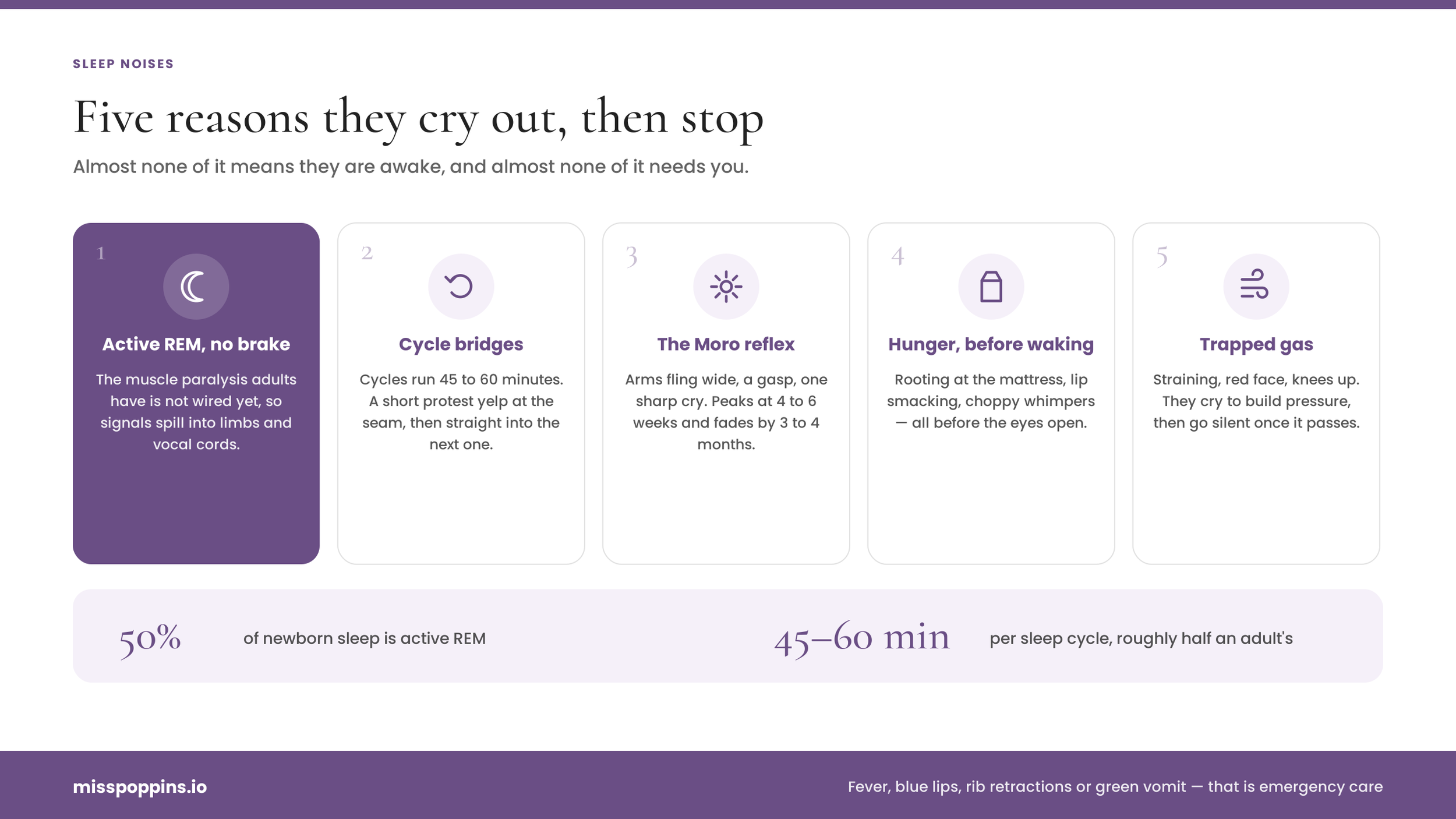
1. Active (REM) Sleep and Incomplete Muscle Atonia
Adults spend about 20% to 25% of the night in REM sleep. During adult REM, the brainstem sends signals down the spine to trigger muscle atonia, a temporary paralysis that stops you from flailing around in bed.
Newborns operate differently. According to sleep architecture data from the National Center for Biotechnology Information (NCBI), infants spend roughly 50% of their rest in active REM sleep, and they drop straight into REM the second they fall asleep. Their brainstem isn't fully wired yet. Every single sensory input from the day is actively building new synapses while they rest. As electrical signals fire across their developing brain, they spill over into the motor cortex and vocal cords. Your baby's legs jerk, their fingers twitch, and their vocal cords contract, making sudden whimpers and sharp cries while they stay dead to the world.
2. Short 45-to-60-Minute Sleep Cycle Transitions
An adult sleep cycle takes about 90 minutes. A newborn cycle is half that. It lasts 45 to 60 minutes. Within that hour, babies bounce between active REM sleep and quiet sleep every 20 to 30 minutes.
Right at the edge between those stages, babies experience micro-arousals. Because infants do not yet know how to stitch infant sleep cycles together, entering the bridge between light and deep sleep triggers a quick protest cry. They let out a yelp right at the boundary, drop into the next cycle, and go silent.
3. The Moro (Startle) Reflex Waking Them Mid-Cycle
During light active sleep, a tiny shift in mattress pressure or a furnace kicking on triggers the Moro reflex. It is an involuntary reaction that mimics a sudden free-fall.
Your newborn flings both arms wide, opens their fingers, gasps, and lets out a sharp cry. This peaks in the first 4 to 6 weeks and integrates by 3 to 4 months. Most of these normal newborn reflexes and sounds happen without waking them up, but if their arms are unbound, the physical jolt can tip them into a full wakeup.
4. Early Hunger Cues Before Full Waking
A newborn's stomach is tiny. It holds very little milk. Digestion happens fast, which means newborn stomachs empty every 2 to 3 hours, or after a 4-to-5-hour stretch once they gain back birth weight.
Hunger doesn't start with a scream. Rising ghrelin levels nudge the brain during the final 15 minutes of an active sleep cycle. Before your baby opens their eyes, they root against the mattress, smack their lips, suck on their fists, and let out choppy whimpers. Catching these early cues is the core of a smart dream feed protocol before stress hormones spike.
5. Trapped Gas, Grunting Baby Syndrome, and Minor Discomfort
Scroll through r/NewParents at 4:00 AM and you will find thread after thread about babies sounding like barnyard animals. This is Infant Dyschezia, or Grunting Baby Syndrome.
Passing gas requires two opposite actions: flexing the abdominal muscles while relaxing the pelvic floor. Newborns don't know how to do both at once. According to pediatric gastroenterology research from the National Institutes of Health (NIH), infants with dyschezia strain, turn bright red, pull their legs up, and cry out in their sleep to build intra-abdominal pressure. Once the gas moves, they go completely silent.
Why Do Newborns Smile and Cry in Their Sleep?
Few things confuse tired parents more than watching a 3-week-old flash a gummy grin, scowl, and let out a whimper within the exact same 30-second window.
Reflexive Smiles, Sleep Laughs, and Sudden Whimpers Explained
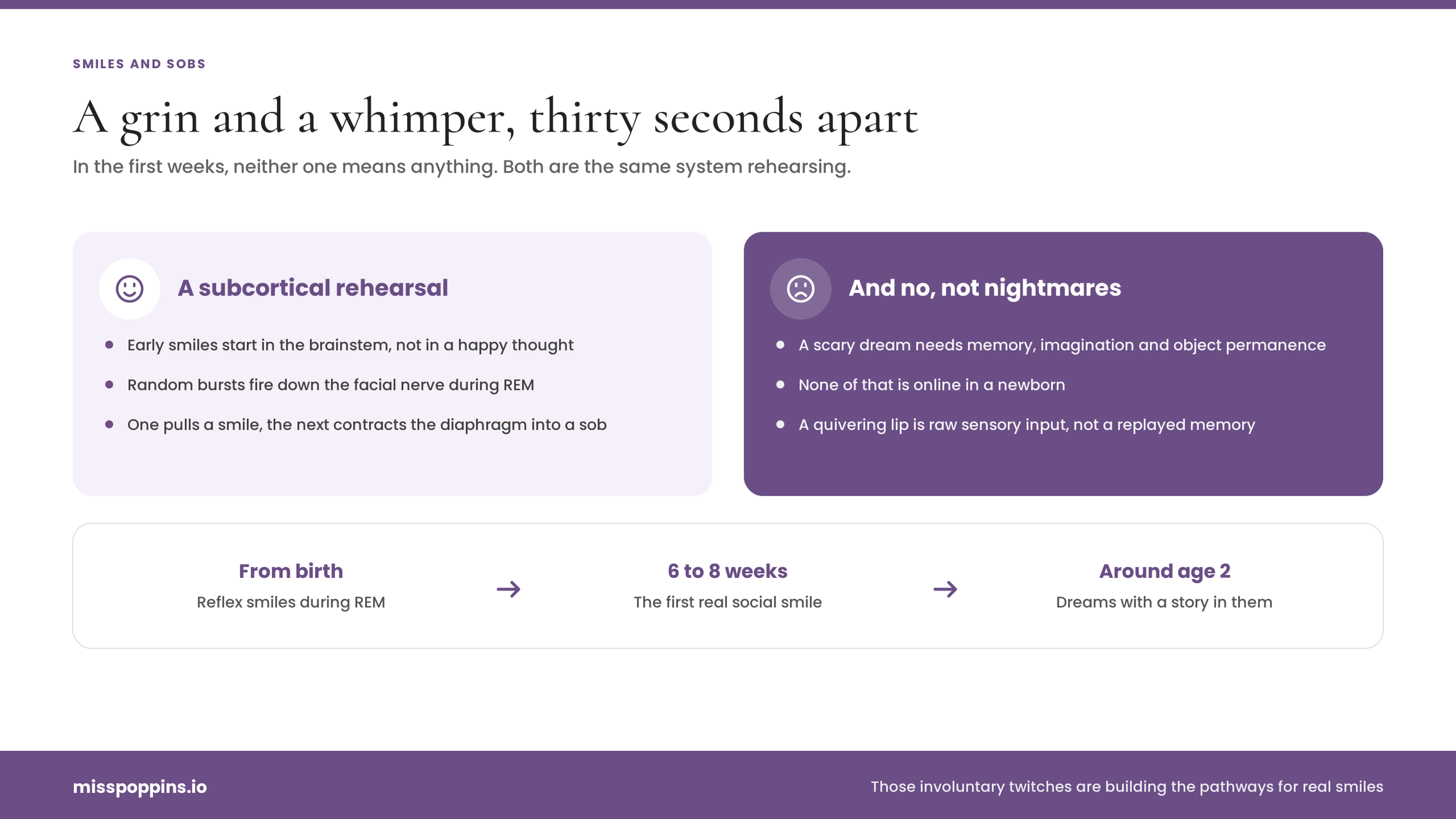
If your baby laughs and cries at the same time in their sleep, you are watching a subcortical dress rehearsal. For the first month or two, infant smiles are not driven by happy thoughts. They start in the brainstem and limbic system during REM sleep.
As rapid eye movements dart under closed eyelids, random electrical bursts fire down the facial and vagus nerves. One micro-burst pulls the mouth into a smile. Five seconds later, another impulse contracts the diaphragm, making a sob. These involuntary workouts build the muscle pathways they will use for social smiles around 6 to 8 weeks.
Are Newborns Having Nightmares When They Cry in Their Sleep?
One of the top questions on parenting forums is: "Does my newborn have nightmares?"
The answer is no. Newborns do not have nightmares or night terrors. Building a scary narrative dream requires autobiographical memory, imagination, and object permanence. According to child development data from the American Academy of Pediatrics (AAP), that cognitive machinery doesn't online until toddlerhood around age 2. When your newborn's lip quivers, they are not reliving a memory. Their brainstem is just processing raw sensory input.
Active Sleep vs. Real Distress: When Should You Pick Up a Crying Sleeping Baby?
Knowing the biology helps, but at 2:00 AM, you need a fast way to know whether to stay in bed. In our coaches' experience working with thousands of families at MissPoppins, jumping up too fast is the number one cause of broken newborn sleep.
"The biggest mistake exhausted parents make at 2:00 AM is treating an active-sleep noise like a rescue call," says Sarah Jenkins, Certified Pediatric Sleep Coach at MissPoppins. "When you scoop up a newborn four seconds into a REM cry, you pull them out of a sleep cycle they were about to connect on their own. Soon, nobody is sleeping."
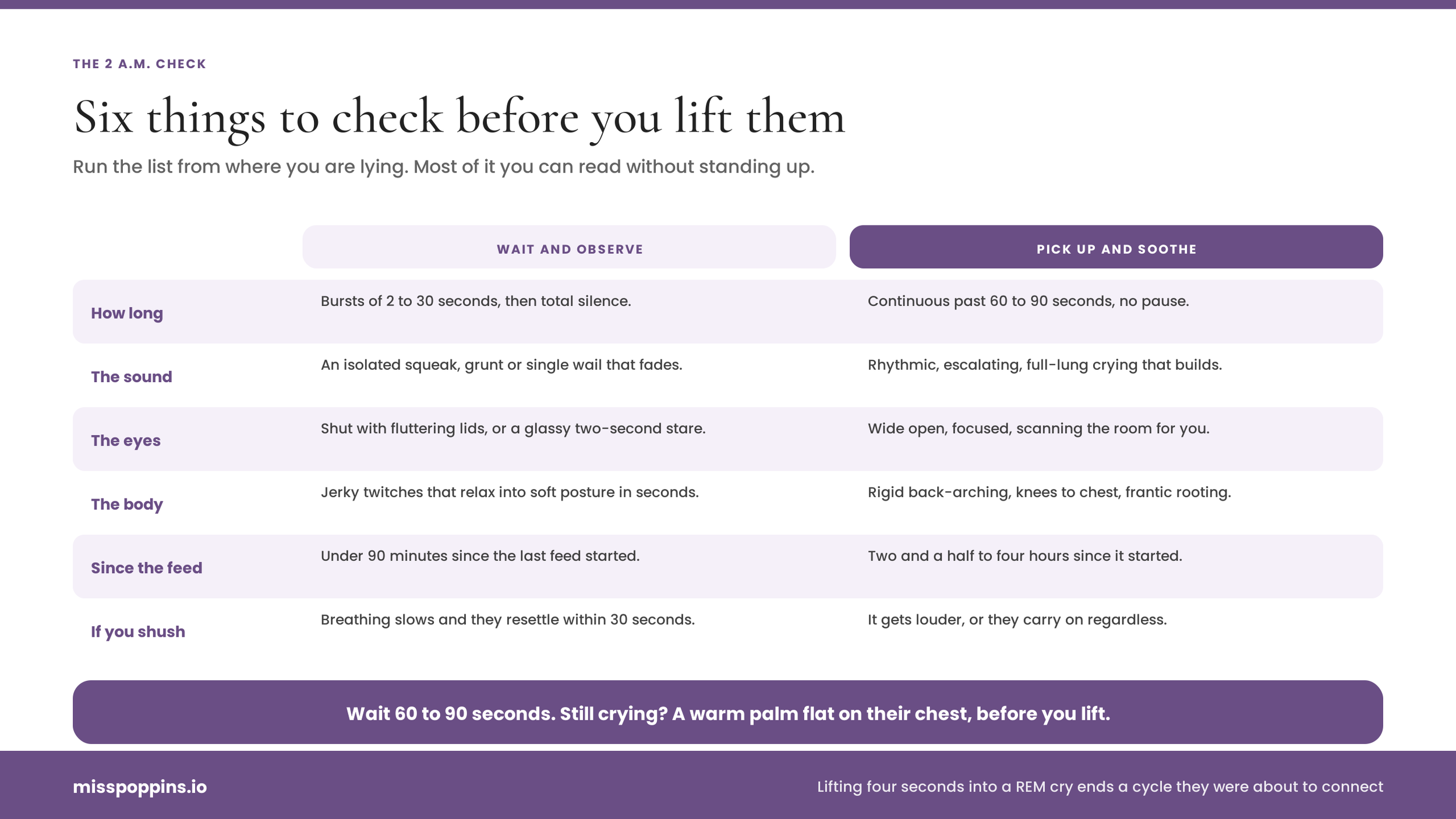
Active Sleep Crying vs. True Awake Distress (6-Variable Matrix)
Run through this quick check before touching the bassinet:
Duration of Cry: Active sleep crying involves brief bursts lasting 2 to 30 seconds, followed by total silence. True awake distress consists of continuous crying past 60 to 90 seconds with no pause.
Sound Quality: Active sleep features an isolated squeak, whimper, grunt, or single sharp wail that quickly fades. True distress sounds like rhythmic, escalating, full-lung crying that steadily gets louder.
Eye and Eyelid Movement: During active sleep, the eyes stay shut with fluttering lids, or pop open for a glassy 2-second stare before closing. During true distress, the eyes are wide open, focused, and scanning the room for you.
Body Posture: Active sleep brings jerky twitches that relax into a soft posture within seconds. True distress brings rigid back-arching, pulling knees hard to the chest, or frantic rooting.
Time Since Last Feed: Active sleep crying typically happens under 90 minutes since the last full feed finished. True distress usually occurs 2.5 to 4+ hours since the last feed started.
Response to Gentle Shushing: In active sleep, the baby's breathing slows down and they settle back into sleep within 30 seconds. In true distress, the crying gets louder or completely ignores bedside shushing.
Differential Guide: Active Sleep vs. Gas, Reflux, and Schedule Needs
Sometimes a crying sleeping baby has a physical issue going on. Compare these four possibilities:
What Is Really Causing the Cry: 4 Common Culprits
Active Sleep (REM) Reflex: Episodes happen every 45 to 60 minutes at sleep cycle bridges, with restlessness peaking from 3:00 AM to 6:00 AM. Physical cues include eyelid fluttering, random smiles, odd breathing patterns, and limb twitches, paired with normal feeding and soft stools. The immediate action is to wait 60 to 90 seconds and avoid lifting the baby.
Infant Dyschezia / Trapped Gas: Episodes happen at random times, often 30 to 60 minutes post-feed or in the early morning. Physical cues include turning red, grunting for up to 10 minutes, and drawing the legs up, though stools remain soft despite heavy straining. The immediate action is to hold the baby upright after feeds and perform bicycle legs during daytime wake windows.
Silent Reflux (GERD): Episodes occur right when the baby is laid flat on their back or 20 to 40 minutes after eating. Physical cues include back-arching, a stiff neck, wet burps, frequent swallowing, and crying in pain, often accompanied by bottle refusal or frantic comfort nursing. The immediate action is to hold the baby upright for 15 minutes post-feed and call your pediatrician if pain continues.
Schedule / Wake Window Issue: Episodes show up as false starts 30 to 45 minutes after bedtime or long middle-of-the-night wakings. Physical cues include yawning, red eyebrows, fist-sucking, and wide-awake eyes at 2:00 AM, alongside taking snack feeds all day and clustering calories overnight. The immediate action is to fix daytime wake windows and build solid sleep habits early.
Why Does My Baby Cry in Their Sleep With Their Eyes Open, Then Stop?
Finding your baby with their eyes wide open while they cry, only for those eyelids to snap shut two seconds later, is unnerving. Parents online call it zombie sleep.
It is a benign partial arousal between sleep cycles. The nerves controlling eyelids link directly to REM sleep centers, so brain surges can pull eyes open for a second. Their gaze is glassy. Their brain is still asleep. Turning on a bright light or unswaddling them right then forces a full wakeup.
The 60-to-90-Second "Pause Rule" (And How to Adapt It If You Room-Share)
French parenting popularized "Le Pause", waiting before responding to night cries. Telling parents to wait 5 minutes for a tiny newborn is unrealistic. For a baby under 12 weeks, 60 to 90 seconds is the sweet spot. Waiting one minute lets 80% of active-sleep cries resolve on their own.
The Room-Sharing Reality: The CDC and AAP guidelines recommend room-sharing for 6 months. Lying in bed for 90 seconds while a newborn grunts two feet away is tough when your partner has an early commute or a toddler sleeps through thin drywall.
If waiting causes family friction, use the Hands-On-Chest Bridge. Wait 15 seconds to check the cry. Then, without picking them up or turning on lights, reach into the bassinet and put a warm palm flat on their chest while shushing softly. It calms the startle reflex and muffles the noise without pulling them out of sleep.
Why Does a Baby Cry in Their Sleep by Age? (From 1 Month to 9 Months)
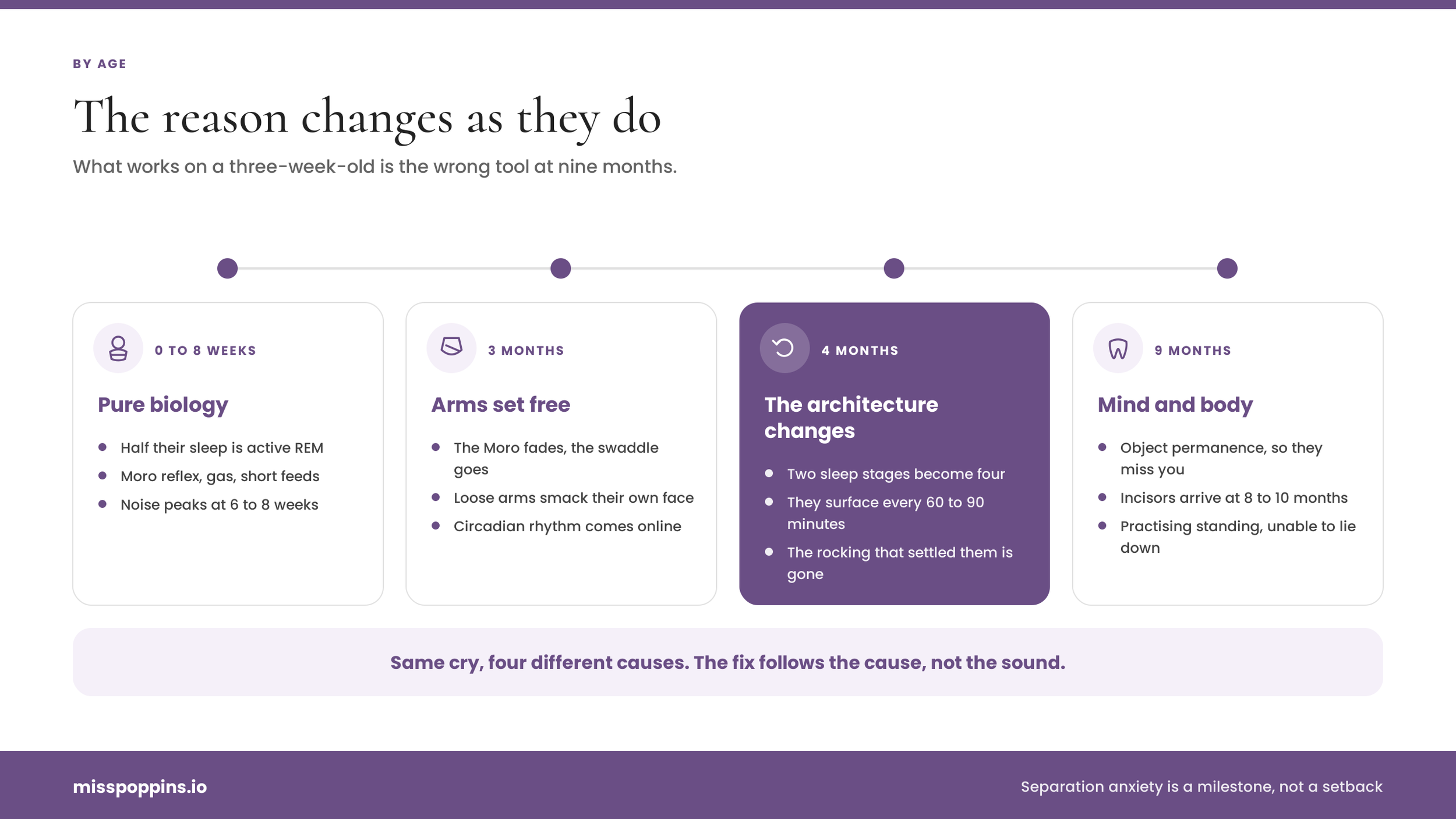
Why a baby cries in their sleep changes across the first year. Treating a 9-month-old like a 3-week-old won't work.
0 to 8 Weeks (1-Month-Old Baby Crying in Sleep But Not Awake)
In the first two months, nighttime noises are driven by pure newborn biology: 50% REM sleep, the Moro reflex, dyschezia, and short feeding intervals. Both awake evening cluster crying and sleep grunting peak between 6 and 8 weeks before starting a steady drop.
Why Do 3-Month-Old Babies Cry in Their Sleep?
Around 12 weeks, two things happen. The Moro reflex fades, and parents transition out of the swaddle. Freed arms often smack the baby's face during light sleep, causing sudden cries. Also, circadian rhythms come online. Using an age-appropriate sleep and feeding schedule helps build sleep pressure so they don't cry between cycle bridges.
Why Do 4-Month-Old Babies Cry in Their Sleep?
If your baby slept quietly and suddenly cries out every hour at 4 months, their brain is upgrading. Per sleep physiology data from StatPearls (NIH), infants shift from 2 newborn sleep stages to 4 adult sleep stages.
During the 4-month sleep regression, babies cycle through deep and light sleep every 60 to 90 minutes. When they hit the shallow bridge at the end of a cycle, they realize the rocking or pacifier that put them to sleep is gone, and they cry out.
Why Do 9-Month-Old Babies Cry in Their Sleep (Or Wake Up Screaming)?
At 9 months, sleep crying has nothing to do with newborn REM. Three new drivers take over:
Object Permanence & Separation Anxiety: Your baby knows you exist elsewhere. When they wake between cycles at 1:00 AM, they realize you aren't there and scream.
Teething Pain: Upper and lower incisors erupt around 8 to 10 months. Cortisol drops at night and blood flow increases when lying flat, making gums throb during light sleep.
Motor Practice: Nine-month-olds practice crawling and pulling to stand in their sleep. It is common to find a 9-month-old sitting in the crib crying with their eyes half-shut because they don't know how to lie back down.
How Do I Stop My Baby From Crying in Their Sleep? (5 Coach-Approved Soothing Steps)
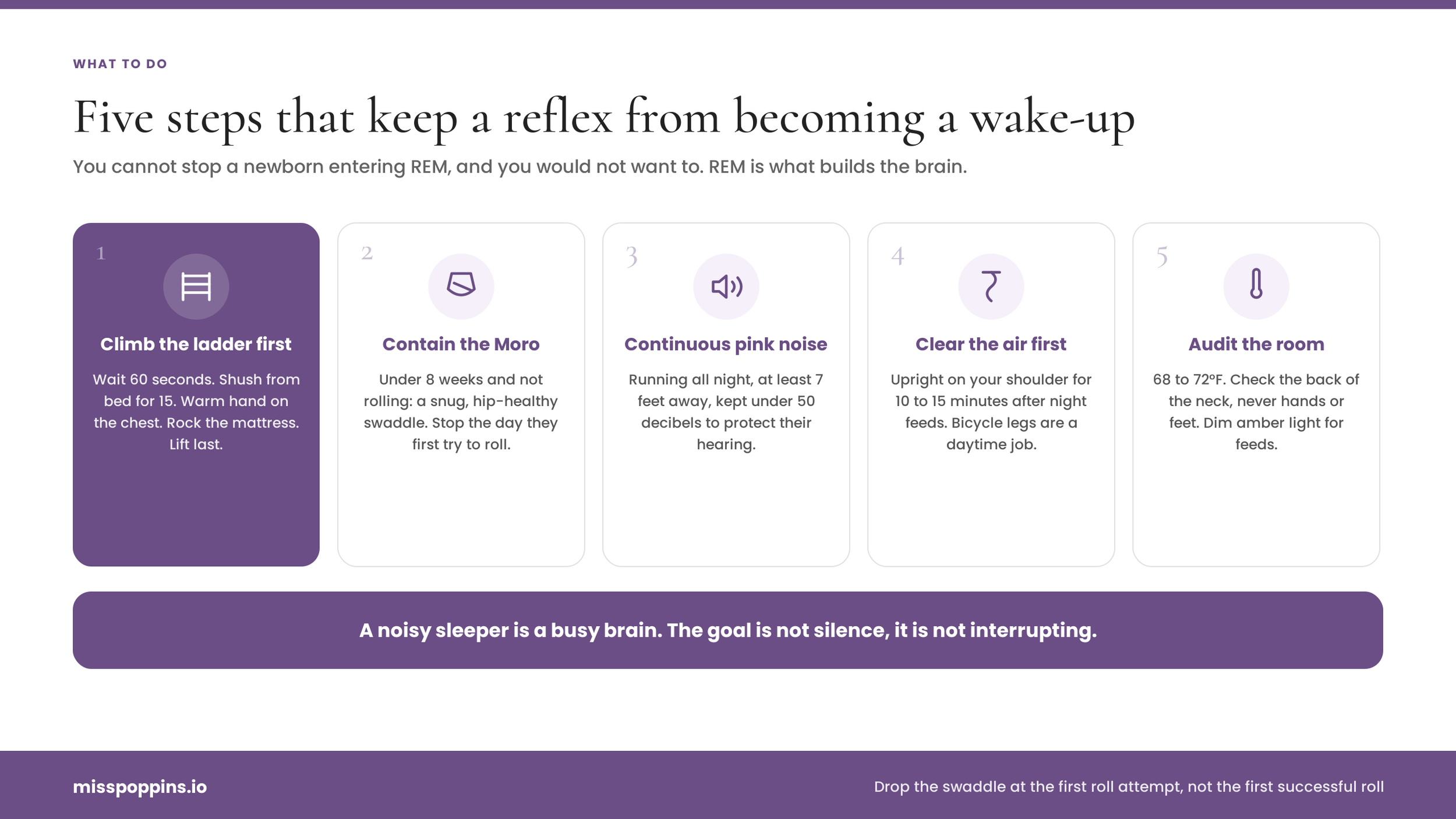
You cannot stop a newborn's brain from entering REM sleep, and you shouldn't want to. REM builds their brain. What you can do is stop normal sleep reflexes from turning into full wakeups.
Master the "In-Bassinet Ladder" Before Lifting: Climb a gradual ladder. Wait 60 seconds. If crying continues, shush softly from bed for 15 seconds. Place a warm hand on their chest. Gently rock their torso on the mattress. Only pick them up if their eyes open wide and crying escalates (see our guide to calming a fussy baby).
Contain the Moro Reflex Safely: For newborns under 8 weeks who aren't rolling, use a snug, hip-healthy swaddle. Stopping wild arm flinging keeps a REM startle from waking them up. Drop the swaddle the day they try to roll.
Use Continuous Pink or White Noise (Under 50 Decibels): A dead-silent room makes every house creak sound loud. Run a continuous white or pink noise machine at least 7 feet away, capped below 50 decibels to protect infant hearing.
Clear Trapped Air Before Laying Down: Hold your newborn upright against your shoulder for 10 to 15 minutes after night feeds so milk settles. Save bicycle legs for daytime wake windows, not 3:00 AM.
Audit the Micro-Environment (68°F to 72°F): Keep the room between 68°F and 72°F (20°C to 22°C). Check their core temp by feeling the back of their neck or chest, never their hands or feet. Use a dim amber nightlight during feeds so blue light doesn't wreck sleep hormones.
Conclusion: You Don't Have to Decode 3:00 AM Alone
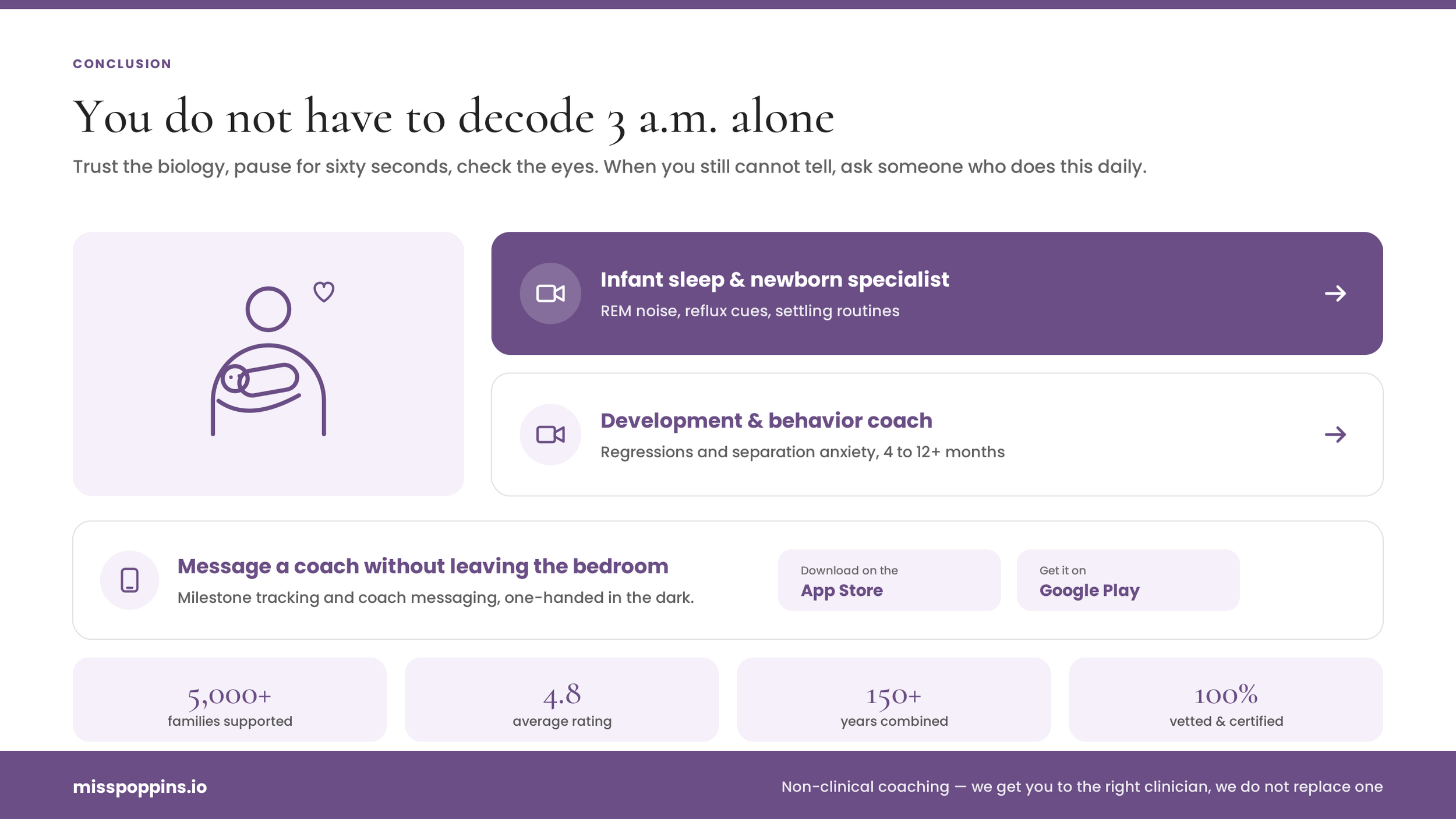
Hearing your newborn whimper in the dark can keep you on edge. Trust the biology: a noisy sleeper is building a smart brain. Pause for 60 seconds, check their eyes, and let them practice connecting sleep cycles.
Still unsure if your baby's cries are active reflux, normal REM, or a sleep regression? Book a consultation with a certified MissPoppins Sleep or Postpartum Coach.
Explore Postpartum & Newborn Coaches / Book an Infant Sleep & Newborn Specialist (Best for newborn REM sleep, reflux cues, and settling routines)
Explore Development & Behavior Coaches (Best for infants 4 to 12+ months navigating sleep regressions and separation anxiety)
Why Parents Trust MissPoppins:
5,000+ families supported across sleep milestones
4.8-star average rating from verified parents
150+ years of combined experience across our network
Vetted, certified coaches in sleep, lactation, and development
100% private, encrypted telehealth sessions from home
Download the MissPoppins App on the Apple App Store or Google Play Store to message coaches and track milestones anytime.
Frequently Asked Questions About Babies Crying in Their Sleep
1. Is it normal for newborns to cry in their sleep?
Yes. Almost all healthy newborns whimper or cry in their sleep because half of their rest is active REM sleep without full muscle paralysis. These noises fade by 3 to 4 months.
2. When does newborn sleep crying and fussiness typically peak?
Evening fussiness and sleep grunting peak around 6 to 8 weeks of age. As digestion matures and sleep cycles shift toward non-REM stages, sleep crying drops by 12 to 16 weeks.
3. How to tell if a sleeping baby is colicky, gassy, or just in active sleep?
Active sleep cries last seconds with closed eyes. Gas cries involve red faces, pulled-up knees, and relief after passing gas. Colic in babies means high-pitched screaming while fully awake for 3+ hours a day, 3+ days a week.
4. Why is my baby not settling back to sleep after a night feeding?
If a newborn cries right after a night feeding, look for trapped air, silent acid reflux, overstimulation from bright lights, or milk protein sensitivity.
5. What are the 4 types of baby cries (Dunstan Baby Language) and do they apply during sleep?
Dunstan language tracks pre-cry sounds: "Neh" for hunger, "Eh" for burps, "Eairh" for gas, "Owh" for tiredness, and "Heh" for discomfort. Listening for "Neh" vs "Eairh" helps spot hunger vs gas during light sleep.
6. What is the 5-8-5 rule for putting a crying baby to sleep?
Per study data from the RIKEN Center for Brain Science, the 5-8-5 rule calms an infant: walk steadily for 5 minutes, sit holding the sleeping baby for 8 minutes through light REM into deep sleep, then lay them down.
7. What is the difference between Purple Crying and nighttime sleep crying?
Per the Cleveland Clinic, the Period of PURPLE Crying is an awake phase starting at 2 weeks and ending by 5 months where babies cry inconsolably in the evening. Sleep crying is a brief, eyes-closed REM reflex.
8. What are the danger signs in a newborn when crying in their sleep?
Call your pediatrician immediately if sleep crying comes with a rectal fever of 100.4°F (38°C) or higher, a high-pitched pain scream, grunting at the end of every breath, rib retractions, blue lips, green vomit, or extreme lethargy.