

How to Survive the Witching Hour With a Newborn: A Calm Evening Plan for You and Your Baby

Dinner is going cold, the sun is going down, and your newborn has been crying for what feels like hours with no clear reason. If your evenings have turned into a stretch of fussing that no feed, diaper change, or cuddle seems to fix, you are living through what many parents call the witching hour. It can leave you feeling helpless and worried you are doing something wrong. You are not. The witching hour in newborns is developmentally normal, extremely common, and temporary. In this guide we cover why it happens, how to soothe your baby, how to stay regulated when you are running on empty, and when evening fussiness is a reason to call your pediatrician.
The witching hour is a predictable stretch of evening fussiness, roughly 5 to 11 p.m., that is common in newborns starting around 2 weeks, peaking near 5 to 8 weeks, and easing by 3 to 4 months. You can survive it by lowering stimulation, offering comfort feeds, using motion and skin-to-skin contact, and protecting your own calm so you can respond steadily.
Key Takeaways
The witching hour is normal, temporary, and not caused by anything you did.
It usually runs from about 5 to 11 p.m., starts around 2 weeks, and fades by 3 to 4 months.
Common drivers are overstimulation, overtiredness, gas, and cluster feeding.
Soothing works best when you also regulate yourself, and it is safe to put baby down and step away.
Call your pediatrician for fever, an inconsolable or unusual cry, or feeding red flags.
What Is the Witching Hour in Newborns?
The witching hour is a stretch of predictable evening fussiness and crying that is hard to soothe, typically landing between about 5 and 11 p.m. It is not a medical diagnosis. It is a nickname parents use for the very real pattern of a baby who was content all day and then falls apart after dinner.
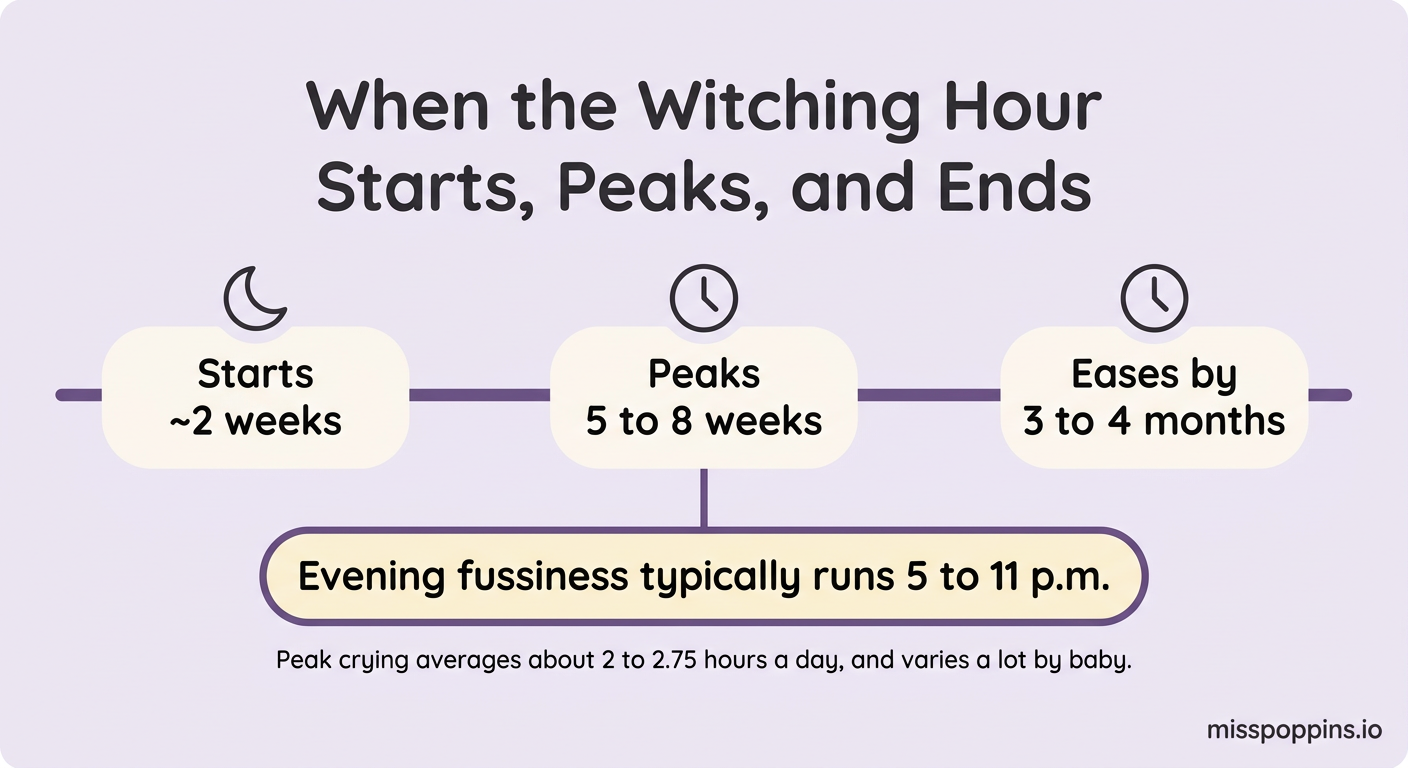
The timing follows a well-documented arc. Infant crying tends to rise from around 2 weeks of age, peak near 5 to 8 weeks, and decline by 3 to 4 months (Parsons et al., 2022, Child Development). At the peak, pooled research puts average crying at roughly 2 to 2.75 hours per day, with wide variation. Some babies cry far less and some cry more, so treat these numbers as a range, not a target.
A reassuring way to understand this phase comes from developmental pediatrician Dr. Ronald Barr and the National Center on Shaken Baby Syndrome, who describe the Period of PURPLE Crying. PURPLE stands for Peak of crying, Unpredictable, Resistant to soothing, Pain-like face, Long-lasting, and Evening (Barr, via Cleveland Clinic). Every one of those features, including a cry that looks like pain but is not, is normal and temporary. Naming the pattern can take some of the fear out of it, because it means your baby is following a developmental curve, not signaling that you are failing.
Witching Hour vs. Colic: What's the Difference?
Colic and the witching hour are often talked about as if they were separate conditions. They sit on the same spectrum. Colic is defined by the Wessel "Rule of Threes," crying for at least 3 hours a day, at least 3 days a week, for at least 3 weeks in an otherwise healthy, well-fed baby (StatPearls, 2023). By these criteria, colic affects up to roughly 1 in 5 infants (Scientific Reports, 2026).
The witching hour is the everyday, lower-intensity version of this same fussiness that most babies experience. Colic is essentially the high end of the normal crying range, not a separate disease. Both usually resolve on their own by 3 to 4 months, which is why the calendar is one of your most reliable allies here.
Why Does My Newborn Get Fussy at Night?
Parents often ask why a baby who was calm all day comes undone in the evening. Usually it is a combination of factors stacking up rather than a single cause:
Overstimulation: By evening, a newborn's developing nervous system can be maxed out from a full day of light, sound, and handling, and crying becomes the release valve (AAP).
Overtiredness: Newborns can only stay comfortably awake for short stretches, and a day of slightly-too-long wake windows or missed naps often catches up with them at night.
Gas and digestive discomfort: Air swallowed during feeding and fussing can add to the discomfort and the crying.
Cluster feeding: Many babies "tank up" with frequent evening feeds, which is normal and can look like nonstop fussing.
A developing circadian rhythm: Newborns are not born with a mature day-night clock, and the evening is when that immature system tends to struggle most.
Wake windows of roughly 45 to 90 minutes for young newborns are commonly used as pediatric-practice guidance rather than official policy, but they are a helpful starting point for spotting overtiredness before it snowballs.
Is Cluster Feeding Normal During the Witching Hour?
Yes. Evening cluster feeding, where your baby wants to nurse again and again over a few hours, is normal newborn behavior. It can feel alarming, especially if you worry it means your milk supply is low, but that worry is usually misplaced.
According to the Academy of Breastfeeding Medicine, evening cluster feeding and near-constant feeding for hours are not indications for formula supplementation in a healthy, full-term baby (ABM Protocol #3, 2017). Federal guidance echoes this: babies may nurse every 30 to 60 minutes in the evenings, and that does not mean your baby is not getting enough (USDA WIC). It is also worth knowing that formula-fed babies get fussy evenings too, so the witching hour is not caused by how you feed. If you have specific concerns about your baby's weight or diaper output, that is the moment to check in with an IBCLC lactation consultant or your pediatrician.
How Do I Soothe My Baby During the Witching Hour?
There is no single trick that works every time, but a layered approach helps. A widely used starting point is the "fourth trimester" concept from pediatrician Dr. Harvey Karp, who suggests that newborns settle when their environment mimics the womb. His 5 S's framework is a practical, popular soothing toolkit, though it is best understood as a set of techniques rather than an RCT-proven bundle:
Swaddle: A snug wrap can help contain the startle reflex and signal calm.
Side or Stomach: Hold your baby on their side or stomach for soothing only, and always place them on their back for sleep.
Shush: White noise can mimic the whooshing sound of the womb.
Swing: Gentle, rhythmic motion is calming for many newborns.
Suck: Sucking on a pacifier or at the breast can trigger a settling response.
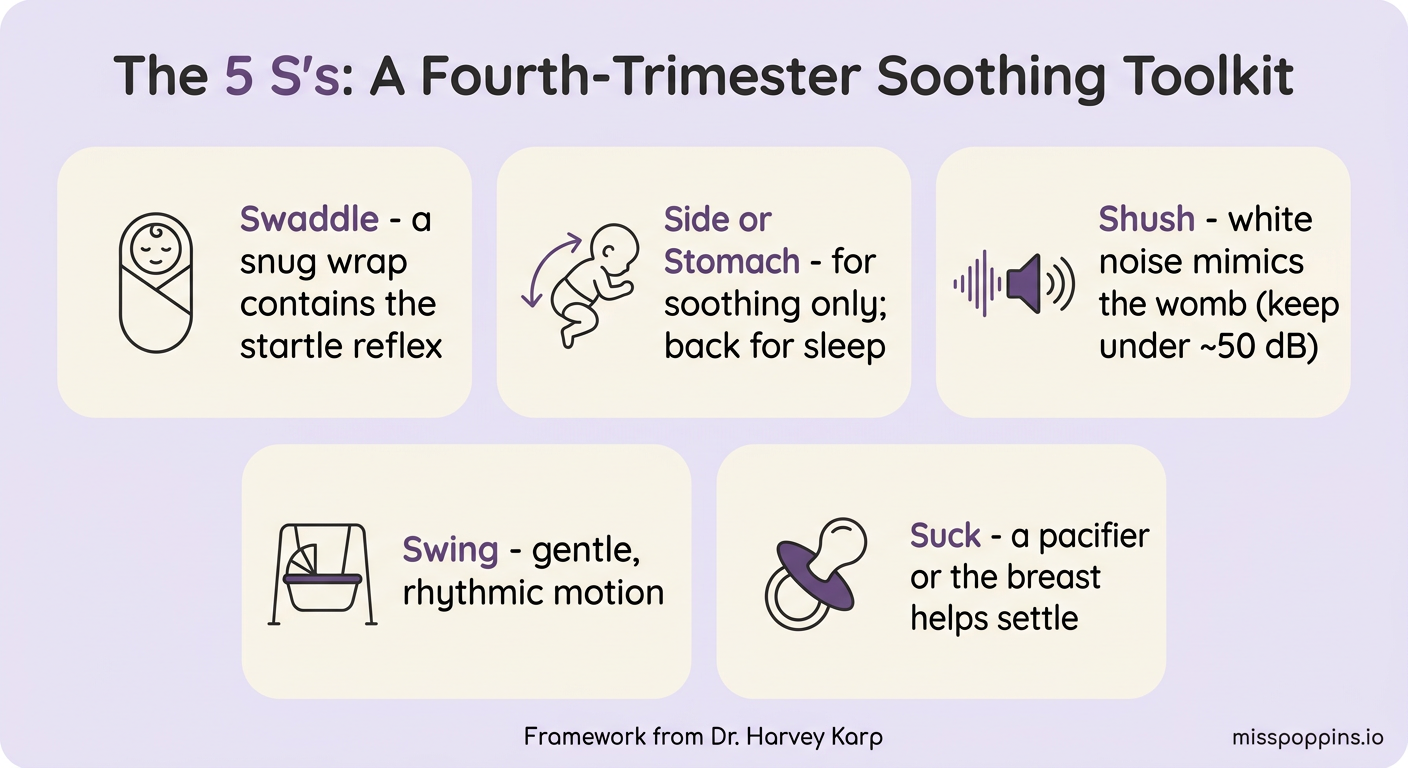
If you use a white noise machine, experts advise keeping it around 50 dB or lower at the crib, about the level of a quiet conversation, and placing the machine at least 7 feet from your baby's head (2014 Pediatrics study). This guidance comes from sleep-machine research rather than official AAP policy, but it is a sensible safety habit.
Beyond the 5 S's, a few environmental resets go a long way. Dim the lights, lower the noise, and move to one calm room instead of a busy, bright space. Motion and closeness also help. In a classic study, parents who carried their infants more had babies who cried 43 percent less at the 6-week peak (Hunziker & Barr, 1986), a finding worth trying even though it has not been consistently replicated since. A carrier, a slow stroller walk, or skin-to-skin contact all combine warmth, motion, and closeness. Offering a comfort feed and following your baby's hunger cues can settle them, and a warm bath or change of scenery sometimes breaks the cycle when nothing else does.
An Hour-by-Hour Evening Game Plan
Having a loose routine gives you something to do when the fussing starts. Treat this as a flexible template and adjust the timing to your own baby:
4:30 p.m., Wind-Down: Dim the lights, lower the volume, and start slowing the pace of the house.
5:00 p.m., Comfort Feed: Offer a feed and a gentle burp to release trapped air.
5:30 p.m., Motion: Use a carrier or a slow walk to add soothing movement and closeness.
6:00 p.m., Warm Bath: A warm bath can reset an overstimulated baby.
6:30 p.m., Skin-to-Skin: Settle into low light with skin-to-skin contact and quiet.
Reset and Rotate: If one approach stops working, cycle back through the others and swap caregivers when you can.
Taking Care of Yourself: Surviving the Witching Hour as a Parent
Here is the piece most advice skips: your baby is not the only person who needs care during the witching hour. You cannot pour from an empty cup, and your own calm is one of your most powerful soothing tools, because babies pick up on a steady, regulated caregiver.
That is why stepping away is not giving up. When you feel your patience running out, it is safe and recommended to place your baby on their back in a safe crib with no bedding and step away for 10 to 15 minutes to breathe and reset (AAP, 2022). A crying baby in a safe crib is fine for a few minutes while you collect yourself.
This break is also a genuine safety practice. Crying is the most common trigger for abusive head trauma, with research estimates of roughly 1,200 to 1,400 US children injured or killed by shaking each year (Barr et al., 2012). It is never safe to shake a baby (AAP, 2022). Normalizing the walk-away break protects both of you, so treat it as part of the plan rather than a last resort.
You do not have to do this alone. Tag-team with a partner or support person so no one is on duty for the whole stretch, accept offers of help, and lower your household expectations in the evening. Dishes and inboxes can wait. And when your baby's fussiness collides with your own overwhelm, know that about 1 in 8 birthing parents report symptoms of postpartum depression (CDC, 2024). It is common, and it is treatable.
When to Reach Out for Help
If you are struggling emotionally, please reach out. In the United States, you can call or text the 988 Suicide & Crisis Lifeline, or contact the National Maternal Mental Health Hotline at 1-833-TLC-MAMA (1-833-852-6262). Postpartum Support International also offers a helpline at 1-800-944-4773. It helps to know the difference between coaching and therapy: coaching is forward-focused, skills-based, and non-clinical, while therapy diagnoses and treats mental health conditions. Many families benefit from both, and for any clinical concern, talk with a licensed provider.
When Should I Call the Pediatrician?
The witching hour is normal, but some signs point to something more than ordinary evening fussiness. Call your pediatrician, or seek care right away, if you notice any of the following (AAP, 2022):
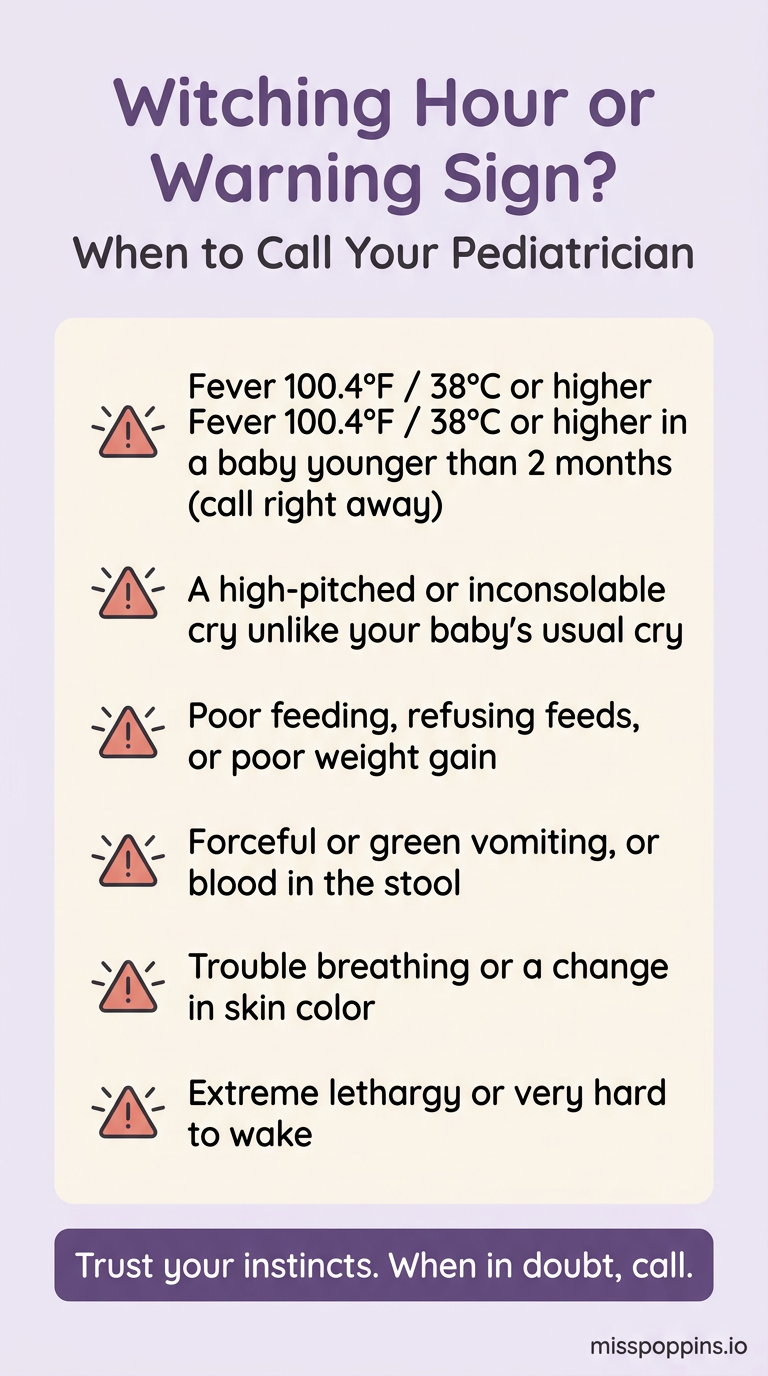
A fever of 100.4°F (38°C) or higher in a baby younger than 2 months, which warrants an immediate call.
A high-pitched or inconsolable cry that sounds different from your baby's usual cry.
Poor feeding, refusing feeds, or crying that is worst after every feed alongside excessive vomiting and poor weight gain.
Forceful or green vomiting, or blood in the stool.
Trouble breathing or a change in skin color.
Extreme lethargy or a baby who is very hard to wake.
Above all, trust your instincts. You know your baby, and if something feels off, a phone call to your pediatrician is always reasonable.
Practical Next Steps
You do not have to fix everything tonight. A few small, concrete moves can make the next week of evenings more manageable:
Track your baby's fussy windows for a few days so you can anticipate the meltdown before it starts.
Prep a wind-down kit and keep it in one spot: swaddle, white noise machine, carrier, and a low lamp.
Set a caregiver rotation so no single person carries the whole evening.
Keep a short "when to call" note on the fridge with your pediatrician's number and the red flags above.
Book a coach if your evenings feel unmanageable and you want a personalized plan.
If evenings have become the hardest part of your day, a certified sleep, lactation, or postpartum coach can help you build a routine that fits your actual baby and household.
Conclusion
The witching hour with newborns is intense, but it is also normal and temporary, and it does not mean you are failing. A simple evening plan, realistic expectations, and a real dose of self-compassion are usually enough to carry you and your baby through to the other side, which most families reach by 3 to 4 months. When you want expert help sooner, MissPoppins connects parents in the United States and Canada with certified human coaches across 24 parenting categories. This is not therapy and not a chatbot, just real, forward-focused support from people who have been where you are. With 5,000+ families supported, a 4.8-star app rating, and 150+ years of combined coach experience, help is one conversation away. When the evenings feel like too much to hold on your own.
You can book a free call with a certified newborn and postpartum coach and walk into tonight with a plan.
FAQs
What Is the Witching Hour and Is It Normal?
Yes. It is a common, developmentally normal stretch of evening fussiness in newborns that typically fades by 3 to 4 months.
What Time Is the Witching Hour for Newborns?
It usually falls between about 5 p.m. and 11 p.m., though the exact timing varies from baby to baby.
Why Is My Newborn Fussy at Night but Not During the Day?
Evenings stack up overstimulation, overtiredness, gas, and cluster feeding, so fussiness tends to peak after a long day.
Is Cluster Feeding During the Witching Hour a Sign of Low Milk Supply?
No. Evening cluster feeding is normal, and per the Academy of Breastfeeding Medicine it is not a reason to supplement a healthy, full-term baby.
Witching Hour or Colic: How Can I Tell?
Colic is the high end of the same crying spectrum (3+ hours a day, 3+ days a week, for 3+ weeks), while everyday evening fussiness is milder, and both usually ease by 3 to 4 months.
What Should I Do When I've Tried Everything and My Baby Won't Stop Crying?
It is safe to place your baby on their back in a crib and step away for 10 to 15 minutes to reset; never shake a baby, and call your pediatrician if the cry seems different or your baby seems ill.