

The 45-Minute Wake-Up: How to Fix a False Start Bedtime Tonight

A false start bedtime is when a baby falls asleep at bedtime, then wakes fully 30 to 60 minutes later, at the end of one infant sleep cycle. It is common, usually caused by timing (over- or under-tiredness), hunger, or a sleep-onset association, not by anything being wrong. Most improve by adjusting the last wake window and helping your baby fall asleep independently.
Key Takeaways
A false start is waking roughly 30 to 60 minutes after bedtime, at the end of one sleep cycle.
Infant sleep cycles run about 50 minutes versus roughly 90 for adults, so the early night is fragile.
The top fixable causes are wake-window timing (over- or undertired), hunger, and sleep-onset associations.
Tonight, keep the resettle boring, keep it safe (AAP back-to-sleep), and give your baby a beat before responding.
Night wakings are normal all year, so the goal is self-soothing, not zero wakings.
It is 8:40 p.m. The baby went down at eight after a full feed and a calm routine, and for 40 blissful minutes the house is quiet. Then the crying starts. If a false start bedtime has become your nightly reality, where your baby falls asleep at bedtime and then wakes fully less than an hour later, you are not doing anything wrong, and your baby is not broken. This pattern is common, it has real and fixable causes, and most families improve it. This guide explains why the 45-minute wake-up happens, how to tell what is driving it, what to do tonight, and how to prevent it for good.
What Is a False Start Bedtime?
A false start bedtime is when a baby falls asleep at the start of the night and then wakes fully 30 to 60 minutes later, alert and often crying, as if bedtime never happened. It is different from a brief stir or partial wake, where a baby fusses for a moment and drifts back down without fully surfacing. It also differs from early-morning waking, where a baby rises for the day too soon, and from a long nighttime wakeful stretch (sometimes called a split night), where a baby is awake and content in the middle of the night. False starts show up most often around the four-month change in sleep, and again in the five-to-eight-month window, when appetite, development, and shifting nap needs collide. Naming it matters, because a false start has a specific mechanism that points directly to the fix.
Why Does My Baby Wake Up 30 to 45 Minutes After Bedtime?
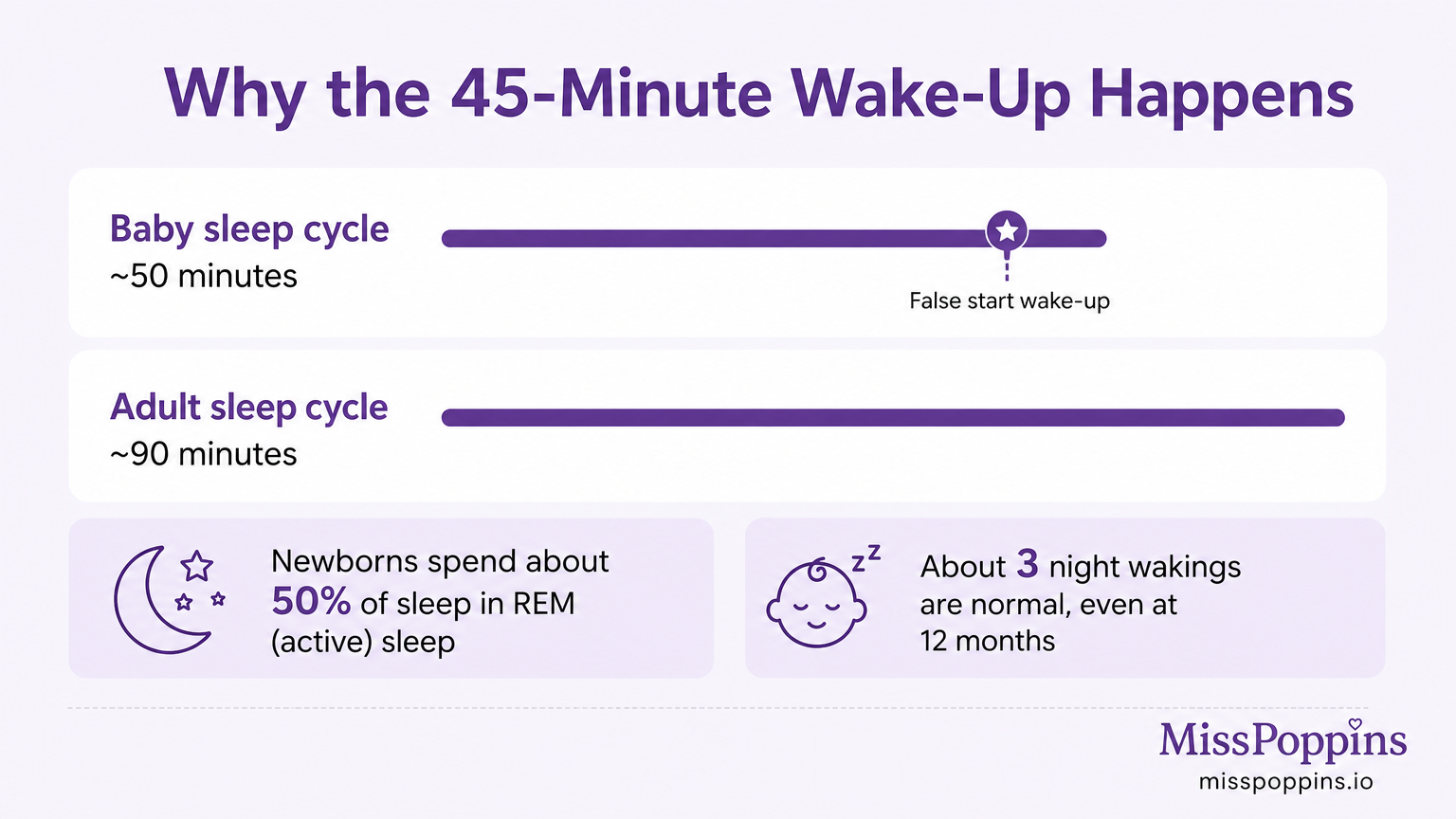
The answer is built into how infant sleep works. Infant sleep cycles run only about 50 minutes, far shorter than the roughly 90-minute cycles adults run, according to the Sleep Foundation. At the end of every cycle, every sleeper briefly surfaces toward wakefulness before dropping into the next one. Adults rarely notice, but a baby who cannot yet link one cycle to the next wakes all the way up, which is why the 45-minute wake-up lands almost exactly when that first cycle ends. Early-night sleep is especially fragile because newborns spend about half their sleep in active (REM) sleep, versus about 20 percent in adults, and they enter sleep through it, per the Sleep Foundation.
Here is the reassuring part. Night wakings are normal all year. In fact, even at 12 months many babies still wake at least once a night, and the ability to self-soothe back to sleep develops gradually across the first year. What changes as your baby grows is not whether they wake but whether they can resettle on their own. The four-month change is a permanent maturation of sleep architecture, not a temporary step backward, so the goal is helping your baby bridge cycles, not chasing zero wakings.
The 5 Most Common Causes of a False Start Bedtime
False starts rarely have a single, obvious trigger. Here are the five most common, and fixable, causes, though from the outside several can look almost identical.
Overtiredness (Bedtime or the Last Wake Window Was Too Long)
When the last wake window runs too long, or bedtime lands too late, a baby sails past the ideal sleep window. The body responds by releasing stress hormones like cortisol and adrenaline, the body's fight-or-flight chemistry, which can leave a baby wired but tired. Overtired babies often fall asleep quickly from exhaustion, then struggle to stay down when the first cycle ends. An earlier, age-appropriate bedtime usually helps here.
Undertiredness (Not Enough Sleep Pressure Yet)
The opposite problem is just as common. If the final wake window is too short, or the day held too much nap time, a baby has not built enough sleep pressure to stay asleep. Sleep pressure is the natural drive to sleep that builds the longer a baby is awake. Without enough of it, the baby drifts off on cue but pops back up at the end of the first cycle, ready to socialize. A slightly later bedtime or trimmed day sleep tends to help.
A Sleep-Onset Association (Fed, Rocked, or Held to Sleep)
Whatever helps a baby fall asleep at bedtime is usually what the baby looks for when a sleep cycle ends. The American Academy of Sleep Medicine calls this the sleep-onset association type of night waking: if a baby is rocked, fed, or held all the way to sleep, those same conditions have to be recreated at the 45-minute mark to get back down. That is why the wake repeats night after night. The fix is helping the baby practice falling asleep with less help.
Hunger or Falling Asleep on the Bottle or Breast
A baby who takes an incomplete feed, or who drifts off partway through nursing or a bottle, may wake genuinely hungry once the first cycle ends. Feeding all the way to sleep also builds a powerful sleep-onset association. Where age-appropriate, offering a full, focused feed earlier in the routine, then a short beat of awake time before the crib, can address both the hunger and the association at once.
Environment, Discomfort, or Timing of Bedtime
Sometimes the trigger is physical. A room that is too bright, too warm, or too noisy, or a baby dealing with gas or general discomfort, can all cut the first stretch short. Bedtime timing matters too: a bedtime that is too early for a baby's age leaves the body not quite ready to consolidate sleep. Small adjustments to light, sound, temperature, and the clock often make a visible difference.
Overtired or Undertired? How to Tell the Difference
Overtiredness and undertiredness are the most common causes and the easiest to mix up, because both end in a baby awake 45 minutes after bedtime. The difference is in the details around the wake.
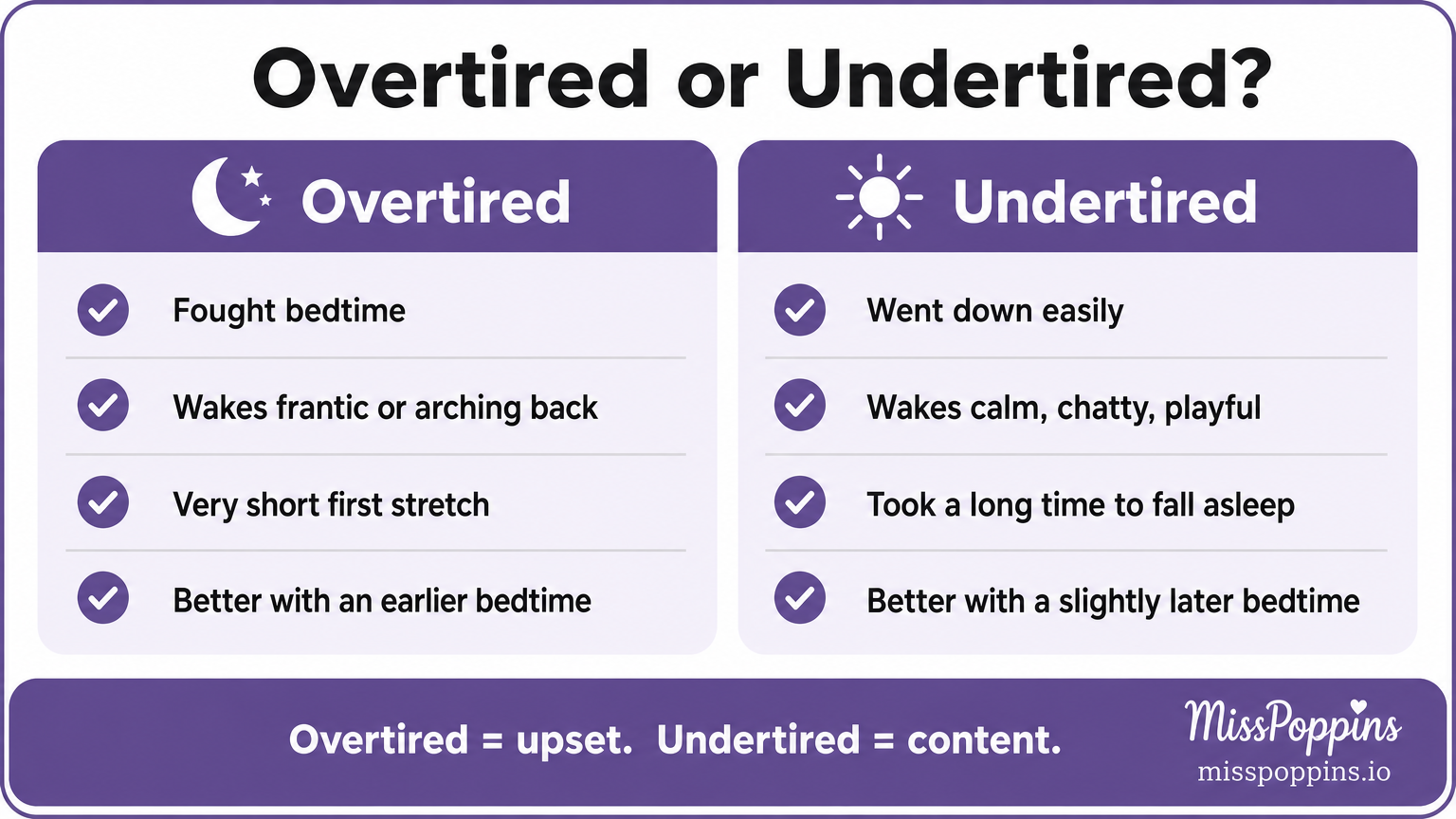
Signs your baby may be overtired:
Fought bedtime or was hard to settle
Wakes frantic, inconsolable, or arching the back
Had a very short first stretch of sleep
Settles better with an earlier bedtime
Signs your baby may be undertired:
Went down easily with little protest
Wakes calm, chatty, or playful rather than upset
Took a long time to fall asleep at bedtime
Settles better with a slightly later bedtime or less day sleep
A simple rule of thumb: an overtired wake is upset, and an undertired wake is content. This is an expert-informed read, not a validated test, and real babies often send mixed signals. When the picture is not clear, a certified coach can read the full 24-hour pattern (naps, wake windows, feeds, and bedtime) to tell which one is at play.
How to Fix a False Start Bedtime Tonight
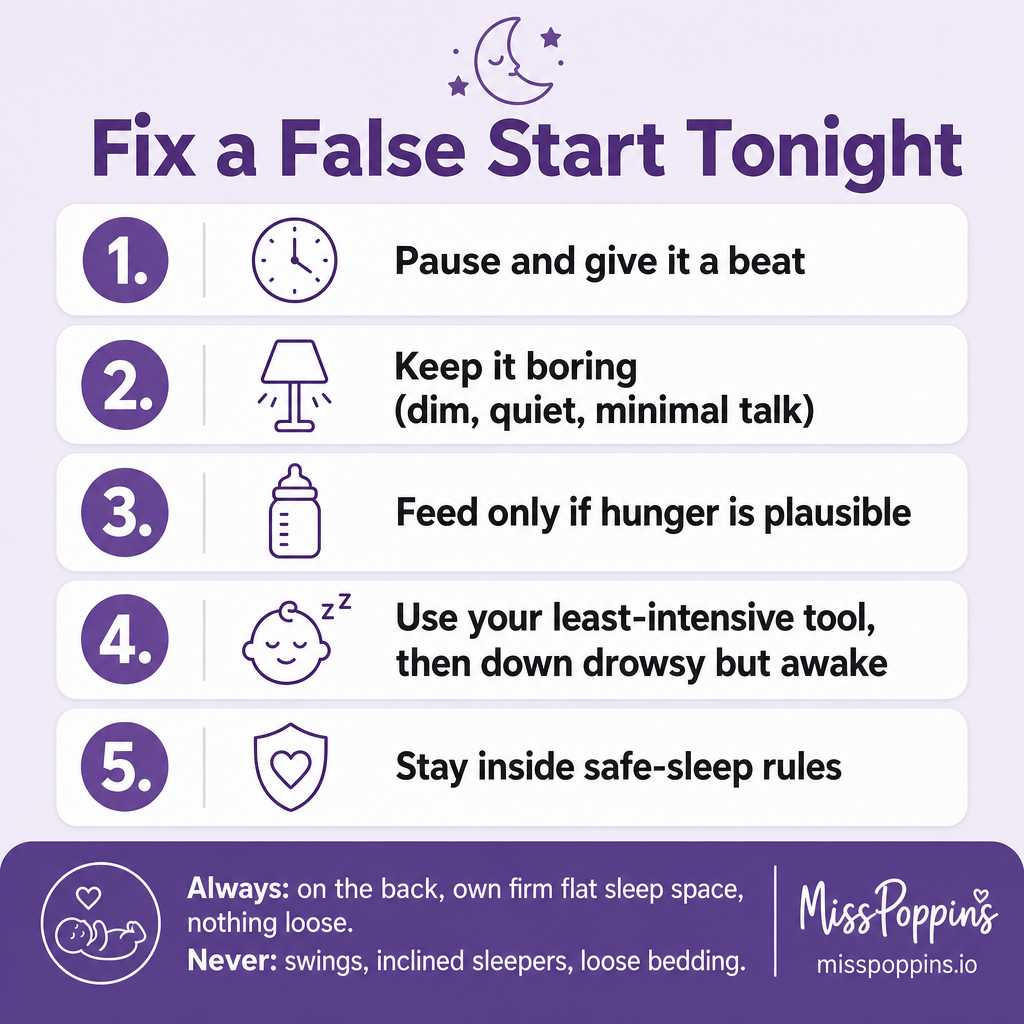
When the crying starts 40 minutes in, you do not need a whole new plan. You need a calm, safe sequence.
Pause and give it a beat. A baby surfacing at the end of a cycle may resettle without you, so wait a moment before rushing in.
Keep it boring. If you do go in, keep the lights dim, your voice low, and talking and eye contact to a minimum, so the room stays a signal for sleep.
Feed only if hunger is plausible. If your baby is at an age where a night feed makes sense and the last feed was light, offer a full feed, and try not to feed all the way back to sleep.
Use your least-intensive tool. Resettle with the smallest amount of help that works, then put your baby down drowsy but awake so the final moments of falling asleep happen in the crib.
Stay inside safe-sleep rules every single time.
Safe-sleep guardrail: The American Academy of Pediatrics 2022 guidance is not optional, even at 2 a.m. Always place your baby on the back, in their own firm, flat, non-inclined sleep space, with no swings, inclined sleepers, loungers, loose bedding, pillows, or weighted sleep products. A quick resettle is never worth an unsafe surface. Coaching offers forward-focused skills, not medical care, so any health concern belongs with your pediatrician.
How to Prevent False Starts for Good
Tonight's triage is one thing; a durable fix is another. Prevention comes down to timing, consistency, and skill-building.
Start with the last wake window. Match it to your baby's age using clinical guidance from pediatric sleep experts, and see our wake windows guide for an age-by-age table. Too long invites overtiredness; too short leaves sleep pressure unfinished.
Protect a consistent, calm bedtime routine. The same short sequence every night, in the same dim room, tells your baby's body that sleep is coming.
Practice drowsy but awake. Babies who are placed in the crib already asleep often look for that same help when a cycle ends, while those who get to finish falling asleep on their own are practicing the skill of linking cycles. Giving your baby that chance is how they learn to resettle.
Then adjust bedtime based on your signal read, earlier for an overtired baby and slightly later for an undertired one, and give any change three to five nights of consistency before judging it. Gentle, expert-guided behavioral approaches work: an American Academy of Sleep Medicine review of dozens of studies found the large majority reported clinically significant improvement, and no study reported harmful effects. Evidence shows no detected harm, which is not the same as any single method being right for every family.
When to Talk to a Professional (and Who)
Most false starts are a timing or habit puzzle, but some wakings have a medical root. See your pediatrician for red flags like reflux, pain, breathing concerns, poor weight gain, or signs of illness, and for any sleep question if your baby is under four to six months.
A certified sleep or parenting coach is the right call when your baby is healthy but the pattern will not budge. A coach reads your full schedule and builds a personalized plan, which is hard to do solo at 2 a.m. That is what MissPoppins offers: 1:1 virtual sessions with certified human coaches, not therapy and not a chatbot, across 24 parenting categories, with same-day availability in the United States and Canada. Coaching is forward-focused and skills-based, so for clinical diagnosis or treatment a licensed provider is the right fit, and many families use both.
Conclusion
False start bedtimes are a mechanical failure in your baby’s sleep pressure, not a permanent phase. If you adjust the final wake window and maintain sensory boundaries without seeing improvement in five days, stop guessing. The underlying issue is a deeper circadian misalignment.
You do not have to fix this through trial and error. MissPoppins has supported over 5,000 families with a 4.8-star App Store rating, backed by certified pediatric experts with over 150 years of combined experience. Stop losing your evenings. Book a Free 1-on-1 Sleep Schedule Audit / Sleep Troubleshooting Consultation and let a certified sleep coach build a deterministic biological plan for your baby today.
FAQs
What Is a False Start Bedtime?
A false start bedtime is when a baby falls asleep at bedtime and then wakes fully 30 to 60 minutes later, at the end of the first sleep cycle. It is common, usually caused by timing, hunger, or a sleep-onset association rather than anything being wrong.
Is My Baby Overtired or Undertired?
An overtired baby tends to fight bedtime and wake upset, doing better with an earlier bedtime, while an undertired baby goes down easily and wakes calm, doing better with a slightly later one. When signals are mixed, a coach can read the full daily pattern.
What Do I Do Tonight When It Happens?
Pause for a beat, keep the resettle boring and quiet, feed only if hunger is likely, and put your baby down drowsy but awake. Keep every step inside AAP safe-sleep rules: on the back, in their own firm flat sleep space, with nothing loose.
Is This Developmental / Will It Pass?
The four-month change is a permanent maturation of sleep architecture, so false starts improve as your baby learns to self-soothe and bridge cycles, not simply because time passes. Consistent, age-appropriate timing and independent-sleep practice are what move the needle.