

Toddler Behavior Red Flags: 7 Subtle Signs of Developmental Delay

Most toddler behavior, including tantrums, defiance, and testing limits, is a normal part of growing up. Toddler behavior red flags are different: they are a pattern of missed or lost milestones in communication, social interaction, play, or movement. The subtle early signs worth watching include not responding to their name, few gestures like pointing, delayed or lost words, little pretend play, skill regression, trouble following simple directions, and repetitive or motor concerns. If you notice one or more, act early and talk to your pediatrician.
You are at the playground, and you catch yourself doing the thing every parent does. You watch another toddler the same age as yours, and a quiet question settles in your stomach: is this normal? Toddlerhood is loud, messy, and full of enormous feelings by design, so it is genuinely hard to tell ordinary behavior from something worth a closer look.
This guide will not diagnose your child. Instead, it will help you tell everyday toddler behavior from subtle toddler behavior red flags, and know what to do next without panicking. Noticing early is not paranoia. It is one of the most protective things a parent can do, and it is exactly the kind of everyday interpretation MissPoppins coaches walk through with parents every day.
Normal Toddler Behavior vs. Toddler Behavior Red Flags
Here is the reassuring part first. Tantrums, saying "no," refusing dinner they loved yesterday, and testing every limit you set are normal signs of a toddler building independence. Days will be uneven. A child who melts down at the grocery store is not showing a developmental concern; they are being a toddler.
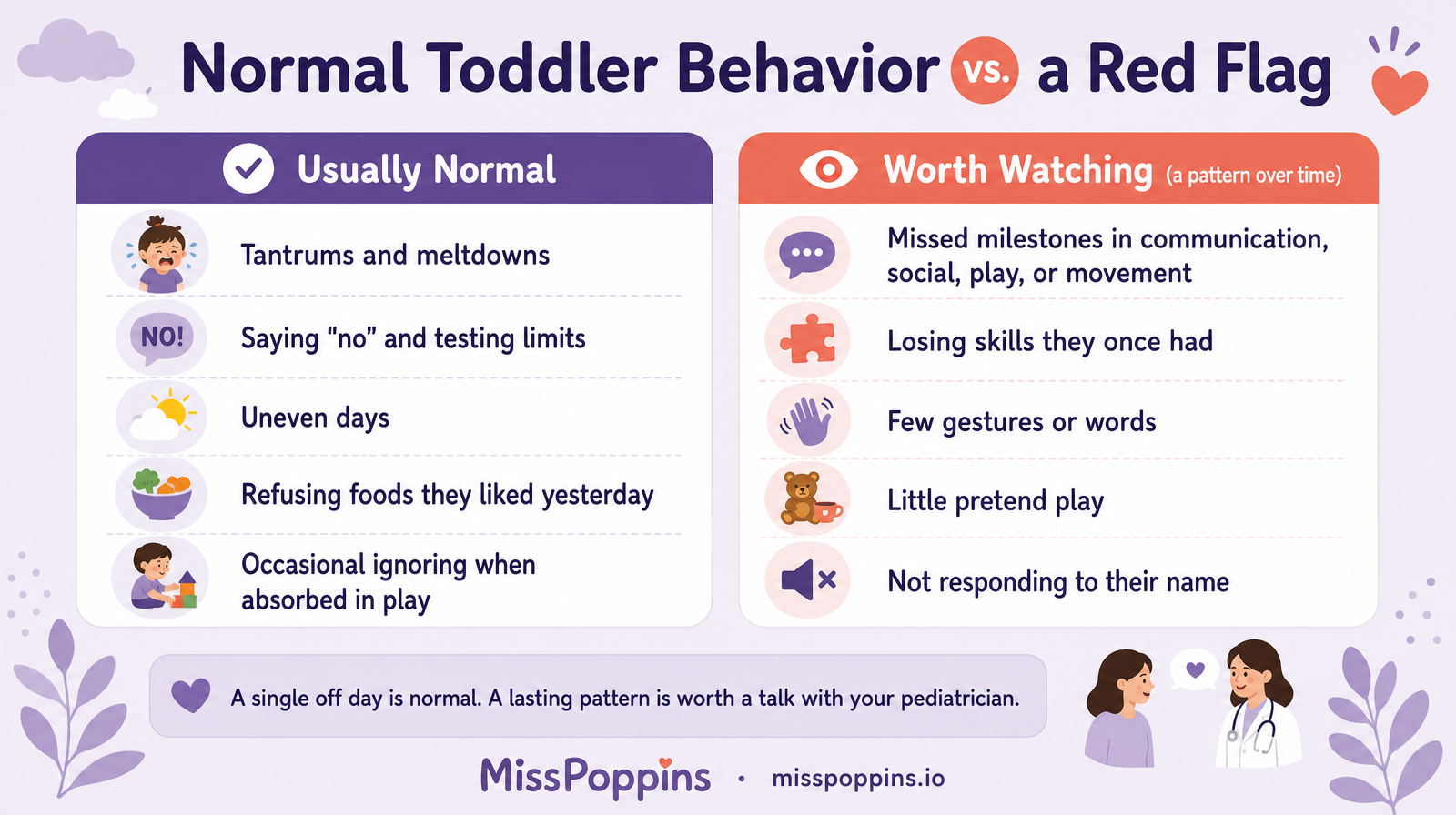
A red flag is different. It is a pattern over time, especially missed milestones across developmental domains, or losing skills a child already had. It helps to think in four simple domains: communication (gestures and words), social and emotional (connecting with people), cognitive and play (thinking and pretending), and movement (motor skills). A single off day means nothing. A consistent pattern across one or more of these areas is worth attention.
For context, developmental concerns are common, and support exists. According to the CDC, about 1 in 31 US children aged 8 has been identified with autism spectrum disorder, based on its 2022 ADDM data released in April 2025. The CDC's National Center for Health Statistics also reports that diagnosed developmental disability affected 8.56% of US children ages 3 to 17 in 2021. These numbers are not cause for alarm. They are a reminder that you are far from alone. Notably, when the CDC and the American Academy of Pediatrics updated their milestone checklists in 2022, they deliberately moved away from a "wait and see" approach so families could act earlier. Trust your observations. Acting early is not overreacting.
7 Subtle Signs of Developmental Delay in Toddlers
The following are signs worth watching, not a diagnosis. One sign on its own is rarely conclusive, but a pattern is a good reason to act early and check in with your pediatrician.
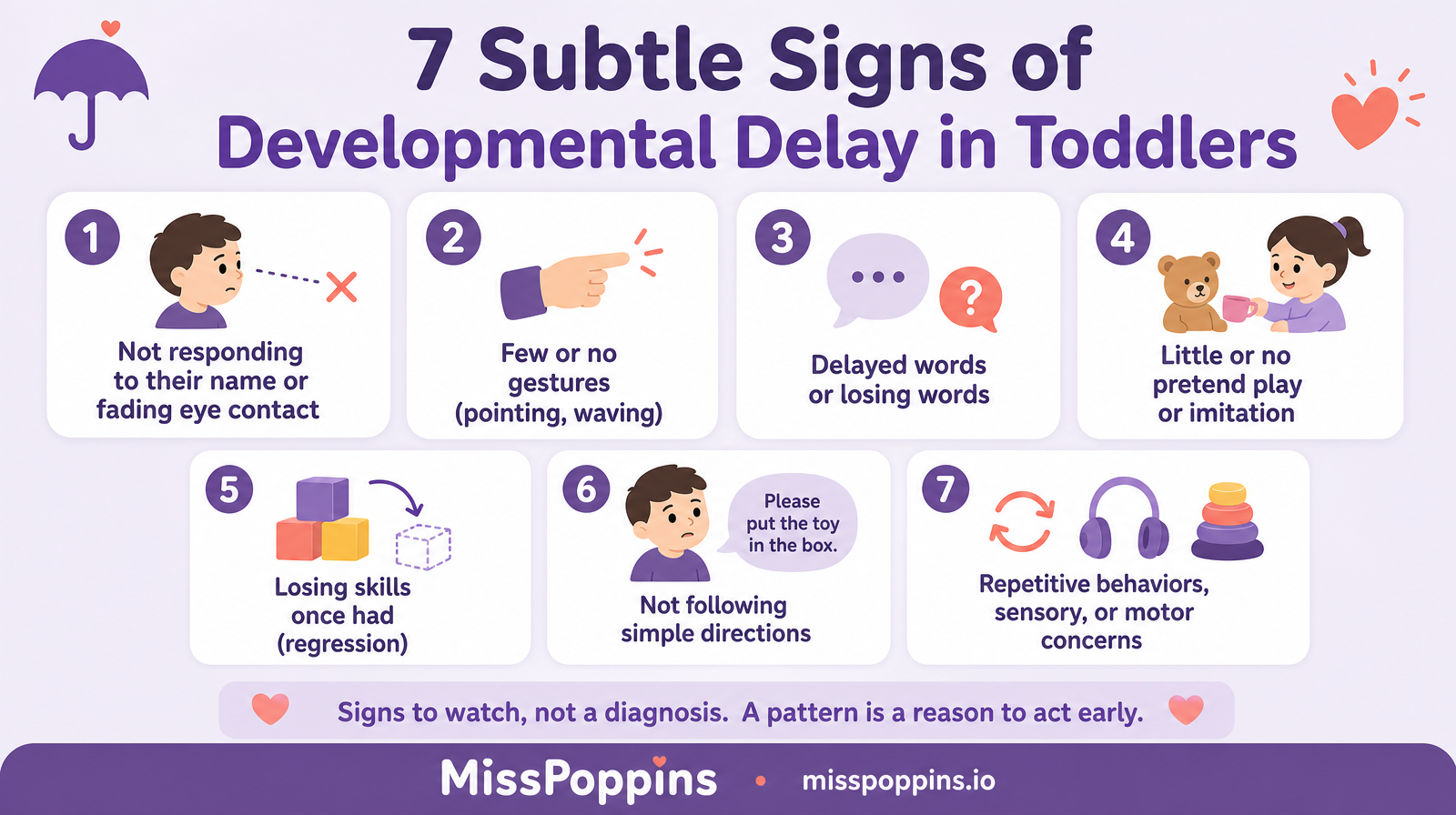
1. Not Responding to Their Name or Fading Eye Contact
In everyday life, this looks like a child who does not turn when you call them (once hearing has been ruled out), or who makes less eye contact during play and feeding. Most children respond consistently to their name by around 12 months. Occasional ignoring when a toddler is deeply absorbed in a toy is normal. Consistent non-response, across settings and over time, is the sign worth noting.
2. Few or No Gestures Like Pointing and Waving
Gestures are a child's first language before words arrive. According to the CDC, most children wave "bye-bye" by 12 months,point to ask for something by 15 months, and point to show you something by 18 months. When these gestures are missing, it often precedes concerns about speech. A toddler who rarely waves, points, or reaches to share a discovery with you is worth watching.
3. Delayed Words or Losing Words They Had
The CDC notes that most children try to say one or two words besides "mama" and "dada" by 15 months, and three or more words by 18 months. ASHA, the American Speech-Language-Hearing Association, adds that by 24 months most children use and understand at least 50 words and put two words together. (The CDC lists the 50-word benchmark a bit later, by 30 months, so these are two separate guideposts, not one.) A child who has few words by these ages, or who was using words and then stopped, is worth discussing with your pediatrician.
4. Little or No Pretend Play or Imitation
Pretend play and imitation are early markers of how a child is thinking and connecting socially. The CDC lists copying you doing chores, like sweeping with a broom, and playing with toys in a simple way, like pushing a toy car, by 18 months, with clearer pretend play, such as using a block to feed a doll, listed a bit later around 30 months. A toddler who does not copy what you do or engage in any "let's pretend" is showing a subtle but meaningful sign. This one is easy to miss because it is quiet, not disruptive.
5. Losing Skills They Once Had (Regression)
This is the single strongest red flag on this list. A child who was babbling, waving, or using words, and then stopped, deserves attention at any age. The CDC includes this "act early" language on every one of its milestone pages: if your child has lost skills they once had, act early. Regression is not something to monitor for a few more months. It is a reason to call your pediatrician now.
6. Not Following Simple Directions or Limited Joint Attention
According to the CDC, most children can follow a direction paired with a gesture ("give me the toy" while you hold out your hand) by 15 months, and a one-step direction without a gesture by 18 months. Joint attention, such as looking where you point, also develops in this window. The useful distinction here is between "won't" and "can't." A toddler who understands but refuses is testing limits. A toddler who consistently does not seem to understand, or does not share attention, may have a comprehension or attention concern worth raising.
7. Repetitive Behaviors, Sensory Differences, or Motor Delays
Some repetition and sensory preferences are completely normal in toddlers. The pattern worth watching is persistence, intensity, and clustering: intense repetitive movements like hand-flapping or rocking beyond typical self-soothing, strong over-reaction or under-reaction to sounds and textures, or motor concerns. On movement specifically, the CDC lists walking without holding on by 18 months. A child who is not walking independently by 18 months, or who is frequently and unusually clumsy, is worth mentioning to your pediatrician.
When to Stop Waiting and Talk to Your Pediatrician
Here is a simple rule you can hold onto. Any lost skill, several missed milestones, or a persistent gut feeling that something is off is enough reason to talk to your pediatrician. You do not need certainty to ask, and asking is never an overreaction.

You can also lean on the schedule your pediatrician already uses. According to the CDC, the American Academy of Pediatrics recommends developmental screening at the 9, 18, and 30 month well-child visits, plus autism-specific screening at 18 and 24 months. You are allowed to request a screening at any visit if you have concerns.
Why move early? There is a real gap between when signs can appear and when families get answers. The CDC reports that the median age of earliest autism diagnosis is 47 months, well after that 18 and 24 month screening window. Noticing subtle signs early can move your family years ahead of the average. You also do not have to wait for a diagnosis to start help. The AAP advises referring a child for intervention at the time a concern is identified, not after a formal evaluation is complete. Early intervention is a large and often free public pathway: the Congressional Research Service reports that roughly 463,000 US infants and toddlers received early-intervention services under IDEA Part C in 2023. It is worth it because timing matters. The Harvard Center on the Developing Child notes the brain forms more than one million new neural connections every second in the first few years of life. Early support improves outcomes. It does not "cure," but it gives children a meaningful head start. A coach can help you organize what you have observed and prepare for that pediatric visit.
3 Myths That Make Parents Wait Too Long
Well-meaning reassurance is one of the biggest reasons families delay action. Here are three common myths worth retiring.
"Boys just talk late." Differences between the sexes are small, and a genuine delay deserves evaluation regardless of a child's sex. Waiting on this belief can cost valuable time.
"They'll grow out of it." Some late talkers do catch up, but there is no reliable way to predict who will. Only an evaluation can tell, and early support helps even children who are likely late-bloomers.
"Bilingual homes cause speech delay." According to ASHA, learning more than one language does not cause speech or language problems. Keep speaking the languages your family is most comfortable using.
How MissPoppins Coaches Support Worried Parents
When something feels off, the hardest part is often the space between "I'm worried" and a formal evaluation. That is exactly where a coach helps. MissPoppins coaching is forward-focused, skills-based, and non-diagnostic. It is not therapy, and it is not a chatbot. It is a certified human coach, and it does not replace your pediatrician or a clinical evaluation.
A coach helps you make sense of what you are seeing, build everyday "serve and return" interaction strategies at home, and prepare for a pediatric or specialist visit so you walk in organized and confident. Development and behavior support at MissPoppins spans speech, neurodiversity, and early-development coaches, part of 24 parenting categories, with many same-day sessions available in the United States and Canada. All sessions are private and encrypted. Every coach is vetted and certified. MissPoppins has supported 5,000+ families, holds a 4.8-star App Store rating, and its coaches bring 150+ years of combined experience.
Key Takeaways
Most toddler behavior is normal; a red flag is a pattern of missed or lost milestones in communication, social interaction, play, or movement.
The subtle signs to watch are no response to name or fading eye contact, few gestures, delayed or lost words, little pretend play, skill regression, trouble following directions, and repetitive or motor concerns.
Losing a skill your child once had is the single strongest reason to act early.
You do not need certainty to act: request developmental screening and start support at the first concern, not after a diagnosis.
The earliest years are the brain's most adaptable, and a certified human coach can help you prepare and respond.
Conclusion and Next Step
Subtle toddler red flags, like echolalia, sensory seeking, and a lack of joint attention, are not phases your child will simply outgrow. They are neurological indicators of how your toddler processes the world. Waiting six months for your next pediatrician appointment only delays the targeted support your child needs right now.
You do not have to navigate this uncertainty alone. MissPoppins connects you with certified development experts who build actionable, biological strategies around your toddler's specific behaviors.
Stop guessing. Book a Development & Behavior Consultation today and let a certified specialist evaluate your child's milestones.
FAQs
What is the difference between normal toddler behavior and a developmental red flag?
Normal behavior like tantrums and defiance comes and goes as toddlers test limits. A red flag is a lasting pattern of missed or lost milestones in communication, social skills, play, or movement that is worth discussing with your pediatrician.
What are the early signs of developmental delay in toddlers?
Watch for not responding to their name, few gestures like pointing, delayed or lost words, little pretend play, losing skills, trouble following simple directions, and repetitive or motor concerns. One sign alone is rarely conclusive, but a pattern is worth acting on.
When should I worry about my toddler's development?
If your child has lost a skill, is missing several milestones, or your instinct says something is off, talk to your pediatrician and ask about developmental screening rather than waiting. You do not need certainty to ask.
Do toddlers grow out of speech delays?
Some late talkers do catch up, but there is no way to predict who will, so an evaluation is the only way to know. Early support helps even children who are likely late-bloomers.
Does raising a child bilingual cause speech delay?
No. According to ASHA, learning more than one language does not cause speech or language problems, so keep speaking the languages your family is most comfortable using.