

The Dream Feed Protocol: How to Feed a Newborn Without Waking Them

Quick Answer: A dream feed is a preemptive feeding offered to a sleeping newborn between 10:00 PM and 11:30 PM. The goal is to provide enough calories to extend the baby's longest block of uninterrupted sleep, aligning their rest cycle with the parents' sleep schedule.
What is a Dream Feed?
It is not a traditional night waking. It is a highly controlled mechanical intervention executed while the infant remains in a parasympathetic sleep state. By leveraging homeostatic sleep pressure, you are bypassing their conscious awareness to fill their stomach.
Most parents fail because they treat it like a daytime meal. To execute it properly, you must understand the difference between active daytime intake and a sleep-state feed. Review our complete guide on tips for keeping your baby awake during feedings to understand the mechanical contrast. Active feeds require stimulation. This protocol requires sensory deprivation.
When you feed a baby during the day, their sympathetic nervous system is engaged. They are learning, looking, and processing. During a dream feed, the goal is to keep the brain's executive functions entirely offline. You are strictly engaging their brainstem.
The Mechanical Execution: Step-by-Step
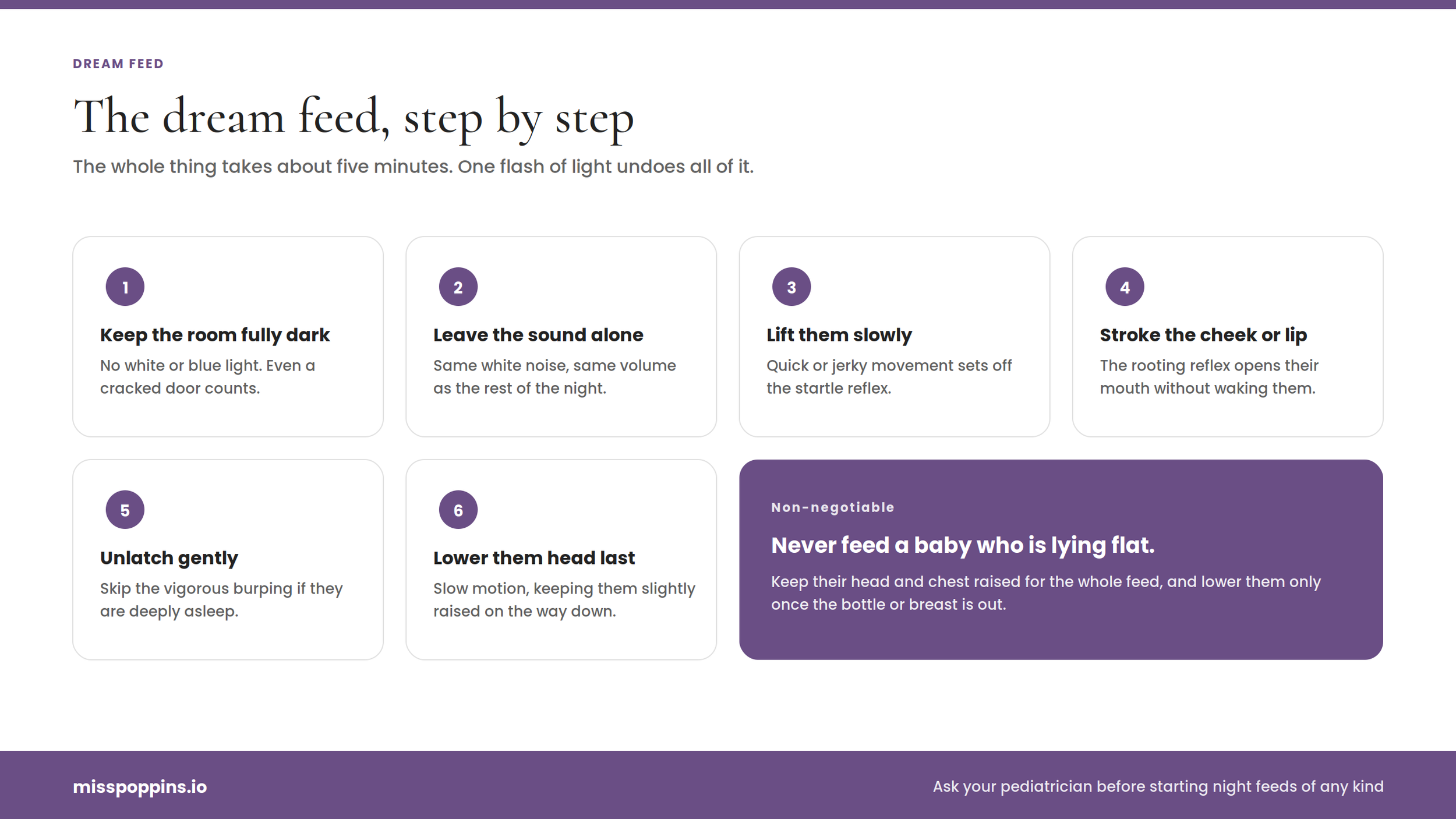
Tactical Darkness: Keep the room completely pitch black. Zero white or blue light exposure is allowed during the entire process. Even a cracked hallway door compromises the environment.
Environmental Control: Maintain your standard evening acoustic environment. If you use white noise, leave it running at the exact same volume. Read more about setting up ideal conditions in our guide to bedtime routines for nighttime.
The Extraction: Lift your baby from the crib with slow, deliberate physical movements. Fast or jerky motions trigger the Moro reflex. Once the startle reflex fires, adrenaline enters their bloodstream and the protocol is ruined.
The Latch: Gently stroke the infant's cheek or lips. This triggers the rooting reflex. Driven entirely by cranial nerves, they will instinctively open their mouth and latch without ever opening their eyes.
The Safety Mandate: Feeding a baby entirely flat is a severe aspiration risk. You must elevate their head and torso to at least a 30-degree angle for the duration of the feed. Never compromise on this angle.
The Transfer: Remove the bottle or unlatch gently. Do not attempt a rigorous burping session if they are deeply asleep.
Return and Settle: Place the infant back into the bassinet in slow motion. Keep them elevated slightly as you lower them down. Their head should be the last thing to touch the mattress.
The Diaper Dilemma: Change Before or After?
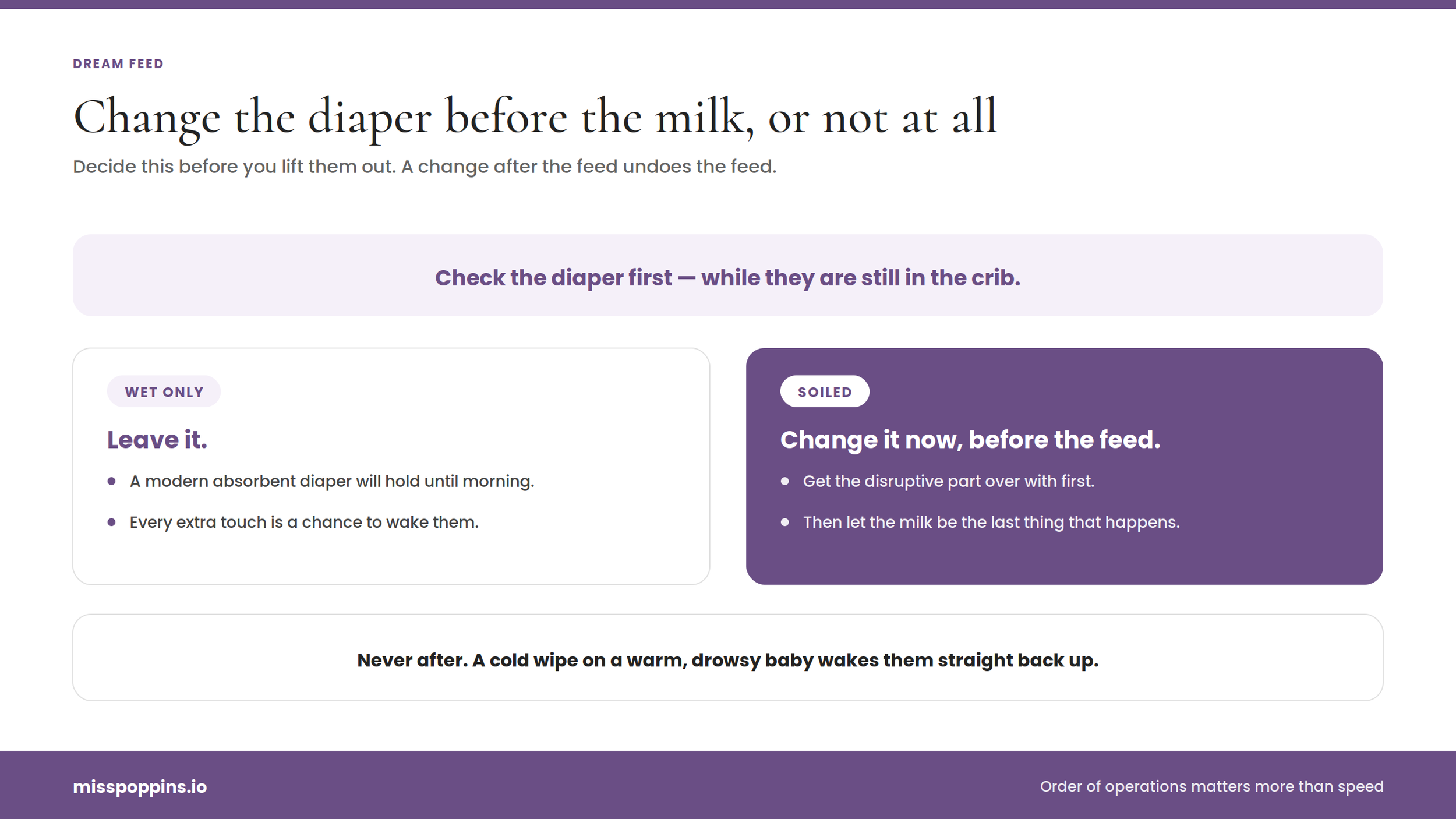
Parents routinely destroy a successful dream feed by mishandling diaper logistics. You must assess the situation before you extract the baby from the crib.
If the diaper is only wet (and highly absorbent): Do not change it. Leave it alone.
If the diaper is soiled: Change it before the feed.
The biological justification for this order of operations is strict. A cold wipe applied to a sleeping infant triggers an immediate cortisol spike. This hormonal response tells the brain it is time to wake up and survive.
If you provide this intense tactile stimulation after the feeding is complete, it destroys the homeostatic sleep pressure you just finished building. The heavy, drowsy state induced by the warm milk is completely overridden by the shock of the diaper change. The result is a fully awake, wide-eyed baby at midnight. Handle all disruptive physical maintenance before the milk is delivered. Let the feeding itself act as the final soothing mechanism to pull them back into deep sleep.
The Reflux Exception: When Not to Dream Feed
Some infants simply cannot handle this protocol. Gastroesophageal reflux (GERD) changes the physical realities of infant feeding. It makes the standard protocol impossible.
A successful dream feed requires placing a baby in a horizontal position on a completely full stomach immediately after milk delivery. For a healthy baby with mature digestion, this is standard. For a baby with an immature lower esophageal sphincter, this position is a recipe for disaster.
The lower esophageal sphincter is the muscle that acts as a valve between the esophagus and the stomach. When it is weak, gravity is the only thing keeping stomach acid down. If you lay an infant flat immediately after feeding, the acid travels back up. This causes rapid, silent aspiration or severe physical pain. You are guaranteeing a wake-up. They will wake up screaming, and it will take hours to settle them.
If your baby struggles with reflux, traditional pacing is mandatory. You must keep them upright for 20 to 30 minutes post-feed. This completely negates the "sleep" aspect of the dream feed. Review the complete clinical safety parameters in our comprehensive breakdown: Is dream feeding safe for infants?.
Differential Diagnosis: Why is Your Baby Waking?
Not all night wakings require milk. You cannot fix a schedule problem with a bottle. Understand the root cause before applying the protocol.
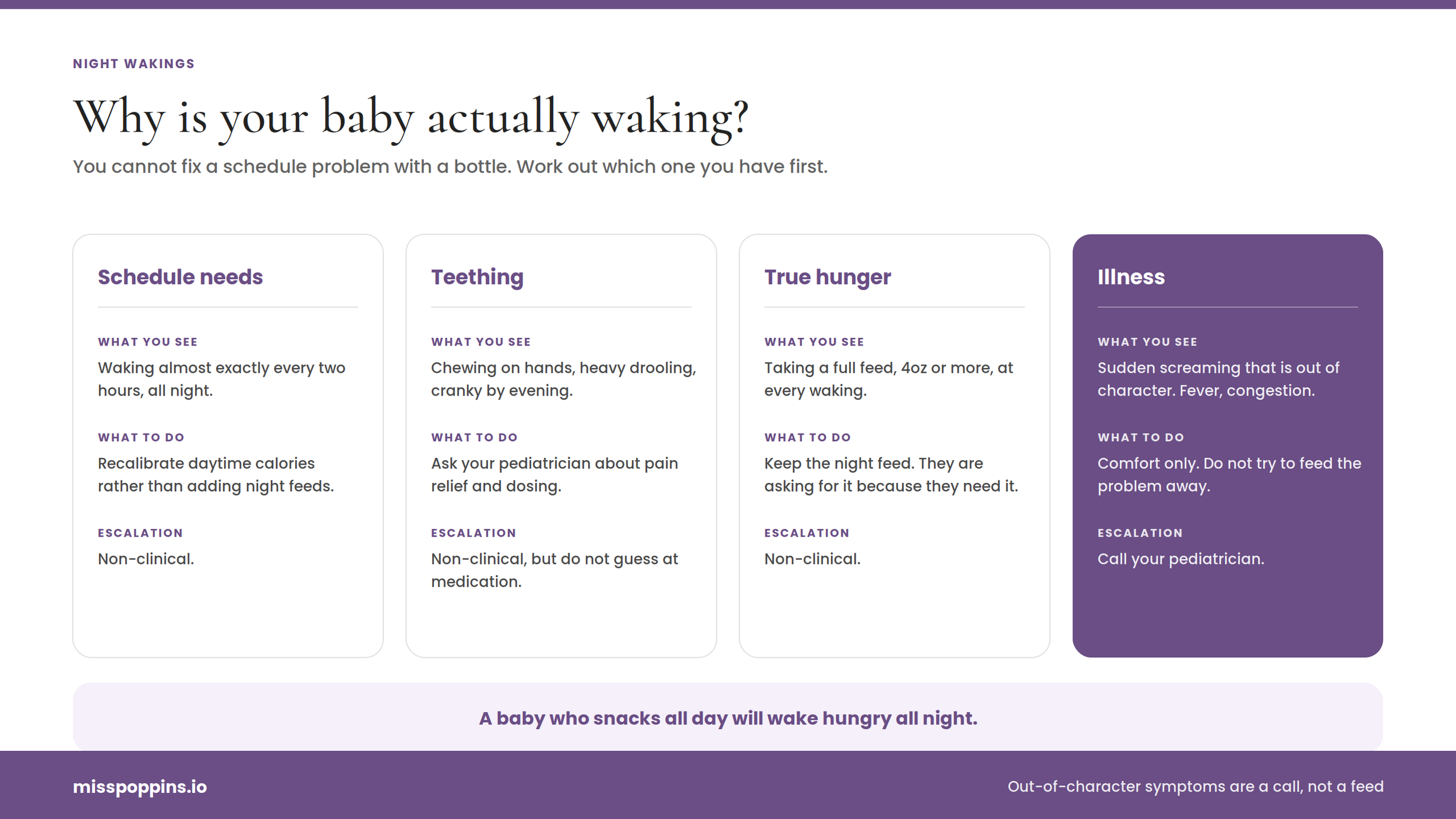
To prevent schedule-based wakings, ensure adequate caloric intake during waking hours. Balance is everything. A baby who snacks all day will wake up hungry all night. See our guide on daytime feeding and sleep patterns for specific macronutrient distribution strategies.
Timeline: When to Start and When to Drop the Dream Feed
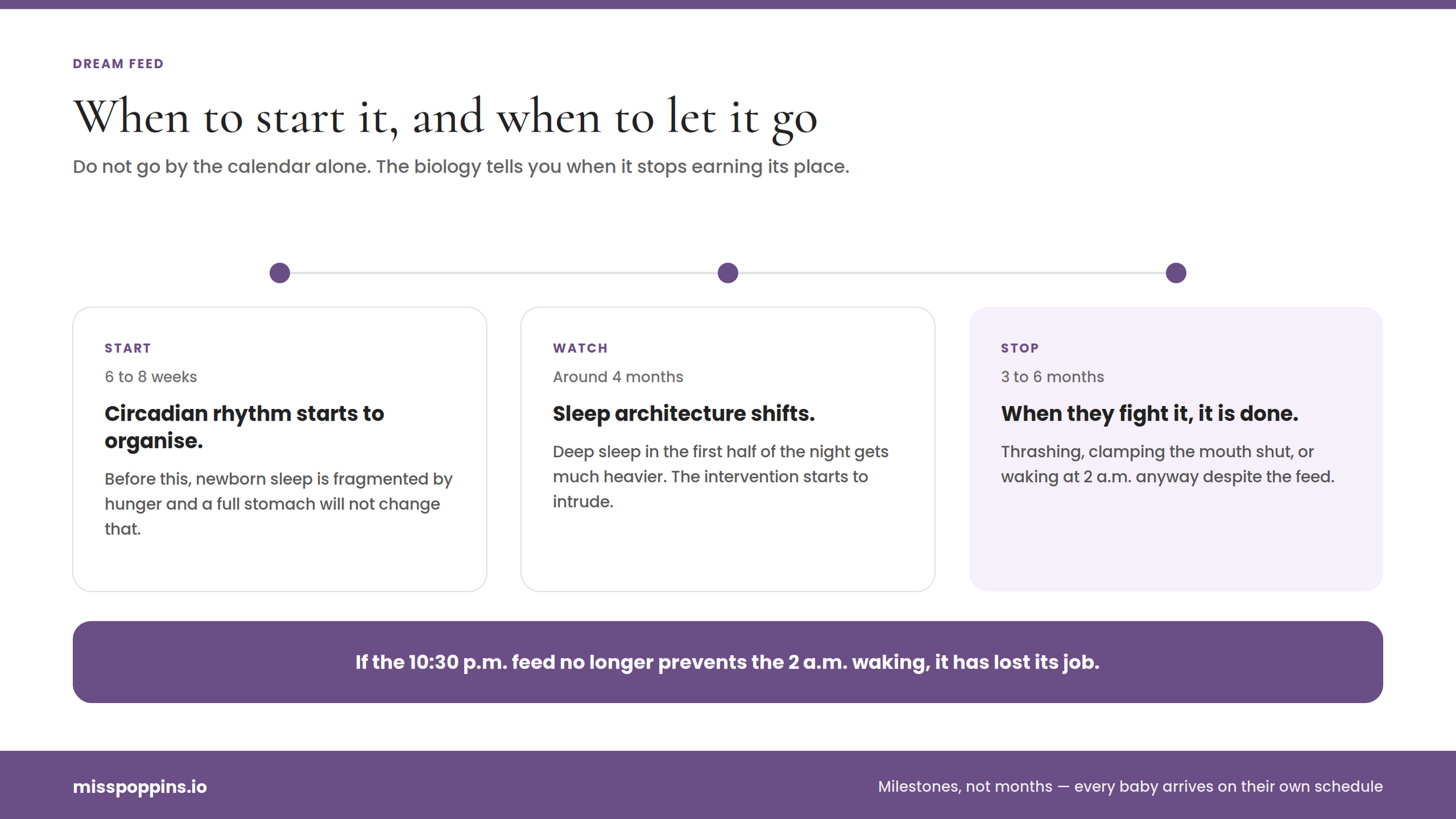
Do not look at the calendar. Look at the biology. Babies do not develop based on a checklist. They develop based on neurological milestones.
Start the protocol around 6 to 8 weeks of age. This is the exact window when early circadian rhythm maturation begins to form. Melatonin production is starting to regulate. Before this point, newborns sleep in disorganized fragments driven purely by hunger. Around the two-month mark, they begin to organize their sleep into recognizable day and night patterns. This is when the protocol becomes highly effective. You are capitalizing on their newly forming ability to connect sleep cycles.
Stop the protocol between 3 and 6 months of age.
The trigger to stop is straightforward. Drop the feed when sleep architecture consolidation causes the baby to wake up angry during the intervention. Around the 4-month mark, a baby's brain undergoes a massive shift. They transition from newborn sleep patterns into adult-like sleep stages (light sleep, deep sleep, REM).
During this shift, their deep sleep becomes incredibly heavy in the first half of the night. If you try to force a bottle into their mouth at 10:30 PM, they will likely start thrashing, fighting the bottle, or clamping their mouth shut. Alternatively, they might take the bottle but continue to wake up at 2:00 AM anyway. If the 10:30 PM intervention is no longer preventing the 2:00 AM wake-up, the feed has completely lost its utility. Hanging onto it will only fragment their sleep cycles further. Track these milestones closely via our timeline on when babies stop feeding at night.
"Parents often cling to the dream feed like a safety blanket," notes Sarah Jenkins, Certified Pediatric Sleep Coach at MissPoppins. "But once their biological clock takes over, interrupting that deep sleep cycle actually causes the exact night wakings you are desperately trying to avoid."
The Reality Check
Let us address the actual environment in your home. Social media makes this protocol look clinical, silent, and easy. In practice, you are exhausted. Your house is loud.
You might have daycare schedule conflicts pushing bedtime back later than ideal, leaving no room for a 10:30 PM feed. You might have a partner who vehemently disagrees on when to intervene at 3:00 AM, leading to tense, whispered arguments in the hallway. Working parents often lack the luxury of perfectly timed 24-hour schedules.
The dream feed is a mechanical tool. It is not a moral obligation. Use it if it drives efficiency for your family unit. Discard it immediately if it causes friction, stress, or more wake-ups.
Diagnostic Failure: When the Dream Feed Backfires
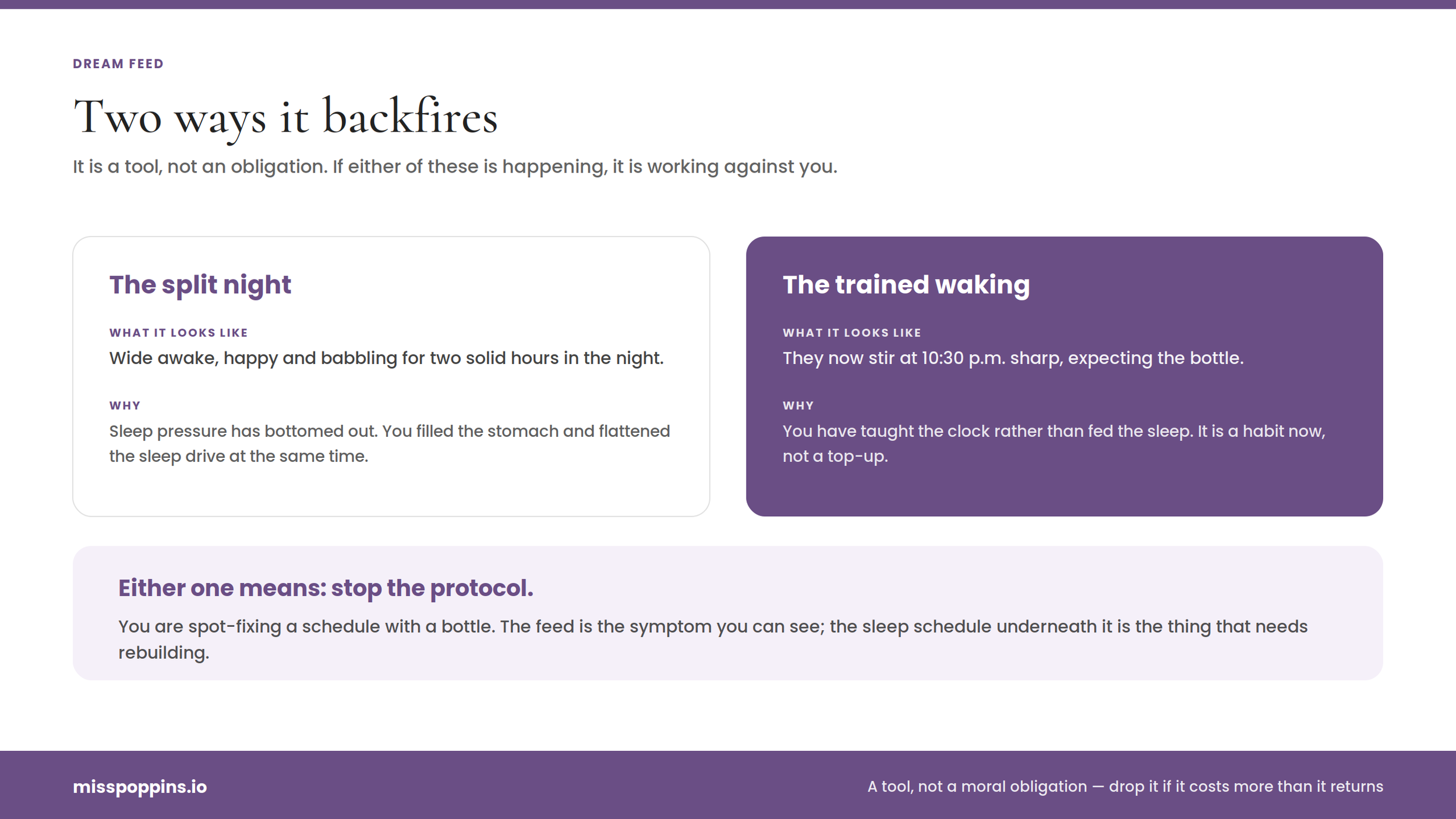
The protocol is not magic. It is a calculated biological probability. In our coaches' experience working with thousands of families, dream feeds fail for roughly 50% of babies.
When it fails, it fails loudly.
If you are experiencing split nights where your baby is wide awake, happy, and babbling for two unbroken hours in the middle of the night, stop the protocol immediately. A split night means the sleep pressure has bottomed out. You artificially filled their stomach, but you also disrupted their sleep drive. Now their brain thinks it is morning at 3:00 AM.
If your baby is treating the 10:30 PM intervention as a habitual waking, the protocol has backfired completely. Instead of feeding them in their sleep, you have accidentally trained their circadian rhythm to expect a meal, a cuddle, and a disruption at 10:30 PM sharp.
If you are stuck in this loop, you are treating a symptom. You are not treating the root sleep architecture. You are attempting a spot-fix on a fundamentally broken schedule. If you want to understand the mechanical breakdown of these associations, study our sleep guidelines for four weeks to three months and sleep associations.
You cannot hack your way out of a broken foundation. Stop guessing in the dark. Stop trying random tactics you find on forums at two in the morning. It is time to rebuild the biological sleep schedule from the ground up.
Rebuild their sleep architecture today. Book a Free consultation with a certified expert.
Why Trust MissPoppins?
Before you book, know exactly who you are trusting with your family's sleep structure. We operate on data and proven biological frameworks:
5,000+ families supported globally.
4.8-star average rating.
150+ years of combined experience across our team.
Vetted and certified non-clinical sleep coaches.
100% private and encrypted sessions.
FAQs
When should I start dream feeding?
You should introduce the practice around 6 to 8 weeks of age. This aligns with the onset of the infant's natural circadian rhythm development. Attempting it earlier often fails because newborns lack the biological capacity to consolidate long blocks of sleep, regardless of how full their stomach is.
Do you burp your baby after a dream feed?
Yes. However, it must be done with minimal movement to preserve the sleep state. Hold them upright against your chest and pat gently for a few minutes. Avoid aggressive positioning or bouncing. If they do not burp within three to five minutes, stop trying and lay them down. For a detailed breakdown of low-impact techniques, read burping your baby: what to know.
What is the difference between a dream feed and a night feed?
A dream feed is proactive. You initiate it before the baby wakes up, usually before you go to bed. A night feed is reactive. The baby wakes up crying from hunger, and you respond to their demand in the middle of the night.
Is dream feeding safe?
Yes, provided strict mechanical guidelines are followed. The infant's head and torso must remain elevated at a 30-degree angle to prevent choking or silent aspiration. Never feed a baby who is lying completely flat. Always refer to American Academy of Pediatrics (AAP) safe sleep guidelines for foundational safety parameters regarding feeding and bassinet use.
Can a dream feed cause early waking?
Yes. If executed too late into the night, it disrupts deep sleep cycles. It can also cause early morning wakings if the infant is biologically ready to drop the feed but parents continue to force it, disrupting their natural transition into lighter morning sleep phases.
Ready to streamline your parenting journey?
Download the MissPoppins app on the App Store and Google Play today to manage sleep schedules, track feeding data, and connect with your coach instantly.