

How Much Does a Doula Cost? (2026 Rates, Hidden Fees & Payment Workarounds)

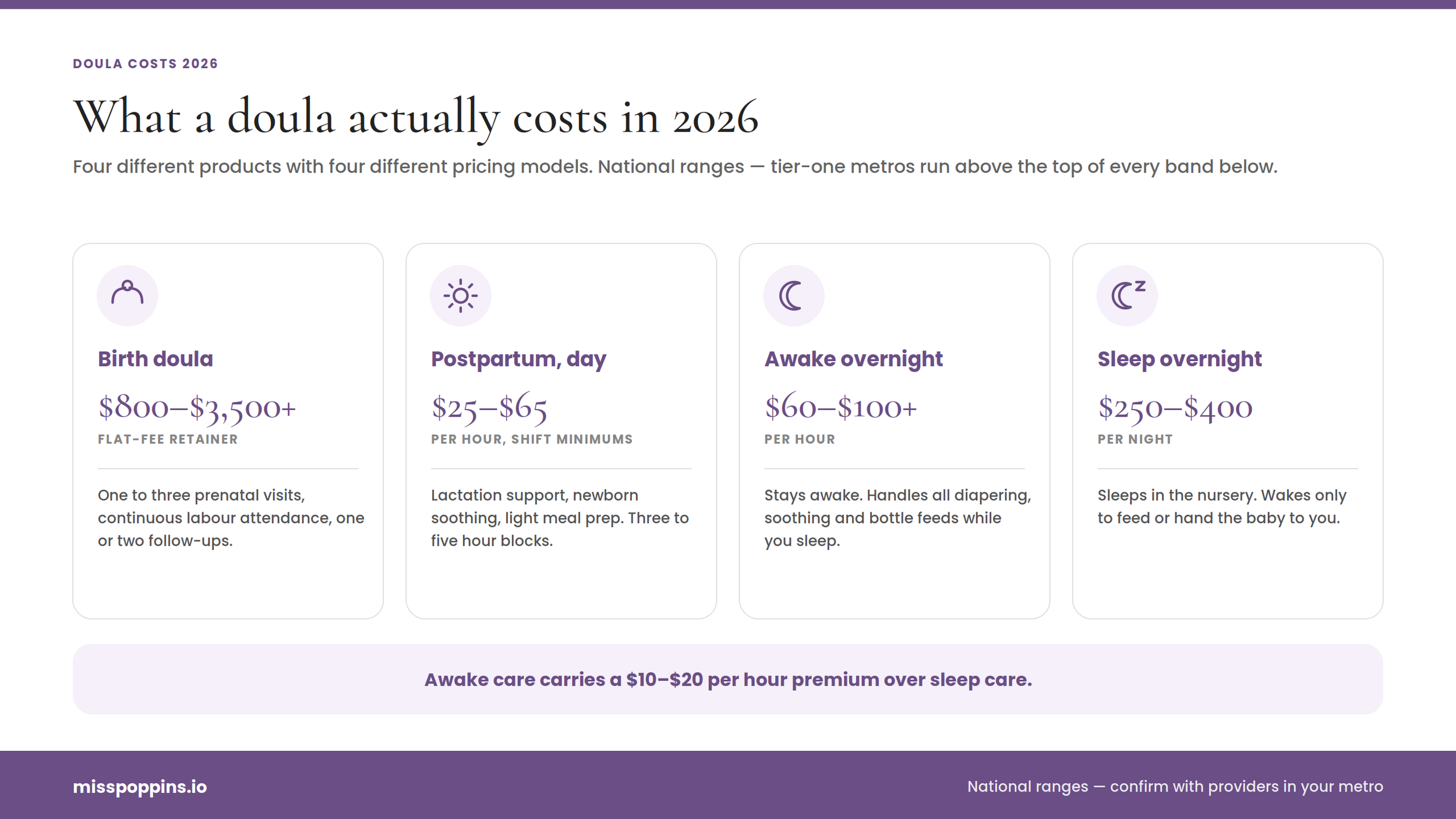
In 2026, a standard birth doula flat-fee package costs between $800 and $3,500 depending on your metro area and the provider's experience level. Postpartum doulas charge $25 to $65 per hour for daytime assistance. Overnight infant care runs $40 to $100 per hour (or roughly $250 to $550 per shift).
Birth Doula vs. Postpartum Doula: How Their Pricing Models Differ
Understanding the exact price tag requires breaking down the services. Birth support and postpartum support operate on entirely different financial models.
Birth Doula Costs: Flat-Fee Retainers ($800 to $3,500+)
Birth doulas do not bill by the hour. They bill for the unpredictable nature of labor.
A standard package secures a specific set of deliverables. You get one to three prenatal visits. You get continuous labor and delivery attendance. You also get one or two postpartum follow-up checks. Most importantly, you are paying for the 24/7 on-call window spanning weeks 37 to 42 of your pregnancy.
Market disparity is massive. Lower-cost and rural markets sit around $800 to $1,200. Tier 1 metros like the SF Bay Area, Manhattan, and Los Angeles consistently push $2,400 to $4,500. We see this verified across the Carrot Fertility 2025/2026 Index and the Doulas by the Bay 2026 Pricing Guide.
Postpartum Doula Costs: Daytime Hourly Rates ($25 to $65/hr)
Postpartum care flips to an hourly model. But you cannot book a postpartum doula for a quick 60-minute visit.
Agencies enforce strict shift minimums. Traditional doulas require three to five-hour blocks. Your absolute minimum spend per visit will range from $100 to $325. This covers the specific postpartum doula care connection required for early maternal recovery, newborn soothing, and lactation assistance.
Overnight Support: Awake Care vs. Sleeping Rates ($40 to $100+/hr)
Night support prices depend entirely on whether the provider gets to close their eyes.
A night doula who sleeps in the nursery and only wakes to hand you the baby charges significantly less. An awake overnight specialist monitors vitals continuously and handles all diapering, soothing, and bottle-feeding while you sleep. That awake care commands a $10 to $20 per hour premium.
Verified community sentiment on r/BabyBumps and r/BabyBumpsCanada confirms the pinch. One parent recently noted the reality. "Seems like the going rate in my HCOL city is $60 to $80/hr. We booked 6 sessions over five weeks and it drained our savings."
“The math of a night doula rarely makes sense on paper until you factor in job performance. A recent thread on r/NewParents highlighted the exact breaking point: "It was very helpful sleep wise. My husband actually did all the night shifts... so when our doula was here it meant my husband could sleep at a normal time and restock his sleep tank".”
Source Link: https://www.reddit.com/r/newborns/comments/1ui944o/night_doula_worth_it/
Why Do Doula Costs Vary So Widely? (The Hidden Price Drivers)
You are never just paying a base rate. Hidden variables heavily manipulate the final invoice.
The "Twin Tax" (Multiples Surcharges)
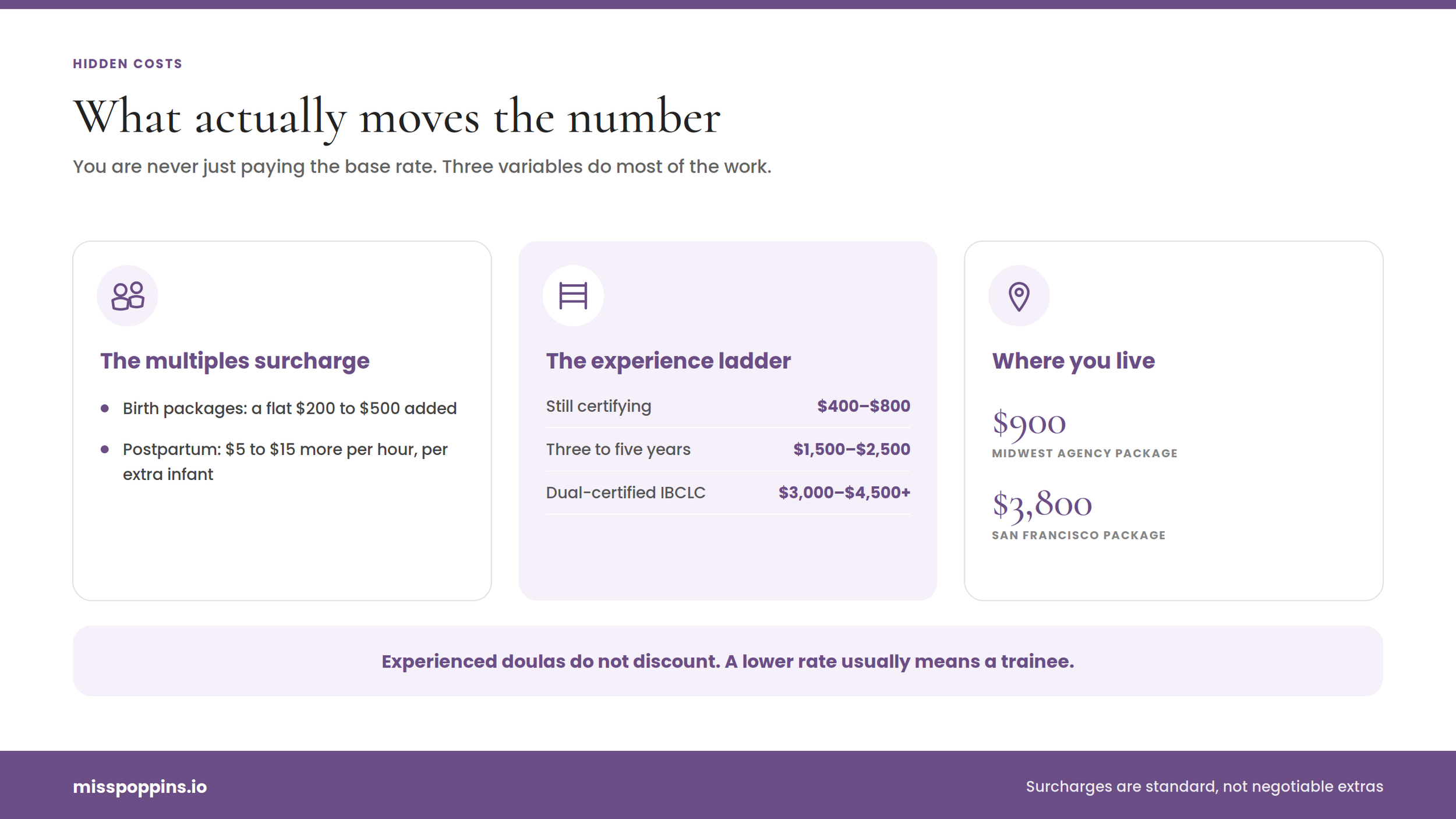
Having multiples automatically spikes your bill. For birth packages, agencies apply flat-fee surcharges ranging from $200 to $500. For postpartum care, expect an hourly add-on of $5 to $15 per hour per additional infant. The Golden Gate Doulas Fee Schedule publicly outlines these standard multi-infant hikes.
Experience Tiers & Certification Badges
A doula's resume dictates their rate.
Certifying Doulas: Providers logging birth hours for DONA International or CAPPA charge $400 to $800. Some use a sliding scale.
Certified & Experienced: Providers with three to five years of experience charge $1,500 to $2,500.
Master Doulas: Dual-certified Lactation Consultants (IBCLC) or midwife assistants demand $3,000 to $4,500+.
“Do not expect experienced doulas to negotiate their rates. The consensus in the professional community is strictly against discounting. As one experienced provider noted on r/doulas: "There is no reason to work for free even just starting out. In my experience clients don't take it as serious when it is free... Value yourself and they will too". If you want a cheaper rate, you will have to hire an uncertified trainee.”
Source Link: https://www.reddit.com/r/doulas/comments/1fl8wx9/how_much_do_you_charge/
Geographic Arbitrage: Metro vs. Rural Spreads
Location drives overhead. A Midwestern agency might quote $900 for a comprehensive package. A San Francisco provider quotes $3,800. The Care.com SF index shows starting postpartum rates hovering around $37.56 per hour before agency markups are even applied.
To compare doula rates to overall parenting support packages, you must factor in these massive regional swings.
The Traditional Doula Friction: Why the $3,000 Non-Refundable Retainer Breaks Budgets

Here is the real talk competitors ignore. Babies do not care about your contract.
You might sign a massive retainer. You might plan a perfect unmedicated birth. Then your toddler brings home a daycare stomach bug, or your partner disagrees with having a stranger in the house at 3:00 AM. Working-parent time constraints clash violently with rigid agency rules.
The On-Call Lock-In & Unused Retainers
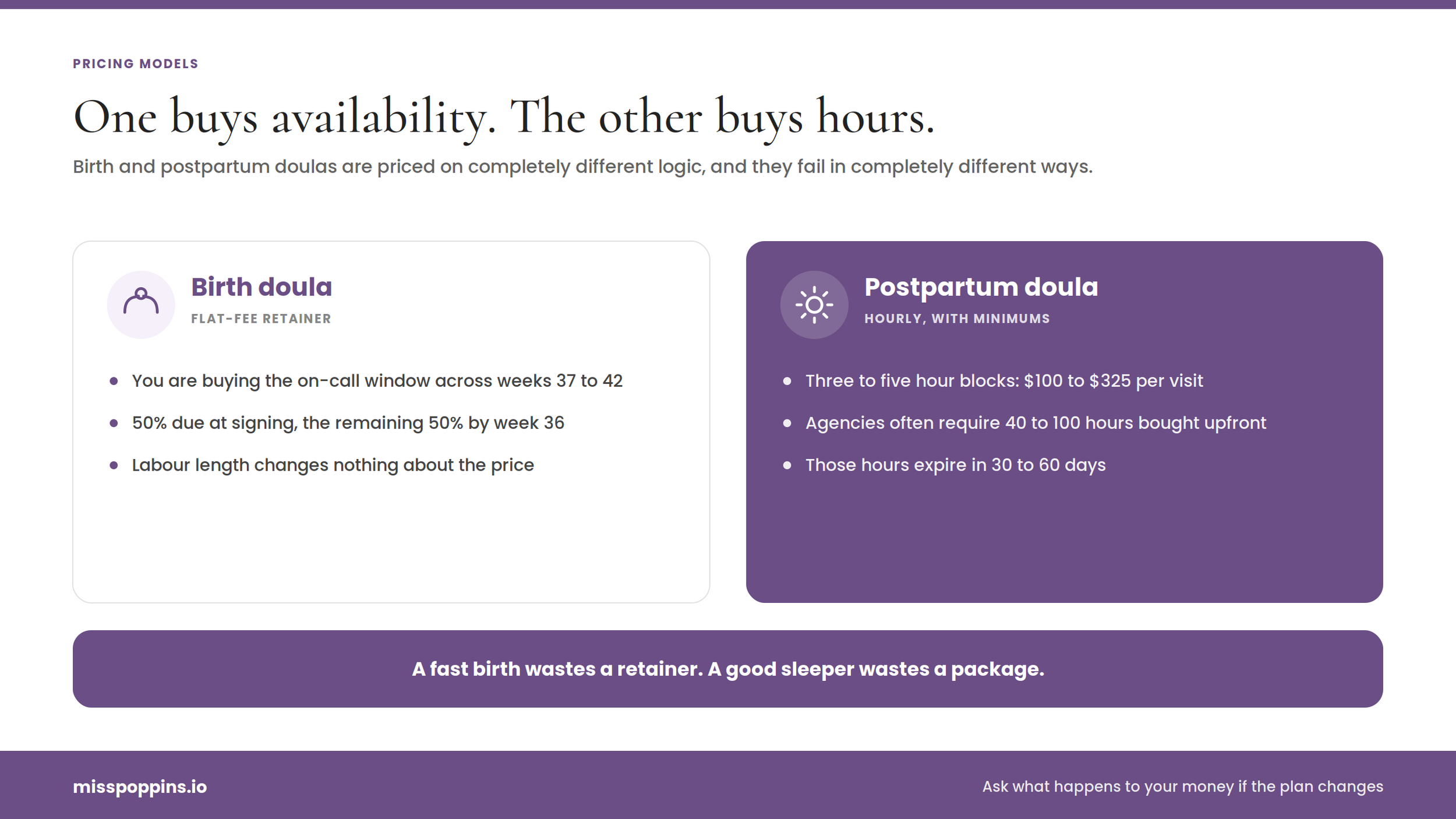
Agencies lock you in early. They require 50% down at signing. The remaining 50% is due by week 36.
This creates a hidden trap. What happens if your baby arrives early via emergency C-section? What if precipitous labor happens in 45 minutes before the doula can even park her car at the hospital? What if hospital visitor caps bar the doula from the room entirely?
In most standard contracts, that $3,000 is 100% non-refundable.
Social proof on Reddit highlights this exact friction. "Insane doula costs. Is it worth it? 4k?! Good lord, our midwife who is doing our delivery doesn't even charge that out-of-pocket."
“The reality of the non-refundable retainer is harsh, even in worst-case scenarios. As one doula on r/doulas frankly explained their business policy regarding pregnancy loss: "For miscarriages we absolve all funds due besides our non-refundable retainer". When you put $1,500 down, you are paying for the calendar block, not a guarantee of a healthy birth.”
Source Link: https://www.reddit.com/r/doulas/comments/1i8u7tc/refund_policy_on_loss/
Rigid Package Minimums vs. Unpredictable Births
Postpartum contracts force you to gamble on your future needs. Agencies frequently require parents to purchase bundles of 40 to 100 postpartum hours upfront. Those hours usually come with strict 30-day or 60-day expiration windows. If your baby turns out to be a great sleeper, you lose the money.
"Parents often panic-buy massive postpartum packages at 3:00 AM while pregnant," says Sarah Jenkins, Certified Pediatric Sleep Coach at MissPoppins. "They don't realize they might just need targeted sleep strategy at month four, not a stranger sleeping in their nursery at week two."
In our coaches' experience working with thousands of families, nearly 40% of parents who purchase massive upfront agency retainers end up with unused hours they cannot refund.
How to Pay for a Doula: Insurance, HSA/FSA, and Benefits
You do not always have to pay cash. Several financial workarounds exist in 2026.
The HSA/FSA Route: IRS Code 213(d) & Letter of Medical Necessity (LMN)
Doula care technically sits in the "Dual-Purpose" medical category under IRS Publication 502 and IRC Section 213(d).
To unlock these funds, you need an approval playbook. You must get your OB-GYN or Certified Nurse Midwife to write a Letter of Medical Necessity (LMN). This letter must indicate clinical necessity. Valid reasons include labor complication mitigation, prior birth trauma, pelvic floor dysfunction, or high postpartum depression risk.
You also need a superbill from your doula. The invoice must itemize perinatal dates, contact hours, and CPT codes rather than generic labels like "baby care." This ensures compliance for doula care and parent coaching coverage under FSA/HSA.
Corporate Fringe Benefits (Carrot, Maven, Progyny)
Modern employers are stepping up. Platforms like Carrot, Maven, and Progyny provide family-forming allowances. These corporate fringe benefits often offer $1,000 to $5,000 in lifetime or annual stipends that cover vetted doula services.
The 2026 Medicaid Landscape (28 States + D.C.)
State-mandated coverage is expanding. According to the National Academy for State Health Policy (NASHP) 2026 Trends report, 28 states plus Washington D.C. now actively reimburse Medicaid doulas.
California Medi-Cal covers up to $3,200. Utah launched its program in April 2026. Arkansas implemented coverage on September 1, 2026. Washington state reimburses up to $3,500. This shift heavily influences the known outcomes of doula care, proving the model reduces maternal mortality.
In-Person vs. Virtual Doula Care: How to Save 60%+ Without Sacrificing Support
You must determine what kind of help you actually need.
Physical Support vs. Strategic Guidance: What You Actually Need
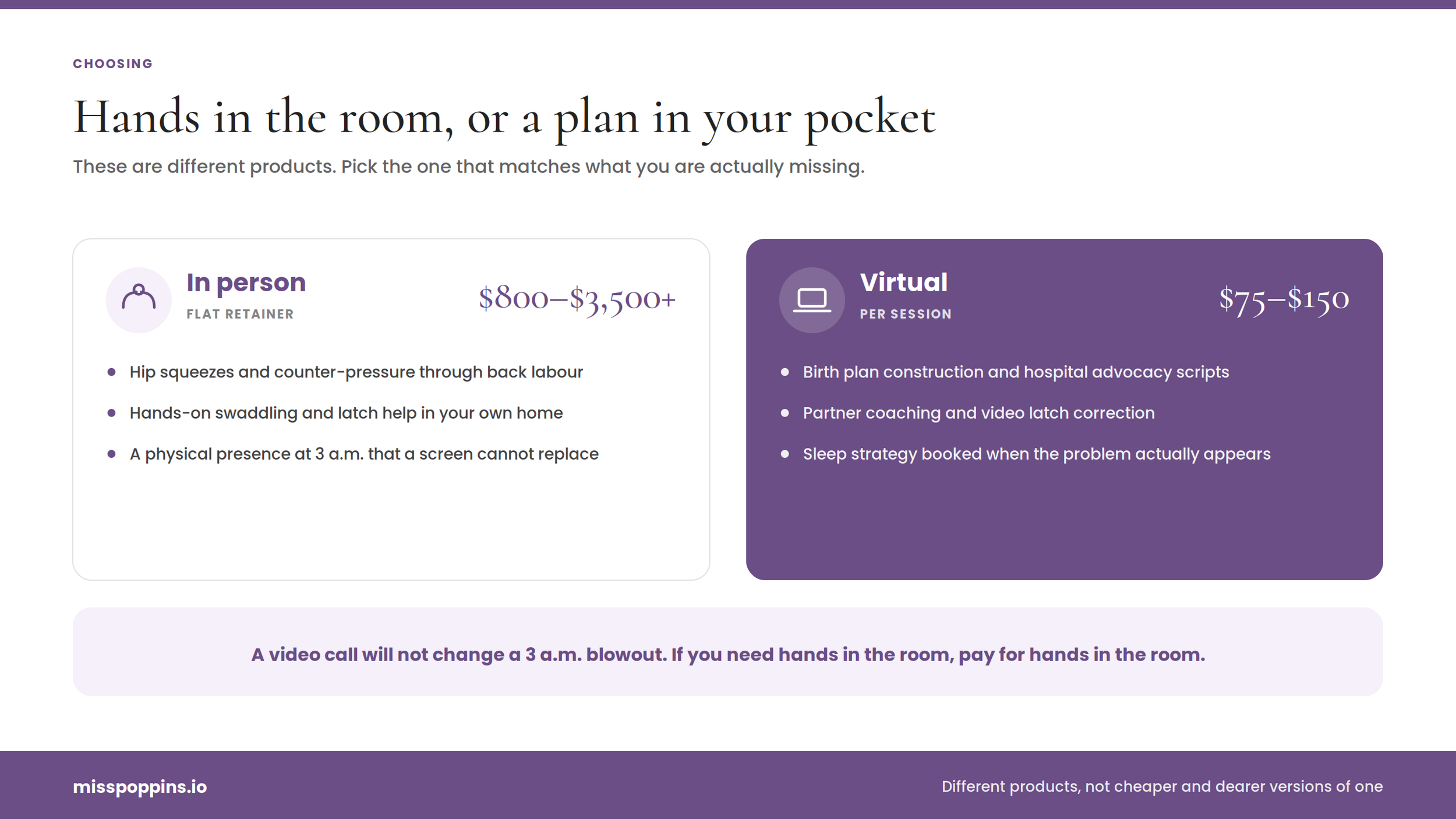
In-person support provides physical intervention. You get hip squeezes. You get counter-pressure during active back labor. You get hands-on swaddling instruction regardless of where doulas attend births.
Virtual telehealth support focuses on strategy. You get birth plan construction. You get hospital advocacy scripts. You get partner coaching, video latch correction, and postpartum sleep architecture.
It is vital to clarify doula scope of practice vs. clinical care. Doulas do not deliver babies. They manage the environment and the parental mindset.
The MissPoppins Modular Model: Zero Retainers, Pay-Per-Session
Let’s be completely honest. A virtual session will not rub your back during a 24-hour back-labor, and a video call will not change a blowout diaper at 3:00 AM. If you require a physical human in the room, you must pay the traditional $3,000 retainer.
But if you already have a supportive partner, and what you actually lack is an actionable sleep strategy, a hospital advocacy script, or a feeding plan, paying a massive upfront agency fee is overkill.
Instead of gambling thousands of dollars on a physical presence you might not fully consume, you can access verified birth and postpartum specialists on demand. A focused virtual session costs $75 to $150. You book it only when a crisis actually occurs. You get immediate answers for sleep regressions, feeding issues, or birth debriefs without signing a mandatory contract.
Skip the Rigid $3,000 Upfront Retainer
Access certified birth and newborn experts on your schedule. No wasted hours. No hidden twin taxes.
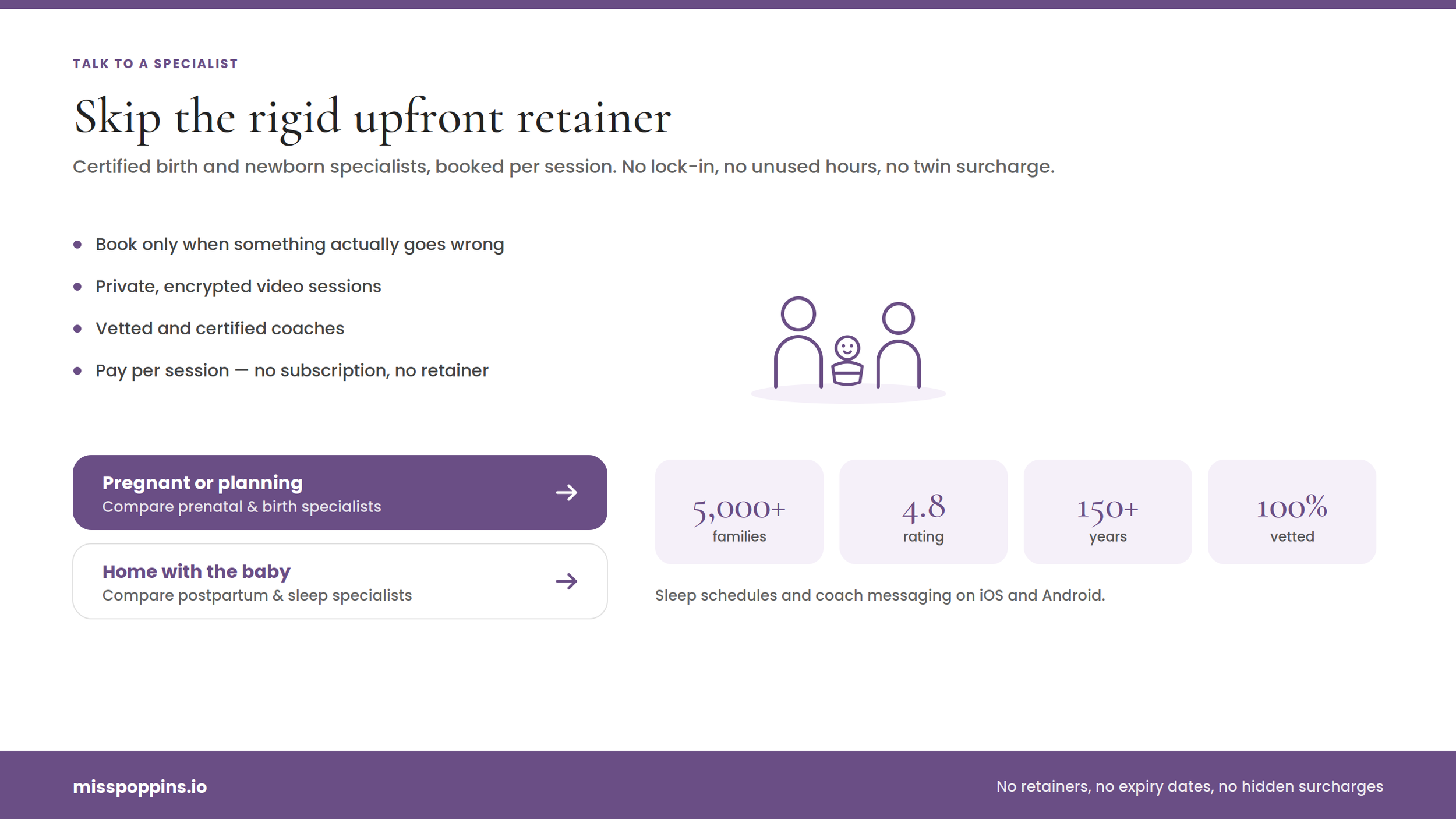
5,000+ families supported
4.8-star average rating
150+ years of combined expert experience
Fully vetted and certified coaches
Private, encrypted video sessions
Choose Your Path:
► Pregnant / Planning: Compare Prenatal & Birth Specialists
► Postpartum / Home with Baby: Compare Postpartum & Sleep Specialists
Take the village with you. Download the MissPoppins app today on the App Store and Google Play.
FAQs
Are doulas worth the money?
Yes, if you utilize their services fully. They statistically lower intervention rates and improve maternal satisfaction. However, massive upfront retainers lose their value if the birth happens too fast or if you overbuy postpartum hours.
Will my insurance cover a doula?
Standard private health insurance (like Aetna, BCBS, or UnitedHealthcare) rarely covers doulas by default. You typically have to pursue out-of-network reimbursement by submitting a Superbill and a Letter of Medical Necessity.
At what point in pregnancy should you get a doula?
Most parents hire a birth doula between weeks 12 and 24. This allows ample time for prenatal visits and birth plan alignment.
Do overnight doulas sleep?
It depends on the contract. "Sleep" doulas rest in the nursery and wake only for feedings. "Awake" care providers stay up all night to actively monitor and soothe the infant. Awake care costs significantly more.
Can I give birth with just a doula?
No. Doulas provide non-clinical emotional and physical support. You must have a licensed clinical provider (an OB-GYN or a Certified Nurse Midwife) to actually deliver the baby and manage medical safety.
Are doulas against epidurals?
Professional, certified doulas support your specific birth preferences objectively. They are trained to help you manage unmedicated pain, but they fully support and advocate for you if you choose an epidural.
When is the best time to get a postpartum doula?
Secure their services in your third trimester. This guarantees their availability for your first few weeks home from the hospital when physical recovery and sleep deprivation peak.
How long do people have night doulas?
Contracts vary wildly. Some families book night doulas for the first two weeks. Others retain them for three to four months until the infant naturally consolidates nighttime sleep.
What are the responsibilities of a night doula?
They manage the entire overnight infant care routine. This includes diapering, soothing, swaddling, bringing the baby to the mother for nursing, or handling bottle feeds entirely so parents can sleep.