

Breastfeeding vs Formula Feeding: What Every New Parent Needs to Know

Every new parent faces the feeding question — and the answers they find online can feel overwhelming, contradictory, and surprisingly judgmental. Whether it comes from a well-meaning relative, a late-night forum scroll, or a pediatrician's offhand comment, the pressure to make the "right" choice starts before the baby even arrives.
Here is what the evidence actually shows: 85.7% of U.S. parents start breastfeeding, but most end up supplementing with formula at some point (CDC, 2024). Feeding is not a binary decision — it is a spectrum, and most families land somewhere in the middle.
This guide walks through the real benefits and challenges of breastfeeding, formula feeding, and combination feeding — backed by current research and practical cost breakdowns. It covers what the science says, what each option actually requires day-to-day, and how to build a feeding plan that works for the baby, the parent, and the whole family.
What Are the Benefits of Breastfeeding?
Breast milk offers a unique combination of nutritional and immune advantages that formula cannot fully replicate. The following comparison highlights the key differences between the two feeding methods across several categories — from immune protection to cost and convenience.
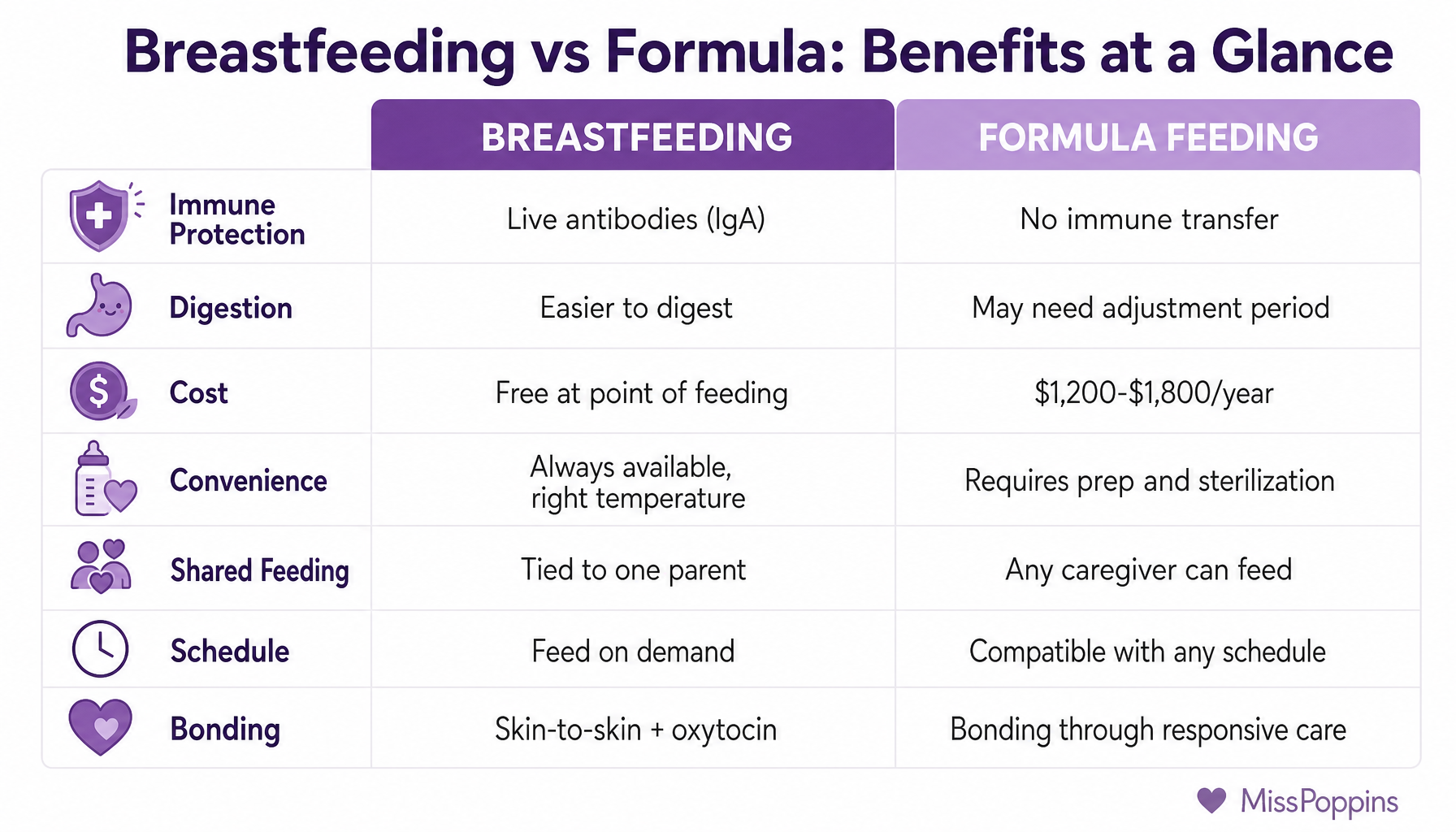
Breastfeeding vs Formula Benefits
Benefits for baby:
Immune protection: Breast milk contains live antibodies (particularly IgA) that help protect against ear infections, respiratory illness, and gastrointestinal infections (AAP, 2022)
Easier digestion: Human milk proteins are structured for infant gut absorption, reducing rates of gas, constipation, and reflux
Lower risk of SIDS: Breastfeeding is associated with a reduced risk of sudden infant death syndrome, even with partial breastfeeding (AAP, 2022)
Long-term health: Reduced risk of type 1 diabetes, childhood leukemia, and obesity later in life (AAP, 2022)
Benefits for the mother:
Cancer risk reduction: Breastfeeding lowers lifetime risk of breast cancer and ovarian cancer (AAP, 2022)
Faster postpartum recovery: Oxytocin released during nursing helps the uterus contract, reducing postpartum bleeding (AAP, 2022). Pairing breastfeeding with proper postpartum nutrition can further accelerate recovery
Reduced risk of type 2 diabetes and cardiovascular disease over time (AAP, 2022)
Cost savings: Breast milk is free at the point of feeding — no formula, bottles, or prep equipment required
Bonding: Skin-to-skin contact during breastfeeding triggers oxytocin release in both parent and baby, supporting emotional attachment and stress regulation. That said, bonding is not exclusive to breastfeeding — responsive caregiving, eye contact, and physical closeness during formula feeding achieve similar outcomes.
Nutritional adaptability: Breast milk composition changes to match the baby's developmental stage. Colostrum, the thick first milk produced in the initial days, is packed with concentrated antibodies and growth factors. Transitional milk follows, and mature milk adjusts its fat and calorie content based on the baby's feeding patterns.
The American Academy of Pediatrics recommends exclusive breastfeeding for the first six months of life, with continued breastfeeding alongside solid foods for at least two years (AAP, 2022). This updated recommendation — previously set at one year — reflects growing evidence on the long-term health benefits of extended breastfeeding for both mother and child.
Despite this guidance, only 27.9% of U.S. infants are exclusively breastfed through six months, and just 40.8% are still receiving any breast milk at 12 months (CDC, 2026). The Healthy People 2030 target calls for 42.4% exclusive breastfeeding at six months — a goal the U.S. is still far from reaching. The gap between recommendation and reality is not about willpower — it is about access to timely, professional support.
What Are the Challenges of Breastfeeding?
Breastfeeding is natural, but it is not always easy. Physical, logistical, and emotional barriers prevent many parents from meeting their own feeding goals — even when they want to continue.
Physical challenges:
Pain and latching difficulty: Sore nipples, shallow latch, and tongue-tie can make early feeds painful. Tools like nipple shields can help temporarily, but without timely intervention from a lactation consultant, many parents stop within the first two weeks. Learn the signs you may need a lactation consultant.
Low supply and engorgement: Perceived low supply is the most common reason parents introduce formula early, though actual insufficient supply affects a smaller percentage (Odom et al., Pediatrics, 2013).
Mastitis: Blocked ducts and breast tissue infection affect roughly 1 in 10 breastfeeding mothers, requiring prompt treatment (Amir, BMJ, 2014).
Time and lifestyle demands:
Newborns feed every two to three hours — including overnight — leaving little room for shared caregiving or uninterrupted rest
Pumping at work requires time, privacy, equipment, and employer cooperation
Some medications and dietary restrictions limit what a breastfeeding parent can consume
Emotional toll: The pressure to breastfeed exclusively can produce guilt, anxiety, and exhaustion — particularly when stress and milk supply challenges compound each other. According to the CDC, approximately one in six U.S. mothers never initiates breastfeeding, and many who start stop earlier than intended (CDC, 2026).
It is worth noting that roughly 95% of mothers can physiologically produce enough milk (Neifert, 2001). The real obstacles are systemic: inadequate parental leave, lack of lactation support, workplace barriers — including limited access to employer-sponsored lactation support — and limited access to evidence-based guidance.
When those barriers are removed, the data is striking. During the 2022 U.S. infant formula shortage, breastfeeding initiation rose by nearly two percentage points nationally — with the largest gains among populations that historically had the lowest rates, including mothers with lower education levels, WIC participants, and Black mothers (Seoane Estruel & Andreyeva, Pediatrics, 2025). The implication is clear: many parents who stop breastfeeding early are not choosing to — they are running out of support.
Parents who struggle with breastfeeding are not failing — they often have not yet had access to the right support at the right time. Early connection with a certified lactation consultant — ideally within the first 48 hours — can resolve most common issues before they become reasons to stop.
What Are the Benefits of Formula Feeding?
Formula feeding offers advantages that matter — practically, medically, and emotionally. Framing formula as a "backup plan" misses the reality that for many families, it is the right primary choice.
Flexibility and shared feeding:
Any caregiver — partner, grandparent, babysitter — can handle feeds, distributing the physical load more evenly
Partners can take nighttime shifts, improving sleep for the recovering parent
Feeding is not tied to one person's body or schedule
Medical necessity: Formula is essential when breastfeeding is not safe. Parents living with HIV, those taking certain medications (such as specific chemotherapy agents), and infants with galactosemia all require formula from the start.
Measurability: Parents and pediatricians can track exactly how much the baby is consuming at each feed — helpful for monitoring weight gain and identifying feeding issues early.
Mental health: For mothers experiencing postpartum depression, anxiety, or breastfeeding-related trauma, formula removes a significant source of stress. Fed and supported is always better than breastfed and suffering.
Lifestyle compatibility: Formula feeding accommodates work schedules, medications, and dietary freedom without restriction. For parents returning to work without pumping access, formula is the practical path.
Modern infant formulas are FDA-regulated and nutritionally complete, designed to meet all of an infant's dietary needs during the first year of life (FDA, 2024). Recent advances have introduced formulas with added prebiotics, human milk oligosaccharides (HMOs), and optimized fatty acid profiles that more closely mirror breast milk composition (Kariyawasam et al., Food Science & Nutrition, 2025). They are not identical to breast milk — but they are safe, effective, and continuously improved.
A comprehensive 2025 review of research spanning 2015–2025 found that while breastfed infants showed small statistical advantages in certain cognitive measures, the differences were not considered clinically significant (Kariyawasam et al., Food Science & Nutrition, 2025). Formula-fed babies develop, grow, and thrive within normal ranges.
What Are the Challenges of Formula Feeding?
Formula is a reliable feeding option, but it comes with logistical, financial, and nutritional trade-offs worth understanding before committing to a feeding plan.
Cost:
Standard formula runs approximately $1,200–$1,800 per year
Specialty formulas (hypoallergenic, amino acid-based) can exceed $2,400 per year
Add bottles, nipples, sterilization equipment, and formula pitchers to the total
Preparation requirements:
Formula must be mixed with clean water at the correct temperature (MedlinePlus, 2025)
Bottles and nipples need regular sterilization
Prepared formula must be used within one to two hours at room temperature or refrigerated and used within 24 hours
No immune transfer: Formula does not contain the live antibodies, white blood cells, or bioactive compounds found in breast milk. Formula-fed infants may experience slightly higher rates of ear infections and gastrointestinal illness in the first year (AAP, 2022).
Digestive adjustment: Many babies need time to adjust to formula, experiencing gas, constipation, or fussiness. Some families cycle through multiple formula types before finding the right fit. A pediatrician or feeding specialist can help narrow down options more quickly than trial and error alone.
Supply chain vulnerability: The 2022 formula shortage affected 34.7% of U.S. parents who relied on formula, exposing the risk of depending on a single manufactured product (Caitlyn et al., U.S. Census Bureau Household Pulse Survey, 2024). Parents who formula feed may want to keep a modest backup supply and track recall alerts through the FDA.
None of these challenges make formula feeding a bad choice. They are practical considerations that help parents plan ahead and avoid surprises.
Can You Combine Breastfeeding and Formula Feeding?
Combination feeding — using both breast milk and formula — is far more common than most parents realize. The following flowchart outlines common decision points that lead families toward exclusive breastfeeding, formula feeding, or a blended approach based on their specific circumstances.
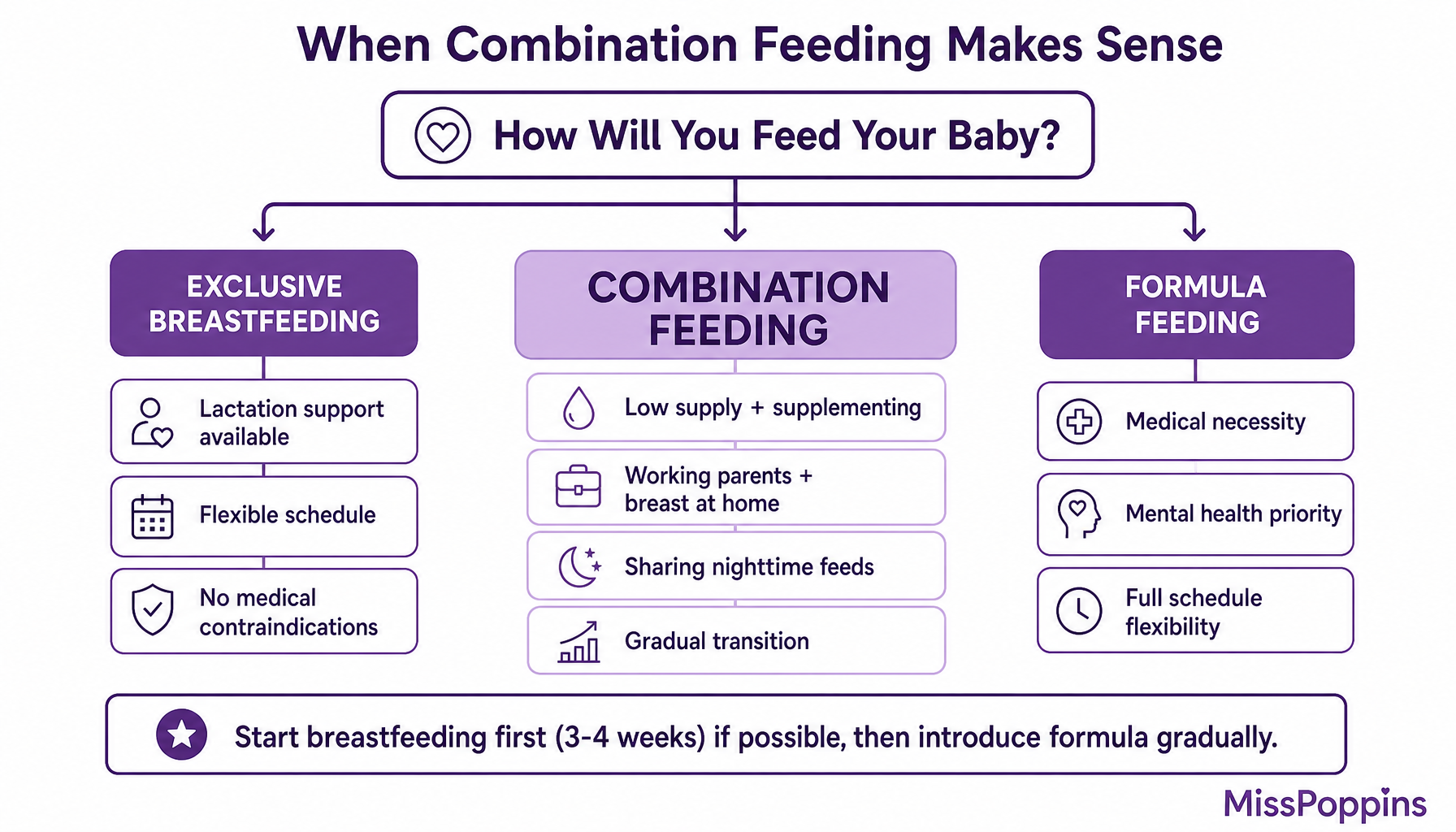
When does combination feeding make sense?
According to the CDC, 22.9% of infants receive formula supplementation within their first two days of life (CDC, 2026). Combination feeding is a deliberate approach that many families use to balance the immune benefits of breast milk with the flexibility that formula allows.
Why families combine:
Low supply supplementing: When breast milk alone is not enough, formula fills the gap while preserving partial breastfeeding benefits
Work-hour bottles: Formula during daycare or work hours, breastfeeding in the morning and evening
Shared nighttime feeds: One parent handles a formula bottle while the breastfeeding parent sleeps
Timing matters: The World Health Organization and AAP recommend establishing breastfeeding for three to four weeks before introducing bottles if possible. This helps solidify latch and supply patterns. However, if supplementation is medically necessary earlier, it should not be delayed.
Practical tips for combination feeding:
Alternate feeds rather than topping off each breastfeed with formula — this protects supply signals
Use paced bottle feeding to mimic the slower flow of breastfeeding and reduce nipple confusion
Pump during skipped breastfeeds if maintaining supply is a priority
Track feeds to identify patterns and ensure the baby is getting enough total volume
Combination feeding preserves some of the immune and nutritional benefits of breast milk while giving families the flexibility they need. There is no minimum threshold of breast milk required to be "worthwhile" — any amount provides measurable health benefit (AAP, 2022).
A lactation consultant can help parents design a combination feeding schedule that fits their goals, whether that means maximizing breast milk intake, maintaining supply while working, or gradually transitioning to full formula feeding on their own timeline.
How to Decide What's Right for Your Family
There is no single right answer. The best feeding method is the one that keeps both parent and baby healthy, nourished, and supported. The following framework can help families think through the decision.
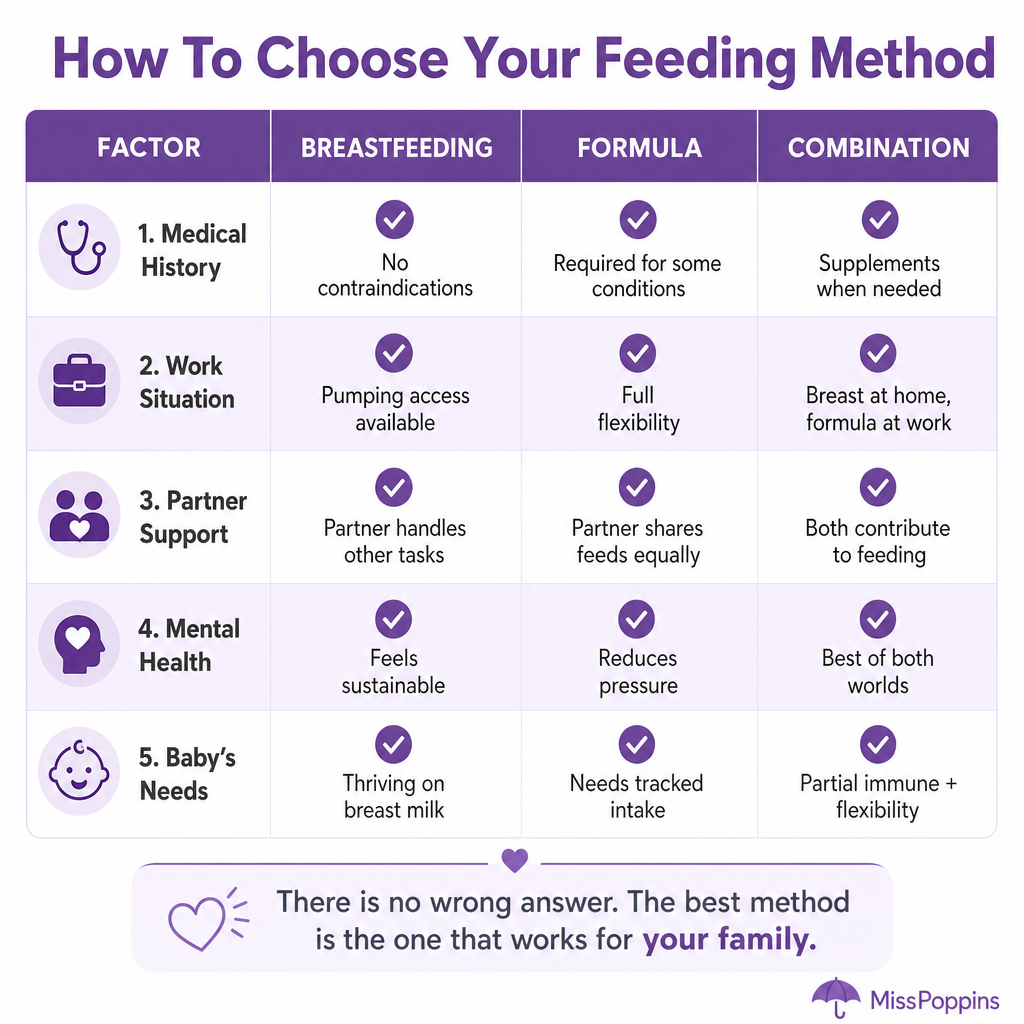
How to choose your feeding method.
When breastfeeding works best:
The parent has access to lactation support and a flexible schedule during the early weeks
The workplace provides pumping accommodations
There are no medical contraindications
The parent wants the immune and cost benefits and feels physically and emotionally ready
When formula may be the better fit:
Medical conditions prevent safe breastfeeding
Mental health concerns make breastfeeding unsustainable
Work or caregiving demands require shared feeding from day one
Previous breastfeeding trauma makes another attempt harmful rather than helpful
When combination feeding makes sense:
The parent wants partial immune benefits with more scheduling flexibility
Supply challenges mean breast milk alone is not meeting the baby's needs
The parent is returning to work but wants to maintain some breastfeeding sessions
Partner support matters more than many parents realize. Research shows that fathers who take two or more weeks of parental leave are 31% more likely to actively support breastfeeding at eight weeks postpartum (Parker et al., 2025). Feeding decisions are family decisions — not just the birthing parent's burden.
Parents benefit from talking to a certified lactation consultant before delivery. A pre-birth consultation can help build a realistic feeding plan, identify potential challenges, and line up support before the first sleep-deprived days arrive.
Feeding plans can and do change. A parent who intends to breastfeed exclusively may need to supplement. A parent who starts with formula may find they want to try nursing later. Adjusting a feeding plan in response to changing needs is a normal and healthy part of parenting.
Frequently Asked Questions
Is breast milk really better than formula?
Breast milk offers immune benefits that formula cannot replicate, but modern formula is nutritionally complete and FDA-regulated — both options produce healthy babies when used appropriately (AAP, 2024).
How much does formula feeding cost per month?
Standard formula costs roughly $100–$150 per month; specialty formulas can run $200 or more, plus the cost of bottles and preparation supplies.
Can I switch from breastfeeding to formula?
Yes. Transition gradually over one to two weeks by replacing one breastfeed per day with a formula bottle to reduce engorgement and allow supply to adjust.
Does formula feeding affect bonding?
No. Bonding happens through skin-to-skin contact, eye contact, responsive feeding, and consistent caregiving — not exclusively through breastfeeding.
Is combination feeding safe?
Yes. Combination feeding is widely practiced and supported by pediatric guidelines, with no evidence of harm when both breast milk and formula are handled properly.
Practical Next Steps for New Parents
Regardless of which feeding method parents choose, the following steps can help set up a smoother experience from the start:
Before delivery: Schedule a prenatal consultation with a certified lactation consultant to discuss goals, learn basic latching techniques, and build a feeding plan that accounts for work, partner involvement, and medical history.
In the first 48 hours: Request hands-on breastfeeding support from hospital lactation staff. If breastfeeding is not going as planned, ask about supplementation options rather than waiting until frustration builds.
At home: Track feeds for the first two weeks — whether breast, bottle, or both — to monitor intake patterns and identify potential issues early. Use a simple notebook or app to log feeding times and duration.
If problems arise: Contact a lactation consultant or feeding specialist before making a permanent switch. Most common breastfeeding challenges — latching pain, perceived low supply, engorgement — are resolvable with professional guidance within one to two sessions. MissPoppins offers same-day video consultations with certified lactation consultants, so parents do not need to wait for an in-person appointment.
For partners: Take an active role in feeding from day one, whether that means handling formula bottles, burping, or managing nighttime logistics so the breastfeeding parent can rest.
Build a support system: Connect with a parenting community or a certified feeding specialist through a platform like MissPoppins to get guidance from parents and professionals navigating the same decisions.
Conclusion
There is no wrong answer — only the answer that works for each family. Whether parents breastfeed exclusively, formula feed from day one, or land somewhere in between, both paths produce healthy, thriving babies when paired with responsive caregiving and adequate support.
What makes the biggest difference is not the feeding method itself — it is having expert guidance when questions arise, challenges surface, or plans need to change. A certified lactation consultant can help parents build a feeding plan that fits their life, not someone else's expectations.
MissPoppins connects parents with certified lactation consultants and feeding specialists — available same-day, via private encrypted video, with no waitlists or travel required.