

How to Get Kids to Eat Vegetables: Age-By-Age Strategies That Actually Work
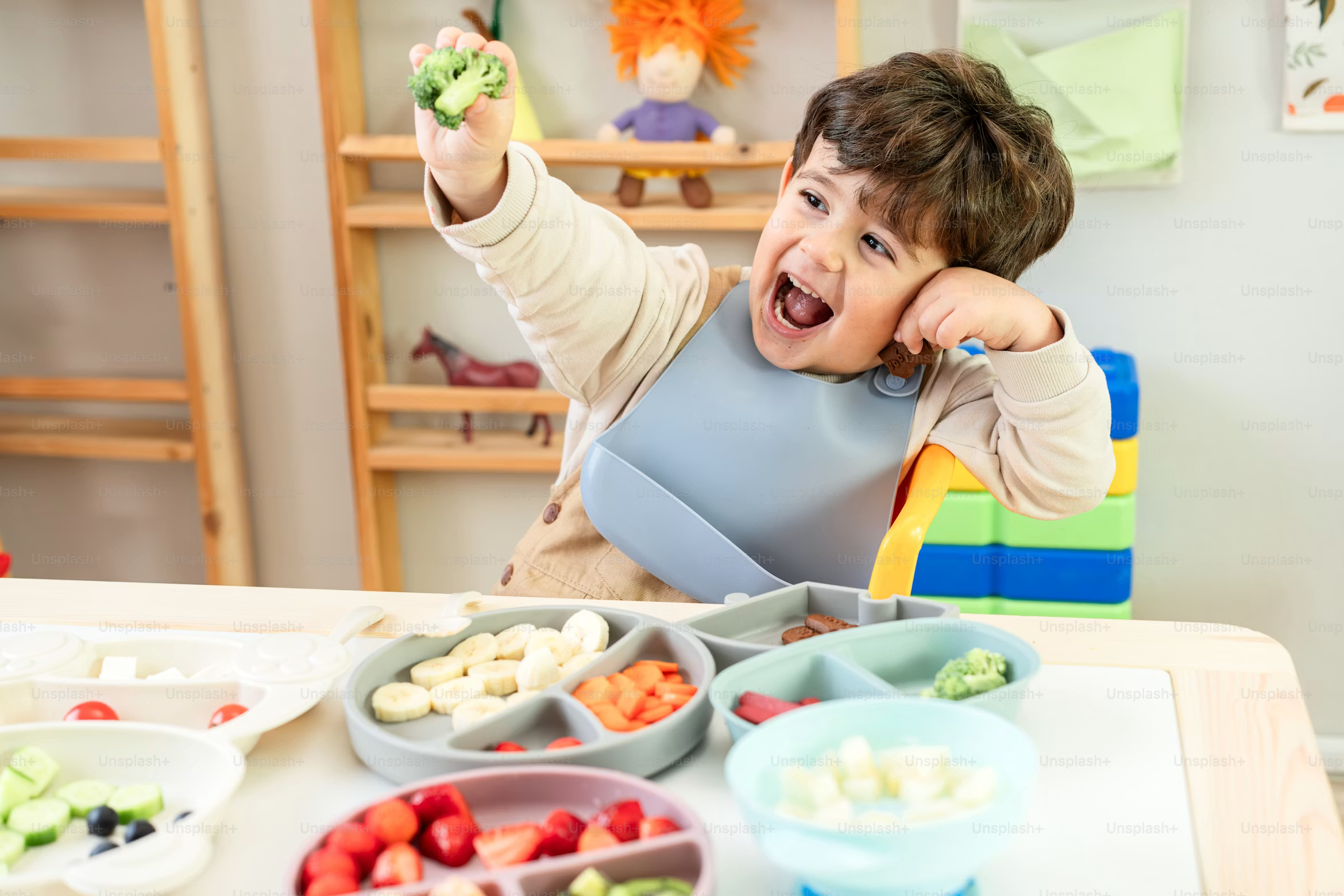
A little boy sitting at a table with a plate of food
Key Takeaways
Food neophobia (fear of new foods) affects 14 to 44 percent of children aged 4 to 7 and is a developmentally normal phase, not defiance.
Research shows repeated, pressure-free exposure, up to 10 to 15 times, is one of the most evidence-supported strategies for increasing vegetable acceptance.
Ellyn Satter's Division of Responsibility model, endorsed by the American Academy of Pediatrics, places the parent in charge of what and when, and the child in charge of whether and how much.
Telling children vegetables are "healthy" or "good for you" can backfire: research by Maimaran and Fishbach (2014) found that health-benefit framing reduces children's desire to eat a food.
Age-specific strategies matter because toddlers, preschoolers, and school-age children have different developmental needs that require different approaches.
Introduction
The broccoli sits untouched. The carrots have been pushed to the edge of the plate. The child stares, arms crossed, while the parent calculates how long this silent standoff will last. If this scene sounds familiar, it is because it plays out in millions of households every night.
The numbers confirm what parents already feel. According to a 2026 National Survey of Children's Health analysis, only about 50 percent of children aged 1 to 5 eat a vegetable on any given day. Among adolescents, the picture is even starker: just 2 percent meet USDA vegetable intake recommendations, according to CDC data published in 2021.
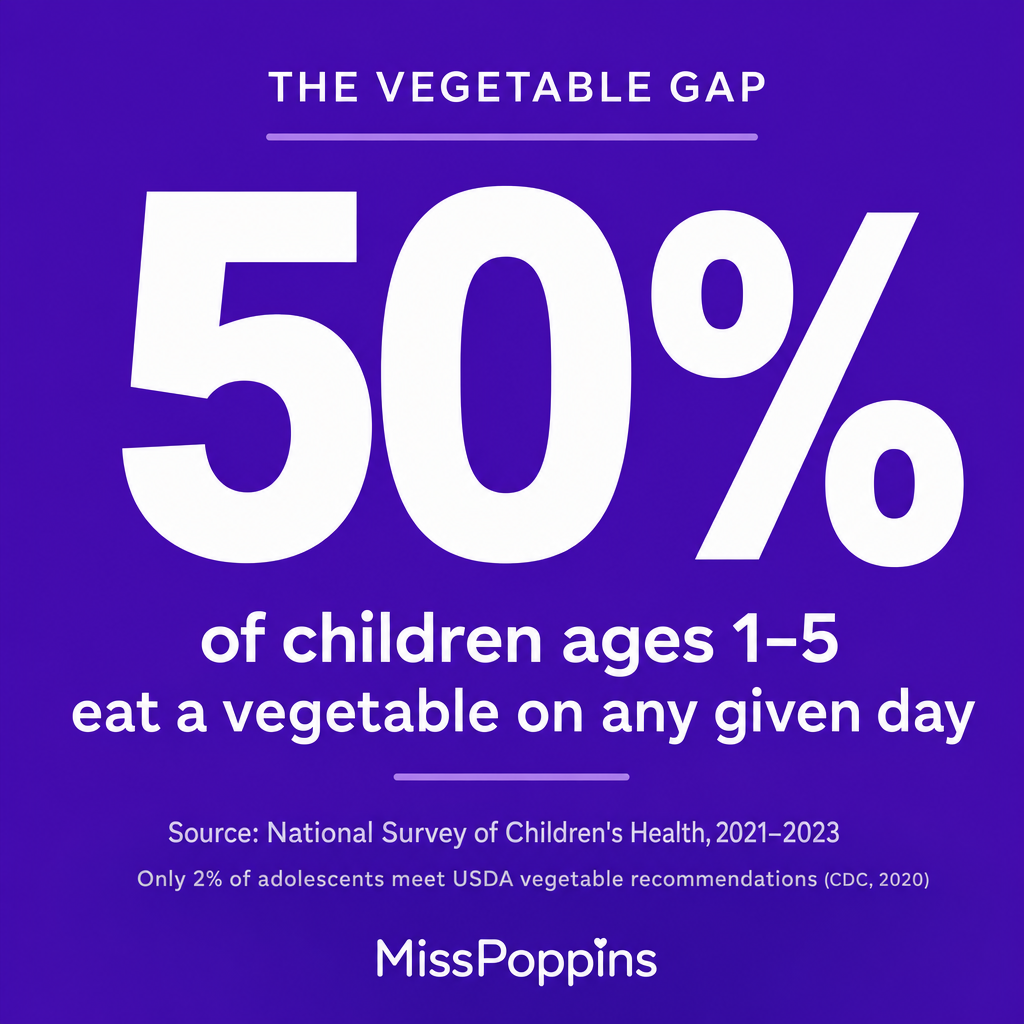
50% of children ages 1 to 5 eat a vegetable on any given day.
Most online advice for how to get kids to eat vegetables recycles the same vague tips: "make it fun," "be patient," "try smoothies." This article takes a different approach. It breaks down the developmental science behind picky eater vegetables battles, maps age-specific strategies to each stage of childhood, and introduces Ellyn Satter's Division of Responsibility, the feeding framework endorsed by the American Academy of Pediatrics. For families who want personalized support, MissPoppins coaches specialize in feeding concerns and are available for same-day consultations.
Why Kids Refuse Vegetables (And Why It Is Not Your Fault)
Before reaching for strategies, it helps to understand why children resist vegetables in the first place. The answer is rooted in biology, sensory processing, and developmental psychology, not in bad parenting.
The Science of Food Neophobia
Food neophobia, the fear of unfamiliar foods, is one of the most studied drivers of vegetable refusal in childhood. Research shows it affects 14 to 44 percent of children aged 4 to 7, with onset commonly beginning around age 2.
This response has evolutionary roots. Young children who instinctively avoided unfamiliar plants, many of which were toxic, had a survival advantage. That ancient wiring still influences how modern children react to an unfamiliar piece of steamed broccoli on their plate.
Food neophobia is not stubbornness or manipulation. It is a biological response that the child does not consciously control. It tends to decrease naturally with age, though some children need more structured support to move past it. Research published in 2024 found that each additional meal containing vegetables per week lowers a child's food neophobia score by 0.8 units, which suggests that consistent, calm exposure has a measurable effect over time.
Vegetables are disproportionately affected because they tend to be bitter, have complex textures, and are often presented in ways that emphasize their "otherness" on the plate.
Sensory Sensitivity and Why Texture Matters
Beyond neophobia, sensory sensitivity plays a major role in vegetable refusal. Vegetables present a wide range of textures, from mushy and stringy to crunchy and slimy, and any of these can be genuinely aversive for a child with heightened sensory processing.
Taste sensitivity compounds the problem. Children have more taste buds per square centimeter than adults, which means bitter compounds in vegetables (such as glucosinolates in broccoli and Brussels sprouts) register as more intense. What tastes mildly bitter to an adult can taste overwhelmingly bitter to a child.
Sensory sensitivity exists on a spectrum. Not every picky eater has a clinical sensory processing disorder, but many children have strong texture or taste preferences that influence which vegetables they will tolerate. The practical takeaway: cooking method matters. Roasting, steaming, and raw preparation each produce different texture and flavor profiles from the same vegetable. A child who rejects steamed carrots may readily eat roasted carrots or raw carrot sticks with dip.
When sensory sensitivity is extreme and significantly limits the child's overall diet, a referral to a feeding specialist or occupational therapist is appropriate. MissPoppins coaches are trained to help parents identify when typical picky eating has crossed into territory that benefits from specialist support.
The Autonomy Piece: Why Pressure Makes It Worse
Children, especially toddlers and preschoolers, are in a developmental stage where autonomy and control are primary motivators. When a parent pressures a child to eat, whether overtly ("eat your broccoli or no dessert") or subtly (hovering, watching anxiously, repeatedly offering), it triggers psychological reactance. The child digs in harder, and food refusal intensifies.
Research by Maimaran and Fishbach, published in the Journal of Consumer Research in 2014, revealed a counterintuitive finding: framing food in terms of health benefits ("this makes you strong") actually reduces children's willingness to eat it. Health-benefit messaging signals to children that the food is instrumental rather than enjoyable, and they eat less of it compared to when the same food is presented simply as "tasty."
The most widely endorsed alternative to pressure-based feeding is Ellyn Satter's Division of Responsibility (sDOR). The framework is straightforward. The parent decides what food is offered, when meals occur, and where eating takes place. The child decides whether to eat and how much. The American Academy of Pediatrics endorses this model, and studies show it leads to more predictable growth and reduced mealtime conflict.
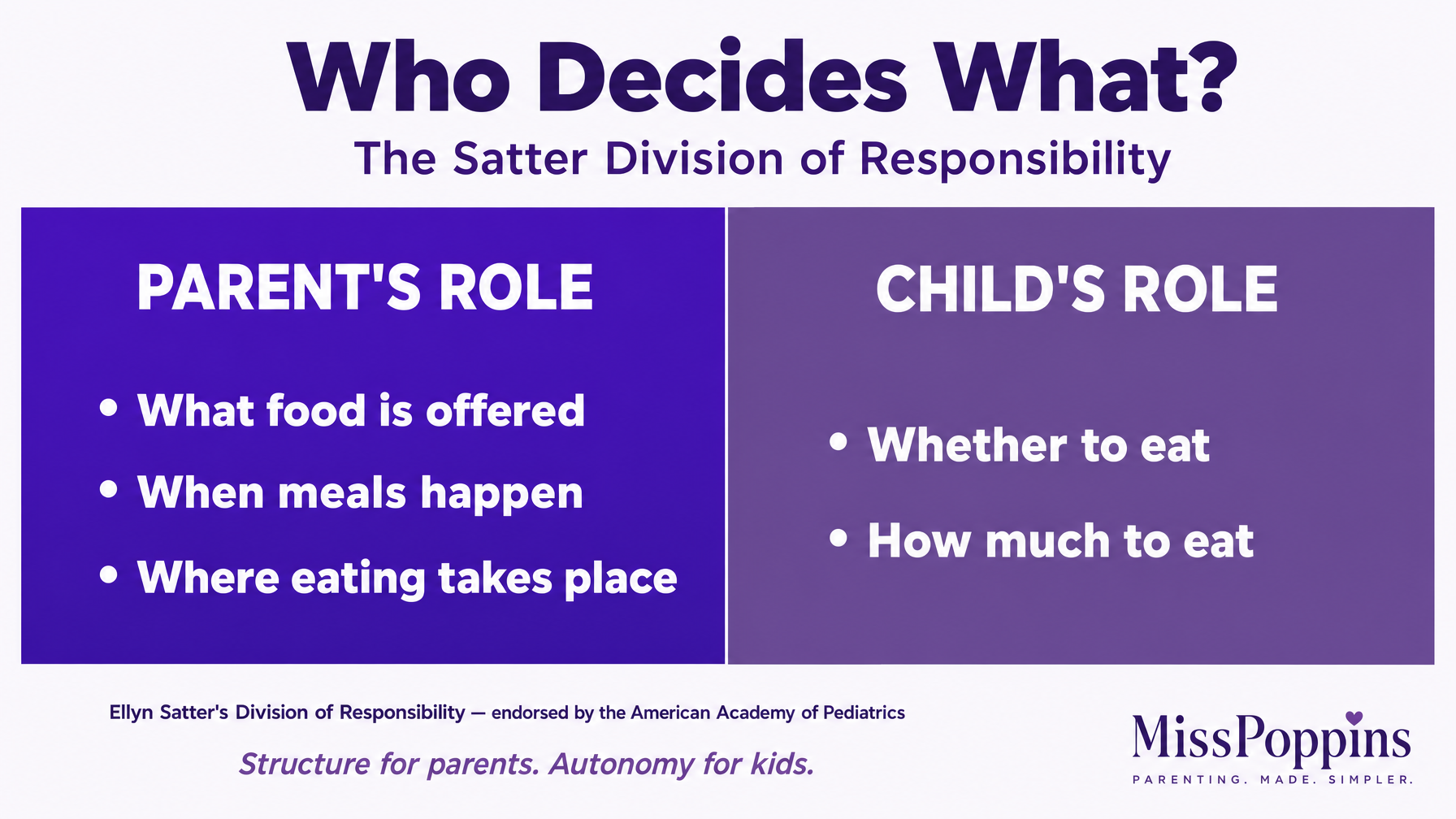
Division of responsibilities among parents and children
Removing pressure does not mean abandoning structure. It means shifting the locus of control strategically so the parent sets the boundaries and the child retains agency within them. This reframe is the core of what MissPoppins coaches help families implement.
Age-By-Age Strategies for Getting Kids to Eat Vegetables
Understanding the "why" behind vegetable refusal is the foundation. The next step is matching strategies to each child's developmental stage, because what works for a toddler is different from what works for a school-age child.
Toddlers (Ages 1 to 3): Building Familiarity Without Pressure
Repeated exposure is the primary lever for toddlers. A 2025 USDA systematic review found moderate evidence that repeated taste exposure increases vegetable acceptance in children aged 2 to 6. Research suggests that 10 to 15 neutral exposures may be needed before a child accepts a new food, and "on the plate" counts as exposure even if the food goes untouched.
Keep portions small. One to two bites of a vegetable is enough for a toddler plate. A full serving of broccoli is overwhelming, not motivating.
Practical strategies for this age:
Involve toddlers in simple food tasks such as washing vegetables, tearing lettuce, or handing items to the parent during cooking. This builds familiarity and a sense of ownership.
Serve vegetables before the rest of the meal when hunger is highest. Some feeding specialists call this the "appetizer method."
Avoid making vegetables a separate event or tying them to rewards and punishments.
Vegetables kids will eat at this stage typically have a sweeter profile and softer texture: cooked sweet potato, cooked peas, corn, and cooked carrots are common starting points.
Preschoolers (Ages 3 to 5): Using Autonomy as a Tool
Preschoolers are driven by a need for control, and parents can channel that developmental drive into vegetable exploration rather than fighting against it.
Offer controlled choices: "Would you like cucumber or carrots tonight?" The child feels autonomy while the parent controls the options. This aligns directly with the Satter Division of Responsibility framework.
"Food bridges" are another effective technique. Start with a vegetable the child already accepts (such as corn) and gradually introduce similar ones (edamame, then green beans) to leverage existing familiarity.
Additional strategies for preschoolers:
Let children participate in grocery shopping and pick one vegetable to try that week.
Serve vegetables in familiar formats. Raw vegetables with dip (hummus or ranch) are often more accepted than cooked at this age because the texture is predictable.
Avoid making the child watch while everyone else eats normally, as exclusion increases anxiety around food.
Vegetables for picky eaters in this age group often include baby carrots with dip, edamame, cherry tomatoes, snap peas, and corn on the cob.
School-Age Children (Ages 6 and Up): Engagement, Education, and Expanding Palates
School-age children can engage with what some experts call "food science" framing: Why does broccoli turn a different shade of green when cooked? What does a Brussels sprout taste like compared to cabbage? Curiosity, rather than obligation, drives exploration at this stage.
Letting school-age children cook a simple vegetable-forward recipe increases consumption because agency in preparation builds investment in the outcome. Peer influence also becomes a real factor at this stage. School lunches, meals at friends' homes, and team sports snacks all shape food exposure in ways parents cannot fully control.
The Satter model still applies. Parents should avoid reverting to pressure as children's schedules and food environments expand. Instead, continue to expand the "safe" vegetable list incrementally: if the child accepts raw carrots, try roasted carrots. If they accept corn, try corn in a stir-fry.
Evidence from a 2025 Fresh Rx study supports this structured approach. In the study, a 16-week produce program increased vegetable consumption from 32.5 percent to 39.5 percent of diet in participating families (Journal of Pediatric Surgery, 2025). The finding confirms that sustained, structured exposure produces meaningful, measurable results.
What Are the Best Vegetables for Picky Eaters?
Not all vegetables are equally difficult. The ones most likely to be accepted by picky eaters share common traits: mild flavor, familiar texture, or a naturally sweet profile. Starting with these entry-point vegetables builds confidence for both parent and child.
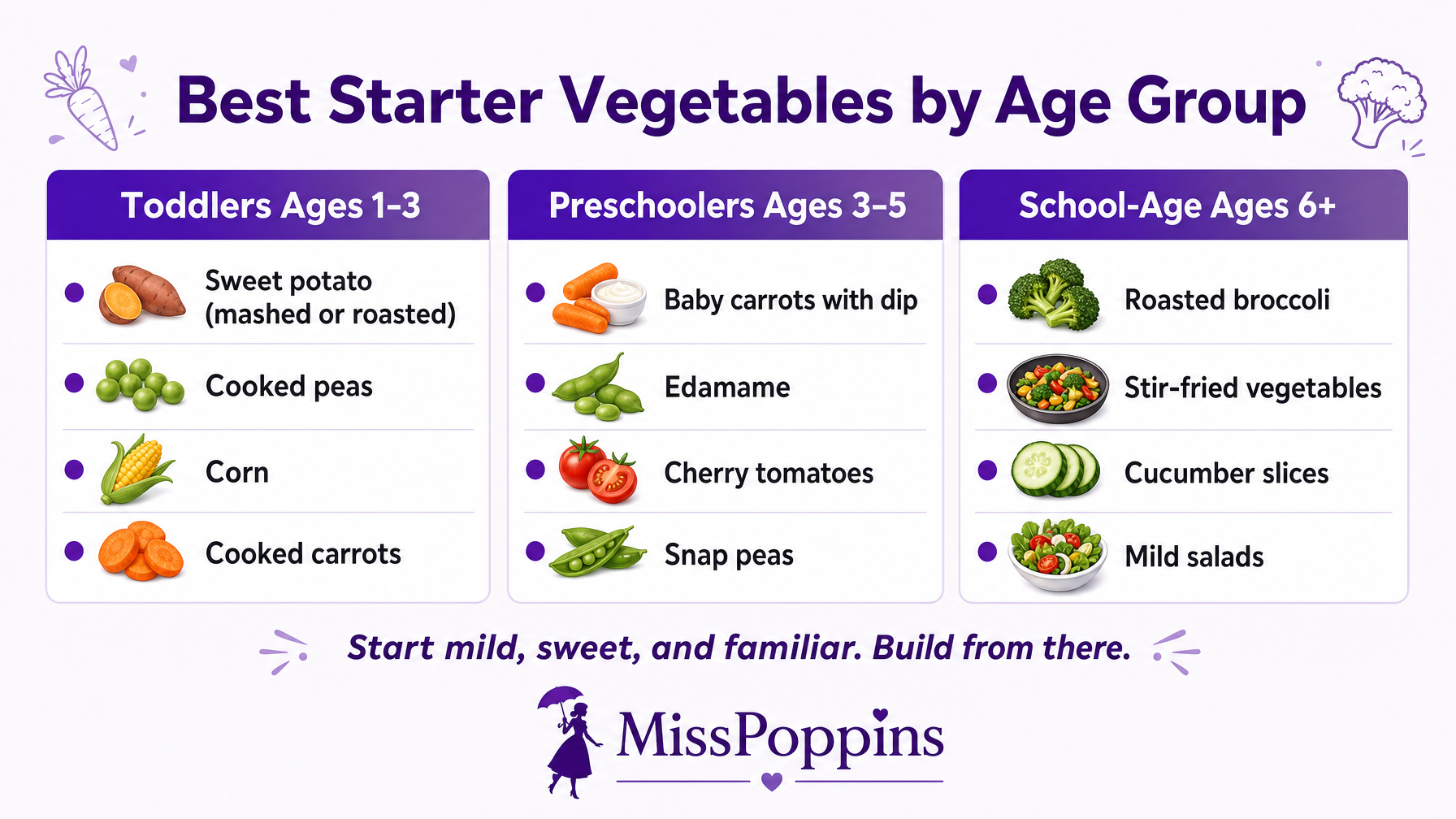
Best starter vegetables by age group
Vegetables most commonly accepted by children:
Sweet potato: Sweet, soft when cooked, and nutrient-dense. Works mashed, roasted, or as fries.
Cooked peas: Sweet, small, and familiar. Easy for young children to pick up and eat independently.
Corn: Sweet, low bitterness, and finger-food friendly. Corn on the cob adds a fun, tactile element.
Baby carrots with dip: Crunchy and predictable. Pairing with hummus or ranch provides a familiar flavor bridge.
Edamame: Mild, fun to eat from the pod, and provides a protein bonus.
Snap peas: Sweet, crunchy, and portable. A reliable option for lunchboxes and snacks.
Cherry tomatoes: Sweet, visually appealing, and bite-sized. Many children accept these before other tomato forms.
Cucumber: Neutral flavor, cool texture, and low intensity. Works as a side with nearly any meal.
How the vegetable is prepared matters as much as which vegetable is chosen. Raw versus cooked presentation can dramatically shift acceptance. A child who refuses steamed broccoli may eat raw broccoli florets with ranch dip. Offering both options over time expands the child's comfort zone without pressure.
Vegetables to introduce later, once a foundation of trust and familiarity is established: broccoli, Brussels sprouts, kale, and asparagus. These tend to be more bitter or have more complex textures that benefit from prior positive vegetable experiences.
MissPoppins coaches help families build a personalized "yes list" as part of feeding support, matching vegetable choices to the child's specific sensory profile and preferences.
Practical Tips and Next Steps
Knowing the science is one thing. Applying it during a Tuesday-night dinner with a tired toddler and a pile of uneaten green beans is another. This checklist focuses on small, concrete steps parents can start this week.
Put one vegetable on the plate at every meal without comment or pressure. Exposure counts even when the food goes untouched.
Offer two vegetable choices and let the child pick one. Controlled choice supports autonomy without giving up structure.
Stop using the word "healthy" when talking about vegetables. Research by Maimaran and Fishbach (2014) found this framing reduces children's willingness to eat.
Try one new preparation method for a vegetable the child already tolerates. Roast instead of steam. Serve raw instead of cooked. Small shifts expand the range.
Involve the child in one food task per week. Washing, stirring, or serving a vegetable builds familiarity and ownership.
Apply the Satter model consistently. Decide what, when, and where. Let the child decide whether and how much.
Track exposures, not consumption. Progress is measured in neutral touchpoints, not bites taken.
If mealtimes are consistently distressing for child or parent, reach out to a MissPoppins coach. Persistent conflict around food is a sign that personalized support could help.
The gap between knowing the right approach and executing it under the pressure of real family life is real. MissPoppins coaches bridge that gap with personalized, one-on-one guidance designed for busy families.
FAQ: Common Questions About Kids and Vegetables
How Many Times Do I Need to Offer a Vegetable Before My Child Accepts It?
Research suggests 10 to 15 neutral exposures before acceptance is common, though some children need more. Placing the vegetable on the plate counts as an exposure even if the child does not eat it, so consistency across meals matters more than any single interaction.
Is It Okay to Hide Vegetables in My Child's Food?
Hiding vegetables (for example, blending spinach into a smoothie) adds nutrients but does not build acceptance of the vegetable in its recognizable form. It can work as a short-term nutritional bridge, but it should not replace direct, repeated exposure, especially with older children who may lose food trust if they discover hidden ingredients.
What Are the Best Vegetables for Picky Eaters?
Sweet, mild, or familiar-texture vegetables are the best entry points. Top options include sweet potato, corn, cooked peas, and baby carrots with dip. See the dedicated section above for a complete list with rationale for each.
Should I Force My Child to Eat Vegetables?
No. Research and clinical guidance, including the AAP-endorsed Satter Division of Responsibility model, consistently advise against forcing. Forced eating increases negative associations with food and can extend picky eating phases rather than shortening them.
What Happens If My Child Does Not Eat Any Vegetables?
Most children with varied diets that include fruit and whole grains are not at immediate nutritional risk from temporarily low vegetable intake. If persistent vegetable refusal limits overall diet variety long-term, a pediatrician can assess whether nutritional gaps exist and recommend next steps.
When Should I Be Concerned About My Child's Vegetable Refusal?
Red flags include consistent gagging or vomiting on textures, a diet restricted to fewer than 20 foods total, or mealtimes that cause significant anxiety for the child or family. At these thresholds, a referral to a feeding specialist, occupational therapist, or MissPoppins coach with feeding expertise is appropriate.
Conclusion
Getting kids to eat vegetables is not about finding the one trick that works. It is about understanding why children resist vegetables in the first place, then applying patient, age-appropriate strategies rooted in developmental science rather than pressure.
The evidence is clear: food neophobia is normal, repeated exposure works, and removing pressure from mealtimes leads to better outcomes for both children and parents. The Satter Division of Responsibility framework gives families a structure for mealtimes that respects the child's autonomy while keeping the parent in the role of provider.
The gap between knowing these principles and implementing them on a Wednesday night with a screaming toddler is real. For families who want personalized, expert guidance through the process, MissPoppins coaches are available for same-day sessions, connecting parents with certified feeding specialists from the comfort of home.