

Newborn Separation Anxiety: Can Babies Have It Early? Age Timeline and Sleep Tips
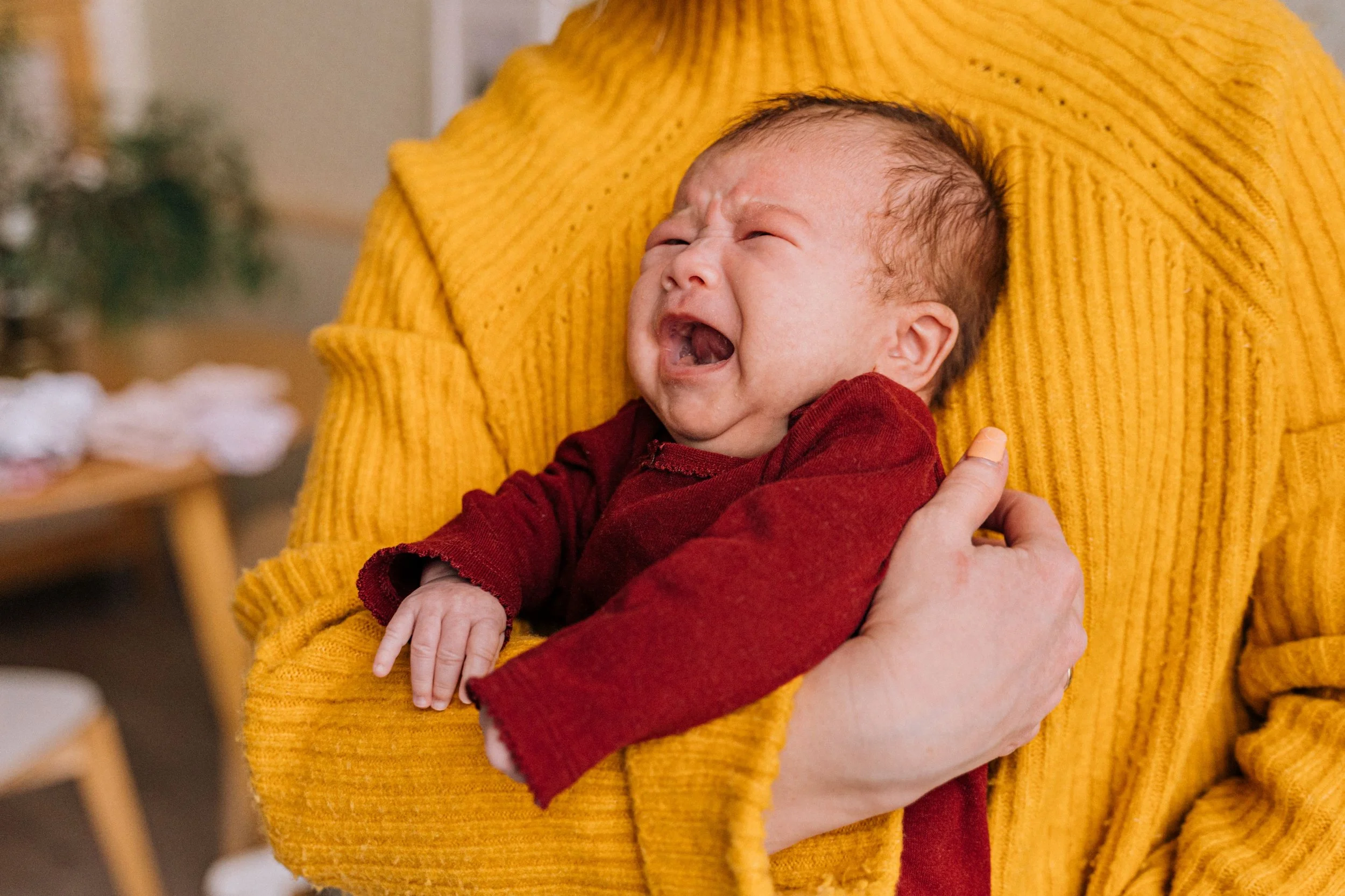
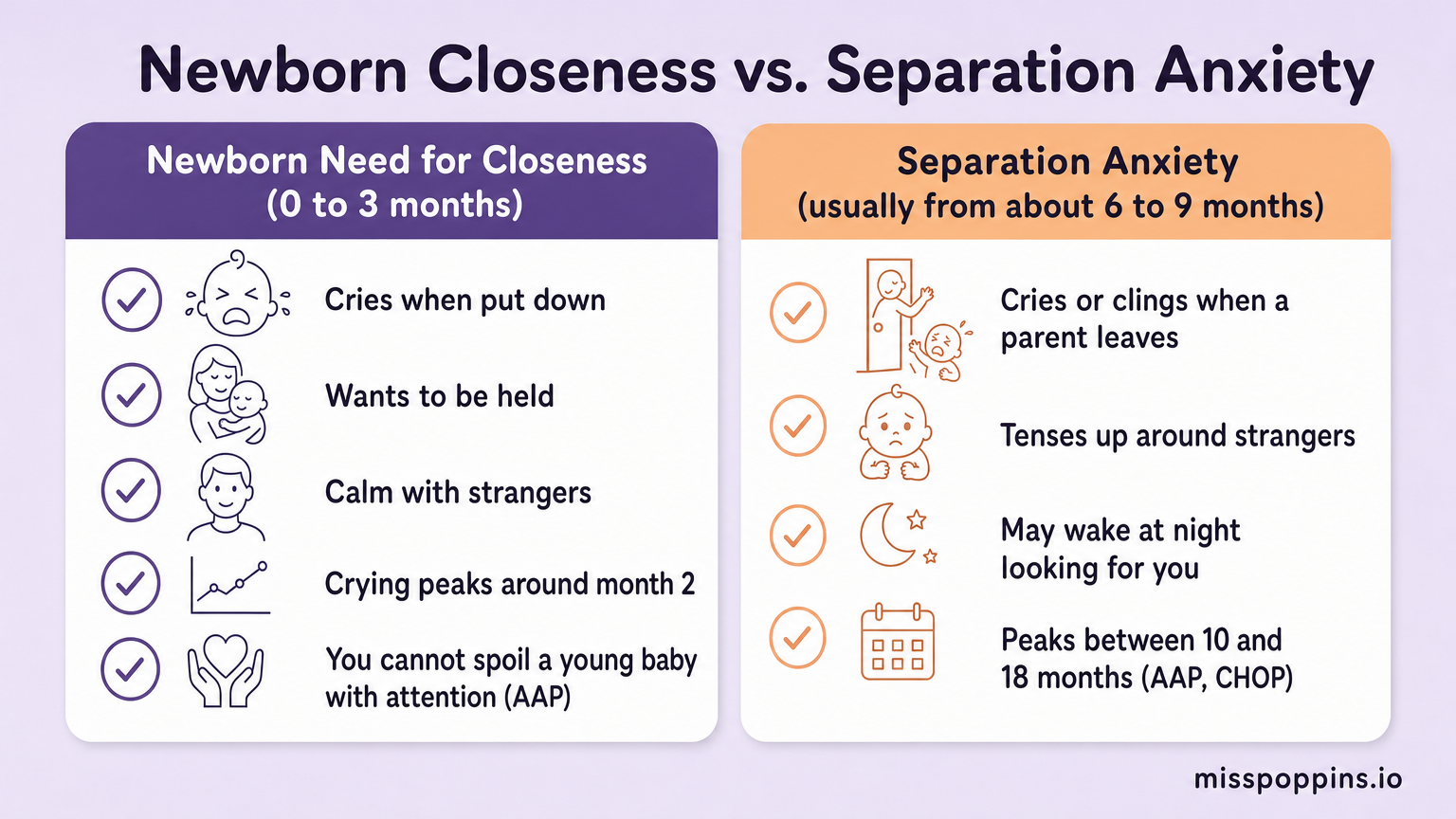
Newborns don't typically show true separation anxiety, which pediatric sources place around 6 to 9 months (early signs at 4 to 5 in some babies). A newborn who cries when put down shows a normal need for closeness, and the AAP says you "cannot spoil a young baby with attention." Separation anxiety usually peaks between 10 and 18 months (AAP and Children's Hospital of Philadelphia) and fades by about age 2 to 3.
Key Takeaways
What looks like newborn separation anxiety is usually a normal need for closeness.
True separation anxiety typically begins around 6 to 9 months and peaks between 10 and 18 months (AAP, CHOP).
Responding quickly to a young baby's cries does not create bad habits, according to the AAP.
Safe sleep rules (back, bare, and their own sleep space in your room) apply at every stage of separation anxiety.
Parents feel separation anxiety too, and support is available.
It's 2 a.m., and your baby has finally fallen asleep on your chest. The second they touch the bassinet, they wake up crying. Many parents in this moment search for "newborn separation anxiety" and wonder if something is wrong.
If your newborn won't sleep unless held, you're far from alone. Yet most search results jump straight to 9-month-olds and toddlers. This guide starts at birth.
You'll learn what's happening in the first 3 months and when separation anxiety typically starts and peaks. You'll also get sleep tips for each age and see which signs are worth discussing with your pediatrician. Finally, you'll find ways to handle your own feelings about being apart.
Can Newborns Have Separation Anxiety?
The evidence suggests not, at least not in the way older babies experience it.
What Pediatric Sources Say About Onset Age
No major pediatric body states outright that newborns can't have separation anxiety. Instead, the answer comes from the ages trusted sources give for when it typically starts.
According to the American Academy of Pediatrics (AAP), some babies show object permanence and separation anxiety "as early as 4 to 5 months of age." Most develop "more robust separation anxiety at around 9 months."
Cleveland Clinic says it typically begins at 6 to 12 months. The Canadian Paediatric Society (CPS) points to about 8 to 9 months.
The AAP also describes a baby who, "at the age of three months, interacted calmly with people she didn't know." Taken together, these onset ages point to true separation anxiety emerging after the newborn period. Sources vary, though, and every baby develops on their own timeline.
What Looks Like Separation Anxiety in the First 3 Months
Newborns are wired to seek closeness. A research review on fetal voice responses, citing DeCasper and Spence (1986), notes that neonates "show preference for their mother's voice just hours after birth."
Crying is part of the package, too. According to the AAP, "newborns routinely cry 1 to 4 hours a day." The Period of PURPLE Crying program says crying commonly peaks in month 2 and eases by months 3 to 5.
Many parents call this stretch the "fourth trimester," an informal way to describe how much a new baby wants to be held. It's also why so many families end up contact napping (see the sleep safety tips below).
Attachment theory offers one more lens. In John Bowlby's theory, as described in Simply Psychology's summary of attachment research, babies from birth to about 6 weeks are in a "pre-attachment" phase. From about 6 weeks to about 7 months, they prefer familiar people but "don't yet protest when separated from a parent."
Are You Spoiling Your Baby by Holding Them?
Many parents worry that holding a baby too much will create a habit. The AAP is direct: "You cannot spoil a young baby with attention, and if you answer their calls for help, they'll cry less overall." It recommends responding "promptly during their first few months."
Holding, rocking, and babywearing during awake time are all valid choices. So is setting your baby down safely while you take a breather.
What works depends on your baby, your energy, and your household. Newborn care specialists on MissPoppins help parents build realistic routines around this phase.
Separation Anxiety Age Timeline: Month by Month
Sources vary slightly, and every baby develops on their own schedule.
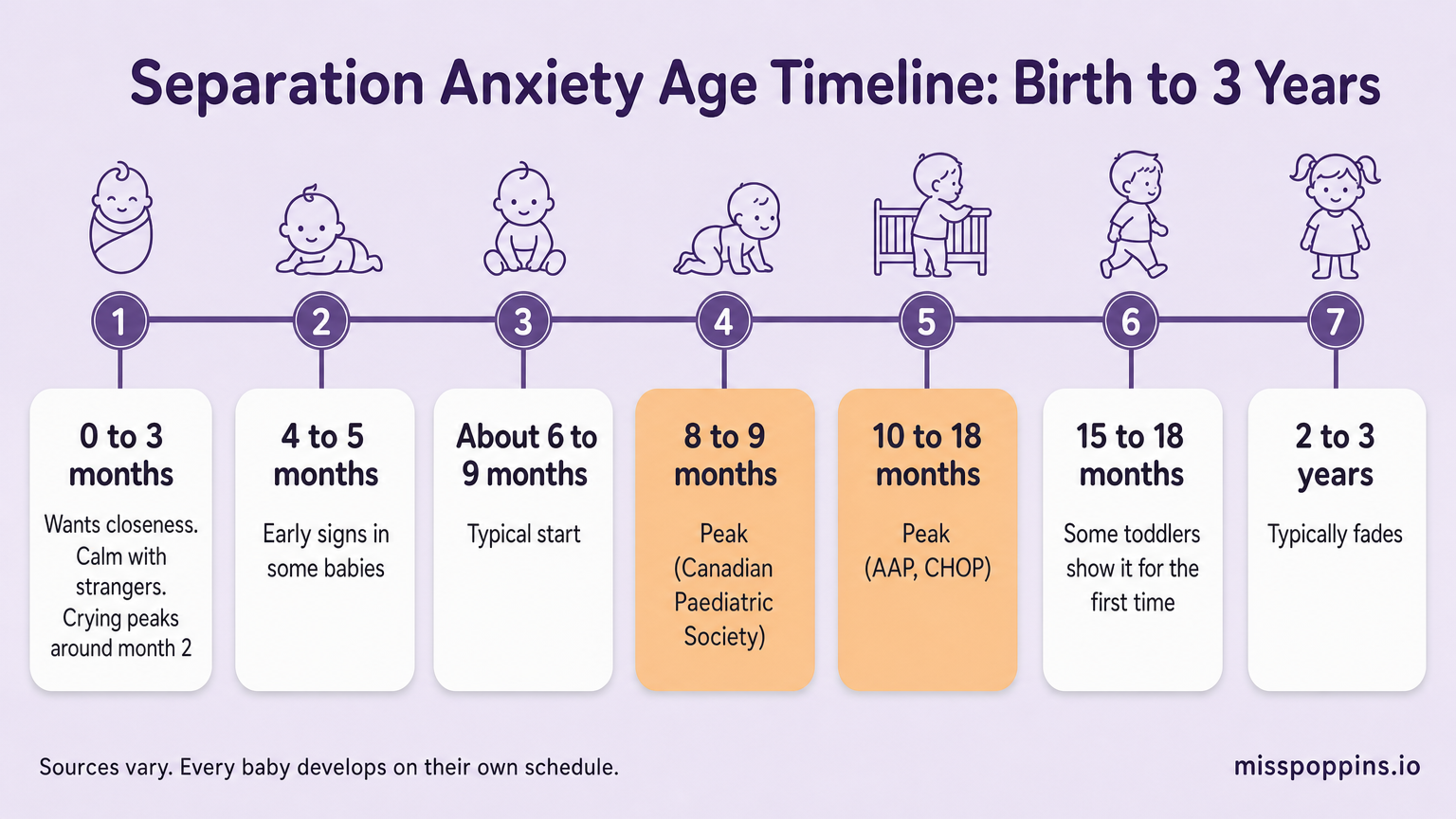
Canadian readers may notice a difference. The CPS says separation anxiety "usually peaks around 8 or 9 months," while the AAP and CHOP place the peak between 10 and 18 months. If you've searched for "6 month separation anxiety" or "9 month separation anxiety," you're looking at the typical onset window.
Why does it start? One commonly cited explanation is that babies are learning that people exist when out of sight, but have little sense of time. CHOP notes that young babies "do not understand time," so a short absence can feel open-ended.
That explanation is a simplification. Jean Piaget tied object permanence to around 8 to 9 months, when babies begin actively searching for hidden objects. Later lab studies by Renée Baillargeon found that infants as young as 3.5 months looked longer when a hidden object seemed to vanish, which researchers read as early awareness (Baillargeon and DeVos, 1991, Child Development).
Knowing a hidden toy still exists also differs from missing a person.
Separation anxiety also isn't the same as stranger anxiety, according to Cleveland Clinic. One is distress when a trusted caregiver leaves; the other is wariness around unfamiliar people.
Signs of Separation Anxiety in Babies
Once true separation anxiety begins, the signs tend to be easy to spot. CHOP and the AAP describe these common behaviors:
Crying or clinging when a parent leaves the room (CHOP).
Waking and crying at night after previously sleeping longer stretches (CHOP).
Refusing to sleep without a parent nearby (CHOP).
Tensing up or crying around unfamiliar people, a sign of stranger wariness (AAP).
Calming down within minutes of a parent's departure, in most cases (AAP).
Not every baby shows every sign, and intensity can vary from day to day. These behaviors describe a normal developmental stage.
The Canadian Paediatric Society notes that strangers "may cause your baby distress on and off throughout their first 2 years."
Newborn and Baby Sleep Tips by Age
Safe sleep rules stay the same at every age. The AAP's 2022 safe sleep policy recommends back to sleep for every sleep, a firm, flat surface, a fitted sheet only, and no soft objects. It also recommends room sharing without bed sharing for at least the first 6 months.
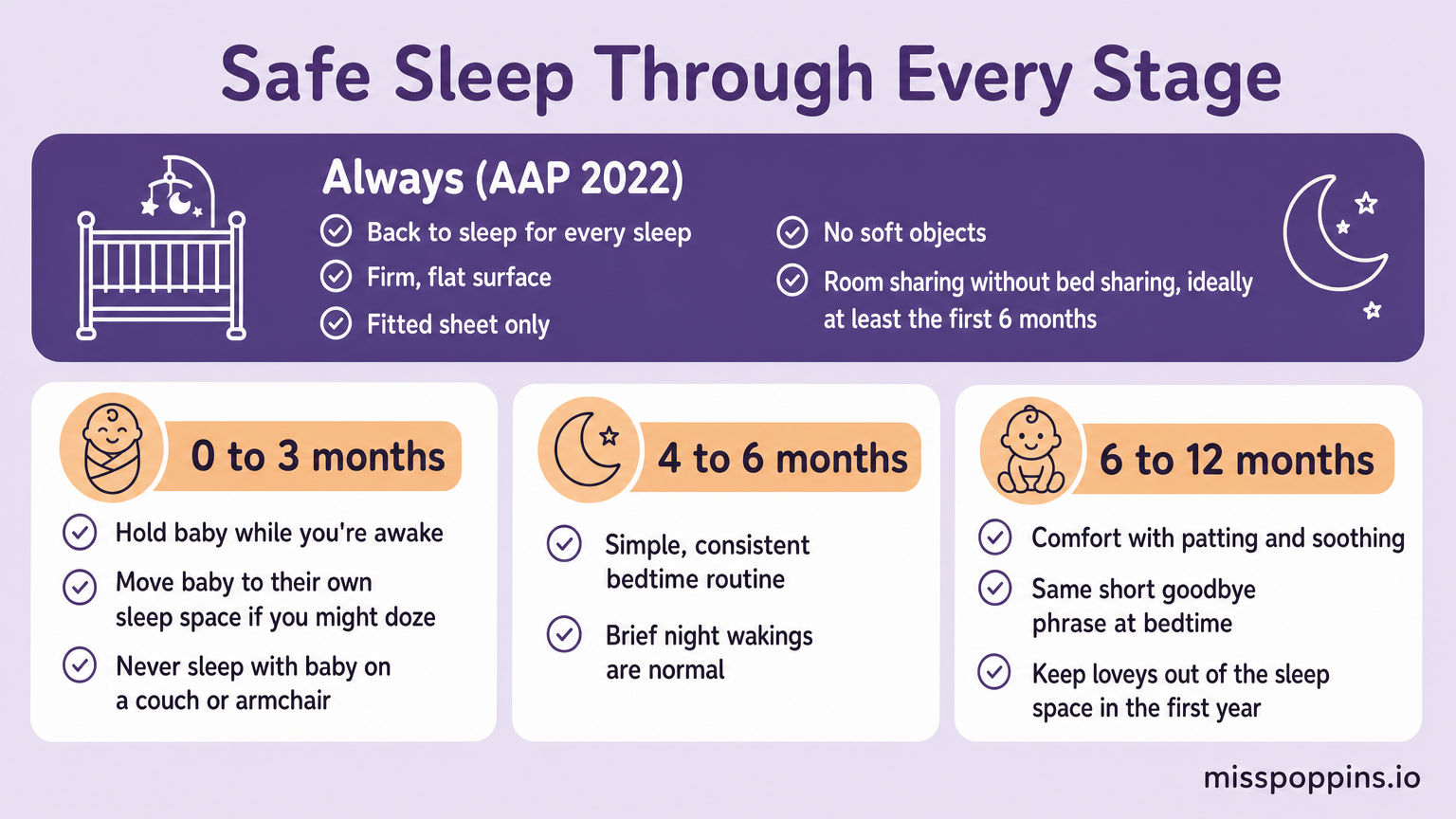
Night waking is normal, too: according to the AAP, "babies do not have regular sleep cycles until about 6 months of age."
0 to 3 Months: When Your Newborn Won't Sleep Unless Held
Holding your baby while you're awake is fine. Johns Hopkins Medicine puts it simply: "When your baby is awake, hold your baby," and "Don't fall asleep with your baby." If you feel yourself starting to doze, move your baby to their own sleep space first.
Couches and armchairs carry the highest risk. According to the AAP, the risk is "up to 67 times higher" when infants sleep with someone on a couch, soft armchair, or cushion. Never fall asleep with your baby on a sofa, even for a moment.
Babies often drift off in a car seat, swing, or carrier. The AAP says to move them to a firm sleep surface on their back as soon as possible. Johns Hopkins adds that these devices "are not advised for routine sleep."
Finally, expect short stretches. The AAP notes that newborns sleep about 16 to 17 hours a day but "may only sleep 1 or 2 hours at a time." Frequent waking at this age is normal.
4 to 6 Months: Building Predictable Bedtimes
Between 4 and 6 months, many families start a simple, consistent bedtime routine. A bath, a feed, a song, and the same short phrase each night can all be part of it.
Night waking still happens. The AAP says "it is normal for a 6-month-old to wake up during the night but go back to sleep after a few minutes." Cleveland Clinic notes that many babies sleep 5 to 6 hour stretches by about 6 months, though some still wake "as often as six times."
Keep soft objects, including blankets and stuffed toys, out of the sleep space for the full first year. The AAP states that its safe sleep recommendations are for babies up to 1 year of age.
6 to 12 Months: Separation Anxiety at Bedtime and Night Wakings
This is when separation anxiety at bedtime often shows up. AAP guidance notes that a baby this age "may wake up searching for you in the middle of the night." Parents often search for this as a "separation anxiety sleep regression," which is informal language.
CHOP recommends that you "comfort and reassure your child by patting and soothing." Using the same short goodbye phrase at bedtime that you use during the day can make bedtime feel familiar.
Comfort objects come up a lot here. According to the AAP, babies often choose one "between months eight and twelve," and these objects "are not a sign of weakness or insecurity." Still, keep soft objects out of the sleep space in the first year, and ask your pediatrician about timing after that.
Want help building a plan? MissPoppins certified sleep coaches work with families on approaches that fit their values, whether gentle, responsive, or more structured.
How to Ease Separation Anxiety During the Day
Pediatricians recommend a few simple habits for daytime separations. These come from AAP and CHOP guidance rather than clinical trials, and they're easy to try at home, at day care, or with a sitter.
Keep goodbyes "short and sweet," as the AAP puts it, because "if you linger, the transition time does too." A quick ritual you repeat every time, like a hug and the same phrase, gives your baby a predictable pattern.
Keep your promise to return, even after a hard goodbye. The AAP suggests using time cues your baby can learn, such as "after nap time," instead of clock times.
Practice being apart at home. AAP guidance suggests that when your baby crawls to another room, you "wait for one or two minutes" before following. CHOP adds that you can tell your baby you're going to another room "and that you will be back; then come back."
Timing matters, too. CHOP recommends planning separations for when your baby is rested and fed, and introducing new caregivers gradually. A sitter who visits a few times while you're home is a gentle way to start.
Finally, once you've said goodbye, try to leave rather than coming back for one more hug. AAP pediatrician Wendy Sue Swanson, MD, shares that returning to visit her son an hour after a hard drop-off "extended the separation anxiety." It's one parent's experience, but it fits the AAP's advice on short goodbyes.
When Is Separation Anxiety a Concern?
Normal separation anxiety is a healthy sign. Dr. Swanson calls it "an entirely normal behavior and a beautiful sign of a meaningful attachment."
Separation anxiety disorder is different, and only a clinician can diagnose it. Under the DSM-5-TR criteria, as summarized by StatPearls (NCBI Bookshelf), the fear must be "developmentally inappropriate and excessive." It must also last at least 4 weeks in children and cause significant distress or impairment.
StatPearls cites about 4% prevalence in population-based studies, but that figure comes from school-age children. The average onset age is about 6 years.
Cleveland Clinic suggests reaching out to your pediatrician if a child over age 3 has significant distress over separations. The AAP adds that it's rare for separation anxiety to persist daily after the preschool years.
Newborns are a separate case, since the guidance above applies to older children. For a newborn who cries a lot or seems unwell, call your pediatrician if you're worried. You know your baby, and checking in is always reasonable.
MissPoppins coaching is not therapy. Clinical concerns belong with your pediatrician or a licensed provider.
What About the Parent's Separation Anxiety?
Cleveland Clinic says a baby's separation anxiety is "not your fault." Parents "shouldn't feel guilty about leaving to go to work or even just taking a shower."
Researchers have studied parents' own separation anxiety for decades. In 1989, Ellen Hock and colleagues developed a scale to measure maternal separation anxiety, and later research describes moderate levels as normal, especially in the first 6 months after birth.
One small study of 40 employed mothers (Pitzer and Hock, 1989, Research in Nursing & Health) found they felt less guilt and anxiety about separating from their second-borns at 7 months than they had with their first-borns. These studies focused on mothers, but partners, dads, adoptive parents, and other caregivers can feel this too.
Postpartum anxiety in mothers and birthing parents is also common, though estimates vary widely depending on how it's measured.
If your worry feels constant or overwhelming, talk with your health care provider. You can also call the Postpartum Support International (PSI) HelpLine at 1-800-944-4773 (English and Spanish). It offers information, support, and referrals, and it is not a crisis line.
In an emergency, call 911 or your local emergency number. For a mental health crisis, call or text 988 to reach the Suicide & Crisis Lifeline.
MissPoppins perinatal specialists and family life coaches offer forward-focused, non-clinical support for this transition. Coaching can complement therapy, but it doesn't replace it.
Practical Next Steps for Parents
Here's a short checklist to use this week, whatever your baby's age:
Note your baby's age and match it to the timeline above.
Respond to cries freely in the first 3 months, and hold your baby while you're awake.
Keep the sleep space bare, flat, and in your room.
Start a 10-second goodbye ritual you use every time, day or night.
Practice brief separations, such as stepping into the next room while your baby is in a safe space.
Check in on your own feelings, and reach out for support if you need it.
Revisit this list as your baby grows, and adjust as needed. What works at 2 months will likely change by 9 months, and that's expected.
Support for Every Stage of Separation Anxiety, For Both You and Your Baby
Most of what parents call newborn separation anxiety is a normal fourth-trimester need for closeness, while true developmental separation anxiety arrives later, peaks, and passes. Your baby’s feelings are normal, and so are yours.
Whether you are navigating newborn bassinet refusal or the 9-month clingy phase, you deserve real human guidance, not a generic chatbot. MissPoppins connects you 1:1 over private, encrypted video with vetted, certified specialists who have supported 5,000+ families (holding a 4.8 out of 5 rating on the US App Store):
Need hands-on strategies for fourth-trimester contact sleep, safe bassinet transfers, or gentle soothing routines? Explore Postpartum & Newborn Coaches to build a custom plan for your baby.
Feeling sleep-deprived, overstimulated, or "touched out" from holding a baby who won't be put down? Explore Maternal Wellness Coaches for dedicated emotional and postpartum lifestyle support.
Need middle-of-the-night backup? Download the MissPoppins App for instant access to certified coaches, personalized milestone tracking, and your free introductory call, right from your phone while you contact-nap.
FAQs
Can Newborns Have Separation Anxiety?
Newborns can be distressed when set down, but pediatric sources describe true separation anxiety as a later milestone tied to attachment to specific people. In the early weeks, crying when set down reflects a need for closeness rather than fear of a parent leaving.
At What Age Does Separation Anxiety Peak?
US sources place the peak between 10 and 18 months, so many families find the toughest stretch lands around the first birthday. Canadian guidance places it earlier, around 8 or 9 months.
How Do I Stop My Baby's Separation Anxiety at Night?
Since it's a normal stage, the goal is calmer nights rather than stopping it, using a predictable routine and brief, reassuring check-ins. If nights stay hard for weeks, a certified sleep coach can help you build a plan that fits your family.
Is It Separation Anxiety or Stranger Anxiety?
Watch what triggers the tears: crying when you leave points to separation anxiety. Crying when a new person approaches, even with you there, points to stranger anxiety.
Why Won't My Newborn Sleep Unless Held?
Your newborn is still "adjusting to this strange new life outside the womb," as the AAP puts it. The AAP also notes that you cannot spoil a young baby with attention, so holding them is a fine response.