

When Will an Infant Sleep Through the Night? The 3- to 6-Month Timeline
In one study, about half of babies slept midnight to 5am by about 3 months, and 10pm to 6am by about 5 months (Henderson et al., 2010, Pediatrics). Mayo Clinic (2026) notes that by 3 to 4 months, many babies sleep at least five hours at a time. Wide variation is normal, and brief night waking continues through the first year.
Key Takeaways
In research, "sleeping through the night" usually means a 5- to 8-hour stretch, not 12 hours.
In one study, about half of babies slept midnight to 5am by 3 months, and the rest were still normal.
The biggest jump in sleep length happens between 1 and 4 months (Henderson et al., 2010, Pediatrics).
In a 388-baby study, not sleeping through at 6 or 12 months was not linked to development or maternal mood.
Safe sleep comes first at every age: on the back, on a firm flat surface, in the baby's own space in the parents' room.
It's 3am, the baby is feeding again, and a friend's text is still on your mind: "Ours sleeps 12 hours now!" If you've typed "when will an infant sleep through the night" into a search bar at this hour, you are in very good company.
The honest answer depends on what "through the night" means, and researchers rarely agree. A baby who seems "behind" may simply be measured against a different yardstick.
This guide explains the definitions, walks through the first six months, and covers what helps and when to get support.
What Does "Sleeping Through the Night" Mean for a Baby?
For babies, "sleeping through the night" rarely means 12 unbroken hours. Researchers choose a specific definition, and results change with it.
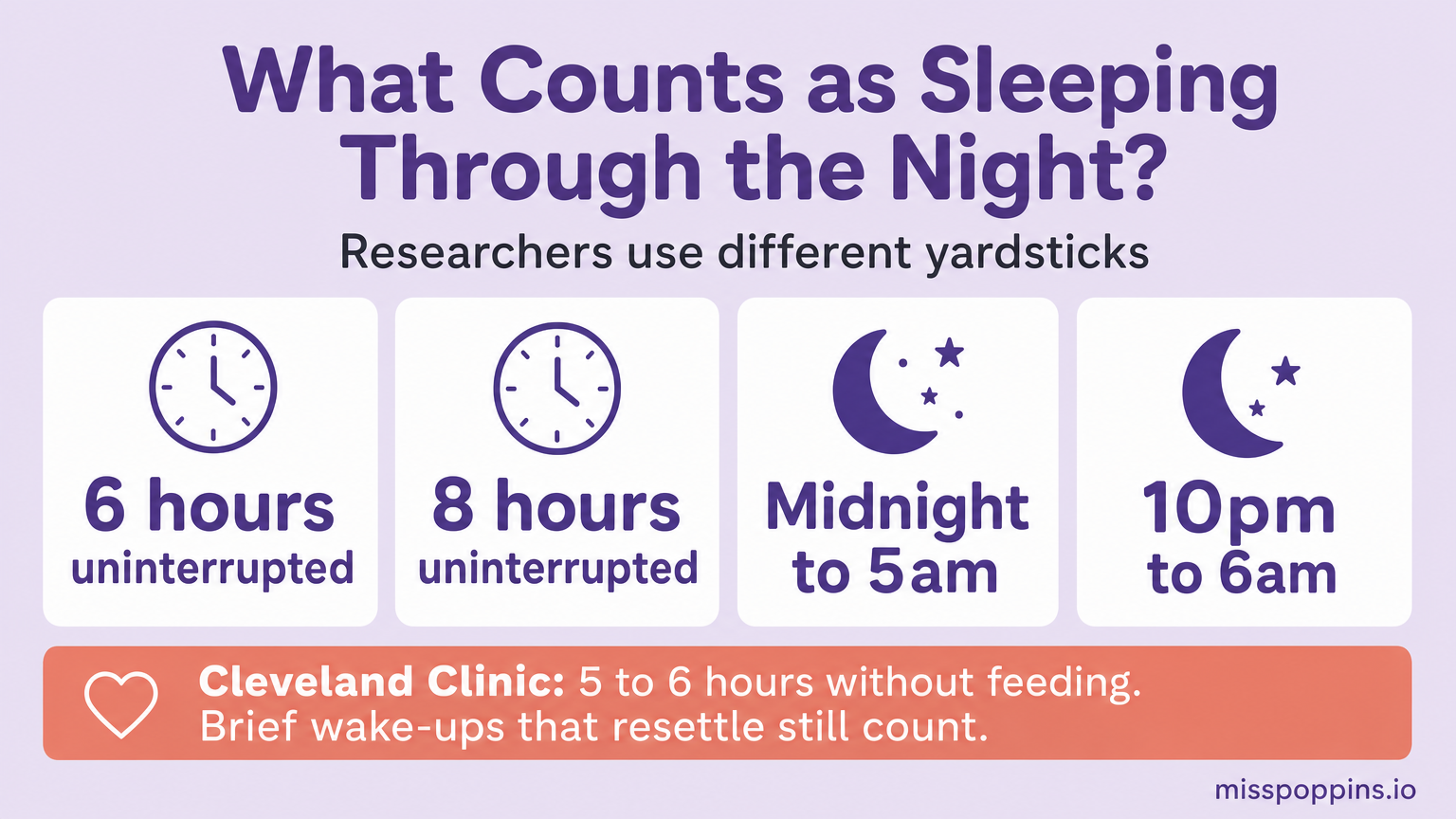
Common research definitions include:
Six hours of uninterrupted sleep (Pennestri et al., 2018, Pediatrics)
Eight hours of uninterrupted sleep (Henderson et al., 2010; Pennestri et al., 2018)
A midnight-to-5am window (Henderson et al., 2010, Pediatrics)
A 10pm-to-6am window (Henderson et al., 2010, Pediatrics)
Cleveland Clinic uses a more modest yardstick: five to six hours at a stretch without feeding. It also notes that waking once or twice a night is natural, and some babies wake as often as six times.
A baby who stirs, fusses for a moment, and resettles without a feed may still meet these definitions.
Babies wake often partly because their sleep structure is still developing. Cleveland Clinic notes that sleep cycles begin to mature around 4 months, so wake-ups between cycles in the early months are expected.
When Do Babies Sleep Through the Night? A Month-by-Month Timeline
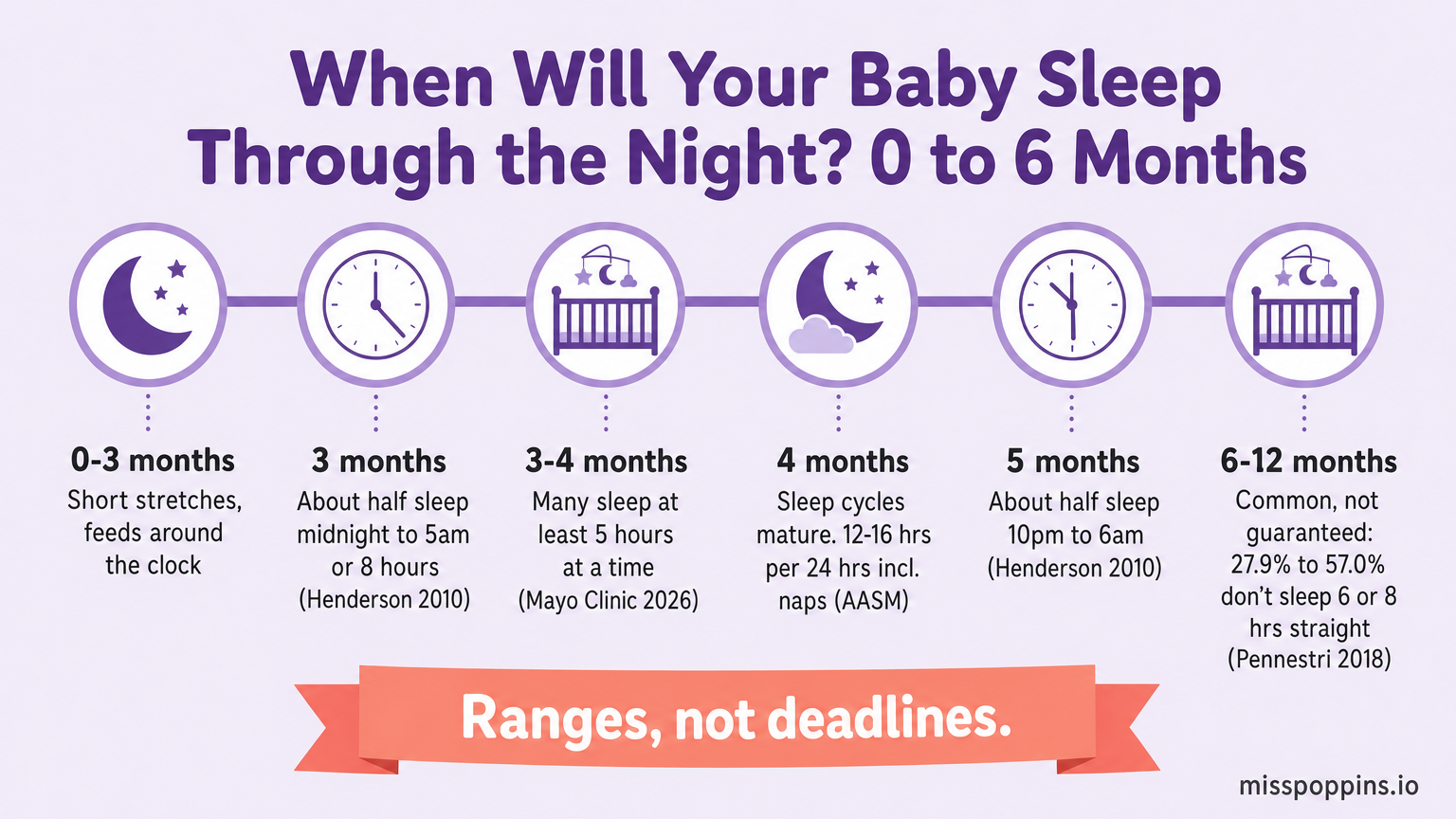
Treat these ages as study-based ranges, not deadlines.
0 to 3 Months: Short Stretches Are the Norm
Newborns feed around the clock, and their sleep comes in short pieces. The American Academy of Sleep Medicine (AASM) sets no sleep-duration recommendation for babies under 4 months. Its consensus panel cited the wide range of normal variation (Paruthi et al., 2016, Journal of Clinical Sleep Medicine).
This is also the period of fastest change. In Henderson's study of 75 New Zealand infants, the largest gain in self-regulated sleep length came between 1 and 4 months, averaging 504 minutes.
3 Months: The First Long Stretch for Many Babies
In Henderson et al. (2010), babies had a 50% probability of sleeping midnight to 5am, or 8 hours, by 3 months. Mayo Clinic (January 2026) adds that by 3 to 4 months, many babies sleep at least five hours at a time.
That also means about half the babies had not reached those stretches at 3 months. They were not behind, and most met those criteria later in the first year.
4 Months: Sleep Grows Up (and Can Feel Worse)
Many parents notice more waking around 4 months, often called the "4-month regression." The Sleep Foundation links it to neurological development toward more mature sleep stages. That makes this phase a sign of maturation.
Cleveland Clinic agrees that sleep cycles begin to mature and the circadian rhythm starts to take effect around this age. From 4 months, the AASM recommends 12 to 16 hours of sleep per 24 hours, including naps. If disruption continues or worries you, it is worth discussing with your pediatrician.
Our sleep regression guide covers this phase.
5 Months: Longer Windows Become Possible
Henderson et al. (2010) found a 50% probability of sleeping from 10pm to 6am at 5 months. In the same study, this clock window took about two months longer to reach than the 3-month milestones.
Night feeds are still common at this age. Whether and when to change night feeds is a conversation for your pediatrician. Our guide to when babies stop feeding at night explores that topic separately.
6 Months and Beyond: Common, Not Guaranteed
In a Montreal cohort of 388 infants, 27.9% to 57.0% did not sleep 6 or 8 hours straight at 6 and 12 months (Pennestri et al., 2018). The share depended on the definition and age. The researchers found no link between sleeping through and development or maternal mood.
Night waking itself stays normal. In a video study of 80 infants, most woke at every age observed: 3, 6, 9, and 12 months. Even at 12 months, half typically needed a parent's help to resettle (Goodlin-Jones et al., 2001, Journal of Developmental and Behavioral Pediatrics).
What Affects When Your Baby Sleeps Longer Stretches?
Age is only one factor, and some popular beliefs don't hold up.
Feeding: Breastfed, Formula-Fed, and the Solids Myth
Many parents hear that formula-fed babies sleep longer. A UK survey of 715 mothers of 6- to 12-month-olds found no feeding-method difference in night wakings (Brown & Harries, 2015, Breastfeeding Medicine). In that survey, 78.6% of babies still woke at least once a night.
Pennestri et al. (2018) found sleeping through was associated with lower breastfeeding rates, though association does not show cause. In France's ELFE cohort, a link between longer breastfeeding and poorer sleep at age 1 was largely explained by parents' sleep practices.
The evidence is mixed, and every feeding choice is a valid one. In the EAT trial of 1,303 infants, introducing solids early was associated with about 16.6 minutes more sleep per night at 6 months (Perkin et al., 2018, JAMA Pediatrics), or about 7 minutes on average across the study period. A related commentary cautions clinicians against recommending early solids to improve sleep, so feeding decisions belong with your pediatrician.
Myth check: you may have heard babies sleep through once they reach 12 to 13 pounds. We found no study supporting a weight-based readiness rule, so treat it as a myth.
Sleep Associations and Self-Settling
A baby who falls asleep while feeding or being rocked may look for that same help between sleep cycles. Feeding or rocking to sleep is a loving choice; this simply explains some night calls.
Practicing "drowsy but awake" gives babies chances to finish falling asleep on their own. An AASM review found behavioral methods effective for night wakings, including positive bedtime routines and preventive parent education (Mindell et al., 2006, Sleep). Our road to independent sleep guide shows what this looks like.
Temperament and Daytime Rhythm
In parent-logged app data, 3- to 7-month-olds averaged a night session of about 10.5 hours (Mindell et al., 2016, Journal of Sleep Research). Individual variation was wide.
How to Encourage Longer Night Sleep From 3 to 6 Months
No routine guarantees a date, but these steps support longer stretches:
Keep a consistent bedtime routine in the same order each night.
Keep night interactions dim, quiet, and brief so nighttime feels different from daytime.
Practice putting your baby down drowsy but awake for some sleeps, without pressure.
Spend time in daylight and active play during the day.
Offer naps when early sleepy cues appear, before your baby becomes overtired.
Use a safe sleep space for every sleep, including naps.
The AAP suggests keeping nighttime feeds and changes calm and quiet, and saving playtime for the day.
Safe Sleep at Every Age
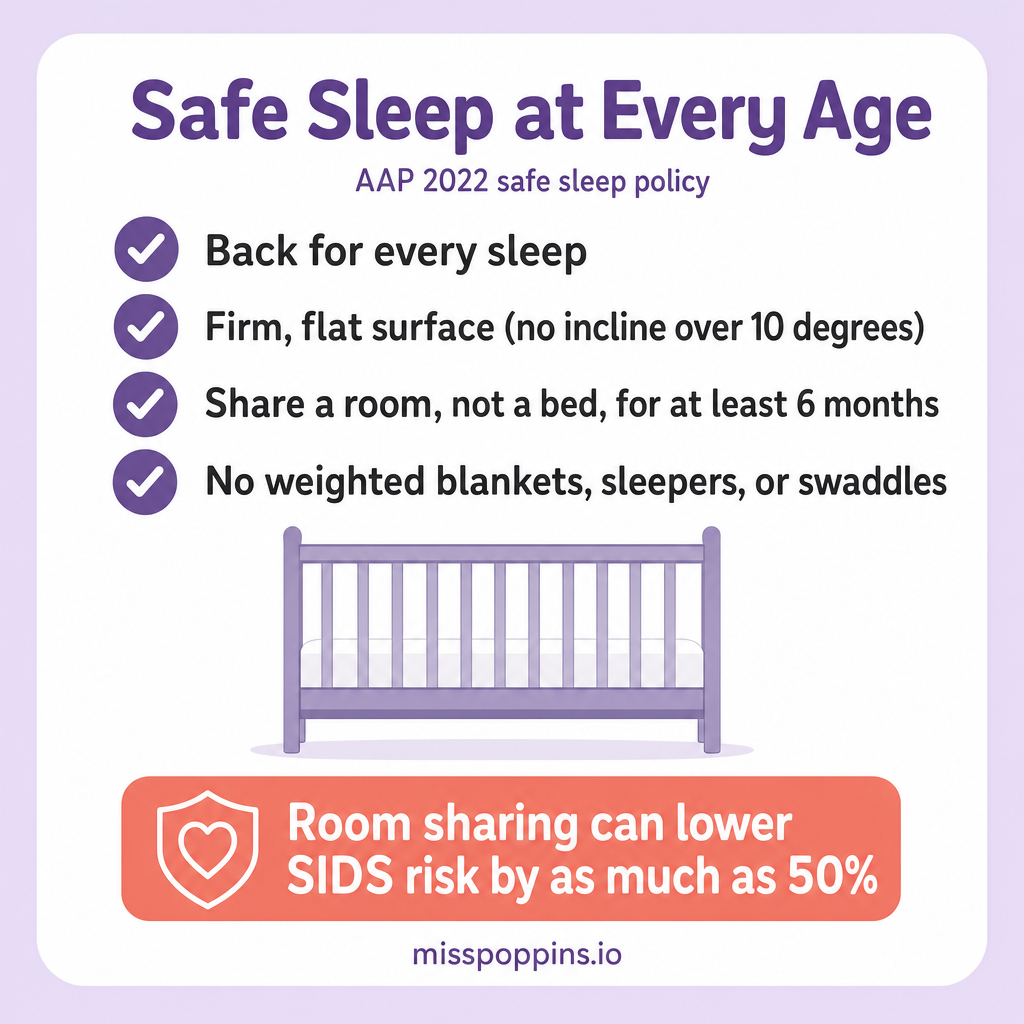
The American Academy of Pediatrics (AAP) safe sleep policy (2022) recommends that parents:
Place your baby on their back for every nap and every night.
Use a firm, flat surface, since any incline over 10 degrees is unsafe.
Share a room, not a bed, for at least the first 6 months; room sharing can lower SIDS risk by as much as 50%.
Avoid weighted blankets, weighted sleepers, and weighted swaddles.
The Canadian Paediatric Society aligns for Canadian families. For the first 6 months, it names the safest place as on the back in a crib, cradle, or bassinet in the parents' room. These steps matter: the CDC reports about 3,400 sudden unexpected infant deaths in the US in 2024.
Is It Too Early for Sleep Training?
An AASM review of 52 studies found 94% reported behavioral interventions were efficacious (Mindell et al., 2006, Sleep). Over 80% of children treated showed clinically significant improvement maintained for 3 to 6 months. Note that the 94% counts studies, not babies.
In a randomized trial of 43 infants aged 6 to 16 months, graduated extinction and bedtime fading improved sleep (Gradisar et al., 2016, Pediatrics). Researchers detected no adverse stress responses or effects on attachment at 12-month follow-up. A five-year follow-up of 225 families found "no marked long-lasting effects (positive or negative)" (Price et al., 2012, Pediatrics).
These trials studied babies about 6 months and older who had sleep problems. Under 6 months, the focus is gentle foundations: routines, day-night cues, and drowsy-but-awake practice. Talk to your pediatrician before starting any structured approach.
Gentle and structured methods both exist, and the choice is your family's. Our Ferber method guide explains one structured option. A certified sleep coach can help you weigh approaches against your values and feeding plan.
When to Talk to Your Pediatrician
Some sleep patterns deserve a medical conversation. Coaching can support routines and confidence, and it is not medical care.
It is worth discussing with your pediatrician if your baby:
Snores often, especially with pauses in breathing or gasping
Has poor weight gain
Seems unusually sleepy during the day
No list covers everything (these signs come from Sleep Foundation guidance). If anything about your baby's sleep worries you, trust that instinct and call.
How a Certified Sleep Coach Can Help
Sleeping through the night arrives on a range, not a schedule, and night waking stays normal well past 6 months. Your baby's timeline is not a grade on your parenting.
MissPoppins connects parents with certified, vetted human sleep coaches for 1:1 private video sessions. We're not a chatbot or a generic sleep guide, you build a plan around your specific feeding approach, values, and your baby's developmental stage.
Find the right support for your baby’s current timeline:
For Infants Under 6 Months (Feeding & Circadian Rhythm): Book a Certified Infant Sleep Consultant
For Infants 6+ Months (Behavioral Methods & Boundary Setting): Explore Sleep & Development Coaches
MissPoppins has supported 5,000+ families across 24 parenting categories and holds a 4.8-star App Store rating. Download the MissPoppins app on the App Store and Google Play to connect with an expert directly from your phone.
Frequently Asked Questions
When do babies start sleeping through the night?
There is no fixed date. In Henderson et al. (2010), 11 of 75 infants still had not slept midnight to 5am or 8 hours by 12 months.
How many hours is sleeping through the night for a baby?
Most research uses five to eight hours. By a common 6-hour definition, a baby who sleeps 11pm to 5am is already sleeping through.
Can a 3-month-old sleep through the night without feeding?
Some can and many cannot yet, and both are normal. Whether your baby still needs night feeds depends on growth and feeding, so ask your pediatrician.
Why did my baby stop sleeping through the night at 4 months?
A step back at this age often reflects developing sleep, not anything you did wrong. Mention it to your pediatrician if it lasts or worries you.
Is it normal for a 6-month-old to still wake at night?
Yes. Mayo Clinic (2026) notes babies start sleeping about 10 hours a night at some point during the first year, not at a fixed month.