

Can You Overfeed a Breastfed Newborn? Nursing vs Bottle-Feeding

Can you overfeed a breastfed newborn? At the breast, it's very unlikely, because babies control the flow and, according to the CDC, generally stop when full. With a bottle, even of breast milk, milk flows easily and the caregiver sets the pace. Paced, cue-led bottle feeding helps keep your baby in charge.
Key Takeaways
Babies nursing at the breast generally take what they need and stop when full.
Bottle-feeding, whether breast milk or formula, makes it easier for a baby to take more than needed.
Frequent nursing and cluster feeding are normal and are not overfeeding.
Gulping, coughing, and lots of spit-up in a nursed baby may point to a fast letdown or oversupply rather than overeating.
Diapers, weight checks, and contentment are better guides than minutes or ounces.
Why Parents Worry About Overfeeding a Newborn
It's been 40 minutes since the last feed, and your newborn is rooting again. A well-meaning relative glances over and says, "You're overfeeding that baby." Then a big spit-up lands on your shoulder, and the doubt sets in.
So, can you overfeed a breastfed newborn? The answer depends less on the milk and more on how it reaches your baby. Nursing at the breast and feeding from a bottle work differently, and that difference shapes how much a baby takes.
This guide covers what research says about nursing vs bottle-feeding and which signs look like overfeeding but usually aren't. You'll also learn how to pace a bottle, how to tell your baby is getting enough, and when to call your pediatrician. It's written for every caregiver, including partners and grandparents who give bottles.
Can You Overfeed a Breastfed Newborn at the Breast?
For a baby feeding directly at the breast, overfeeding is very unlikely. The CDC's 2026 guidance says breastfed babies "will generally take what they need at each feeding and stop eating when they are full." Babies breastfeed about 8 to 12 times in 24 hours, according to the CDC.
Several features of nursing help a baby stay in control:
A baby's sucking usually triggers the let-down that releases milk, according to the Australian Breastfeeding Association, and NHS guidance notes that light sucking with little swallowing removes little milk.
A baby can pause, slow down, or unlatch at any point.
Fat content rises the longer a baby nurses, according to the American Academy of Pediatrics (AAP).
Nursing parents can't see the ounces, so no half-full bottle prompts anyone to "finish it."
The AAP's advice is simple: let your baby nurse until full.
Pediatric sources generally describe nursed babies as not at risk of overfeeding at the breast. "Impossible" still overstates it, because every baby is different. If your baby's feeds worry you, that's worth discussing with your pediatrician.
Nursing vs Bottle-Feeding: Why the Method Matters More Than the Milk
The picture changes with a bottle. Research suggests the delivery method itself shapes how well babies regulate intake, whatever milk is inside.
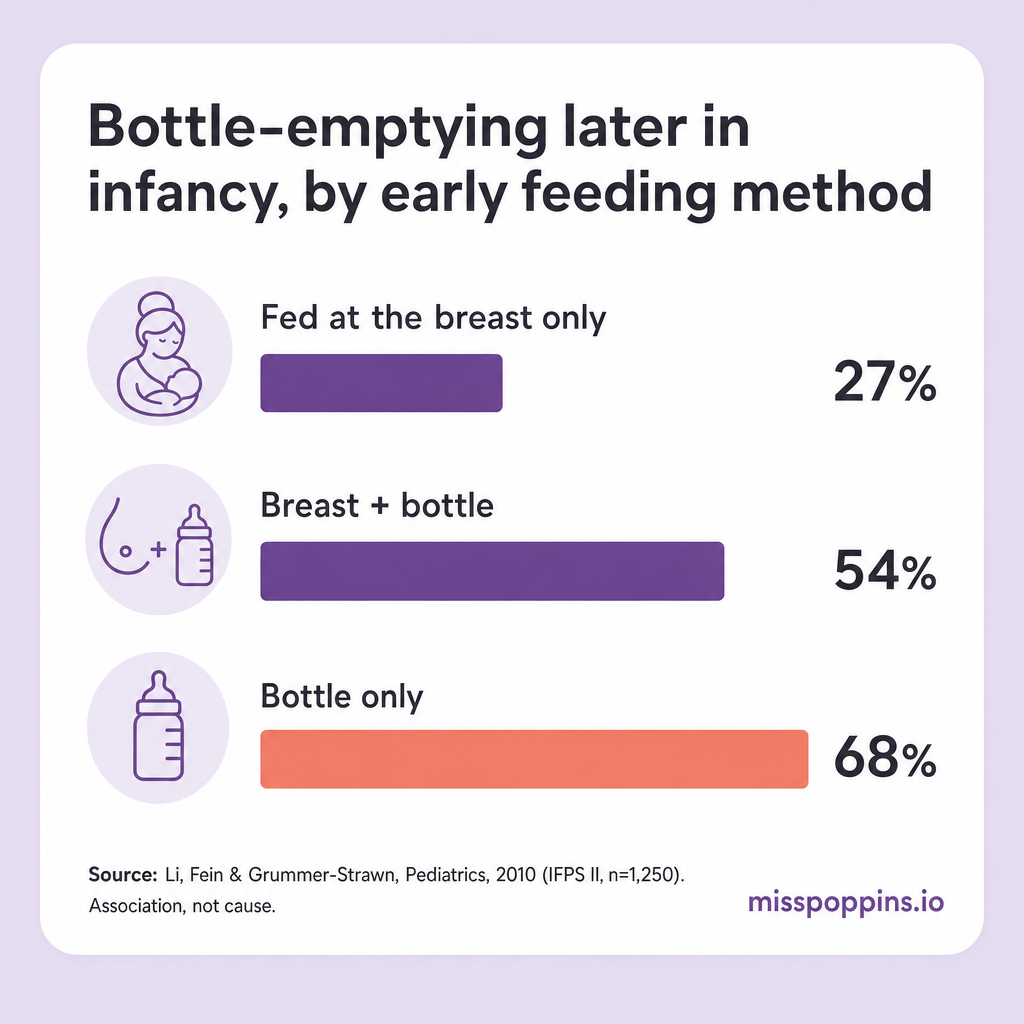
A 2010 study in Pediatrics by CDC researchers Ruowei Li, Sara Fein, and Laurence Grummer-Strawn followed 1,250 infants in the Infant Feeding Practices Study II. In late infancy, 27% of babies fed only at the breast early on emptied the bottle or cup. That rose to 54% for babies fed at the breast and by bottle, and 68% for bottle-only babies.
The pattern held for expressed breast milk and formula considered separately. The authors concluded that bottle-feeding, "regardless of the type of milk," differs from feeding at the breast in its effect on self-regulation.
A 2018 study in Pediatrics by Meghan Azad and colleagues studied 2,553 mother-infant pairs in Canada's CHILD cohort. Among "exclusively breastfed" babies, 55% received some pumped milk. Those babies had 12-month BMI z-scores that fell between directly breastfed and formula-fed babies.
Both studies show associations. They link feeding mode with later patterns and do not prove that bottles cause overeating or excess weight gain.
Three things help explain the link:
Bottle milk can keep flowing even when a baby pauses, because unpaced flow is controlled largely by gravity, as Arizona WIC's paced feeding guide (2023) explains.
Caregivers can see the ounces left, which makes "just finish it" tempting.
The CDC warns that propping the bottle or forcing a baby to finish "can lead to your baby eating more than they need."
None of this makes bottles a problem. Bottles are a normal, often necessary tool for returning to work, sharing feeds with a partner, or supplementing. The research points to technique, and good technique works with breast milk and formula alike.
What Looks Like Overfeeding but Usually Isn't
Many signs that worry parents of a nursed baby have other, usually normal, explanations.
Cluster Feeding and Comfort Nursing
According to the CDC, most exclusively breastfed babies feed every 2 to 4 hours over the first weeks and months. Some feed as often as every hour at times, a pattern the CDC calls cluster feeding.
Cluster feeding is normal. A run of close-together feeds is not, by itself, a sign of overeating.
Comfort nursing is normal too. Nursing soothes as well as feeds, so a baby who wants the breast soon after a feed may be seeking closeness, comfort, or more milk.
Normal Spit-Up
The AAP's symptom checker (2017) calls spitting up a "normal symptom in half of young babies." It's usually effortless and doesn't interfere with normal weight gain.
Babies typically spit up after gulping air with milk, and a baby's small stomach fills quickly, the AAP explains. Swallowing air happens with breastfed and bottle-fed babies, though the AAP notes it's seen more often with the bottle. Burping and limiting active play for 20 to 30 minutes after feeds can help.
Fast Letdown and Oversupply
Sometimes a nursed baby's discomfort comes from milk flowing faster than they can handle. The Academy of Breastfeeding Medicine's Protocol #32 (2020) calls this hyperlactation, often known as oversupply.
Infant signs may include fussiness at the breast, choking, coughing, unlatching, and short feeds. Babies may also have spit-up, gas, or explosive green stools. The protocol notes oversupply can be self-induced by pumping well beyond a baby's needs on top of breastfeeding.
Mild oversupply may settle on its own within a few months. The right next step is an International Board Certified Lactation Consultant (IBCLC), and cutting feeds on your own isn't advised. Through MissPoppins, families can meet certified lactation consultants over 1:1 video.
Signs a Baby May Be Taking More Than They Need
When a baby does take more than needed, it's most often during bottle-feeding. Kaiser Permanente's health encyclopedia (current as of March 2026) lists these signs of overfeeding a baby:
Spitting up more than usual
Loose stools
Gas, often from swallowed air
Fussiness
Discomfort after finishing a bottle very quickly may also suggest the pace is running ahead of your baby's cues.
These signs overlap with other causes, though. Normal spit-up, a fast letdown, and swallowed air can all look similar, so one fussy evening tells you little.
If you notice a pattern, jot down what you see and when. It's worth discussing with your pediatrician, who can look at the full picture, including weight gain.
How to Pace a Bottle So Your Baby Stays in Charge
The CDC describes a responsive bottle-feeding technique without using the word "paced." Its steps match what's often called paced bottle feeding.
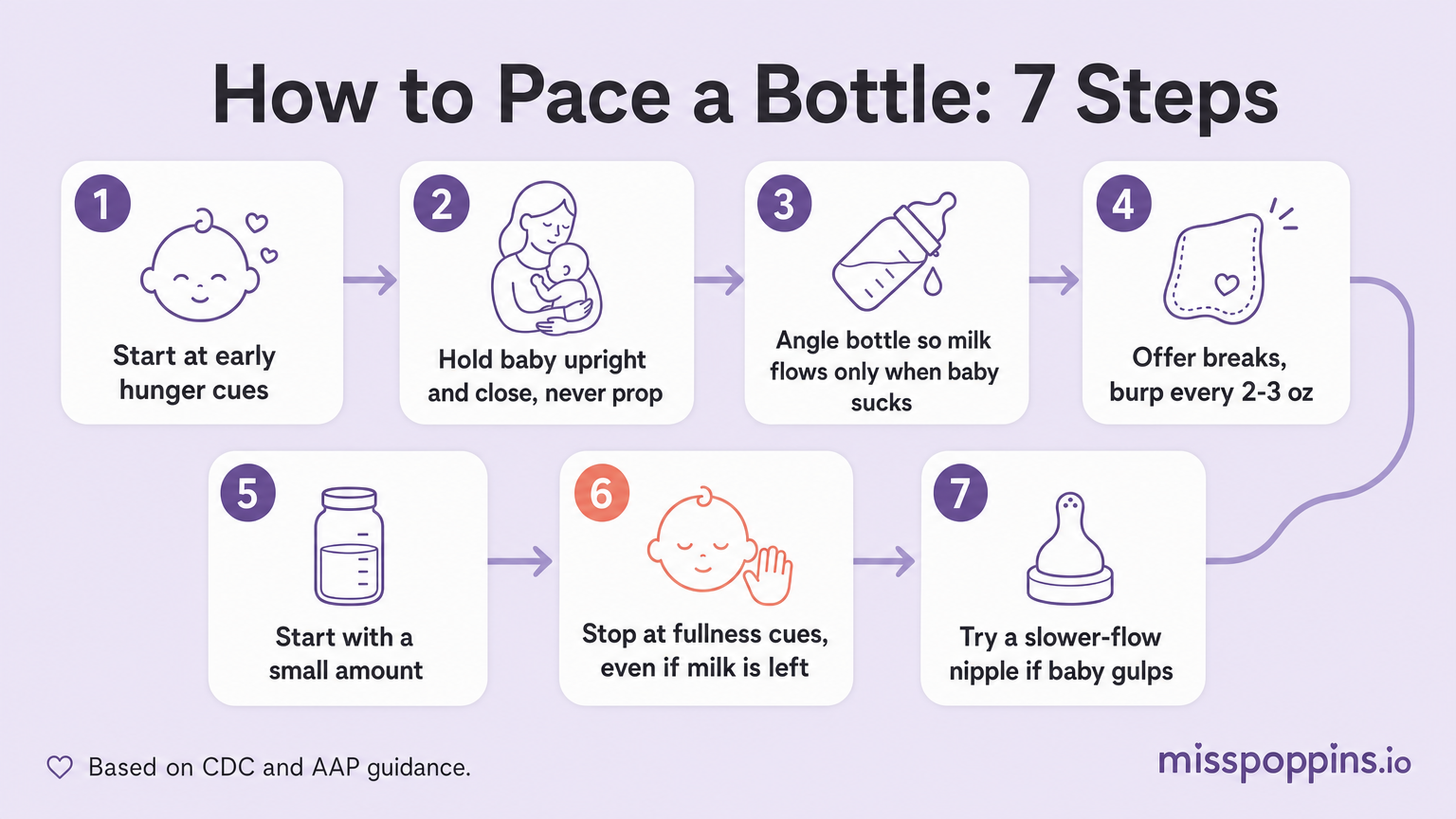
Start at early hunger cues. The CDC lists hands to mouth, turning toward the breast or bottle, and lip smacking. Crying is often a late sign.
Hold your baby fairly upright and close. The CDC advises never propping the bottle.
Angle the bottle so milk flows only when your baby sucks. This mirrors the control a baby has at the breast.
Offer breaks. The AAP suggests burping bottle-fed babies every 2 to 3 ounces.
Start with a small amount. The CDC recommends offering more only if hunger cues continue.
Stop at fullness cues, even if milk is left. Watch for a closed mouth, turned head, or relaxed hands.
Consider a slower-flow nipple if your baby gulps or chokes. Minnesota WIC (2018) recommends a slow-flow nipple for paced feeding, and Arizona WIC notes that gulping signals the flow is too fast.
As the CDC puts it, your child "does not need to finish a bottle."
Pacing works best when everyone who feeds the baby uses it. Partners, grandparents, and childcare providers can learn the same steps in minutes. MissPoppins also offers new dad coaching for partners who want hands-on help with bottle feeds.
How to Know Your Breastfed Newborn Is Getting the Right Amount
Guidance from the CDC (2024) and the AAP (2025) points to more reliable markers:
About 8 to 12 feeds in 24 hours
Swallowing you can hear during feeds
Seeming content for 1 to 3 hours between feeds
At least 6 wet diapers and 3 stools a day by days 5 to 7
Losing no more than 8% to 10% of birth weight in the first days
Returning to birth weight by about day 10 to 14
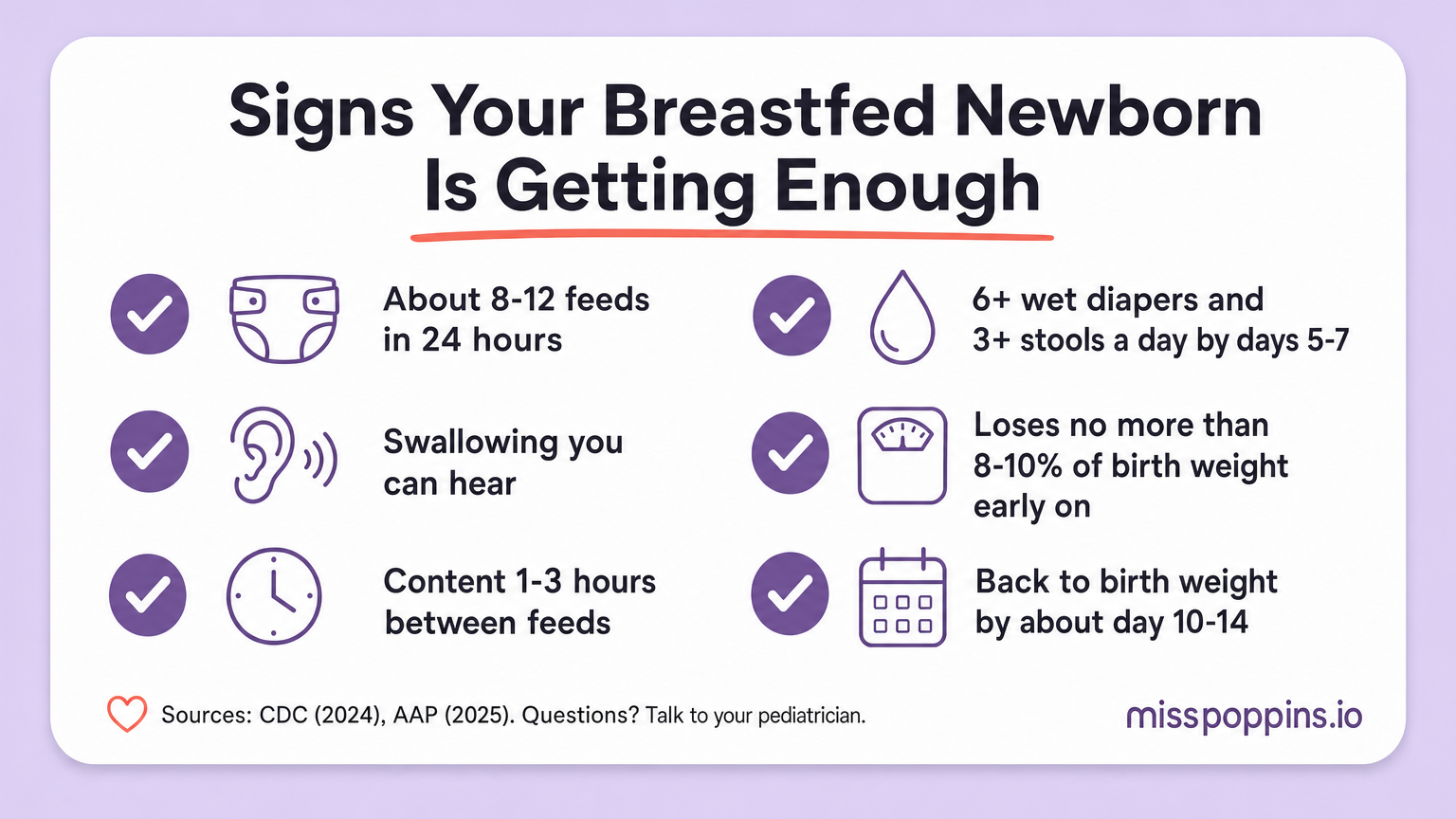
A baby who meets these markers is generally getting what they need, even if some feeds are short and others long. If your baby isn't meeting them, review it with your pediatrician.
When to Call Your Pediatrician
Coaching is not a substitute for medical care. The AAP's spit-up and reflux guidance and its guide to why babies spit up list warning signs like these. Contact your pediatrician promptly if you notice:
Forceful or projectile vomiting
Green (bile-colored) vomit
Blood in spit-up
Poor weight gain, or not back to birth weight by about 2 weeks
Fewer wet diapers than expected
Blood in the stool or signs of dehydration, such as no urine in more than 8 hours, dark urine, or a very dry mouth
A baby who looks or acts sick
If something feels off, calling is always reasonable.
Practical Next Steps
Daily habits that help:
Track diapers, not minutes. Wet and dirty diapers are a better guide than feed length.
Let your baby set the pace at the breast. Feed on cue and nurse until full.
Pace every bottle. Use the same technique for any milk, and teach it to every caregiver.
Avoid pumping far beyond your baby's needs. Follow the plan your provider or IBCLC recommends.
Get latch and flow help early. An IBCLC can spot a fast letdown or oversupply early.
Keep a simple feeding log. Note feeds, diapers, and spit-ups for pediatric visits.
You don't have to work through this alone. On MissPoppins, you can meet a certified lactation consultant or newborn care specialist 1:1, and many experts offer same-day sessions.
The Bottom Line on Breastfeeding, Bottles, and Overfeeding
At the breast, babies hold the controls, making true overfeeding highly unlikely. Bottle-feeding requires a bit more mechanical care, and paced feeding places that control back in your baby's hands. Always let their cues, diaper output, and weight checks tell the story rather than a timer.
If feeding anxiety is still lingering, you do not have to figure it out alone. MissPoppins connects families in the US and Canada with vetted, certified human coaches across 24 parenting categories. With a 4.8-star App Store rating and over 150 years of combined coach experience, we provide private, encrypted, human-led support, never chatbots.
Book an IBCLC or Lactation Consultant: Work with a postpartum specialist to evaluate latch efficiency, oversupply, fast milk flow, oral restrictions, and newborn digestive symptoms.
Explore Development & Behavior Coaches: Address underlying causes of feeding fussiness, including sensory sensitivities, body tension, or regulatory challenges during feeds.
Download the MissPoppins app on the App Store and Google Play to connect with an expert directly from your phone.
Frequently Asked Questions
Can you overfeed a baby breast milk in a bottle?
Yes, it's possible, since bottle milk flows with little effort and the person feeding sets the pace. Paced, cue-led feeding lowers that risk.
Is cluster feeding a sign of overfeeding?
No. The CDC treats frequent, close-together feeds as a normal pattern for many breastfed babies.
Should I wake my newborn to feed?
In the early weeks, often yes. The CDC says babies need to eat every 2 to 4 hours at first and that you may need to wake your baby to feed. Follow your pediatrician's guidance, especially before birth weight is regained.
Can comfort nursing make my baby overeat?
It's unlikely at the breast, since light, fluttery sucking with little swallowing removes little milk, according to NHS guidance. Comfort feeds with gulping and heavy spit-up may signal oversupply worth discussing with a lactation consultant.