

How Long Is a Formula Bottle Good For? The 24/2/1 Rule Explained
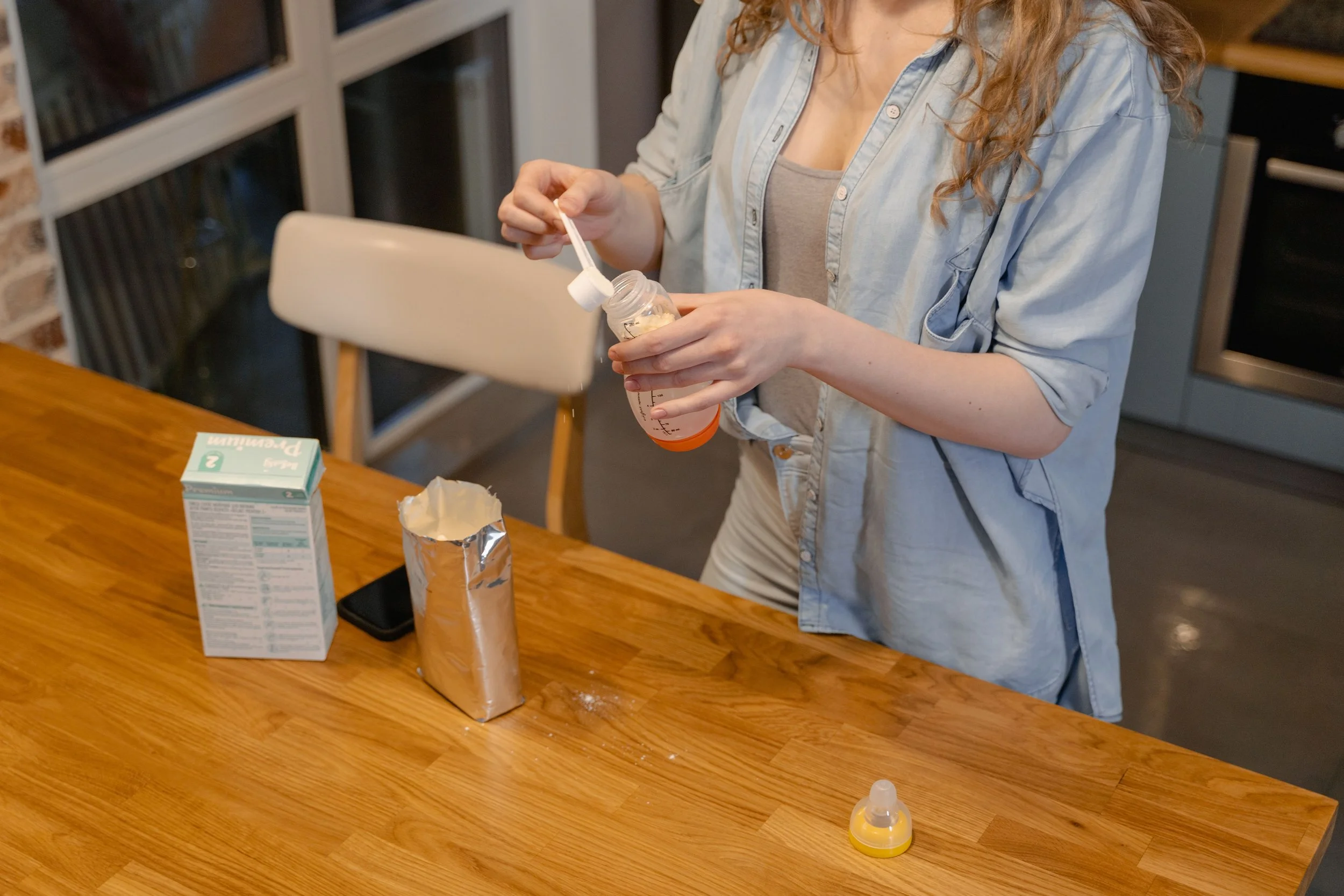
How long is a formula bottle good for? Per the CDC (updated May 14, 2026), use prepared formula within 2 hours of mixing and within 1 hour of when feeding begins. An untouched bottle that goes into the fridge right away can be used within 24 hours.
Key Takeaways
A freshly mixed formula bottle is good for 2 hours at room temperature, according to the CDC.
Once your baby starts drinking, use the bottle within 1 hour and throw out what's left.
An untouched prepared bottle can go in the fridge right away and be used within 24 hours.
"24/2/1" is a parent memory aid, and the timings behind it come from the CDC.
Babies under 2 months, born preterm, or with weakened immune systems need extra preparation steps.
It's 2 a.m., and the baby fell asleep after three sips. A parent stands in a dark kitchen, holding a half-full bottle and wondering: how long is a formula bottle good for? Pouring it out feels wasteful, but keeping it feels risky.
The advice rarely lines up. A grandparent, a forum thread, and a daycare may each say something different. Meanwhile, formula is expensive, and nobody wants to toss it without reason.
This guide covers a simple way to remember how long formula is good for, the reasoning behind each number, and scenario answers. Breast milk, formula, or both: every feeding path is valid.
What Is the 24/2/1 Rule for Formula?
The 24/2/1 rule is a parent memory aid for three formula time limits. The timings come from the CDC's Infant Formula Preparation and Storage guidance (updated May 14, 2026), which doesn't use the "24/2/1" name.
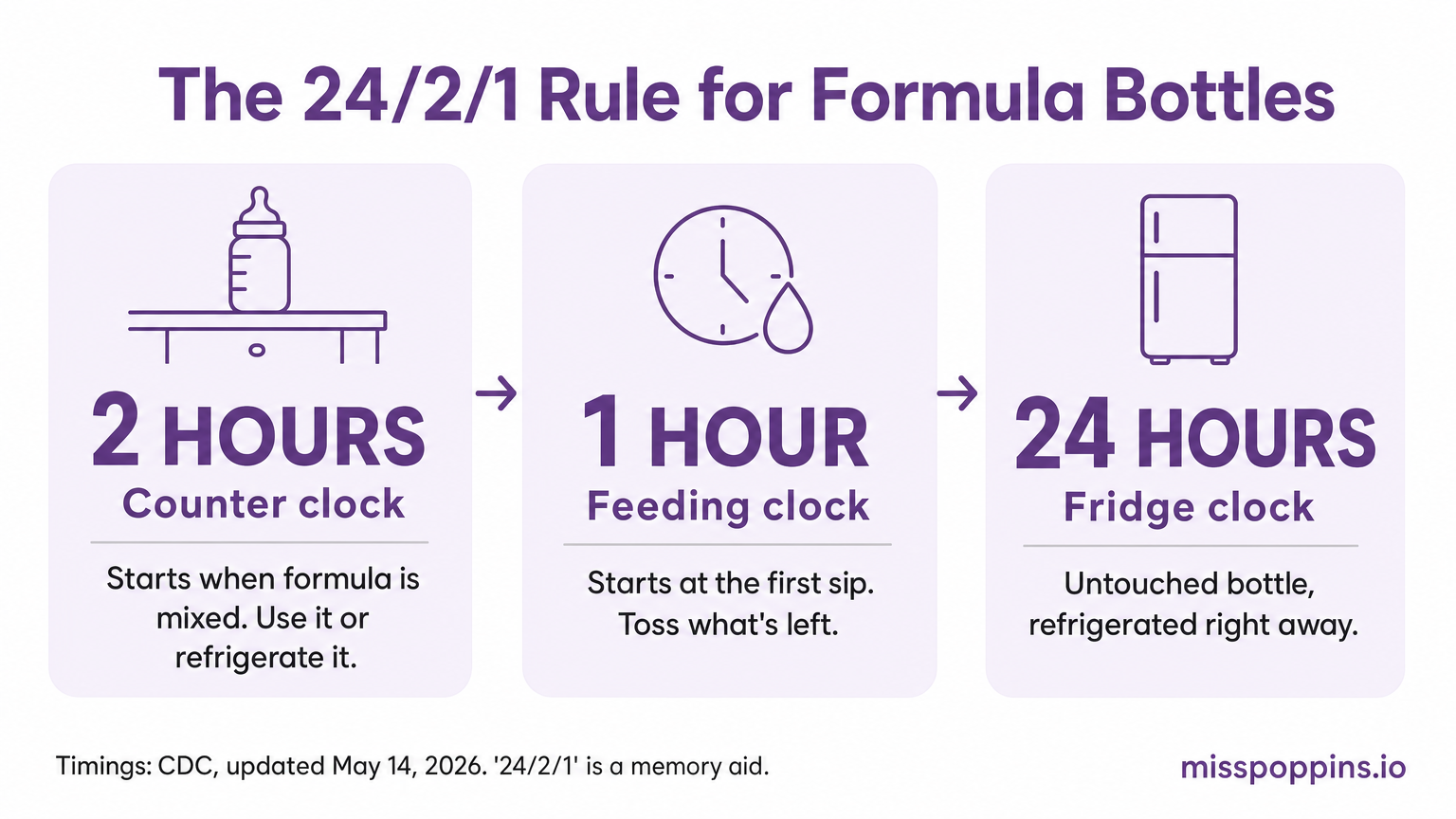
In the order a bottle moves through them:
2 hours (the counter clock): A freshly prepared bottle can sit at room temperature for up to 2 hours. If feeding won't start in that window, the CDC says to refrigerate it immediately.
1 hour (the feeding clock): Once a baby starts drinking, the CDC says to use the bottle within 1 hour. Whatever is left after the feeding gets thrown out.
24 hours (the fridge clock): An untouched prepared bottle stored in the fridge should be used within 24 hours. That's how long formula is good for in the fridge.
The FDA (content current as of May 17, 2024) gives the same 2-hour and 24-hour limits. So how long can formula sit out? In the US, 2 hours.
When Does Each Clock Start?
Most confusion comes from when each clock starts. The 2-hour clock starts when the formula is mixed. The 1-hour clock starts at the first sip, and the 24-hour clock starts when the bottle goes into the fridge.
The CDC's wording uses two limits together: within 2 hours of preparation and within 1 hour from when feeding begins. Whichever limit arrives first is the one to follow. That covers how long formula is good for once mixed.
Writing the prep time on each bottle with tape or a marker means nobody guesses at 4 a.m.
Why Does Formula Expire After 1 or 2 Hours?
Prepared formula can spoil when it sits at room temperature. Once a baby drinks from the bottle, saliva mixes in. According to the CDC, "the combination of infant formula and your baby's saliva can cause bacteria to grow."
That is why leftovers get tossed instead of saved, a point the FDA (May 17, 2024) makes too.
The formula type matters too. Powdered formula is not made to be sterile, while the FDA notes that liquid ready-to-feed and liquid concentrate are.
Babies' immune systems are still developing, so guidance leans conservative. Tossing a leftover bottle is a routine safety step, with no judgment attached.
How Long Is a Formula Bottle Good For in Common Scenarios?
Real life rarely matches a textbook feed. The table covers the moments parents ask about most.
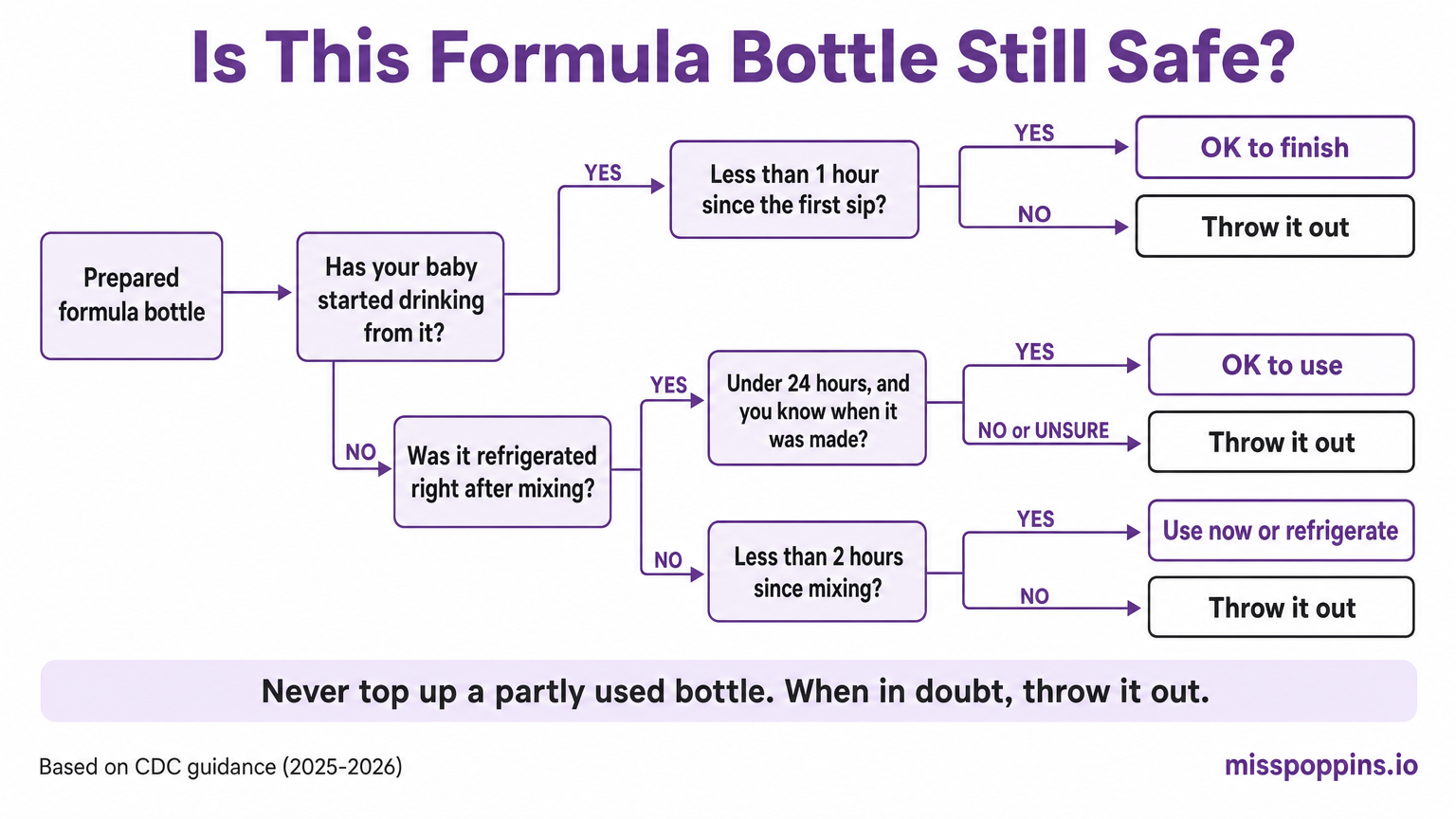
Warmed bottles. The CDC (updated May 14, 2026) says formula doesn't need warming, and warming should never happen in a microwave, which can create hot spots. The CDC sets no separate window for warmed formula, so warm a bottle right before feeding and use it promptly.
Unknown or topped-up bottles. The CDC's Preventing Cronobacter in Infants page (September 29, 2025) says to throw out formula "if you can't remember how long you have kept it in the refrigerator." It also warns that germs can grow quickly when formula is added to a partially used bottle.
Opened liquid formula. For opened ready-to-feed or liquid concentrate containers, the label is the rule. HealthLink BC, British Columbia's provincial health service, says to discard them after 48 hours "or follow label instructions."
Outings. For trips of 2 hours or less, HealthLink BC suggests an insulated bag or cooler with an ice pack. For longer outings, it calls unopened ready-to-feed formula the safest option. The US agencies we reviewed set no specific cooler time.
What About Bottles That Mix Breast Milk and Formula?
Combo feeding is common. According to CDC National Immunization Survey data (updated July 31, 2026), 33.6% of breastfed babies born in 2023 received formula before 3 months. Many of those families wonder whether a mixed bottle follows breast milk rules or formula rules.
Breast milk alone has longer windows. The CDC says freshly expressed breast milk can stay at room temperature (77°F/25°C or colder) for up to 4 hours. Those rules don't address a bottle that also contains formula.
No US or Canadian health authority we reviewed sets a separate time limit for mixed bottles. As a cautious approach, follow the formula rules for the whole bottle, and confirm the plan with your pediatrician or a lactation consultant. MissPoppins lactation consultants can help families plan a combo-feeding routine that fits their day.
Does the 24/2/1 Rule Change for Newborns, Preemies, or Canadian Families?
The CDC (updated May 14, 2026) adds extra preparation steps for babies who:
Are younger than 2 months old.
Were born before 37 weeks of pregnancy.
Have a weakened immune system.
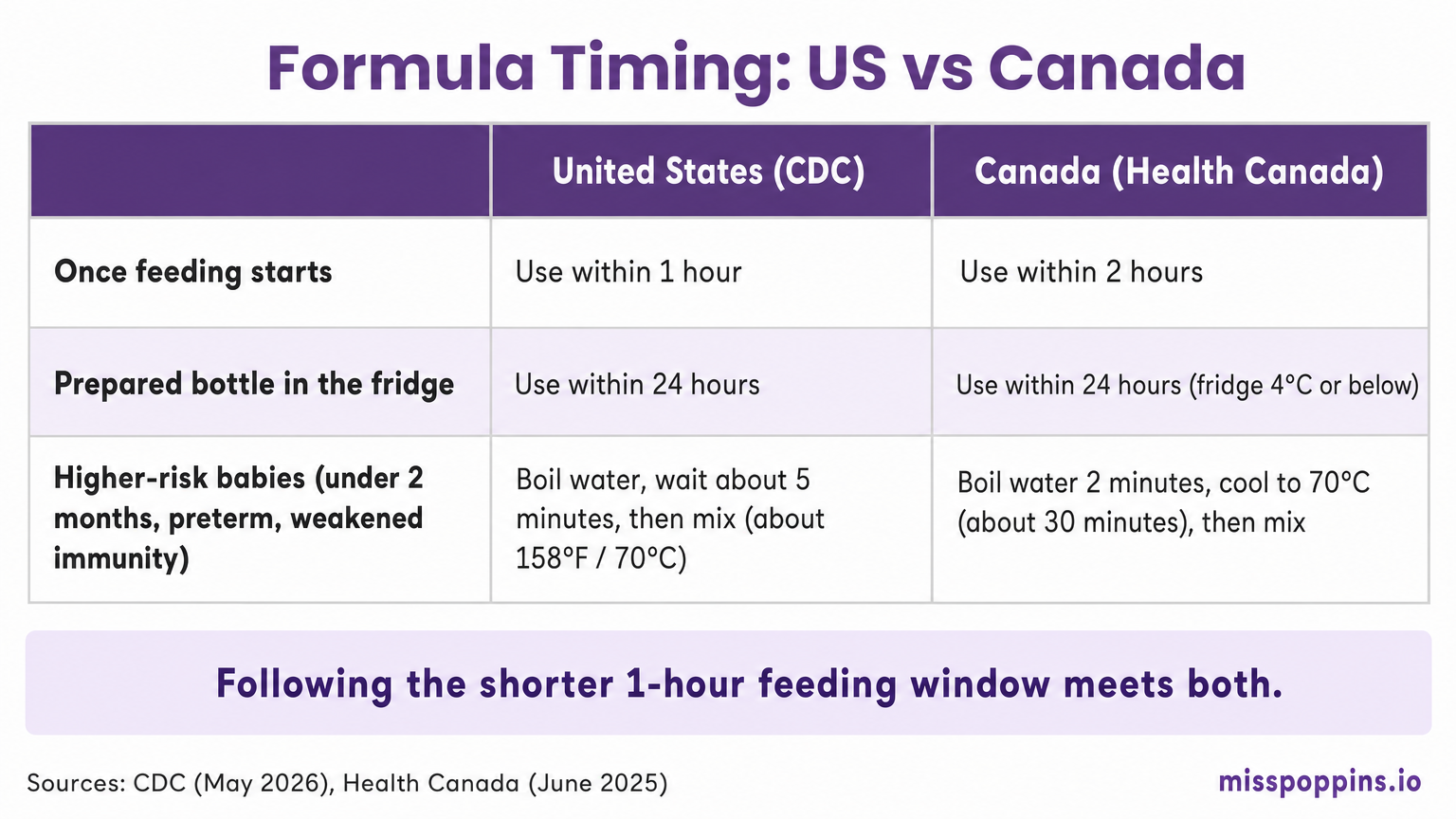
For these babies, the CDC says to boil the water, wait about 5 minutes, and then mix it with powdered formula. Very hot water, around 158°F (70°C), is needed to kill germs like Cronobacter. Let the bottle cool before feeding.
The CDC's About Cronobacter Infection page (September 29, 2025) calls these infections rare but serious in infants. Invasive Cronobacter infection became nationally notifiable in 2024. The FDA (May 17, 2024) adds that liquid ready-to-feed and liquid concentrate are safer options for higher-risk babies not receiving breast milk.
Families of babies in these groups can ask their pediatrician which formula type and preparation method fit best.
Canadian guidance differs on one key number. Health Canada (modified June 27, 2025) says that once feeding starts, the bottle should be used within 2 hours, compared with the CDC's 1 hour. Prepared formula in the fridge should be used within 24 hours, with the fridge at 4°C or below.
For higher-risk babies, Health Canada says to boil water for 2 minutes, then cool it to 70°C, which takes about 30 minutes. Families who follow the shorter US 1-hour feeding window meet both countries' guidance.
What Happens If My Baby Drinks an Old Formula Bottle?
This is an easy mistake to make on little sleep. The useful next step is to watch the baby closely and know when to call for help.
The CDC (September 29, 2025) lists early signs of Cronobacter infection in babies under 1 year: fever, poor feeding, excessive crying, or very low energy. Some babies may also have seizures.
If any of these signs appear, or something seems off, call your pediatrician, especially for a baby under 2 months. The CDC advises getting a baby to a medical provider as soon as possible if infection is suspected. Seizures call for urgent care right away.
Practical Tips for Safer, Less Wasteful Bottles
A few small habits cut guesswork and waste:
Make smaller bottles and offer more if your baby is still hungry.
Label every bottle with the time it was mixed.
Consider keeping prepared bottles toward the back of the fridge rather than in the door, as the CDC advises for stored breast milk.
Prep a day's batch, refrigerate it immediately, and use it within 24 hours.
Set a phone timer at the first sip so the 1-hour clock isn't left to memory.
Share the same rule with every caregiver, including partners, grandparents, nannies, and daycare staff.
Throw it out when in doubt, as the CDC advises for fridge bottles of unknown age.
Caregiver hand-offs are where rules slip. A fridge note listing 2, 1, and 24 keeps everyone aligned.
MissPoppins sleep coaches, new dad coaches, and family life coaches help families build night-feed routines and smoother hand-offs between caregivers.
Conclusion
The 24/2/1 memory aid boils down to three CDC timings: 2 hours from mixing, 1 hour from the first sip, and 24 hours chilled. Health Canada allows 2 hours once feeding starts. Babies under 2 months, preemies, and babies with weakened immune systems need extra preparation steps.
Tossing a half-finished bottle is a safety step. Formula, breast milk, or both, the goal is a fed baby and a parent who feels sure of the next step.
So the next time you're wondering how long is a formula bottle good for, check which clock applies, and when in doubt, throw it out. For clinical questions, call your pediatrician.
Ready to stop doing 2 a.m. formula math? Feeding routines get easier with a concrete plan. MissPoppins connects families with vetted, certified human experts to solve the friction in your daily parenting routines, no chatbots, no generic advice.
Need help building a feeding system? Bottle hygiene, safe preparation, feeding frequency, and pacing are foundational responsibilities. Let our newborn care specialists and postpartum doulas build a system that works for your sleep schedule. Explore Postpartum & Newborn Coaches
Handing off the routine? If you are transitioning care to nannies, daycares, or grandparents who must strictly follow your formula safety protocols, get everyone on the exact same page. Explore Family Systems & Transition Coaches
Get Expert Support on the Go Download the MissPoppins app on the App Store and Google Play to connect with an expert directly from your phone.
The MissPoppins Standard:
5,000+ families supported | 4.8-star App Store rating | 150+ years combined coach experience
All sessions are private and encrypted. Every coach is vetted and certified.
Coaching is not medical advice. Clinical concerns, including any symptoms after a feed, must go to your pediatrician.
Frequently Asked Questions
How long can you keep a formula bottle once made?
An untouched bottle refrigerated right after mixing keeps up to 24 hours, per the CDC (updated May 14, 2026). If the formula label gives a shorter time, follow the label, as Health Canada (June 27, 2025) also advises.
Can I feed baby a bottle after it's been out for two hours?
Not under CDC guidance, which says to use prepared formula within 2 hours or refrigerate it right away. If a bottle has been out longer, the safest call is to throw it out.
Can you re-warm a formula bottle?
Health Canada (June 27, 2025) advises against refrigerating and reusing warmed prepared formula, so warm only what your baby will drink at that feeding. Test a few drops on your wrist before offering it.
How long is a container of powdered formula good for once opened?
Check the label first: the CDC (updated May 14, 2026) says most formulas need to be used within 1 month of opening. Never use formula past its "Use By" date, and keep the lid closed between scoops.
Can you freeze formula?
The FDA (May 17, 2024) doesn't recommend it, because freezing may cause the parts of the formula to separate and lower its quality. For make-ahead convenience, a fridge batch used within 24 hours is the option CDC guidance supports.