

Nighttime Nursing: Newborn Breastfeeding Routines & The 5-3-3 Rule

Nighttime nursing is a biological requirement for newborns to regain birth weight and establish a mother's long-term milk supply. Frameworks like the 5-3-3 rule offer structured sleep intervals for parents, but infants should only adhere to spaced feeding schedules after explicit pediatrician clearance. Expect frequent night waking to peak between weeks three and six.
Medical Disclaimer: The information provided in this article is strictly for educational purposes. MissPoppins coaches are non-clinical support professionals. If your baby exhibits signs of illness, extreme lethargy, poor weight gain, breathing issues, or prolonged distress, stop reading and contact your pediatrician immediately.
Your baby wakes up. It is 3:14 AM. You just fell asleep 40 minutes ago. This is the reality of early parenthood. Exhaustion hits a biological limit, and the internet offers contradictory advice about schedules, sleep training, and milk supply. You need plain facts. You need a system that protects your infant's health and your sanity. We are going to break down exactly how nighttime feeding works, why your body demands it, and how to build a routine that actually functions in the real world.
Why Nighttime Nursing is Crucial for Newborns (Not Just a Phase)
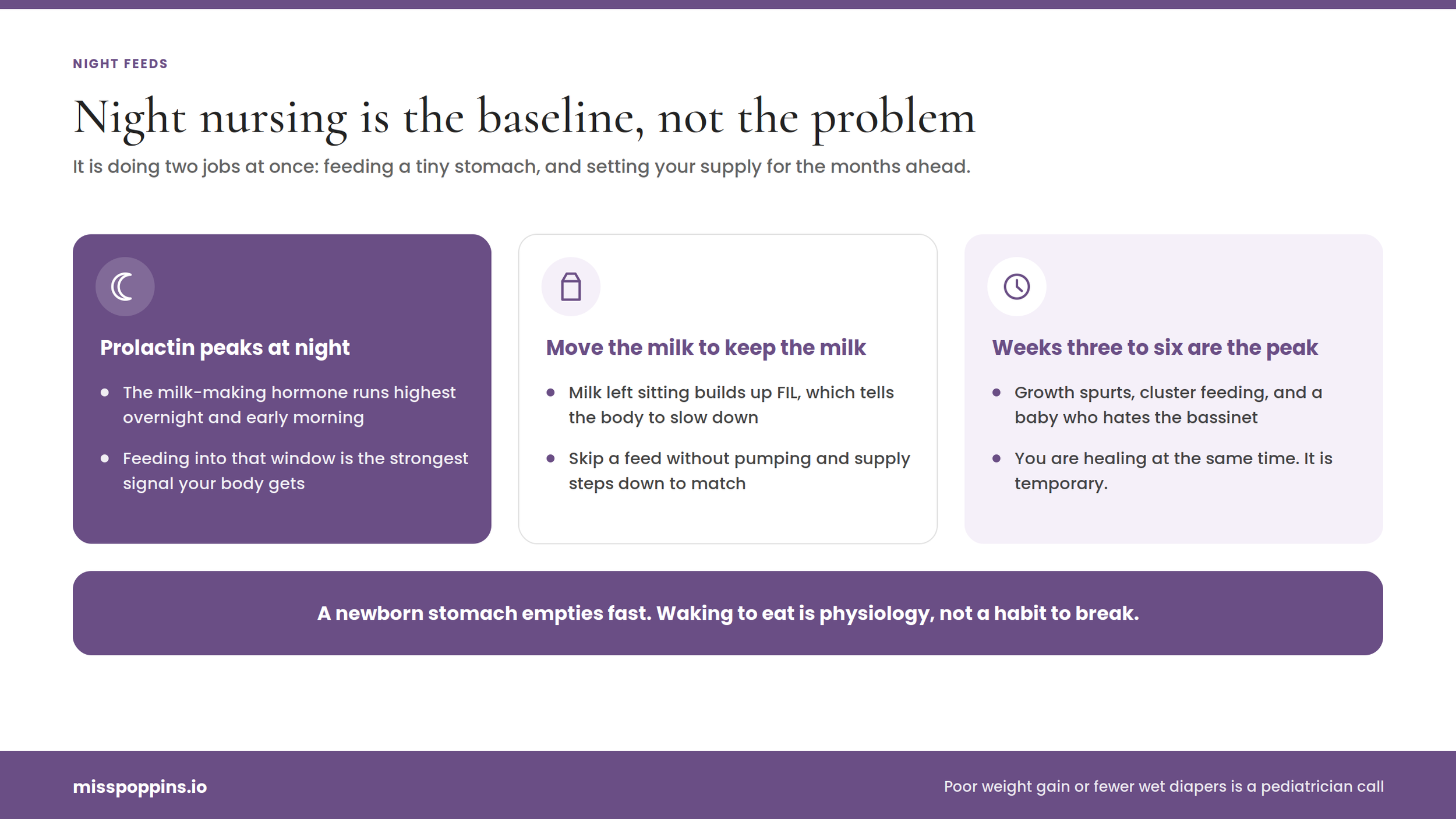
Newborns possess tiny stomachs. They process breast milk rapidly. They require calories around the clock. This is not a behavioral problem to fix. It is a physiological baseline.
Does Night Nursing Increase Milk Supply?
Yes. Night nursing dictates your long-term lactation capacity. The hormone responsible for milk production is prolactin. Prolactin levels do not remain static. They peak significantly during the night and early morning hours. When you practice nighttime nursing care, your baby stimulates the breast during this hormonal peak. This sends a massive demand signal to your brain.
Skipping these feeds in the early weeks disrupts the supply-and-demand loop. According to the Centers for Disease Control and Prevention (CDC), consistent breast emptying is required to maintain adequate milk production. Breastfeeding at night locks in your supply for the coming months.
Will My Milk Supply Decrease If I Don't Feed at Night?
Your body operates on a strict feedback loop. When milk sits in the breast for prolonged periods, a protein called Feedback Inhibitor of Lactation (FIL) accumulates. FIL actively signals your body to slow down production.
If you skip nighttime feeds without replacing them with a pumping session, your body downregulates. You will wake up engorged. The pressure from engorgement physically damages milk-making cells over time. Many mothers naturally wake up after five hours simply because the physical pain of engorgement overrides their exhaustion. You must move the milk to keep the milk.
What is the Hardest Month of Breastfeeding?
Weeks three through six test your endurance. This period is statistically the most demanding. Your infant undergoes rapid growth spurts. They begin cluster feeding, demanding the breast constantly to drive up your supply to meet their expanding caloric needs.
You are healing. You are sleep-deprived. Your baby might refuse the bassinet, crying instantly upon being set down. This is the hardest phase. It is entirely normal, but validating that normality does not make 4:00 AM any easier.
The 5-3-3 Rule: Newborn Sleep Framework or Internet Myth?
You see it in every parenting forum. The 5-3-3 rule is heavily promoted. Let us strip away the marketing and look at the mechanics.
What is the 5-3-3 Rule for Nighttime Feeding?
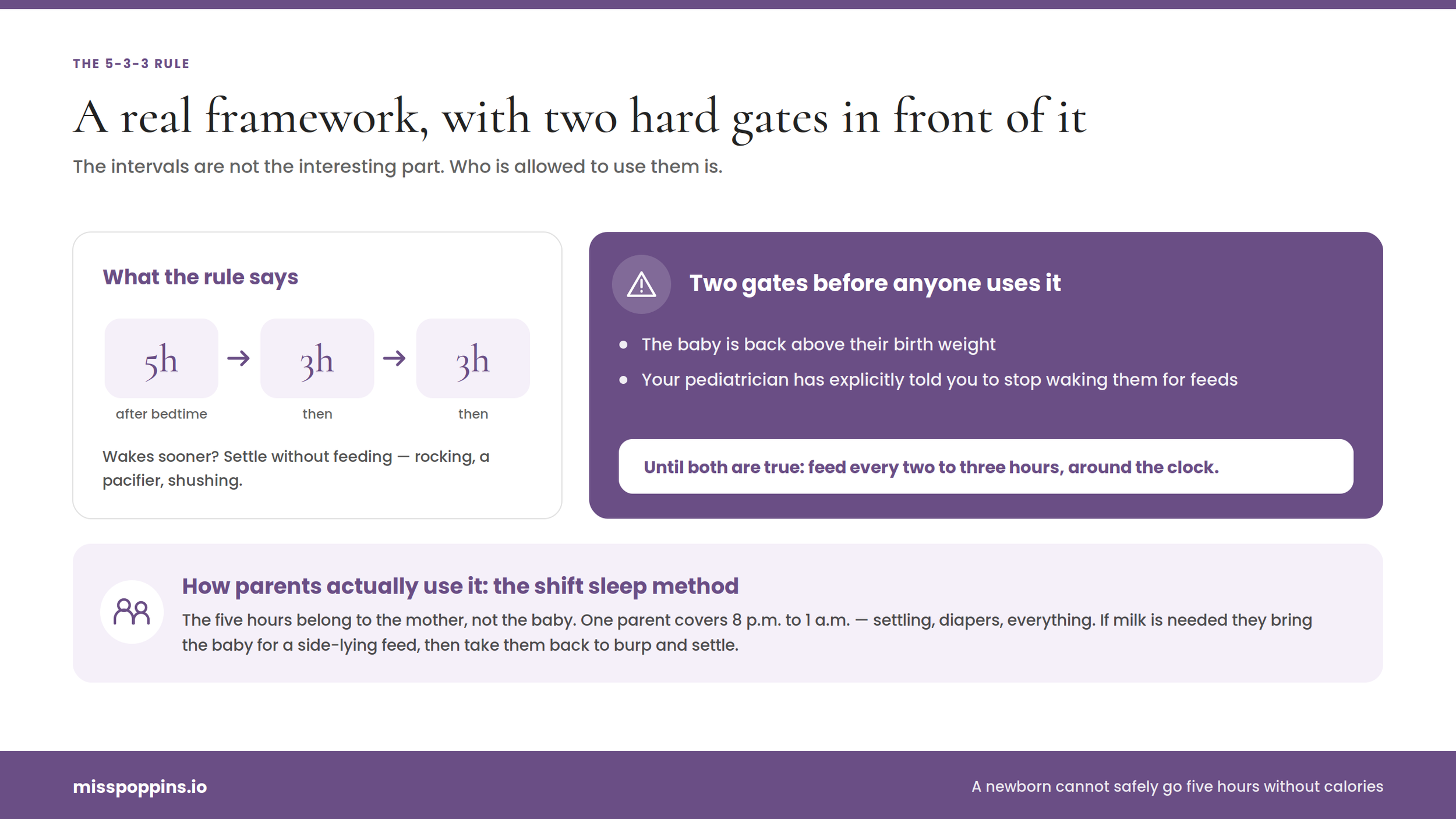
The 5-3-3 rule is a structured feeding schedule designed to stretch nighttime sleep. It dictates that you allow the baby to sleep for a five-hour stretch after bedtime before initiating a feed. Following that first feed, you wait three hours for the next feed, and then another three hours.
If the baby wakes before those intervals, the parent utilizes non-feeding soothing methods (rocking, pacifiers, shushing) rather than immediately offering the breast.
Can My Newborn Go 5 Hours Without Eating at Night?
Absolutely not, unless specific criteria are met. A brand-new baby cannot safely go five hours without calories. They must wake every two to three hours.
You can only begin using structured sleep frameworks like the 5-3-3 rule to space nighttime nursing when two things happen. First, the infant must surpass their original birth weight. Second, your pediatrician must give explicit clearance to stop waking the baby for feeds. Never implement interval feeding without medical approval.
How Real Moms Use the 5-3-3 Rule (The Shift Sleep Method)
The internet often misinterprets the 5-3-3 framework. Social listening data from platforms like Reddit reveals a different, highly effective application. For many couples, the "5" does not apply to the baby's sleep. It applies to the mother's sleep.
Parents execute the Shift Sleep Method. One parent noted online, "Husband is completely in charge for the first 5 hours." The non-nursing partner takes all settling, diapering, and soothing duties from 8:00 PM to 1:00 AM. If the baby requires milk, the partner brings the baby to the mother, facilitates a side-lying feed, and then takes the baby away to burp and settle. This guarantees the mother a protected five-hour block of baseline sleep.
How to Build a Frictionless Nighttime Feeding Routine for Your Newborn
Theory is hard to apply at 2:00 AM when you are managing a distressed baby. You need a mechanical, frictionless system.
The Setup: Dim Lights, Nighttime Nursing Bras, and Hydration
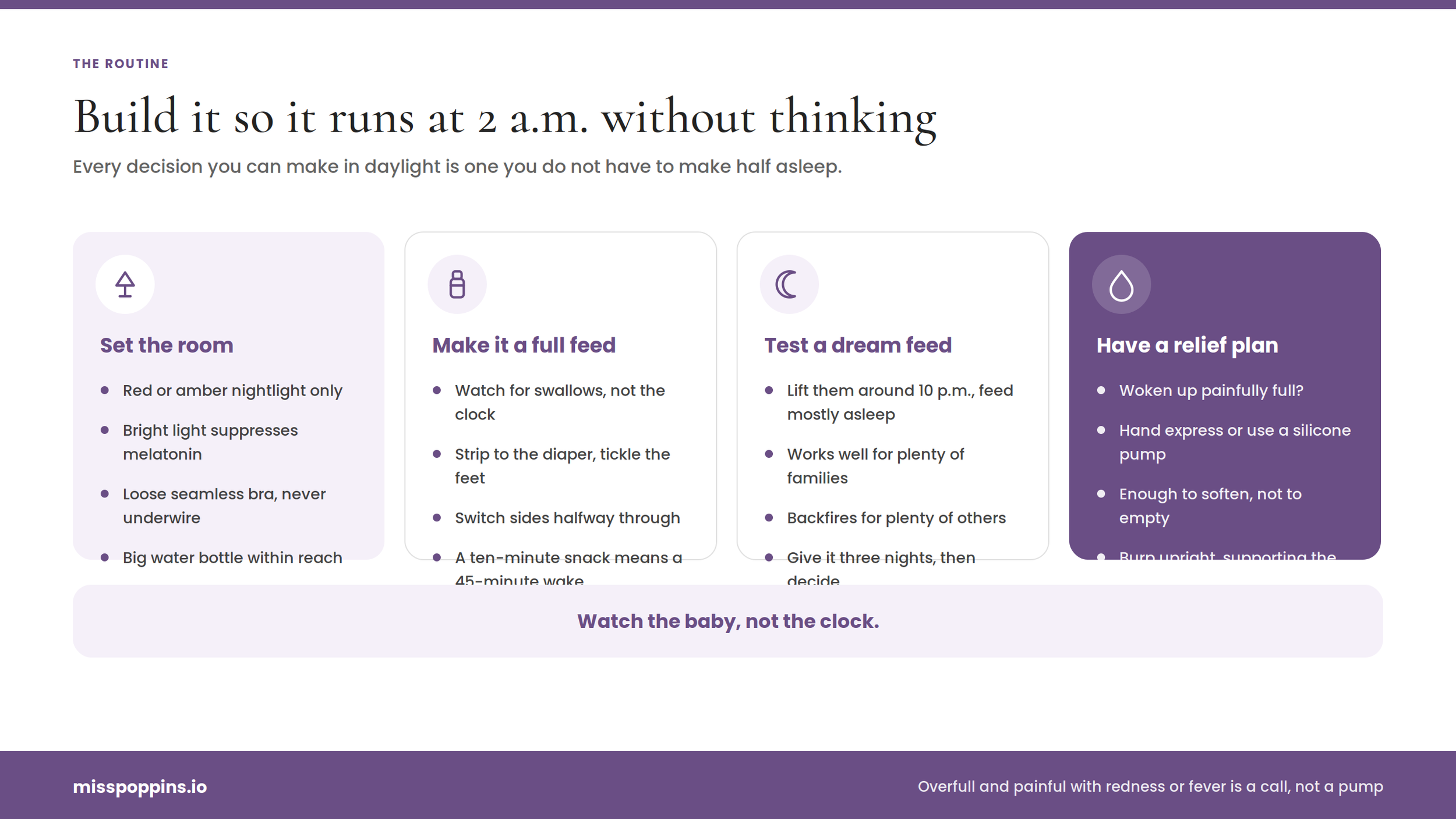
Environmental control dictates how fast you and your baby return to sleep. Keep the lights low. Exposure to bright light spikes cortisol and inhibits melatonin production. Use a red or amber nightlight.
Your clothing matters. Wear a loose, seamless sleep bra. Restrictive underwire or tight sports bras cause blocked ducts and mastitis when worn overnight. Keep a massive water bottle on your nightstand. Lactation requires heavy hydration, and the physical act of nursing triggers intense thirst.
If you wake up painfully full before the baby demands milk, you need a protocol for relieving overnight engorgement. Hand expression in the sink or a manual silicone pump provides relief without overstimulating supply.
Dream Feeding: Does It Actually Work?
A dream feed involves waking the baby slightly to feed them right before you go to sleep. You might put the baby down at 7:30 PM. At 10:30 PM, you gently lift them, offer the breast while they are mostly asleep, and place them back down.
Incorporating a proactive dream feed before parental bedtime aims to align your longest stretch of sleep with the baby's. It works brilliantly for about half of all families. For the other half, it backfires. It can disrupt the infant's natural deep sleep cycle, causing them to wake more frequently afterward. Test it for three nights. If it fails, abandon it.
Sometimes, evening feeds are incomplete. A distracted or exhausted baby might take a shallow feed, leading to a wake-up less than an hour later. Addressing incomplete evening feeds causing false starts within 45 minutes requires keeping the baby fully awake during that final bedtime feed.
When Can Babies Go 4 Hours Between Feedings at Night?
Stomach capacity dictates sleep length. At two weeks old, a baby's stomach holds roughly 2 to 3 ounces. By one month, it expands to 3 to 4 ounces. By two to three months, it can hold 4 to 5 ounces.
As stomach capacity grows, sleep stretches organically. You must focus on daytime calorie consolidation to reduce nighttime waking. If a baby does not eat enough during the day, they will reverse cycle and demand those calories at night.
Is a 10 Minute Night Feed Enough?
Parents often stare at the clock, anxious about whether the baby consumed enough. You must watch the baby, not the clock.
Look for active swallowing. A strong, older baby might efficiently drain a breast in 10 minutes. A newborn cannot. Newborns often fall asleep at the breast, transitioning from nutritive sucking (deep, rhythmic swallows) to non-nutritive pacifying (shallow, rapid flutters).
Keeping babies engaged to ensure full feeds instead of shallow snacking is mandatory. Strip them down to their diaper. Tickle their feet. Switch breasts halfway through. If they snack for ten minutes and fall asleep, they will wake up hungry in 45 minutes.
Once the feed concludes, trapped air causes immense pain. Burping techniques after sleepy nighttime nursing sessions involve sitting the baby upright and supporting their jaw to release air gently without waking them fully.
Safety Guidelines and Managing Expectations for Night Feeds
Do not combine extreme exhaustion with unsafe sleep environments. Extreme fatigue makes it harder to maintain a safe sleep environment.
Night Waking Differentials
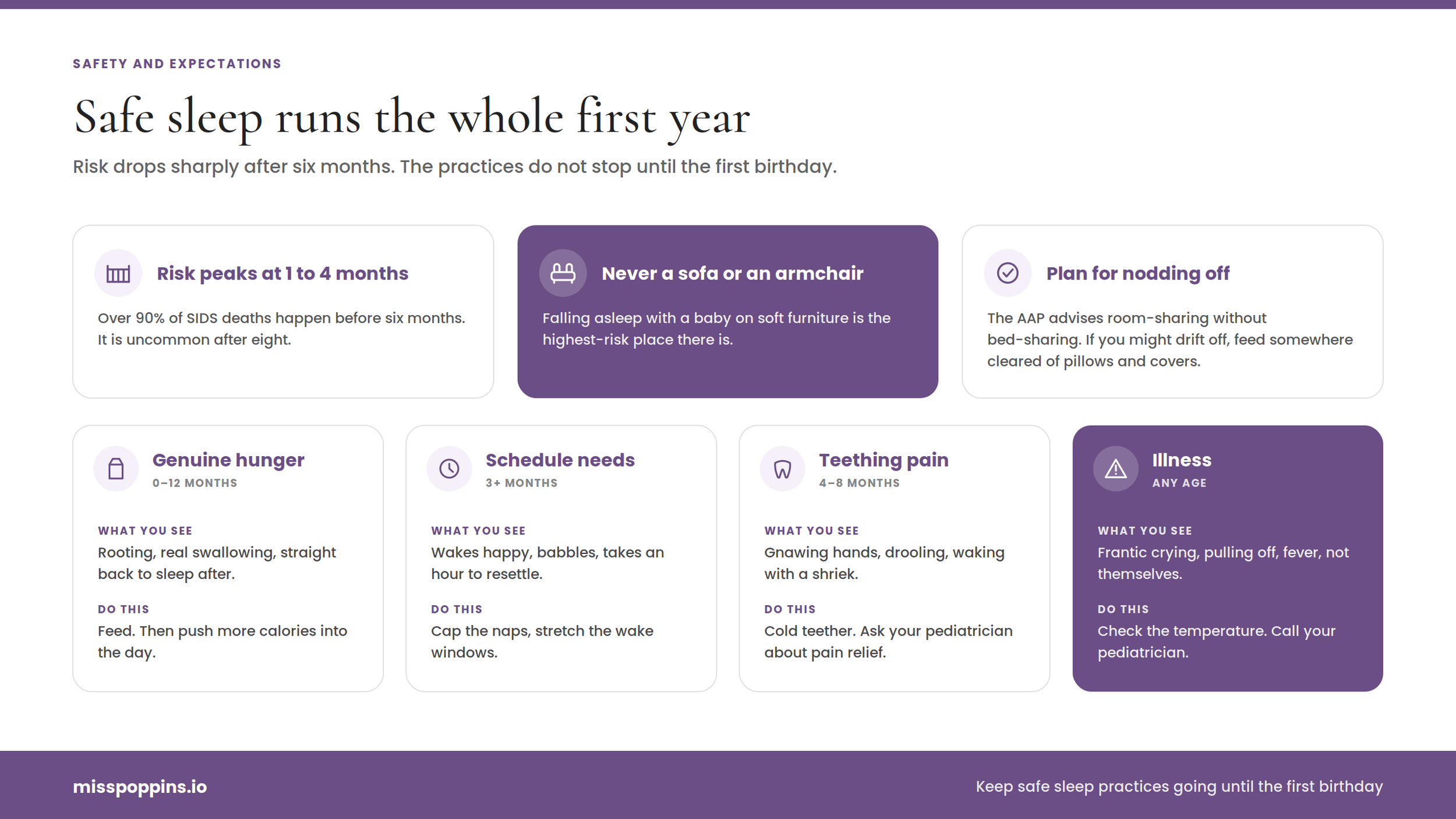
Is it hunger? Or is it something else? Use this differential matrix to identify the root cause of the waking.
"In our coaches' experience working with thousands of families, the most common mistake is treating a scheduling issue like a hunger issue. Parents end up feeding a baby who actually just needs 15 more minutes of awake time during the day."
Sarah Jenkins, Certified Pediatric Sleep Coach at MissPoppins.
At What Age is SIDS No Longer a Risk?
Sudden Infant Death Syndrome (SIDS) is the primary concern for nighttime safety. The risk is highest between one and four months of age. According to the American Academy of Pediatrics (AAP), the risk drops significantly after six months and is practically eliminated by twelve months.
You must practice safe sleep. Never nurse on a soft couch or recliner if you are at risk of falling asleep. If you choose to co-sleep, research the Safe Sleep Seven. Intentional bed-sharing is vastly safer than accidentally falling asleep on a sofa with an infant.
Do Babies Naturally Drop Night Feeds?
Yes and no. Some infants independently sleep through the night by four to six months. Others do not. We must establish realistic developmental timelines for when babies drop night feeds.
Often, waking becomes a habit. The infant develops a feed-to-sleep association. They wake between sleep cycles and require the breast to fall back asleep, even if they are not hungry. Implementing the eat-play-sleep rhythm to prevent feeding-to-sleep dependency breaks this association gently.
You Do Not Have To Do This Alone
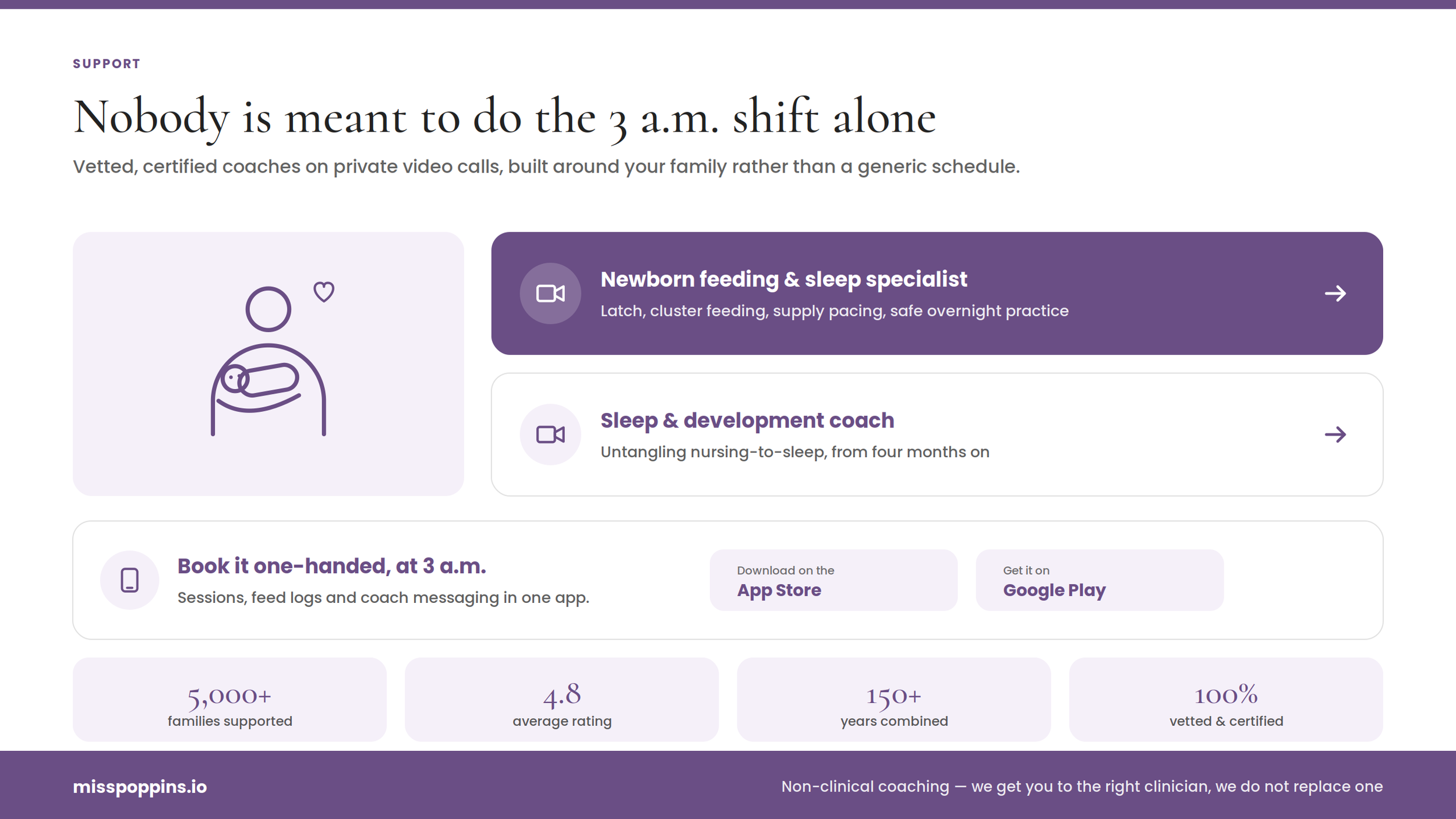
Exhaustion compromises your physical and mental health. MissPoppins connects you with vetted, certified professionals who provide encrypted, private telehealth sessions tailored to your exact family dynamic.
5,000+ families supported
4.8-star average rating
150+ years of combined expert experience
Fully vetted, non-clinical parenting coaches
Explore Postpartum & Newborn Coaches / Book a Newborn Feeding & Sleep Specialist
Get help with latch mechanics, cluster feeding, milk supply pacing, and safe overnight practices.
Explore Sleep & Development Coaches
Ideal for untangling nursing-to-sleep associations and building healthy sleep habits for babies 4+ months.
Download the MissPoppins app on the App Store and Google Play today.
FAQs
What is the 5-3-3 rule for nighttime feeding?
The 5-3-3 rule is a sleep scheduling framework. It suggests parents wait five hours after bedtime for the first night feed, followed by three-hour intervals for subsequent feeds. It should only be used after a baby surpasses birth weight and receives pediatrician clearance.
What age should night feeds stop?
Most babies naturally drop night feeds between six and twelve months as solid foods increase. However, this varies wildly. Consult your pediatrician before actively forcing nighttime weaning.
Is it normal for a 10-week-old baby to sleep 8 hours at night?
It is rare but entirely normal, provided the baby is gaining weight appropriately and producing enough wet diapers. Enjoy the sleep, but remain vigilant about your milk supply and pump if you wake up engorged.
Does night nursing increase milk supply?
Yes. Prolactin (the milk-making hormone) levels peak during nighttime hours. Feeding during this window sends the strongest possible signal to your body to maintain long-term milk production.
Will breast milk dry up if baby sleeps through the night?
It will not completely dry up instantly, but your supply will downregulate. To protect your supply, you must remove the milk. Add a dream feed or a quick morning pumping session to empty the breasts.
At what age can I let my baby sleep through the night without feeding?
You can allow your baby to sleep without waking them for feeds the moment they regain their birth weight and your pediatrician explicitly tells you to stop waking them.