

3 Month Old Feeding Guide: Exact Ounces, Timetables, and Formula vs. Breastfeeding Benchmarks

At 3 months old, babies generally feed every 2.5 to 4 hours. Breastfed babies typically nurse 6 to 8 times a day. Formula-fed babies take a bottle 5 to 6 times a day. The standard intake for a 12-week-old is between 22 and 34 ounces in a 24-hour period.
Parents do not have the bandwidth to scroll through endless paragraphs at 3:00 AM while a baby screams in the background. You need exact numbers right now. The schedule below outlines the biological baseline for a 12-week-old infant.
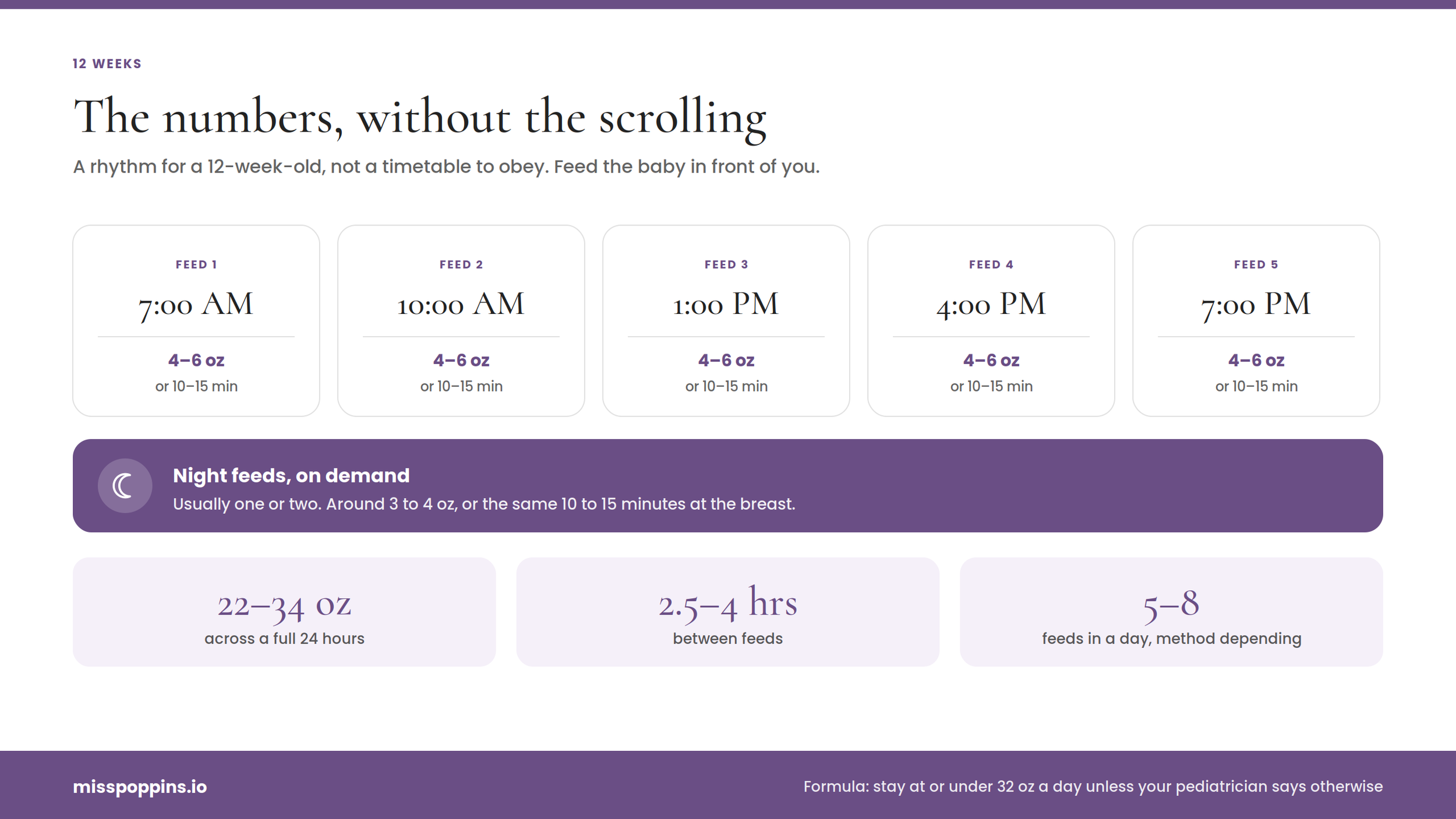
Typical Feeding Frequency for a 3-Month-Old Infant
Standard pediatric metrics dictate 5 to 7 feeds per 24 hours. By the third month, your baby has graduated from the chaotic newborn phase. Their stomach capacity has grown significantly. They no longer need to eat every 90 minutes.
For healthy infants, the total amount of milk they need to consume per 24 hours ranges from 22 to 34 ounces. Guidelines from the American Academy of Pediatrics (AAP) clearly state that to successfully wean off night feedings, the only way is to finish all that milk during the daytime. To achieve this, one must follow the universal pediatric feeding standards, which stipulate that babies should be fed 5 to 7 times every 24 hours.
Especially for babies who have reached the third month, they have already passed the newborn phase with irregular eating and sleeping patterns. Their stomach capacity is much larger than when they were just born, so they no longer need to eat every 90 minutes as they did right after birth. This puts them in a position to accumulate enough feeding times during the day, finish all the milk they need to consume throughout the day within their waking hours, and smoothly break the habit of needing to eat at night.
Real parents see this physiological shift clearly.
"Our boy was already maxing out on formula by 3 months! I think we generally did about 4oz bottles every 3 to 4 hours at that point, usually getting up to 28 to 32 oz a day." (via Reddit r/newborns, https://www.reddit.com/r/newborns/comments/1b8cdtp/how_much_was_your_baby_eating_at_three_months/ )
Formula vs. Breast Milk: 12-Week Milestones
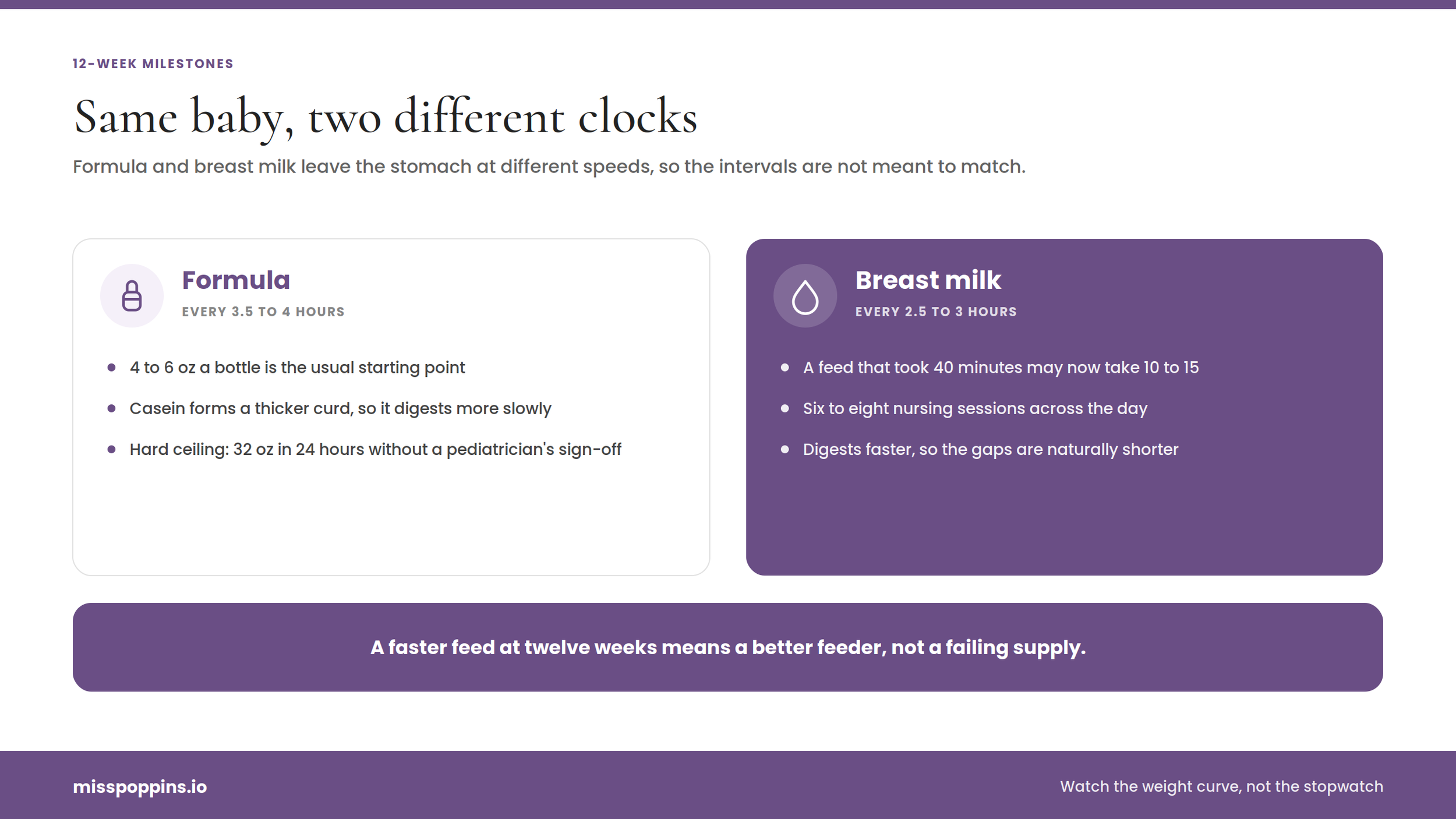
The volume and timing of your baby's meals depend heavily on what is actually in their stomach. Formula and breast milk digest at completely different rates due to their unique protein structures. You must adjust your expectations based on your feeding method.
How Much Formula Should a 3-Month-Old Drink Per Session?
If you are just starting to give your baby formula, prepare 4 to 6 ounces per bottle first, that is the most basic dosage standard. You may notice that formula is digested much slower than breastmilk, and it will not be fully digested as quickly as breastmilk.
This is because the casein contained in formula forms a thicker curd when it enters the baby's stomach, which is harder to break down than the curd formed by breastmilk, naturally slowing down the entire digestion process. Precisely because digestion is slower, babies fed formula do not need to be fed as frequently: you can usually extend the interval between two feedings to a full 3.5 or 4 hours, instead of having to top up their feeding shortly after like you would for a breastfed baby.
However, there is a hard line for this dosage that must never be crossed arbitrarily. Even if your baby always seems to have not had enough, you must not break this upper limit without authorization. If you have not directly consulted your baby's pediatrician in advance and obtained their approval, the total amount of formula fed to your baby within any consecutive 24-hour period must never exceed 32 ounces.
If you persist in the mindset that "feeding more can't hurt" and overfeed your baby every day, the first consequence will be that your baby's delicate stomach walls will be stretched out of shape. It may also trigger severe gastroesophageal reflux, which means your baby will frequently spit up large amounts of milk, choke on milk, and may even follow an unhealthy weight gain trajectory, gaining weight too quickly or too slowly, both of which are inconsistent with the baby's developmental pattern.
The Centers for Disease Control and Prevention (CDC) has also specifically reminded all parents never to overfeed a fussy baby just to soothe them; this practice of stopping crying through overfeeding is completely inadvisable.
By sorting out the respective dosages of formula and breastmilk for when your baby reaches 3 months old, you will know exactly how much milk to put in the bottle each time, and you will no longer worry needlessly about whether you are overfeeding, creating a lot of unnecessary anxiety for yourself.
The Breastfeeding Rhythm at 3 Months
If you are nursing, 12 weeks marks a massive physiological shift. Nursing efficiency radically increases. A feed that used to take 40 agonizing minutes may now take 10 to 15 minutes.
This speed terrifies many mothers. They assume their milk supply has crashed. It has not. Your baby simply became an expert at extracting milk. Their jaw muscles are stronger. They latch better. The World Health Organization (WHO) supports exclusive breastfeeding for the first six months, noting that supply regulates to meet the exact demand of the infant. Do not panic and start aggressively pumping unless your pediatrician notes a drop in the baby's weight curve.
Sample Daily Feeding Routine for a 3-Month-Old
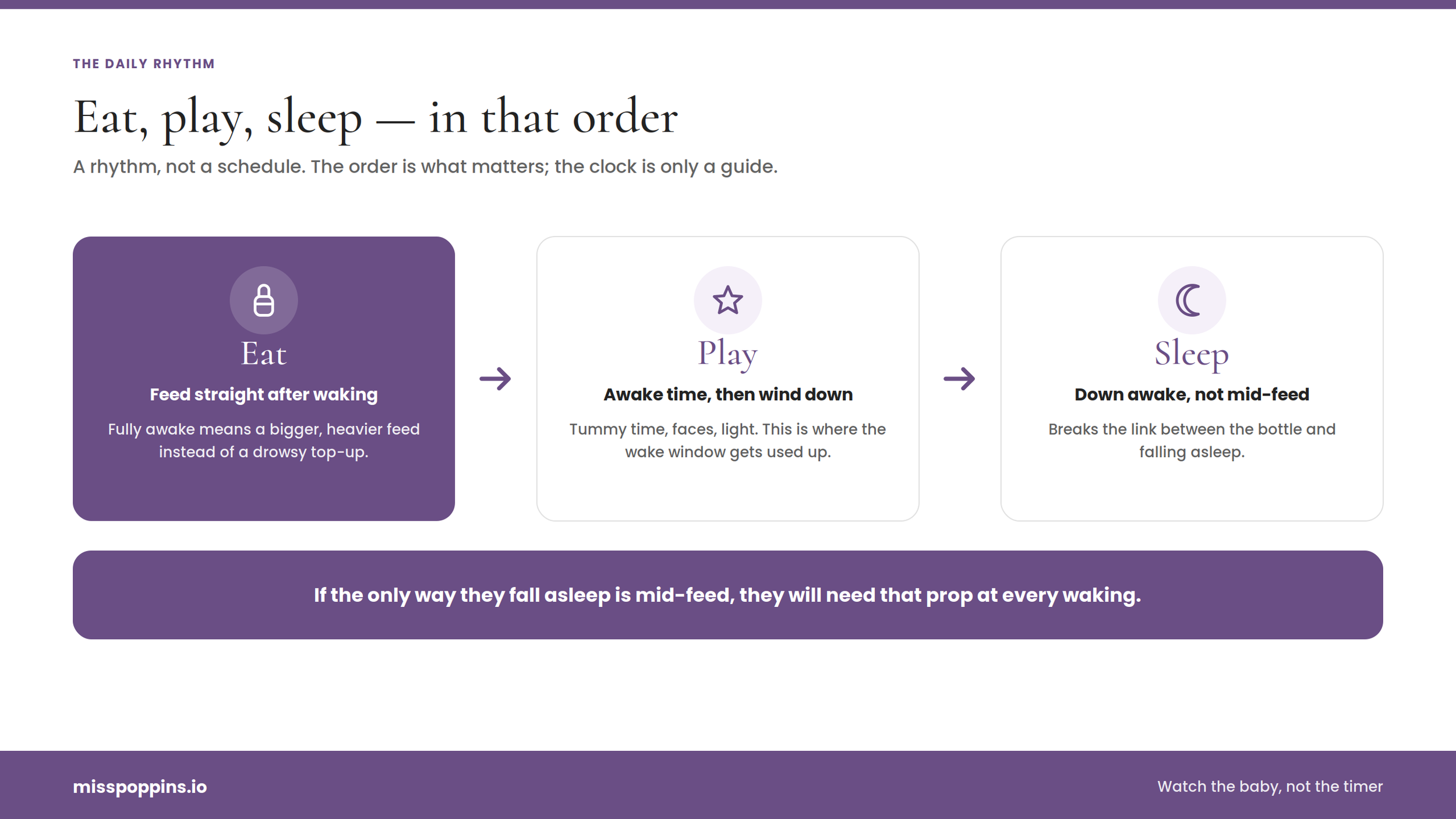
We call this a rhythm, not a schedule. Rigid clocks fail because babies are humans, not factory machines. A rhythm creates predictability without the stress of watching the minutes tick by.
The "Eat, Play, Sleep" Dynamic
You must feed immediately upon waking. This is non-negotiable for building healthy sleep habits. Feeding right after a nap ensures the baby is fully awake and has the energy to take a massive, heavy feed. This sequence is the ultimate key to preventing drowsy snacking so baby gets full feeds.
It also completely dissociates feeding from falling asleep. If a baby only knows how to fall asleep with a bottle or a breast in their mouth, they will demand that same prop every time they wake up slightly between sleep cycles at night.
"We've never really put our 3 month old on a strict schedule. He's worked it out himself. He eats about every three hours like clockwork... If he does eat more, he spits up A LOT." (via Reddit r/newborns, https://www.reddit.com/r/newborns/comments/1htj9hr/typical_schedule_for_a_3_month_old/ )
Adjusting the Schedule for Longer Sleep Stretches
Night sleep is built during the day. You must pack daylight hours with calories. Balancing calorie intake during the day to help consolidate night sleep physically allows a 5 to 8-hour stretch of uninterrupted rest. The American Academy of Sleep Medicine (AASM) notes that sleep consolidation begins around this age, provided nutritional needs are met during waking hours.
If they do not get those 24 to 30 ounces before sunset, they will wake up in the dark and demand them. For more context on this transition, review the typical night feeding expectations for 3-month-olds.
Reading the Cues: Managing the 12-Week Growth Spurt
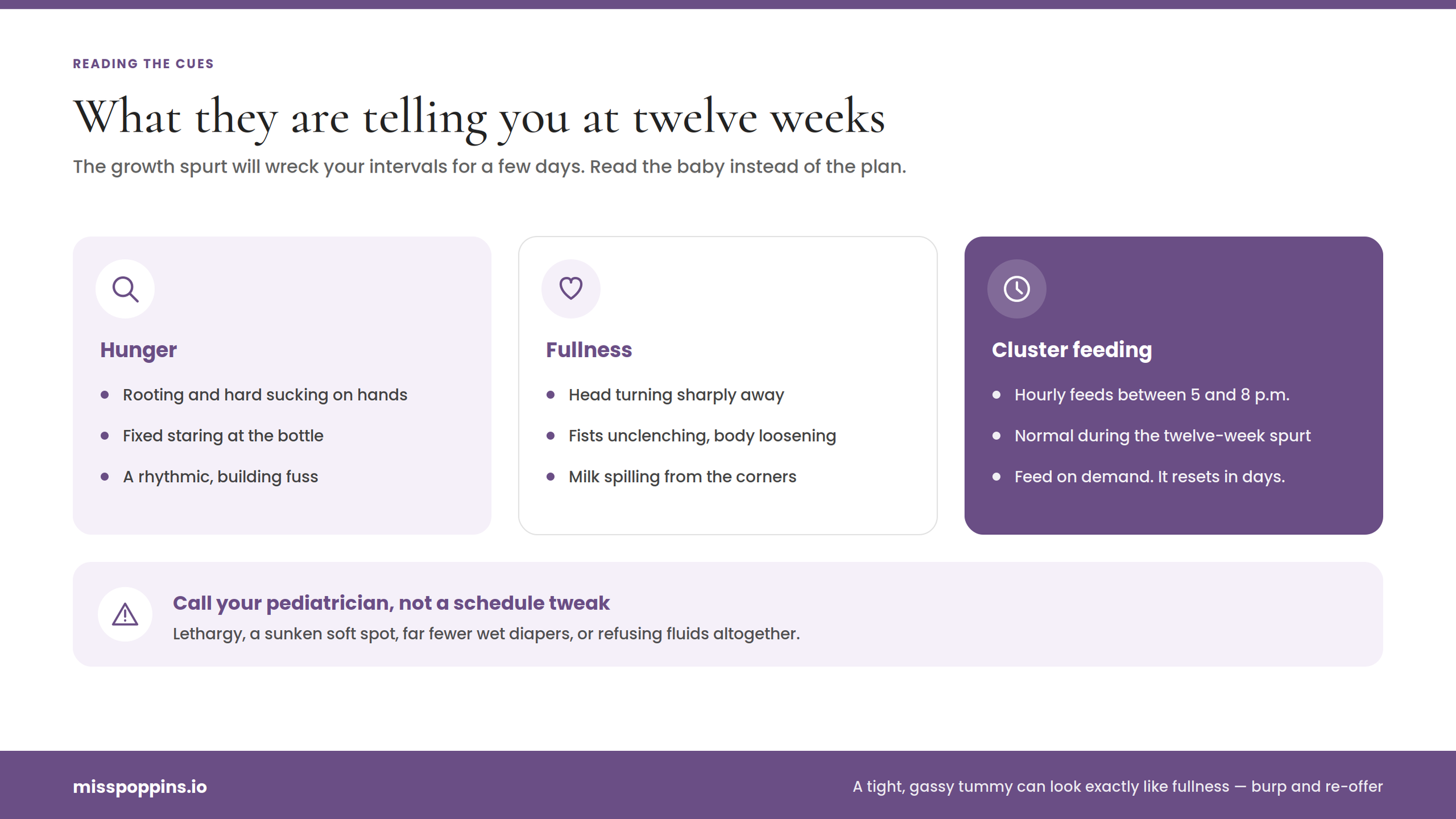
Schedules look great on paper until your baby hits a developmental leap. The 12-week mark brings a massive growth spurt. Your perfect 3-hour intervals will temporarily disintegrate. You need to know how to read the physical signs to avoid starvation-induced meltdowns.
Signs of Hunger and Fullness in a 3-Month-Old Baby
Hunger cues change at this age. They are less subtle than newborn cues but still require attention.
Hunger: Rooting, aggressively sucking on hands, intense staring at the bottle, and a specific rhythmic fussing.
Fullness: Turning the head sharply away, relaxing their fists, letting milk spill from the corners of their mouth, or simply stopping.
Make sure you use proper burping techniques after full daytime feeds. A baby with a trapped gas bubble will show fullness cues because their stomach feels tight. Burp them, wait two minutes, and offer the food again.
What to Do If a 3-Month-Old Is Refusing to Eat Enough
The 3-month nursing crisis (or bottle aversion) is a documented behavioral shift. At this age, a baby's vision improves dramatically. They suddenly realize the world is incredibly interesting. They will unlatch from the breast or push the bottle away just to stare at the dog walking past the door or a ceiling fan spinning.
Daycare schedule conflicts and partner disagreements at 3:00 AM make this refusal even harder to manage. The solution is a low-stimulation environment. Feed them in a dark, quiet room with white noise playing. Back off immediately if the baby arches away aggressively. Forcing a feed creates a psychological aversion.
If they show signs of lethargy, sunken fontanelles, or a lack of wet diapers, stop reading and call your pediatrician immediately.
The Cluster Feeding Clause
During a 12-week growth spurt, the standard schedule goes entirely out the window. Your baby might demand to eat every 60 minutes between 5:00 PM and 8:00 PM. This is called cluster feeding.
Feed on demand. Do not try to hold them off. They are rapidly signaling your body to produce more milk or simply demanding the extra calories required to build new brain tissue. You are heavily managing 3-month wake windows alongside feeding cues during this phase. Survive the evenings, let them eat, and the schedule will reset in a few days.
The "Snacking" Trap & 4-Month Regression Preparation
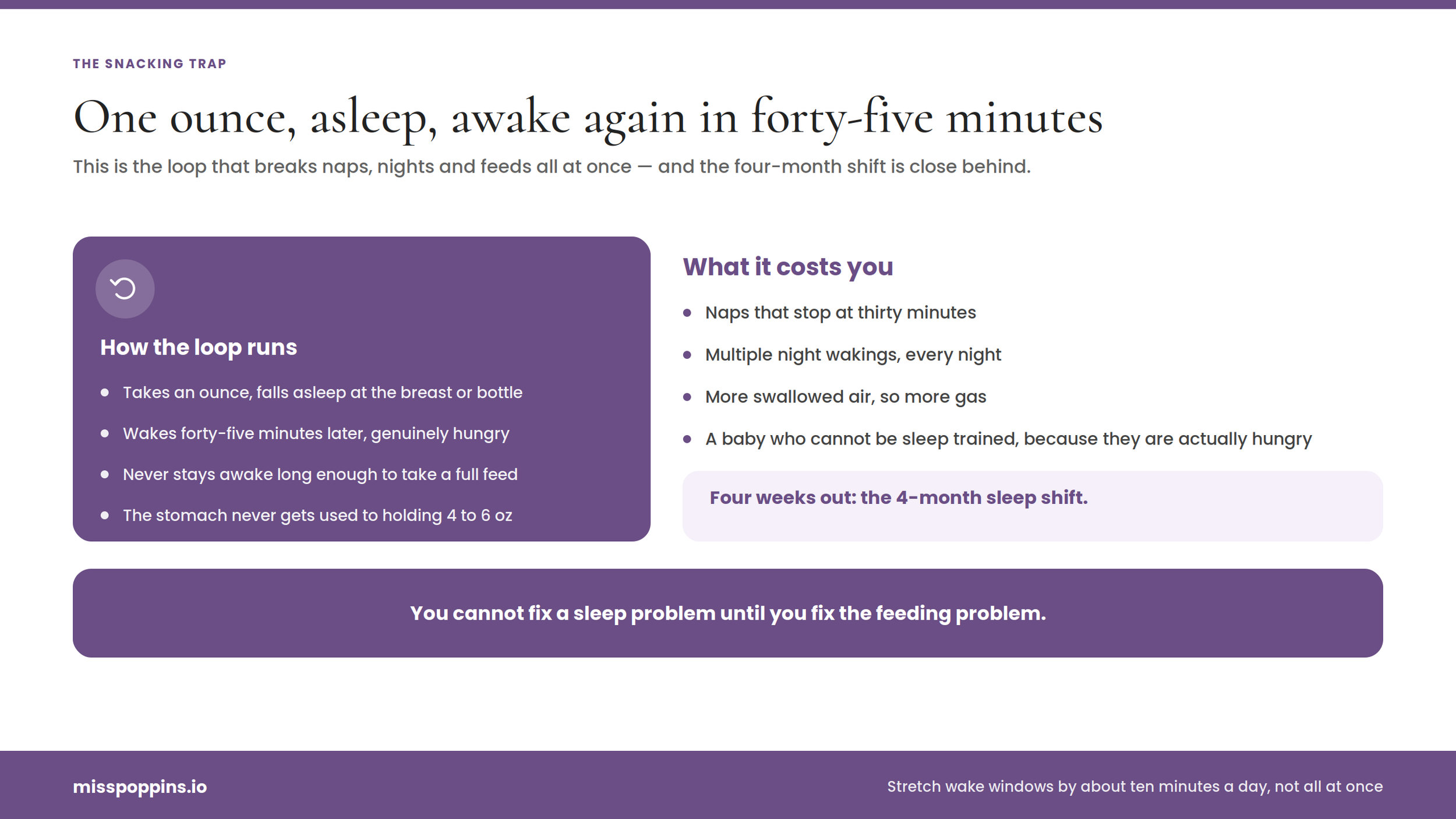
This is the most critical warning in this guide. If your 3-month-old is taking one ounce, falling asleep, and waking up crying 45 minutes later, your schedule is entirely broken.
This snacking cycle destroys their ability to take a full feed. Their stomach never stretches to hold the required 4 to 6 ounces. It ruins their daytime naps because they wake up from genuine hunger after 30 minutes. It absolutely guarantees they will wake up multiple times a night.
"Avoid short snacking for baby, make sure baby gets a good feed. Since I squeezed an additional feed before the bedtime, it became easier to follow Eat Play Sleep with 4 naps." (via Reddit r/sleeptrain, https://www.reddit.com/r/sleeptrain/comments/qn0uwt/good_sleep_habits_for_35_month_okd/)
Worse, you are exactly four weeks away from the infamous 4-Month Sleep Regression. At four months, a baby's sleep architecture permanently changes from two stages to four stages. They will wake up fully between every single sleep cycle.
If your baby is trapped in a snacking cycle right now, the upcoming regression will completely shatter whatever fragmented sleep you are currently getting. You cannot fix a sleep problem until you fix the feeding problem. A baby who is genuinely hungry cannot be sleep trained.
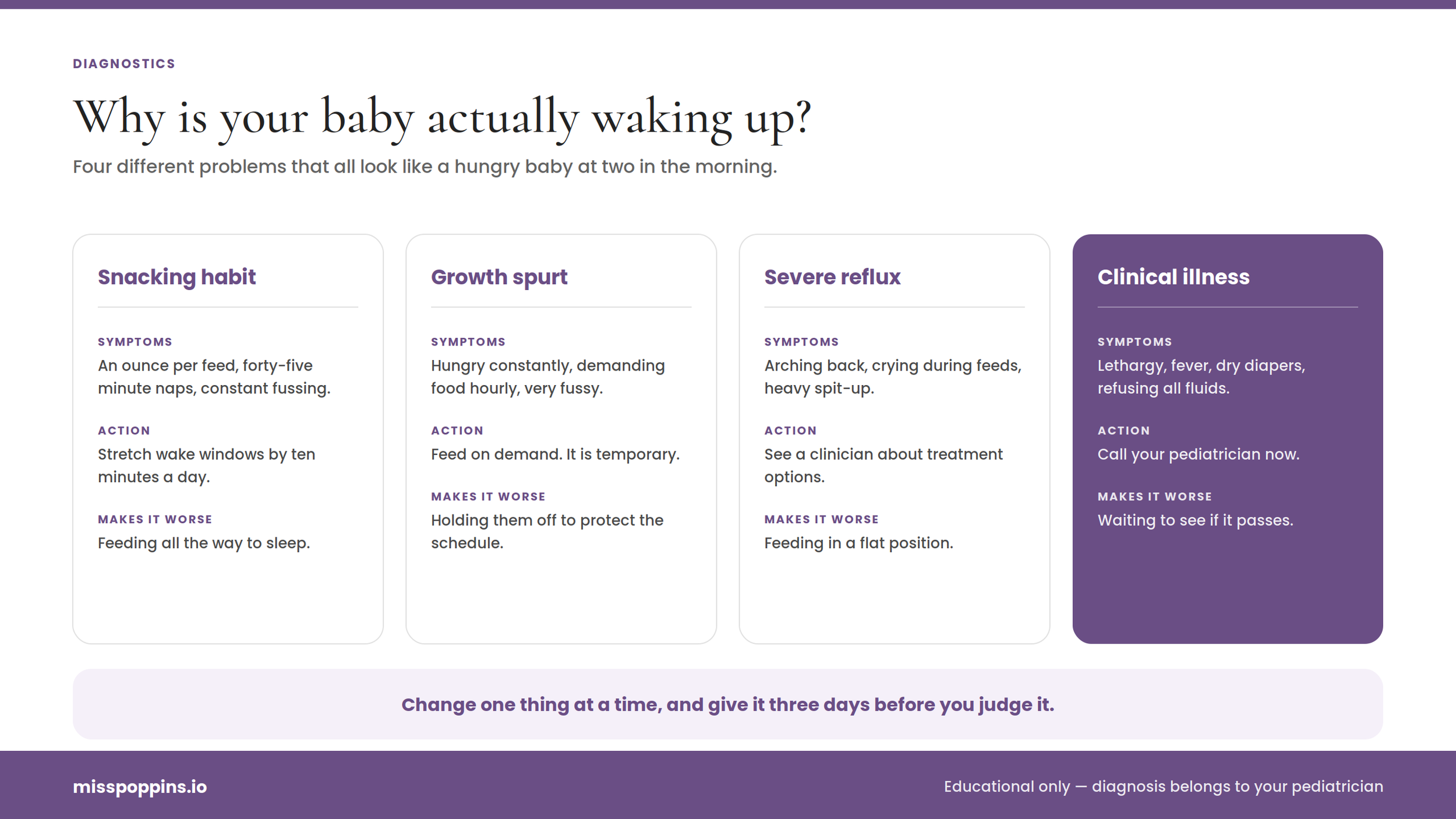
Diagnostics: Why Is My Baby Waking Up?
Before you change your schedule, you must isolate the root cause. Compare the symptoms below to determine your next action.
Stop Guessing. Call an Expert.
You do not have to wait out the snacking phase in misery. You do not have to panic about the incoming sleep regression while digging around for a pacifier in the dark. The best time to intervene is right now.
In our coaches' experience working with thousands of families, guessing only prolongs the exhaustion. Staring at confusing internet charts will not fix your baby's unique temperament.
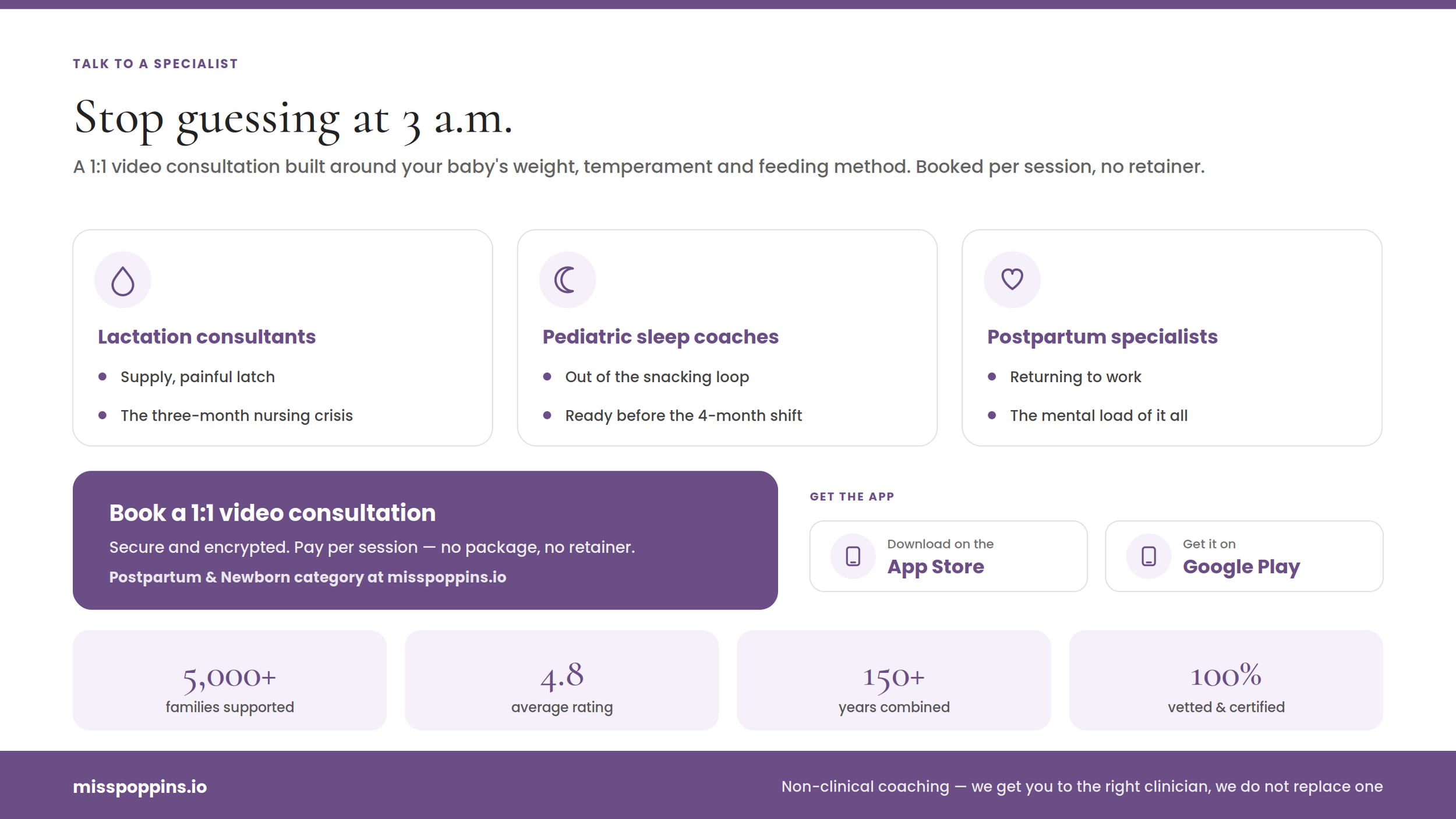
MissPoppins connects you with certified experts in Newborn Care and Postpartum Support. Stop relying on algorithms and get a customized action plan tailored to your baby's exact weight, temperament, and feeding method.
Lactation Consultants: To optimize milk supply, fix painful latching issues, or handle the 3-month nursing crisis safely.
Pediatric Sleep Coaches: To gently transition your baby from a chaotic snacking loop into a predictable "Eat, Wake, Sleep" rhythm before the regression hits.
Postpartum Specialists: To support your transition back to work, manage the mental load of early motherhood, and help you regain your footing.
As Sarah Jenkins, Certified Pediatric Sleep Coach at MissPoppins, explicitly notes: "Rhythms matter more than rigid clocks. Watch the baby, not the timer."
Browse our hand-picked community of certified professionals in the Postpartum & Newborn, Pediatric Sleep Coaches, & Lactation Consultants category at MissPoppins and book a secure, 1:1 video consultation today. Get real-time answers from a real human expert.
5,000+ families supported
4.8-star average rating
150+ years of combined clinical and coaching experience
Strictly vetted and certified coaches
Private and fully encrypted sessions
Download the MissPoppins app on the App Store and Google Play today to book your consultation directly from your phone.
FAQs
How often should I feed my 3-month-old?
At 3 months old, babies generally feed every 2.5 to 4 hours. Breastfed babies typically nurse 6 to 8 times a day, while formula-fed babies take a bottle 5 to 6 times a day.
How much should a 3-month-old eat in 24 hours?
The standard intake for a 12-week-old is between 22 and 34 ounces in a 24-hour period. Formula-fed babies max out around 32 ounces per day, taking 4 to 6 ounces per bottle.
Is 4 oz too much for a 3-month-old?
No. 4 to 6 ounces per feeding is the exact biological capacity for a standard 3-month-old stomach. If they are keeping the milk down and not showing signs of severe reflux, 4 ounces is perfectly normal.
Can a 3-month-old go 4 hours between feedings?
Yes, especially if they are formula-fed and taking larger 5 or 6-ounce bottles. However, you should always follow your baby's hunger cues. If they are showing signs of hunger at 3 hours, feed them immediately.
How do I transition a 3-month-old to a solid feeding schedule?
You absolutely do not. Pediatric medical consensus strictly forbids introducing solid food at 3 months due to severe choking risks and an undeveloped digestive system. This is a vital reminder that solids should not be introduced at 3 months. Solids wait until 4 to 6 months.
When should I increase milk intake for a growing 3-month-old?
You should increase bottle volume by 0.5 to 1 ounce if your baby is consistently draining their current bottles and actively looking for more, or during the 12-week growth spurt when hunger drastically increases.
What are the best feeding bottles to reduce gas in a 3-month-old?
Anti-colic bottles with vented nipples help, but the best way to reduce gas is to stop snacking. Frequent, short feeds cause a baby to swallow more air. Consolidated, full feeds drastically reduce gas buildup in the intestinal tract.
Disclaimer: This is educational content. MissPoppins coaches are non-clinical professionals. If your baby exhibits signs of illness, severe pain, breathing issues, or prolonged feeding refusal, stop reading immediately and call your pediatrician.