

When Do Babies Hold Their Own Bottle? (Timeline & Safety Milestones)
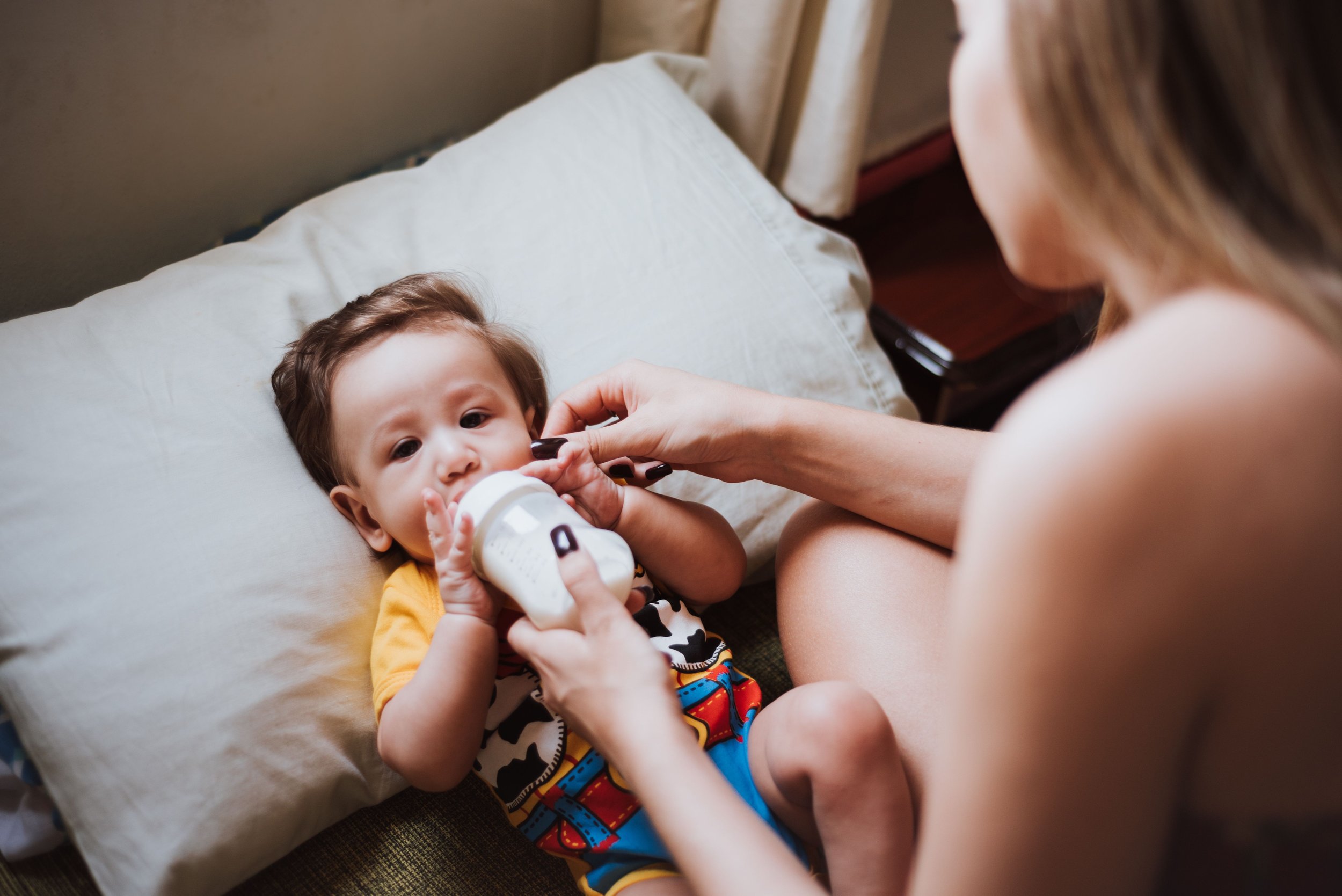
Babies typically develop the complex motor skills required to hold their own bottle between 6 and 10 months of age. While reflexive grasping appears between 3 and 5 months, true independent feeding demands advanced hand-eye coordination, midline crossing, and core stability. Caregivers must always supervise feeds. Bottle propping is unsafe and significantly increases the risk of aspiration.
The Developmental Timeline for Bottle Holding
Infants do not wake up one day with the ability to manage a bottle. The process is a gradual sequence of motor skill acquisitions. It takes months of neurological development.
3 to 5 Months (Exploration): Early exploration begins here. Your baby will start bringing their hands to the midline of their body. They will pat the bottle. They will wrap their tiny fingers around yours while you hold the base. Do not confuse this with independence. They do not have the strength or proprioception to manage the weight or the angle of the milk flow.
6 to 7 Months (Assistance): True assistance starts in this window. Babies at this age can typically sit with support. Their core stability improves dramatically. You will notice them grasping the bottle firmly and guiding it to their mouth. You still need to support the base. The American Academy of Pediatrics (AAP) notes that solid food introduction typically begins around six months. This accelerates oral-motor development. If you are choosing ergonomic bottles and appropriate flow rates for self-feeding, this is the exact time to introduce wider, easily grippable silicone bases.
8 to 10 Months (Mastery): Mastery occurs late in the first year. The baby can sit completely independently. They can lift a full eight-ounce bottle, tip it back to maintain milk flow, and remove it to take a breath. They will drop it. They will pick it back up. They are in control.
Early Signs of Readiness vs. Reflexive Grasping
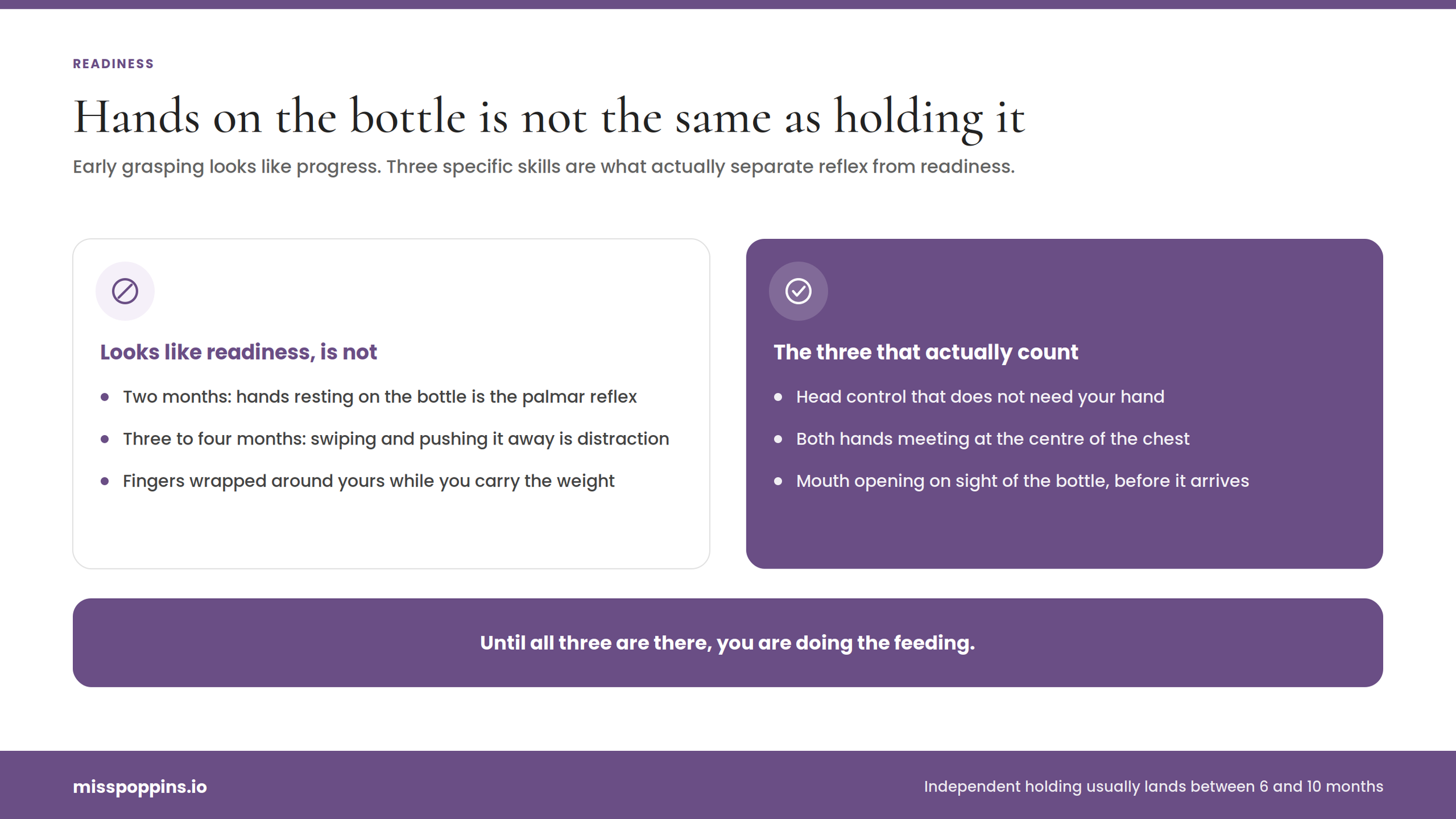
Parents often mistake early newborn reflexes for developmental readiness. A two-month-old resting their hands on the bottle is exhibiting a natural palmar reflex. It is not intentional feeding.
By three or four months, babies become highly distracted. They will swipe at the bottle. They will try to push it away to look at the dog. This is exploration. True readiness requires three distinct physical achievements.
First, independent head control. Second, the ability to bring both hands to the center of the chest simultaneously. Third, the capacity to open the mouth intentionally when the visual cue of the bottle approaches. Until all three are present, you are doing the feeding.
Critical Supervision: The Lethal Risk of Bottle Propping
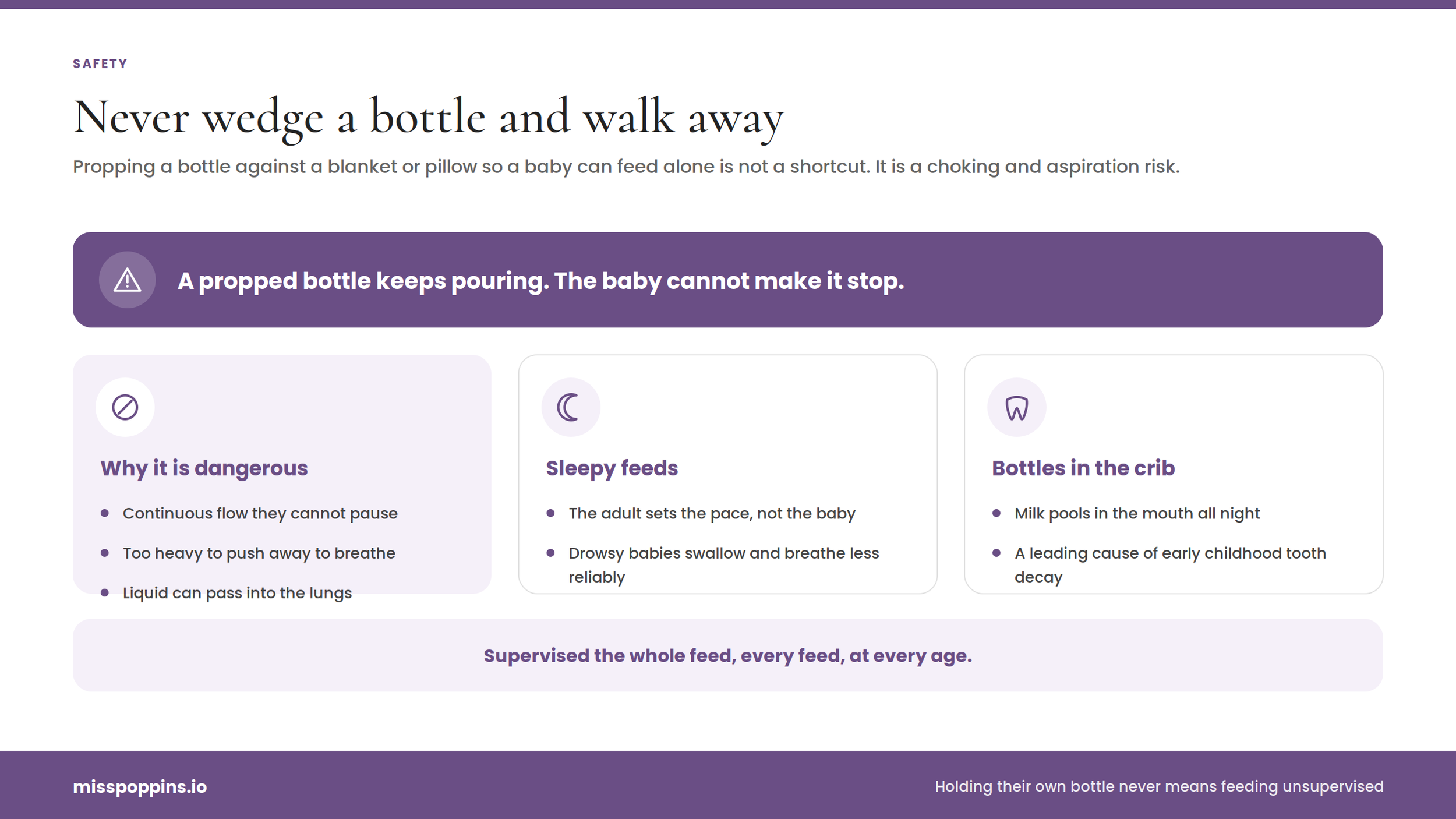
You must never prop a bottle. Wedging a bottle against a rolled-up blanket or a nursing pillow so the baby can feed unsupervised is a severe safety hazard.
Propping forces a continuous flow of liquid into the baby's mouth. They cannot push the heavy bottle away if they need to breathe or if the flow becomes overwhelming. This leads directly to fluid aspiration into the lungs. Understanding safety guidelines and why bottle propping increases choking risks is non-negotiable for anyone caring for your child.
Sleep-feeding presents similar risks. Caregivers should dictate the pace of nighttime feeds. This is exactly why caregivers, not the baby, should control the bottle during sleepy feeds.
Furthermore, allowing a baby to hold a bottle in their crib overnight guarantees milk pooling in the oral cavity. This practice is the primary cause of early childhood caries (tooth decay). Parents must prioritize preventing toddler dental decay and baby teeth care from continuous or bed-time bottle holding.
Concurrent Fine-Motor Feeding Milestones
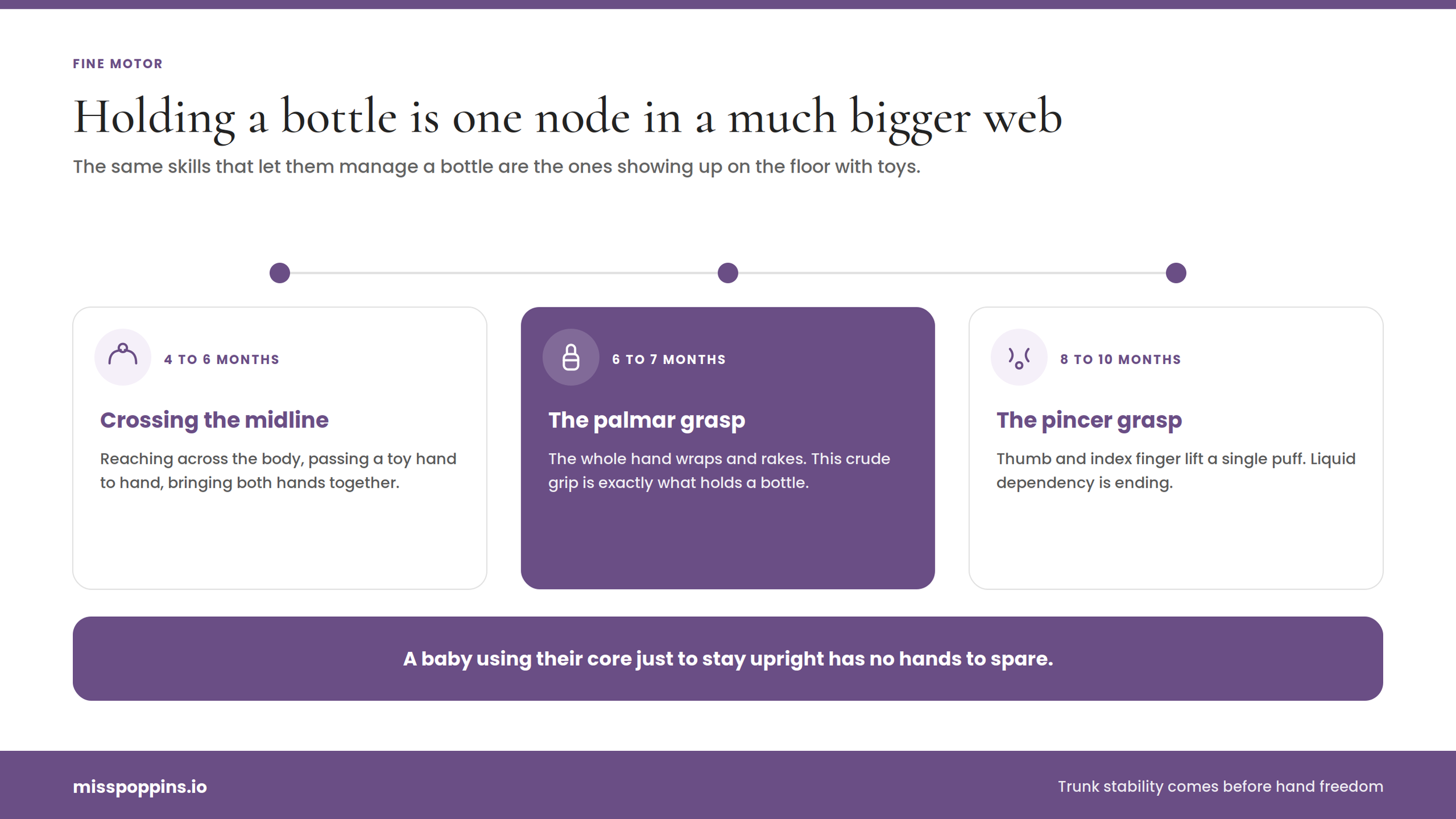
Holding a bottle is not an isolated event. It is a highly visible node in a much larger web of fine-motor development. When a baby learns to hold a bottle, they are proving their central nervous system is maturing properly.
Crossing the Midline and Trunk Stability
Around 4 to 6 months, a baby learns to cross the midline. This means they can reach across their body with their right hand to grab a toy located on their left side. They can also bring both hands together at the center of their chest.
Passing a toy from hand to hand is the biological prerequisite for holding a bottle centrally. If a baby cannot bring their hands together, they cannot manage the two-handed grip required to support the shifting weight of liquid. You will see these crucial developmental readiness signs appearing around 6 months. Trunk stability also plays a massive role here. A baby cannot use their hands freely if they are using their core muscles just to keep from falling over.
The Evolution from Palmar to Pincer Grasp
Infants start with a palmar grasp. They use their entire palm and all their fingers to rake objects toward them. This crude, whole-hand wrap is exactly what they use to hold a bottle.
As they approach 8 to 10 months, you will see a biological shift. They develop the pincer grasp. This involves using the thumb and index finger to pick up small objects. While the palmar grasp handles the heavy bottle, the pincer grasp is what allows them to pick up a single puff from their highchair tray. This fine motor skill progression and independent feeding marks the transition from liquid dependency to solid food readiness.
When to Intervene: Red Flags in Motor Development
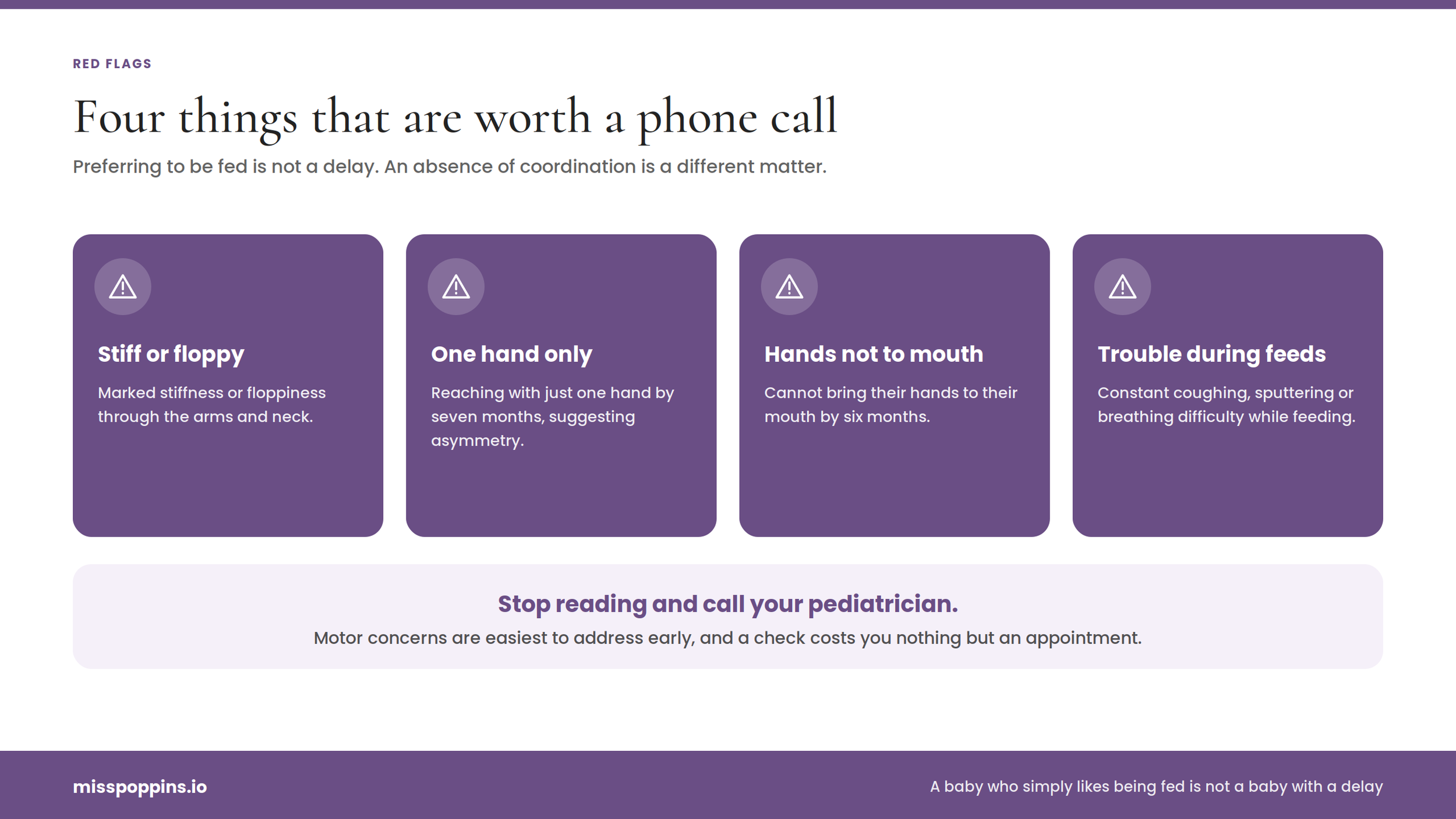
Sometimes a baby simply prefers that you hold the bottle. It is a bonding experience. However, an absolute lack of hand-eye coordination warrants professional attention.
Stop reading and call your pediatrician if your baby exhibits any of the following:
Extreme stiffness or floppiness in their arms and neck.
Only uses one hand to reach for objects by 7 months (indicating potential asymmetry).
Cannot bring their hands to their mouth by 6 months.
Experiences constant coughing, sputtering, or breathing difficulty during feeds.
"In our coaches' experience working with thousands of families, parents often stress over a baby who refuses to hold the bottle at 8 months. Nine times out of ten, the baby has the motor skills but simply enjoys the luxury of being fed. We look at their play habits on the floor to confirm the motor skills are actually present."
Sarah Jenkins, Certified Pediatric Sleep Coach at MissPoppins
In our internal data tracking over 5,000 infant profiles, nearly 40% of babies who physically could hold their bottle at 8 months actively chose not to during the evening feed, preferring parental contact.
Transitioning from Bottle Holding to Cup Drinking
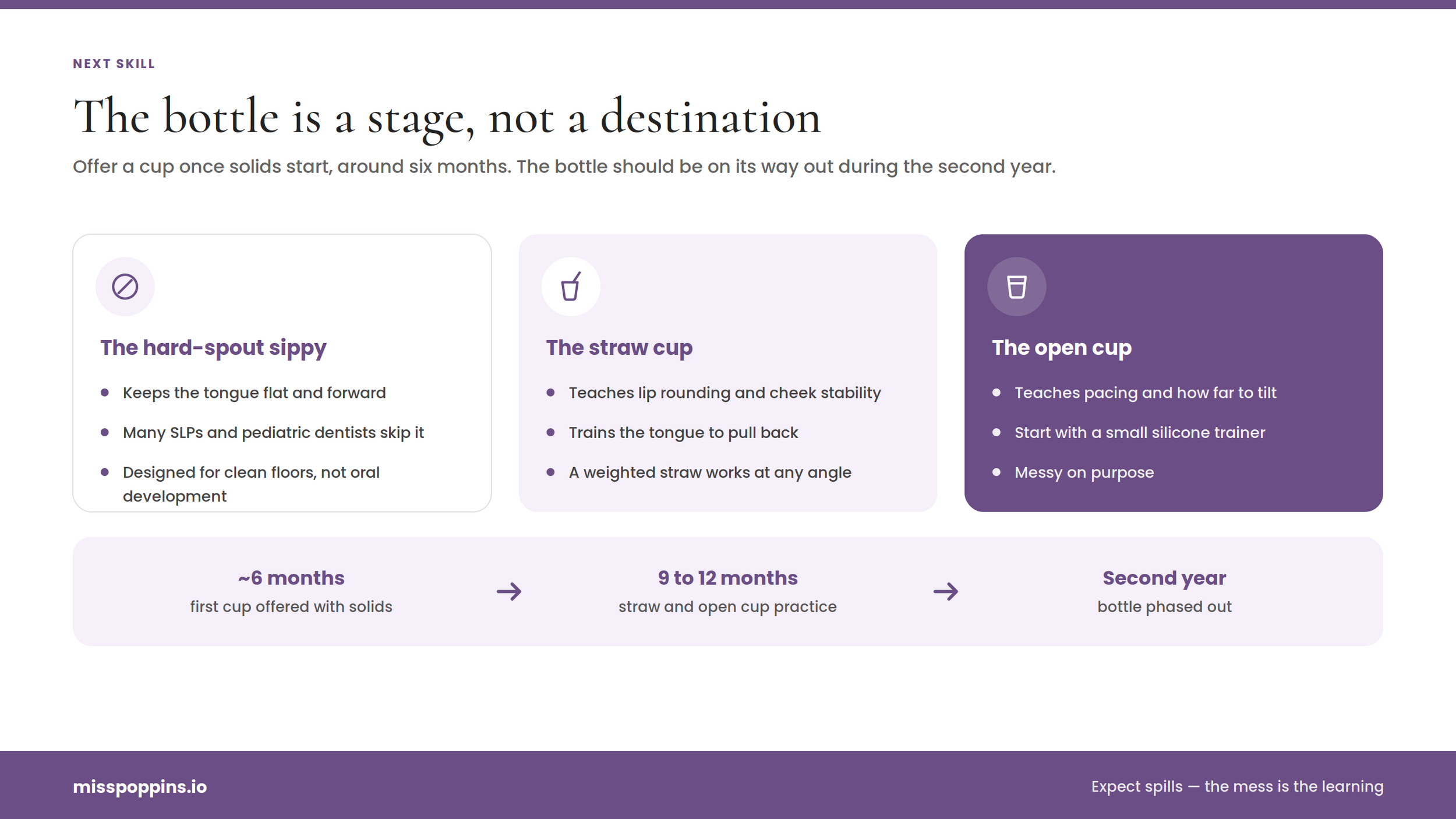
Right when a baby masters holding the bottle, pediatricians recommend preparing to take it away. The AAP suggests phasing out bottles entirely between 12 and 24 months. The transition requires a completely different oral-motor skill set.
Why Modern Pediatricians Reject the Sippy Cup
Sippy cups were invented by mechanical engineers to keep parents' floors clean. They were not designed by pediatric speech pathologists for infant oral development.
Hard-spout sippy cups force a baby to use an infantile suckle pattern. The tongue thrusts forward and sits flat under the hard plastic spout. Prolonged use can negatively impact palate formation, delay speech development, and alter the resting position of the tongue. Modern dental advice advocates bypassing traditional sippy cups entirely. This creates a massive friction point for parents who want a spill-proof solution, but the developmental trade-off is significant.
Introducing the Straw Cup and Open Cup
You should begin transitioning from holding a bottle to open cups or straw cups around 9–12 months.
Straw cups require lip rounding, cheek stability, and complex tongue retraction. Open cups teach pacing. A baby must learn how far to tilt the cup without pouring water down their shirt. Start with small silicone training cups or weighted straw cups. A weighted straw allows the baby to drink from any angle, mimicking the flexibility they had with a bottle.
Expect spills. Expect a mess. You will clean the floor a lot. It is a necessary phase of neurological learning.
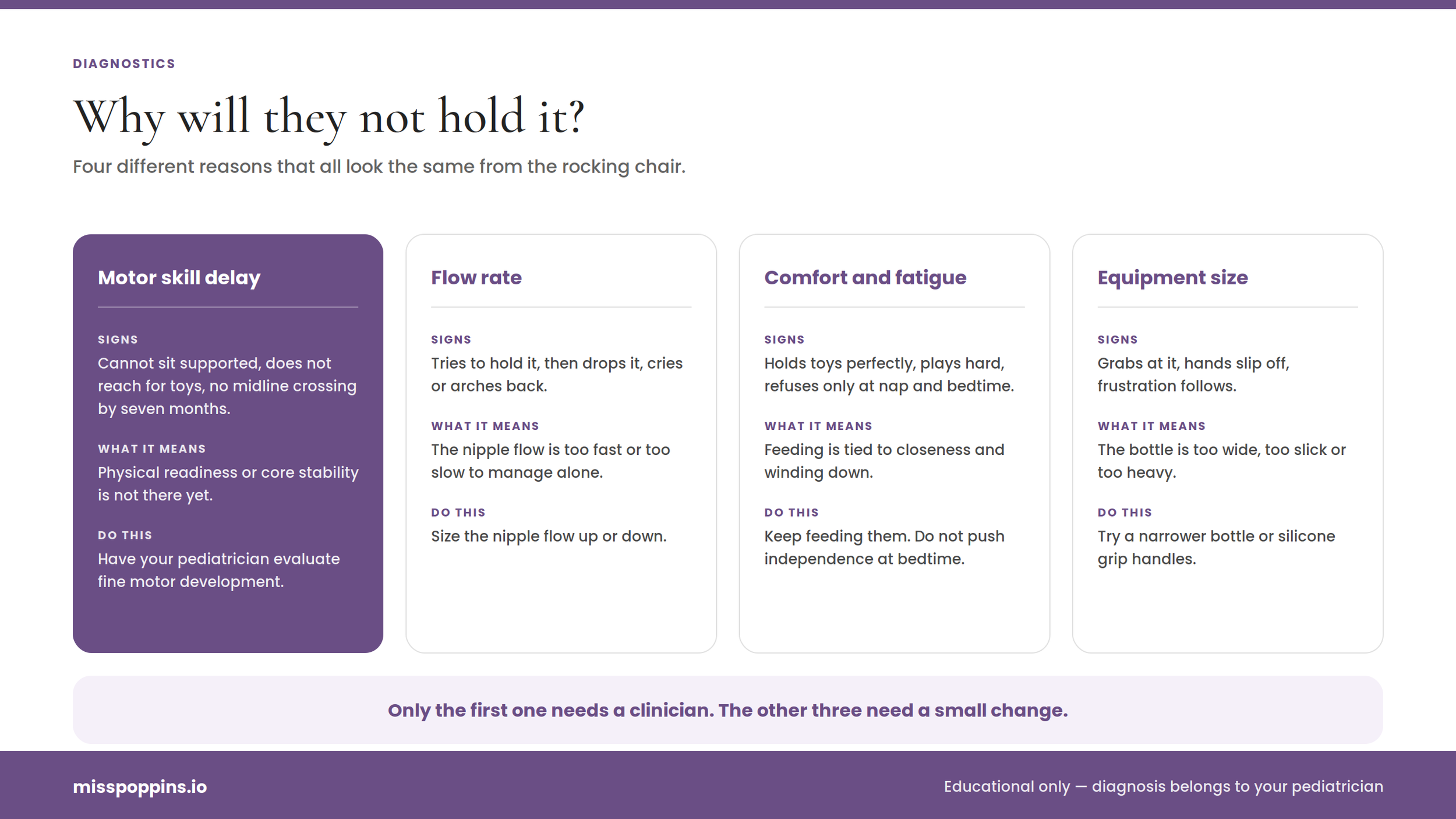
Differential Diagnosis: Why Is My Baby Refusing to Hold the Bottle?
Use this framework to identify the root cause of bottle refusal.
The Reality Check for Exhausted Parents
Let us look at the reality of modern parenting. You are exhausted. It is 3:00 AM. Your partner is asleep. You have to be up for a Zoom meeting in four hours. The idea of your baby holding their own bottle sounds like a literal lifeline.
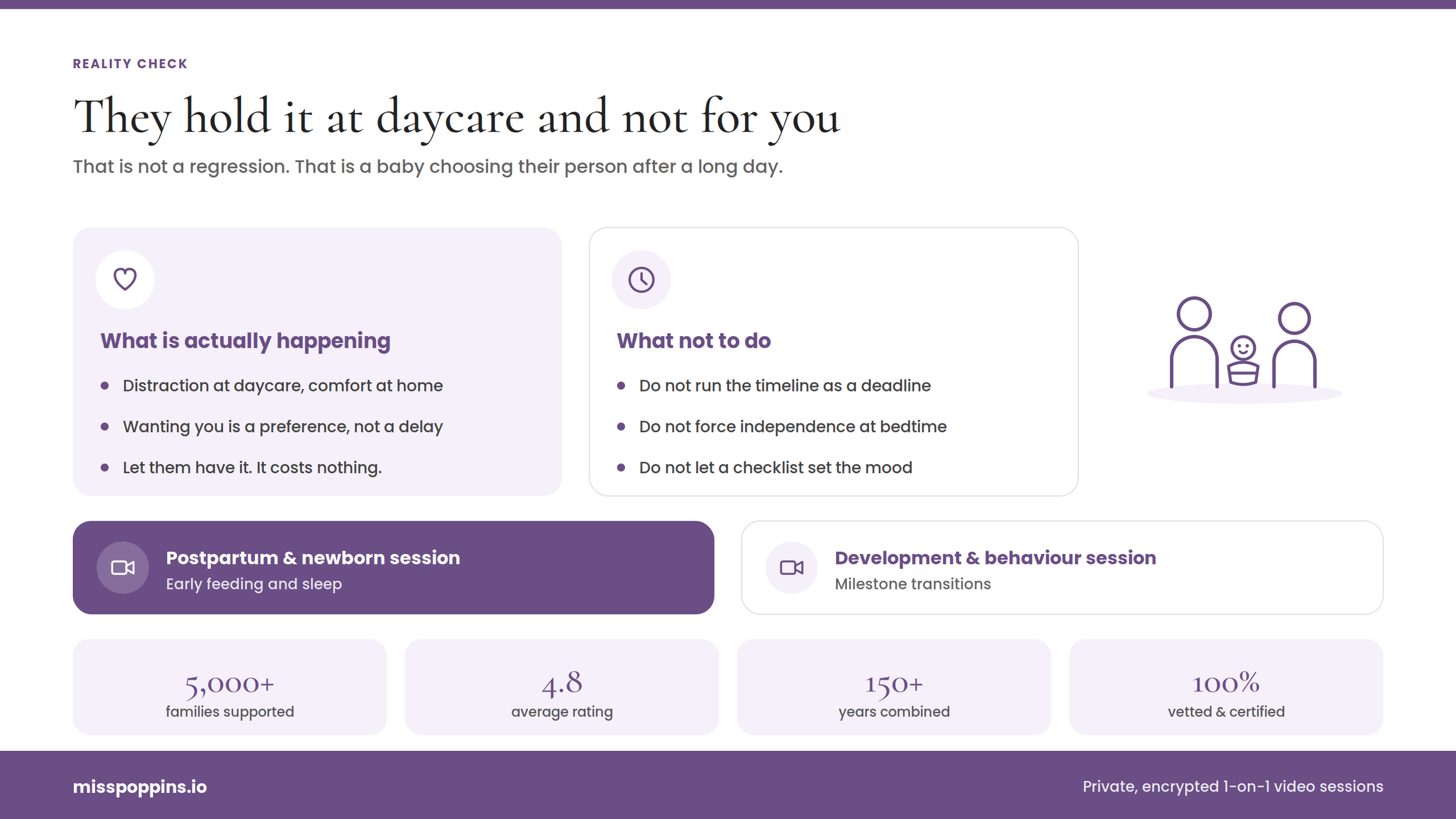
Competitors and influencer mom-blogs will tell you a rigid timeline is everything. The truth is much messier. Daycare schedules conflict with home schedules. A baby might hold a bottle perfectly for the daycare provider because they are distracted by other children, only to demand you hold it the minute they get home.
They are not regressing. They are demanding the blue blanket instead of the green one. They are demanding the comfort of their primary caregiver after a long day of sensory overload. Let them have it. Do not let a checklist amplify your anxiety.
If feeding transitions are causing friction in your home, our certified coaches can evaluate your specific schedule and build a system that works.
Book a Postpartum & Newborn Support Session to navigate the early days of feeding and sleep.
Book a Development & Behavior Session if you need strategic guidance on milestone transitions.
5,000+ families supported globally
4.8-star average rating
150+ years of combined pediatric and sleep experience
Vetted, certified non-clinical coaches
Private, encrypted 1-on-1 video sessions
FAQs
Is it normal for a 7-month-old to refuse holding their bottle?
Yes. Complete refusal at 7 months is incredibly common. Many babies view feeding as a time for comfort and physical connection. If your baby is successfully transferring blocks between their hands and sitting with support, their motor skills are likely fine. They are simply choosing to let you do the work.
How do I teach my baby to hold his own bottle?
You can encourage it by placing their hands over yours while you feed them. Use lightweight bottles or add silicone grip handles. Never force it. If they drop it or become frustrated, step in and assist immediately.
Why does my baby hold the bottle for water but not for formula/milk?
Water is usually given in a lighter, smaller training cup during playtime when the baby is alert and sitting upright in a highchair. Formula or breastmilk is often given during wind-down routines in a rocking chair. When a baby is tired, they revert to passive behaviors. They want you to hold the milk bottle because they are preparing for sleep.
Is it normal for a 3 month old to hold their own bottle?
A 3-month-old may rest their hands on a bottle as a reflex, but they lack the intentional motor control, core stability, and strength to hold and angle a heavy bottle independently. Full independent holding happens closer to 6 to 10 months.
What is the hardest month for a baby?
Many parents find months 3 to 4 incredibly challenging. This period brings the four-month sleep regression, the fading of newborn reflexes, the awakening to environmental distractions, and the onset of early teething symptoms.
Will a baby starve by refusing a bottle?
A healthy baby will not intentionally starve themselves. However, prolonged bottle refusal can lead to rapid dehydration. If your baby refuses all fluids for more than a few hours and shows signs of dehydration (fewer wet diapers, lack of tears, sunken fontanelle), call your pediatrician immediately.