

Breastfeeding Workouts: Safe Postpartum Exercises That Protect Milk Supply

You can exercise while breastfeeding safely. Working out does not dry up your milk. It does not alter the nutritional value for your baby. To protect your supply, you only need to manage three variables. Drink water to replace sweat. Eat enough calories to sustain lactation. Wear encapsulation bras rather than tight compression gear.
You step off the treadmill, pump an hour later, and notice the bottle is half empty. Panic sets in immediately. You blame the workout. You assume the physical exertion somehow burned away your milk supply, so you cancel your gym membership and retreat to the couch.
This is the exact fear stopping most postpartum mothers from moving their bodies. It is also entirely based on a misunderstanding of human biology.
The verdict is clear. Moderate physical activity is safe. Exercise does not reduce your milk volume. According to guidelines published by the American College of Obstetricians and Gynecologists, physical activity has zero negative impact on infant weight gain. Instead, experts recommend exercise as a tool for stress reduction and mental health.
The danger lies in the logistics. Working out is fine. Starving yourself while working out is a disaster. Sweating heavily without drinking water ruins milk production. Squashing your breasts into a tight sports bra causes severe inflammation. If you fix the logistics, your supply remains completely safe.
Medical Disclaimer: This article is strictly educational. MissPoppins coaches provide non-clinical guidance. Always clear your exercise plan with an OBGYN or pelvic floor physical therapist. Stop reading and call your pediatrician if your baby develops a fever, refuses to feed entirely, or produces fewer than six wet diapers a day.
The Physiology of Exercise While Breastfeeding (Does It Affect Milk Supply?)
The Lactic Acid Myth Debunked
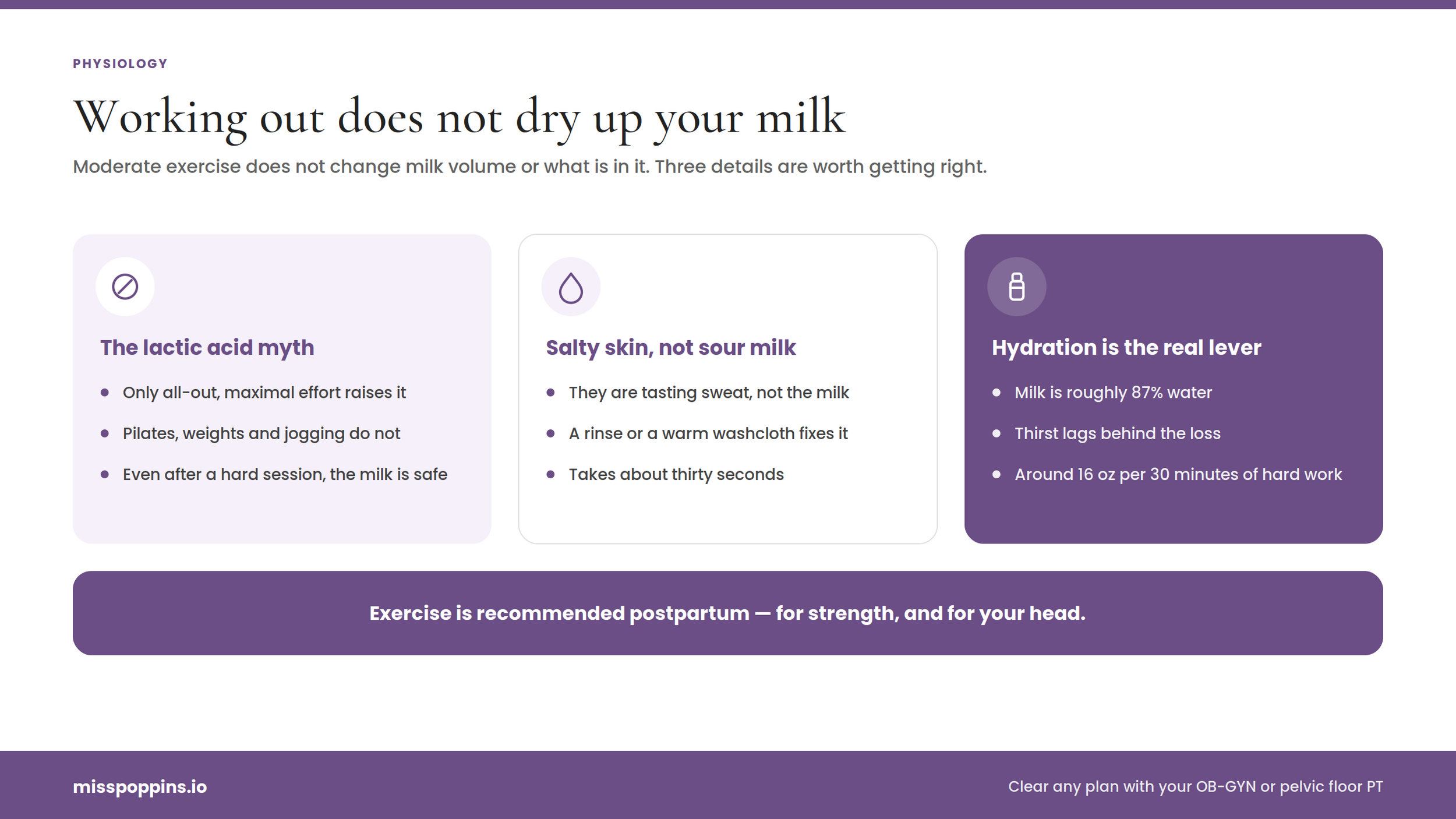
People will tell you that exercising makes your milk taste sour. They blame lactic acid. The clinical data says otherwise. Only maximal, anaerobic exertion pushes lactic acid into breast milk. We are talking about maximum-effort sprinting until you vomit, or competitive CrossFit competitions. If you are doing pilates, lifting weights, or jogging, your lactic acid levels remain stable.
Even if you do push yourself to the absolute limit, the resulting lactic acid is harmless. The National Institutes of Health (NIH) houses multiple studies confirming that infants accept milk following maximal maternal exercise without issue. The milk is not spoiled. It is perfectly safe to consume.
Sweat, Sodium, and Baby Fussiness
Mothers frequently post in community forums about their baby rejecting the breast post-workout. The baby latches, grimaces, and pulls away crying. The mother assumes her milk has gone bad.
The baby is just tasting your sweat.
Human sweat is highly concentrated with sodium. When a baby latches onto a sweaty breast, they get a mouthful of salt before the milk lets down. They hate the taste of the skin, not the milk inside. The solution takes thirty seconds. Take a quick shower. If you are rushing because the baby is screaming, grab a warm, wet washcloth and wipe down your chest. The fussiness will stop immediately.
The Hydration-Supply Axis
Milk is approximately 87 percent water. You cannot produce fluid from nothing. When you sweat, your blood volume drops. When blood volume drops, the body conserves water by slowing down non-essential functions. Unfortunately, lactation is one of the first systems to take a hit.
Drinking only when you feel thirsty is a mistake. Thirst is a lagging indicator. You need a mechanical hydration protocol. Drink 16 ounces of water for every 30 minutes of physical exertion. If you are in a hot garage gym or attending a heated yoga class, add an electrolyte packet to replace the lost sodium. The Centers for Disease Control and Prevention (CDC) emphasizes that nursing mothers require significantly more baseline hydration than the general population.
The Caloric Math: Breastfeeding, Fat Loss, and Fuel
The Daily Burn
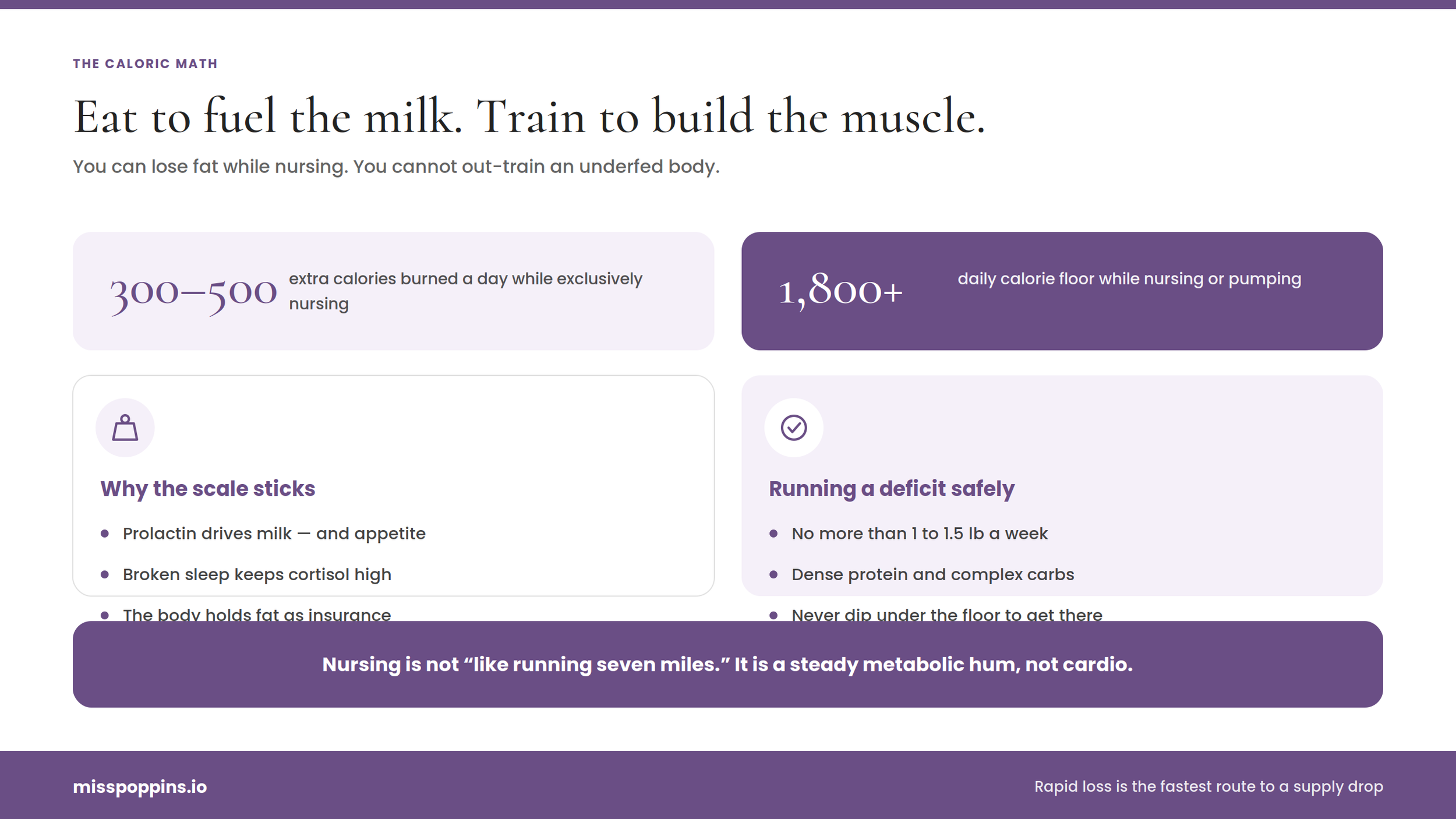
Producing food for another human being requires a massive amount of metabolic energy. Exclusive breastfeeding burns an additional 300 to 500 calories a day.
You will see viral posts claiming that nursing a baby is "equivalent to running 7 miles." That is a gross exaggeration. Running seven miles requires aggressive cardiovascular output and muscle breakdown. Breastfeeding is a slow, steady metabolic hum. It is a massive daily demand, but it is not a cardiovascular workout.
The Fat Loss Trap
Logically, burning an extra 500 calories a day should cause rapid weight loss. Reality is rarely that simple. Many mothers find themselves holding onto weight despite eating well and working out.
Your endocrine system is running the show. Prolactin drives milk production. It also stimulates appetite. Cortisol spikes from chronic sleep deprivation. When you sleep in two-hour increments, your body perceives a state of emergency. It holds onto fat stores as an insurance policy to ensure the baby survives a potential famine. You cannot simply out-work these hormones in the gym.
Structuring Your Deficit Safely
You can absolutely lose body fat while nursing. You just have to be incredibly careful with the math.
The rule is non-negotiable. Eat to fuel the milk. Workout to build the muscle. Dropping your daily intake below 1,800 to 2,000 calories while exclusively pumping or nursing is a guaranteed way to crash your supply. You must prioritize meeting caloric and macro needs to fuel workouts and milk supply. Focus on dense proteins and complex carbohydrates like oats, which have the secondary benefit of supporting lactation naturally.
Logistics and Friction: How to Actually Execute a Breastfeeding Workout
The "Empty First" Rule
Trying to do jumping jacks with engorged breasts is physically painful. It also places unnecessary stress on the delicate Cooper's ligaments supporting the breast tissue.
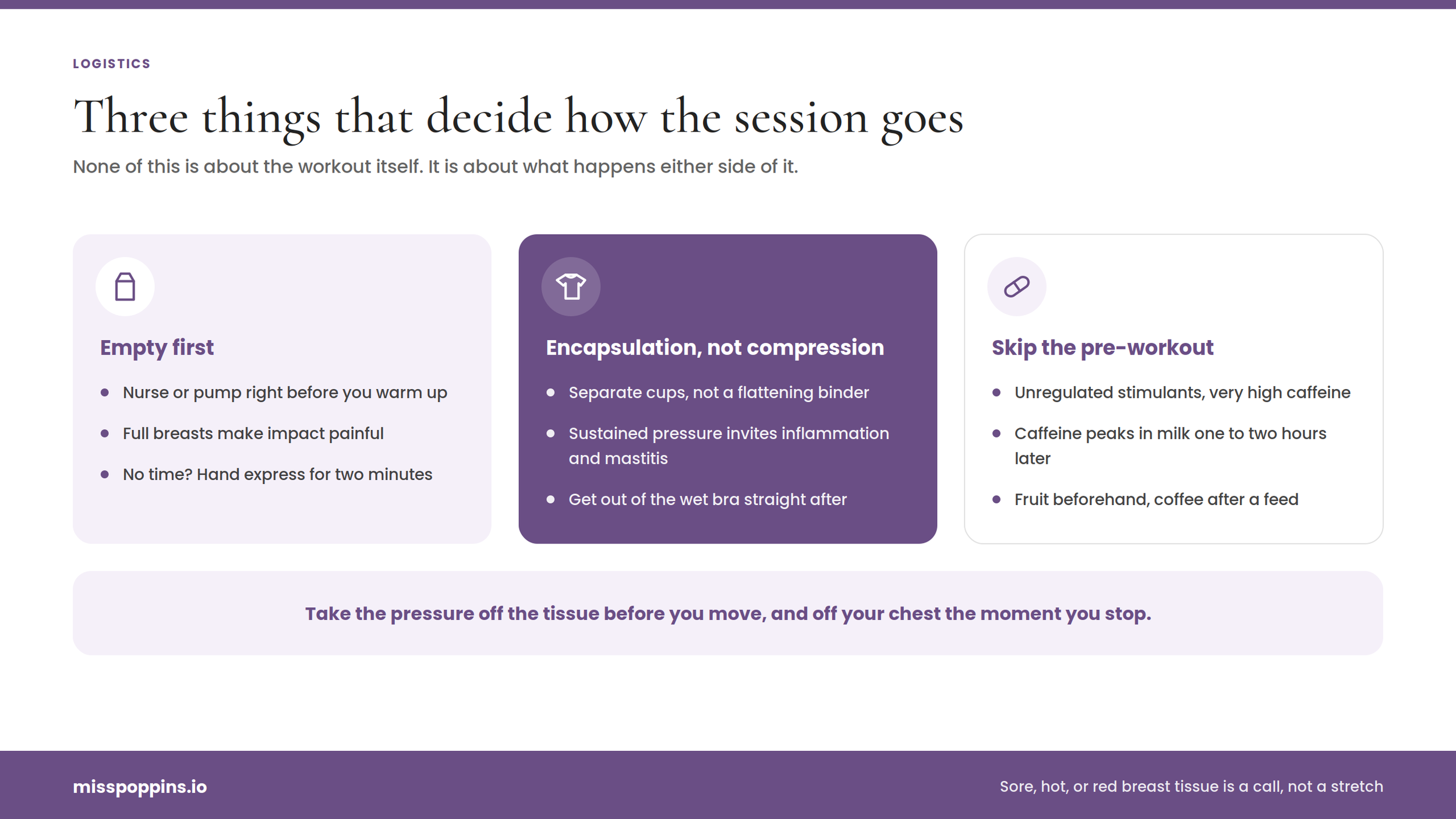
You need to follow the "Empty First" rule. Nurse your baby or pump right before you start your warmup. Do not skip this step. If you are stuck in traffic on the way to the gym and feel full, spend two minutes in the locker room relieving breast fullness before high-impact workouts using manual hand expression. Take the pressure off the tissue before you move.
Gear Warning: Encapsulation vs. Compression
This is the biggest blind spot in postpartum fitness. High-compression sports bras are dangerous for nursing mothers.
Traditional sports bras work by flattening the tissue against the chest wall. This acts like a binder. Continual compression crushes the milk ducts. Blocked ducts quickly turn into bacterial infections. You must actively focus on preventing plugged ducts and mastitis caused by compressive sports bras.
Throw out the compression bras. Buy encapsulation bras. These are designed with distinct cups that support each breast separately without smashing them flat. Furthermore, you must take the sweaty bra off the exact second you finish your cool-down stretch. Do not sit in wet, tight clothing.
Pre-Workout Supplements & Breastfeeding
Sleep deprivation makes pre-workout powders look very appealing. Avoid them.
Commercial pre-workouts are packed with unregulated stimulants and massive doses of caffeine. According to the American Academy of Pediatrics (AAP), caffeine passes freely into breast milk. The peak transfer window hits one to two hours after you drink it. If you slam a highly caffeinated energy drink, go lift weights for an hour, and then nurse your baby, you are feeding them a stimulant right as it peaks in your bloodstream.
Pay strict attention to the foods and supplements to watch while nursing. Skip the chemical powders. Eat a piece of fruit for fast carbohydrates, drink one normal cup of coffee after a feeding session, and rely on discipline rather than stimulants.
Safe Postpartum Workout Progression for Nursing Mothers
Weeks 0-6: The Foundation Rules
Do not rush this phase. The internet will pressure you to "bounce back." Ignore it.
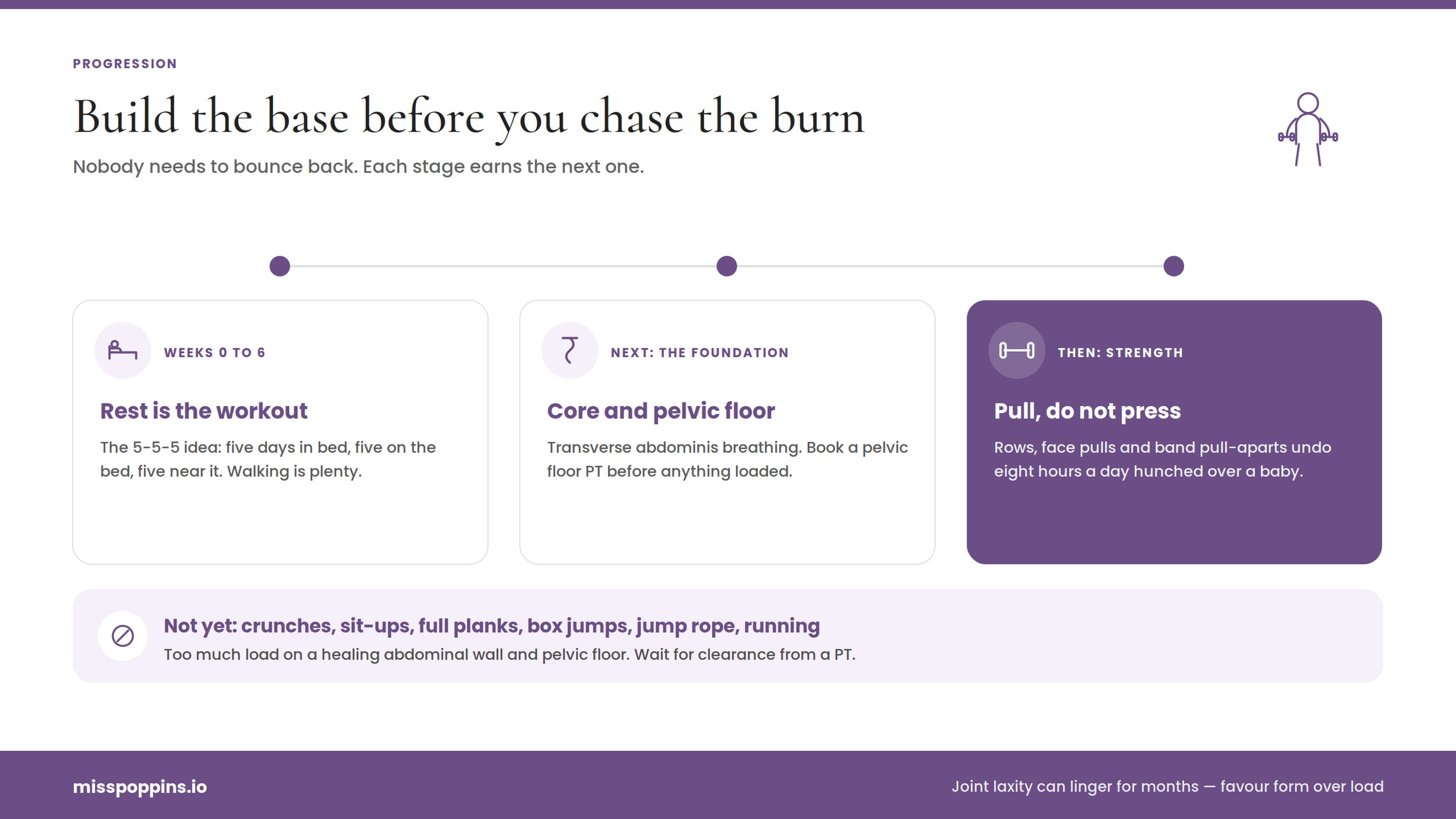
Follow the 5-5-5 rule for early postpartum recovery. Spend five days in the bed, five days on the bed, and five days near the bed. This is not laziness. This is a clinical necessity to allow the placental wound to heal and the uterus to shrink. You must commit to prioritizing postpartum healing before resuming intense exercise. Walking to the mailbox is enough of a workout for the first month.
Core and Pelvic Floor Repair
Your abdominal wall just stretched to its absolute limit for nine months. Your pelvic floor caught the brunt of the impact.
Do not attempt standard core routines. Start with transverse abdominis breathing. Schedule an evaluation with a pelvic floor physical therapist. Your body is still flooded with relaxin, a hormone designed to loosen your ligaments for childbirth. Relaxin stays in your system for as long as you are breastfeeding. Your joints are unstable. Securing this foundation is critical for long-term core and abdominal recovery post-birth.
Returning to Strength Training
Is it okay to lift weights while breastfeeding? Yes. Resistance training builds bone density and muscle mass.
However, you need to adapt your exercise selection. Nursing mothers spend eight to twelve hours a day hunched over a baby. This creates severe upper cross syndrome (a rounded upper back and tight chest). Do not bench press heavily right away. Focus your entire upper body routine on the posterior chain. Do cable rows, face pulls, and band pull-aparts to pull your shoulders back into alignment.
Movements to Avoid
Certain exercises are highly destructive in the early postpartum months. Avoid crunches, sit-ups, and planks entirely. Forward flexion movements force the abdominal muscles outward, which severely worsens diastasis recti (the separation of the ab muscles).
Avoid plyometrics completely. Box jumps, jump rope, and heavy running place extreme downward pressure on a weakened pelvic floor. Stick to low-impact, high-intensity movements until a physical therapist clears you for jumping.
Troubleshooting Postpartum Symptoms
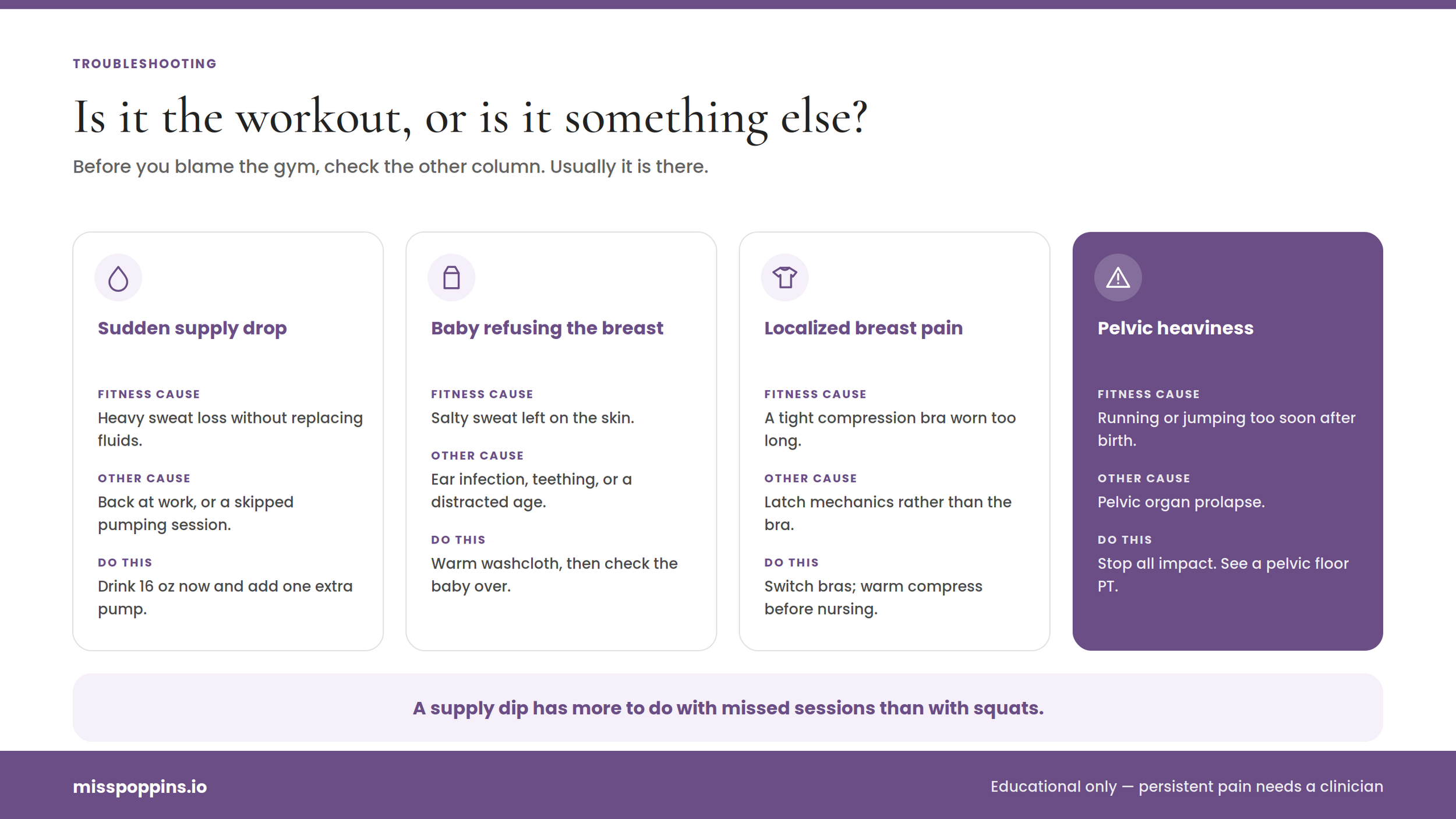
Sometimes a drop in milk supply has nothing to do with your workout. Use this differential table to isolate the actual variable causing your issue.
Decoding the "Rules" (Nutrition vs. Lactation)
Search engines frequently scramble postpartum advice by mixing up different fitness trends. Let us clearly define the boundaries so you know what actually applies to lactation.
The 30-30-30 Rule
This protocol requires eating 30 grams of protein within 30 minutes of waking up, followed by 30 minutes of low-intensity cardio. It is a viral blood sugar management tool. It is not a lactation rule. While a nursing mother can safely eat protein in the morning, jumping straight into fasted cardio on low sleep is a fast track to adrenal fatigue and a subsequent milk supply drop.
The 3-3-3 Rule
This has absolutely nothing to do with fitness. It is a strict food safety guideline for human milk. Freshly pumped breast milk can sit for 3 hours at room temperature, 3 days in the refrigerator, and 3 months in a deep freezer.
Conclusion
You do not have to choose between rebuilding your physical strength and feeding your baby. The two goals are entirely compatible. It simply requires strategy rather than brute force.
"Mothers often view exercise and breastfeeding as competing interests," notes Sarah Jenkins, Certified Pediatric Sleep Coach at MissPoppins. "They aren't. When fueled and supported correctly, a stronger mother directly translates to a more resilient parent."
In our coaches' experience working with thousands of families across the country, the mothers who successfully return to the gym without losing their milk supply share one trait. They refuse to rush the early weeks, and they actively protect their daily caloric baseline. You must eat to fuel the work.
If you are dealing with painful clogged ducts, supply anxiety, or struggling to figure out how to schedule a workout around a newborn's chaotic sleep cycles, get professional help. You do not need to guess your way through this phase.
Why Choose MissPoppins?
5,000+ families supported
4.8-star marketplace rating
150+ years of combined expert experience
Vetted and certified non-clinical coaches
Private and fully encrypted sessions
Take control of your postpartum recovery today. Download the MissPoppins app on the App Store or Google Play to connect with a certified specialist instantly.
FAQs
Is it okay to workout while breastfeeding?
Yes. Moderate exercise is highly recommended. It improves cardiovascular health and mental well-being without decreasing milk supply or negatively affecting infant growth. Ensure you stay hydrated and consume enough calories to support both the workout and lactation.
What should be avoided while breastfeeding?
Avoid severe caloric deficits, high-compression sports bras worn for extended periods, and extreme high-impact exercises before your pelvic floor has healed. Additionally, avoid high-stimulant pre-workouts, as excess caffeine can transfer to breast milk and disrupt your baby's sleep.
Is it okay to lift weights while breastfeeding?
Yes. Lifting weights is perfectly safe and encouraged to rebuild postpartum strength. Focus on upper back and core strength to combat the hunched posture caused by frequent nursing. Keep in mind that nursing hormones like relaxin can keep joints lax, so prioritize form over heavy loads initially.
Will it be easier to lose weight when I stop breastfeeding?
For some women, yes. While breastfeeding burns calories, the body also produces high levels of prolactin, a hormone that can stimulate appetite and cause the body to hold onto fat stores. Weaning often leads to hormonal stabilization, making fat loss easier for some mothers.
What exercises should you not do postpartum?
Avoid traditional core flexion exercises like crunches, sit-ups, and planks immediately postpartum, as they can worsen diastasis recti (abdominal separation). Also, avoid high-impact plyometrics (like jumping jacks or heavy running) until you have been cleared by a pelvic floor physical therapist.
Can I lose 10 pounds in a month while breastfeeding?
Losing 10 pounds in a single month requires a steep caloric deficit, which is not recommended while breastfeeding. Rapid weight loss (more than 1 to 1.5 pounds per week) can severely drop your milk supply and deprive you of the energy needed for postpartum recovery.