

Toilet Training Regression in Kids Ages 2 to 5: A Calm Reset Guide

Toilet training regression (or potty training regression) is when a trained child returns to frequent accidents, refuses the potty, or asks for diapers. According to the American Academy of Pediatrics (AAP), many children pick up where they left off after a few days or weeks. Start with a pediatrician visit to rule out constipation or a urinary tract infection (UTI), then run a calm, consistent reset.
Key Takeaways
Regression is common and, in many cases, short-lived, according to AAP guidance.
Rule out medical causes first, especially constipation, which can quietly drive wetting.
Triggers tend to look different at age 2, age 3, and ages 4 to 5.
Reset with routine and calm, since pediatric groups advise against punishment.
Night dryness is a separate milestone that usually comes later.
It's been weeks of dry underwear. Then comes a morning with three accidents before lunch, a call from daycare, and a laundry pile that seems to grow on its own. If you're facing a toilet training regression, you're probably tired, confused, and wondering what changed.
Here's the reassuring part: a setback like this is a common detour. The AAP's regression guide, updated in 2022, describes it as a possible healthy way for a child to meet emotional needs, rather than a sign of an emotional problem.
This guide covers what regression is, why it happens, and how it looks at ages 2, 3, and 4 to 5. You'll also find a 2-week reset plan, a diapers decision guide, and clear red flags. You don't have to figure this out alone.
What Is Toilet Training Regression (and What Isn't It)?
Toilet training regression happens when a child who had the hang of the potty starts losing that skill. Common signs include:
Frequent accidents after a stretch of dry days
No longer telling you when they need to go
Refusing to sit on the potty or toilet
Asking for diapers again
Hiding to pee or poop
A single accident isn't a regression. According to pediatrician Noah Schwartz, MD, of Cleveland Clinic, missing the bathroom while busy on the swings is an expected slip. He suggests waiting a couple of days and watching for a pattern: several accidents a day, accidents only at school, or accidents that build.
The National Institute of Diabetes and Digestive and Kidney Diseases (NIDDK) says children usually gain bladder control between ages 2 and 4. Its guidance, last reviewed in 2017, adds that occasional wetting is common even at ages 4 to 6.
NIDDK also says loss of urine is almost never due to laziness, a strong will, or poor toilet training. Accidents aren't a verdict on your child or on your parenting.
Why Does Toilet Training Regression Happen?
A potty training regression usually has a reason, even when it isn't obvious. Most causes fall into four groups, and more than one can apply at once.
Life changes and stress are the most familiar trigger. The AAP's list of common causes includes a pregnancy or new sibling, a move, and a change in child care. It also names major illness, a death in the family, and family conflict or divorce.
Constipation and withholding come next. NIDDK (reviewed 2018) says children most often get constipated from holding in stool, and one listed reason is feeling stressed about potty training. The AAP notes that a backed-up bowel can push on the bladder and cause a child to lose bladder control.
NIDDK defines constipation as fewer than two bowel movements a week, or painful, hard stools. A daily poop doesn't rule it out. A 2018 meta-analysis (Koppen et al., Journal of Pediatrics) found a pooled prevalence of about 9.5% for functional constipation among children worldwide, using Rome III criteria. That figure isn't specific to toddlers.
Medical causes matter too. The AAP notes that toilet training regression sometimes signals an infection or other condition that needs treatment. For children 2 and older, NIDDK lists new leaking after toilet training as a possible UTI sign, confirmed only by a urine test.
Readiness and power struggles round out the list. Some children were trained before they were fully ready, so the skill may slip under stress. Zero to Three notes that power struggles sometimes lead children to regain control over their bodies by withholding urine or bowel movements.
Hidden Constipation: The Cause Parents Miss Most
Constipation can hide in plain sight, especially in a child who still poops most days. NIDDK's guide to constipation in children lists withholding signs such as standing on tiptoes and then rocking back on the heels.
The same guide lists daytime or nighttime wetting, and stool in the underwear that looks like diarrhea. Those smears may point to a backup rather than a stomach bug. Because a full bowel can press on the bladder, pee accidents may rise at the same time.
If you notice these signs, ask your pediatrician before trying any remedy, including diet changes.
Toilet Training Regression by Age: 2, 3, and 4 to 5
Age often shapes why a toilet training regression happens. The patterns below are common tendencies drawn from pediatric guidance, not diagnoses, so your child may not fit one row.
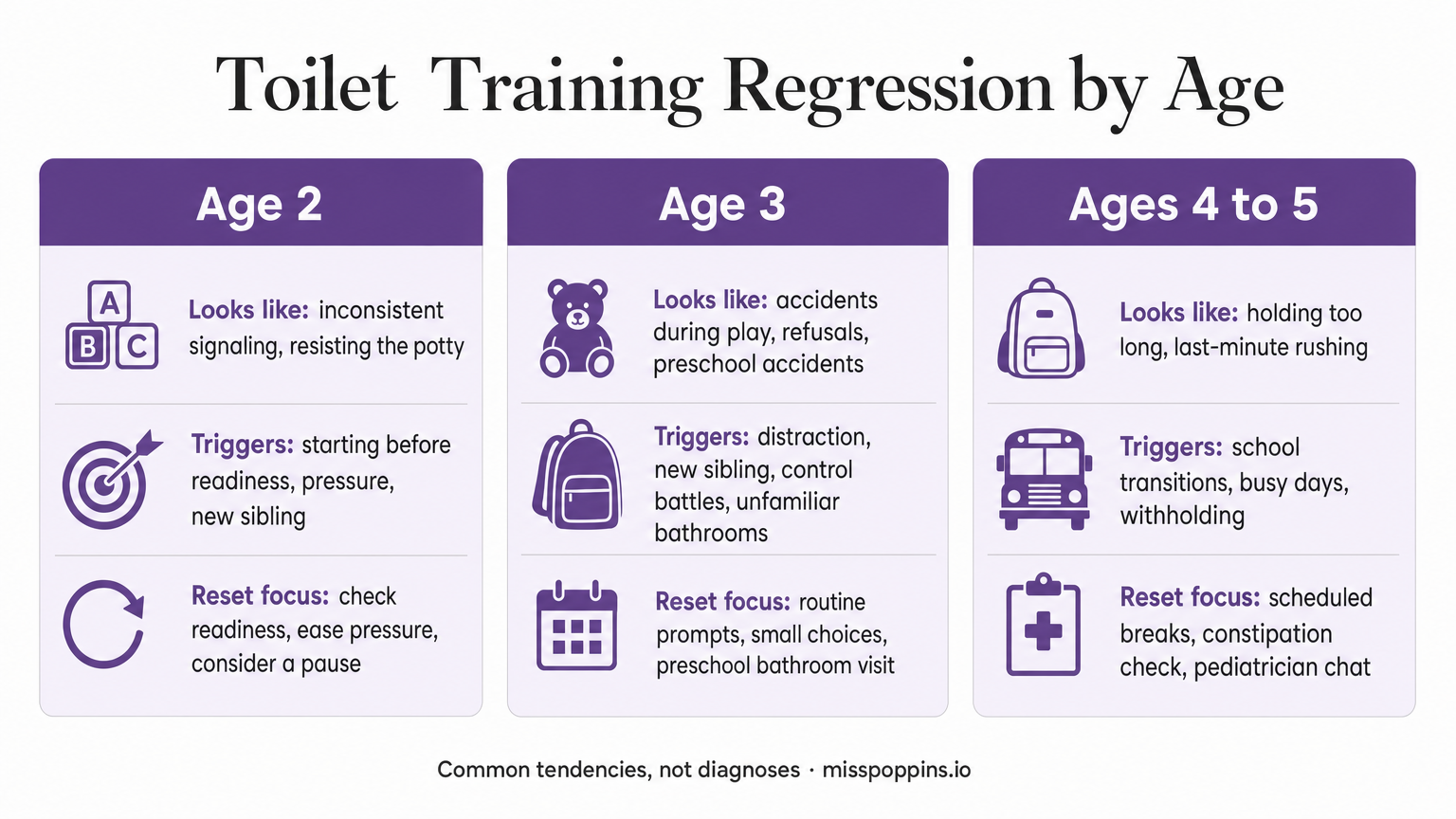
At age 2, regression is often a readiness question. The AAP says most children in the United States are bowel and bladder trained by age 4, and training often starts between 2 and 3. The Canadian Paediatric Society (CPS) says most Canadian children start between 2 and 4, taking 3 to 6 months to leave diapers.
So a 2-year-old who struggles may simply need more time. If your child shows few potty training readiness signs, pressure can backfire, and a short pause may be the right move.
At age 3, power struggles and new siblings often take center stage. A child absorbed in play may wait too long, and preschool bathrooms can feel loud or unfamiliar. If your 3-year-old is having accidents after being potty-trained, check for constipation first, then look at control.
Guidance on handling potty tantrums and power struggles can help keep the potty out of the battle zone. Small choices, like which potty to use, give a 3-year-old some control.
At ages 4 to 5, school transitions and busy days often lead children to hold too long. The International Children's Continence Society's 2016 terminology standard uses about age 5 as its reference point for bladder symptoms, though some younger children already have bladder control. That benchmark doesn't make earlier accidents automatically normal, so persistent day accidents at 4 to 5 are worth raising with your pediatrician. The CPS also advises a doctor visit if a child who used the toilet well for 6 months or more seems to be slipping back.
The 2-Week Reset Plan for Potty Training Regression
A reset gives everyone a clear structure for the next 14 days. A 2021 systematic review (Mrad et al., Journal of Pediatric Urology) found toilet training approaches have not been directly compared. No single method can be called best, so treat this plan as a framework to adapt.
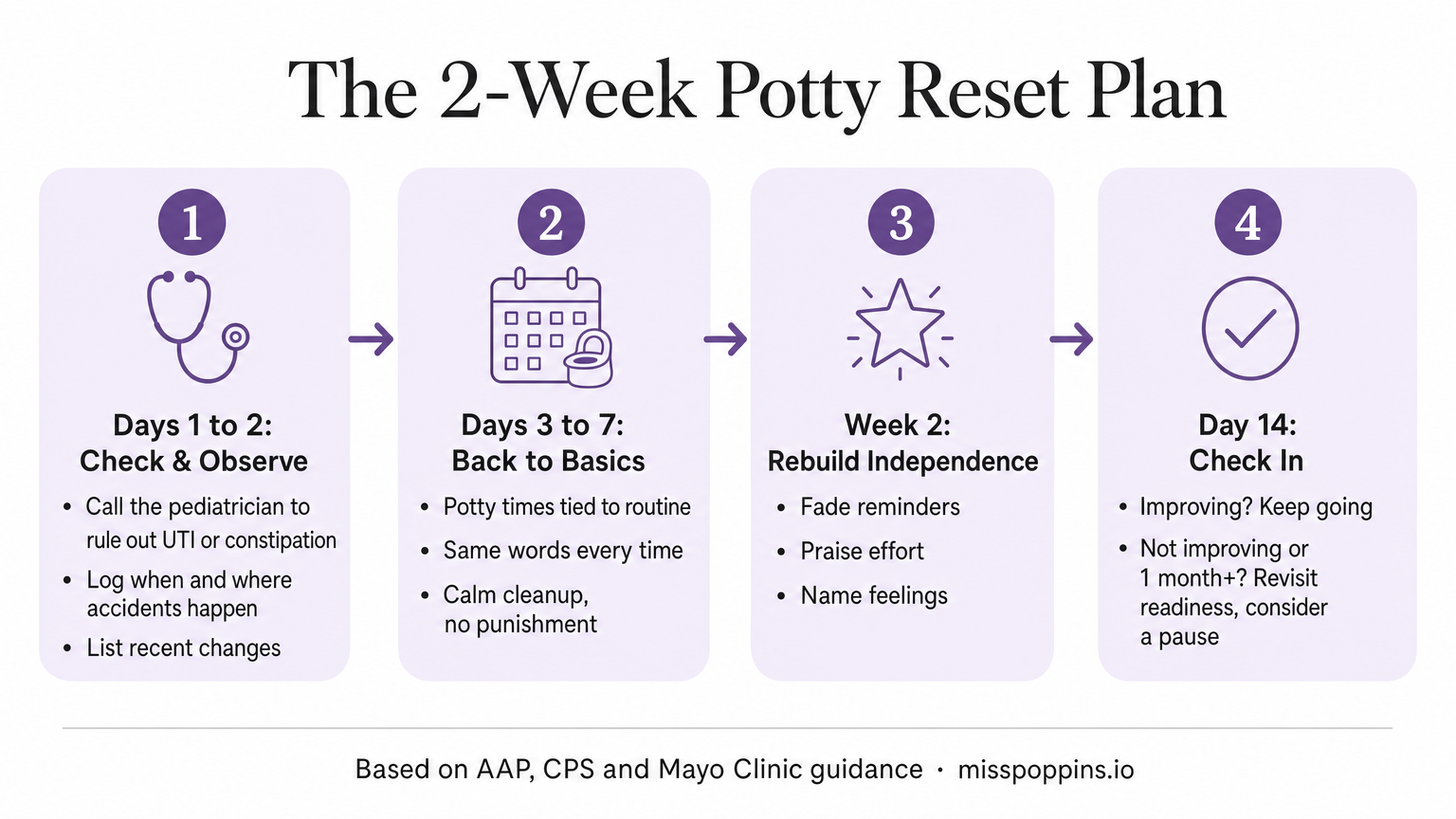
You may have seen the "10, 10, 10 rule" online. No pediatric source defines it, so this plan ties potty breaks to your child's daily routine instead.
Days 1 to 2: Check and observe.
Call your pediatrician to rule out a UTI or constipation, the AAP's recommended first step.
Note when and where accidents happen.
List any recent changes at home, in child care, or at school.
Days 3 to 7: Back to basics.
Set potty times tied to routine: on waking, after meals, before naps and bed, and before leaving the house.
Use the same words and steps every time.
Keep cleanup matter-of-fact, and let your child help, such as carrying wet clothes to the hamper.
Skip punishment: Mayo Clinic says it has no role in the process, and the CPS advises against punishing or overreacting.
Lean on the 3 important Cs of potty training to keep the routine steady.
Week 2: Rebuild independence.
Fade reminders as your child starts telling you they need to go.
Praise effort, and keep it low-key: Zero to Three cautions against too much praise.
Sources differ on stickers: AAP and Mayo Clinic pages mention sticker charts, while the CPS says rewards aren't necessary.
Name feelings around the trigger, such as "Having a new baby here is a big change."
Fix what you can, as the AAP suggests: one-on-one time after a new sibling, or a visit to the daycare bathroom.
Day 14 check-in.
If accidents are dropping, keep going.
If not, or if the regression has lasted a month or more, the AAP suggests revisiting readiness and considering a pause.
A certified coach can help you tailor these steps to your child and stick with them through a hard week.
Get Every Caregiver on the Same Script
A reset is easier for a child to follow when every adult handles it the same way. That means the same words, the same schedule, and the same cleanup at home, at daycare, and with co-parents and grandparents. The CPS puts it simply: "It's important that everyone is consistent and working together."
Share a one-line script with daycare and family. For example: "We're doing a potty reset, so please offer the potty on waking, after meals, and before naps, and handle accidents calmly."
If a grandparent or co-parent sees things differently, agree on the basics for 2 weeks and revisit at the Day 14 check-in.
Should You Go Back to Diapers or Pull-Ups?
This is where trusted sources disagree. The AAP's regression guidance suggests avoiding major concessions such as returning to diapers, but it allows training pants under underwear. The Canadian Paediatric Society says it's okay to go back to a diaper after a stress-related regression.
Zero to Three suggests letting the child decide between the potty and a diaper or pull-up when possible. No outcome research shows that one approach works better, so the choice comes down to your child, your setting, and your stress level.
Option
Pull-ups or training pants
Underwear
Short break from training
Typical use
Nights, naps, and long car trips
Awake time at home
A distressed child, or a month-long regression
Potential issues
AAP says they may signal no need to use the toilet
More laundry while skills rebuild
Can drift without a clear restart date
Many families use a hybrid: potty training underwear during the day and pull-ups for sleep. Let your child have a say when you can, such as picking which underwear to wear.
Nighttime Accidents Are a Different Milestone
Wet nights after dry days usually aren't a potty training regression. Daytime control tends to come first, and the CPS notes that staying dry through naps and nights can take several more months or years. Mayo Clinic says most children can stay dry at night between ages 5 and 7.
Bedwetting is also common at age 5. NIDDK (reviewed 2017) puts it at about 1 in 6 children, while a 2026 AAP page says around 20% of children have some bedwetting at age 5.
The exception is new night wetting after 6 months or more of dry nights, or wetting with pain or fever. That's worth a call to your pediatrician. For sleep routines, see our guide to nap and nighttime potty training.
When to Call Your Pediatrician
This is not medical advice. Coaching doesn't replace your pediatrician. Call your child's doctor if you notice any of the following.
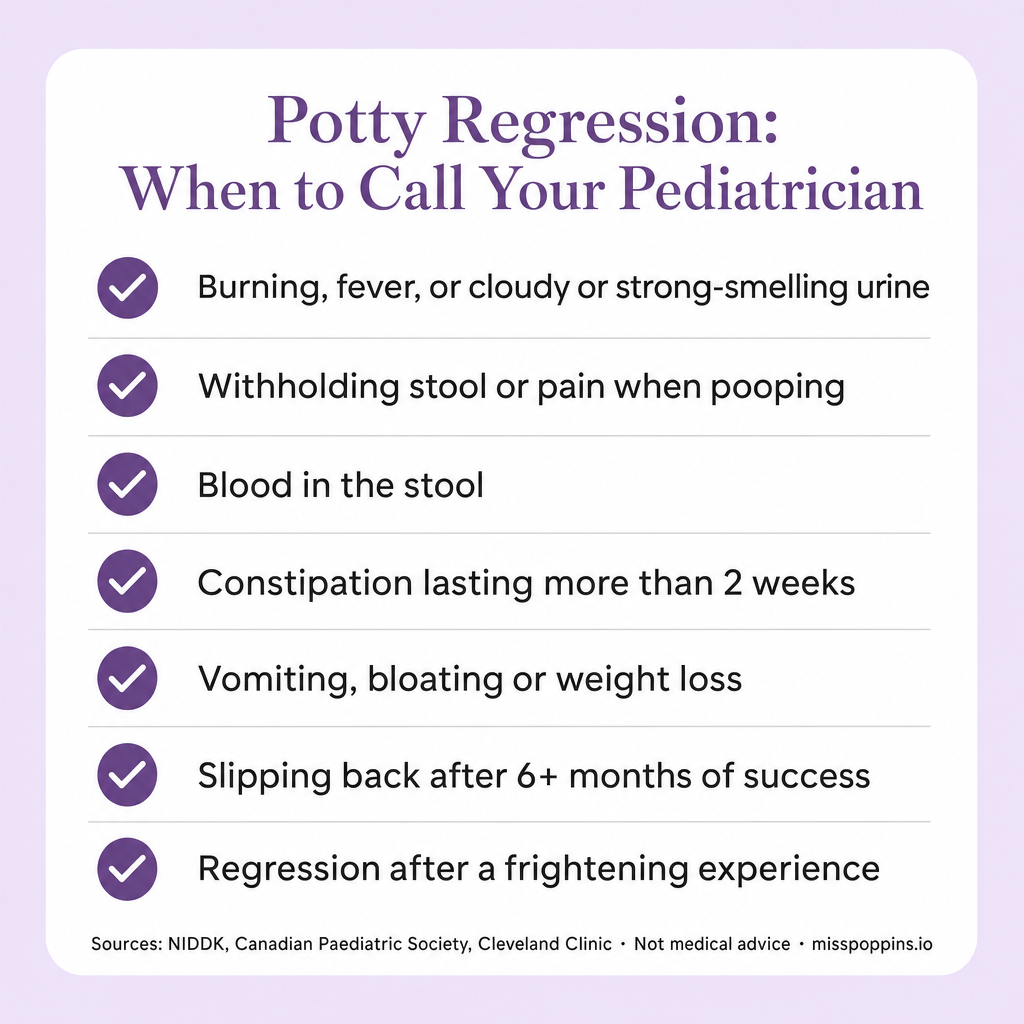
Burning, fever, frequent urges, or cloudy, bloody, or strong-smelling urine (UTI signs listed by NIDDK)
Withholding stool, pain when using the potty, or blood in the stool (CPS)
Constipation symptoms lasting more than 2 weeks (NIDDK)
Vomiting, bloating, or weight loss alongside constipation (NIDDK)
Slipping back after 6 months or more of using the toilet well (CPS)
Regression that may be linked to trauma (Cleveland Clinic)
A potty training regression may look different for autistic or neurodivergent children. In a CDC-funded study of more than 2,000 US children, parents reported toileting resistance in 49.1% of autistic children aged 48 months and older. That compared with 8.0% in the general population sample (Wiggins et al., 2022, Journal of Developmental and Behavioral Pediatrics).
The same study reported constipation in 35% of the autistic group, and the authors note that cause and effect can't be determined. A developmental pediatrician can help tailor a plan. Our guide to toddler behavior red flags covers other changes worth raising.
Taking Care of Yourself During a Potty Setback
Feeling frustrated during a setback is normal, and it doesn't make you a bad parent. Dr. Schwartz of Cleveland Clinic notes that a parent's anxiety can transfer to a child. That's one reason co-regulation matters: your calm helps your child find theirs.
Lower the stakes where you can. Tag-team cleanups with another caregiver, keep spare clothes handy, and remember that toilet training regression often passes.
A 2024 American Academy of Pediatrics clinical report notes normal variations in toilet training are among situations that have triggered harsh or abusive caregiver responses. If your anger ever feels unsafe, call or text the Childhelp National Child Abuse Hotline at 1-800-422-4453, available 24/7. It isn't an emergency line, so call 911 if anyone is in immediate danger.
Practical Next Steps (Checklist)
Book a pediatrician check to rule out constipation or a UTI
Start a 3-day accident log noting time, place, and activity
Pick 4 to 5 routine potty times
Write a one-line script for every caregiver
Decide your plan for nights and naps
Set a Day 14 review on your calendar
For more on readiness, tantrums, and nighttime dryness, browse the MissPoppins potty training series.
When to Stop Guessing and Get a Custom Reset Plan
A toilet training regression is a frustrating detour, not a permanent setback. Once your pediatrician rules out physical causes like constipation or a UTI, resolving the accidents comes down to diagnosing the exact behavioral trigger and getting every caregiver on the exact same script.
If you have tried resetting routines at home and your 2 to 5 year old is still locked in daily accidents, poop withholding, or toilet refusal, generic internet checklists will only prolong the power struggle. MissPoppins connects you 1-on-1 with vetted, certified human parenting coaches across the United States and Canada to build a step-by-step reset plan tailored to your child:
For Power Struggles, Potty Refusal, and Autonomy Pushback: If your toddler or preschooler is fighting prompts, hiding to poop, or testing boundaries, Book a Potty Training & Behavior Specialist to defuse the resistance and rebuild consistent bathroom habits without bribes or battles.
For Setbacks Triggered by a New Sibling, Daycare, or School: If sudden accidents started right after welcoming a new baby, switching nurseries, or disrupting household routines, Explore Family Systems & Transition Coaches to align your home and caregiver schedules and help your child adjust securely.
Backed by 150+ years of combined specialist experience, a 4.8-star App Store rating, and 5,000+ families supported, all MissPoppins sessions are 100% private, encrypted, and designed to work alongside your pediatrician's care. Download the MissPoppins app on the App Store and Google Play to connect with an expert directly from your phone.
FAQs
How Long Does Toilet Training Regression Last?
According to AAP guidance, many children pick up where they left off after a few days or weeks. If it stretches to a month or more, the AAP suggests reassessing readiness.
How to Fix Toilet Training Regression?
Rule out medical causes first, then follow the 2-week reset plan above. Its core is routine potty times, calm cleanups, and one script for every caregiver.
Why Is My 3 Year Old Having Accidents After Being Potty-Trained?
At 3, common triggers include getting absorbed in play, a new sibling, and a push for control. Hidden constipation is also worth checking with your pediatrician.
What Is the 10, 10, 10 Rule for Potty Training?
It's popular online advice, but no pediatric source defines it, and research hasn't directly compared toilet training methods. Prompts tied to your child's routine are a safer bet.
Should I Put My Child Back in Diapers During a Regression?
Pediatric groups disagree: the AAP suggests avoiding a return to diapers, while the CPS says a diaper is okay after a stress regression. Many families use underwear by day and pull-ups for sleep.