


A standard baby teeth chart tracks 20 deciduous teeth that begin erupting between 4 and 7 months of age and complete primary dentition by 30 to 36 months. Lower central incisors emerge first around 6 months, while acute gum inflammation peaks for 72 hours per tooth before subsiding once enamel pierces the gumline.
At 2:14 AM, your 6-month-old is wide awake, soaking through a second cotton sleep sack with warm drool and gnawing furiously on the crib slats. Your partner whispers across the dark nursery, wondering if those red cheeks mean a molar is cutting, an ear infection is brewing, or a sleep regression just arrived. Guesswork at midnight ruins sleep for the entire household. This clinical baby teeth chart, month-by-month infant teeth schedule, and differential symptom matrix separate true dental eruption from look-alike childhood illnesses so you can respond with exact pain relief tonight.
Active Tooth Eruption (72-Hour Window)
Symptom Pattern: Swollen, blanched gum ridge, frantic finger chewing, temperature below 100.4°F
How to Verify Today: Run a clean finger along the gumline to feel a hard, asymmetrical white ridge under the tissue.
Tonight's Adjustment: Offer a chilled solid silicone teether before bed and consult your doctor on weight-based pain relief.
Acute Otitis Media (Middle Ear Infection)
Symptom Pattern: Bilateral ear tugging, screaming when laid flat in the crib, fever above 100.4°F
How to Verify Today: Lay your infant flat on the changing pad. Horizontal pressure shifts middle-ear fluid and triggers immediate crying.
Tonight's Adjustment: Elevate your pediatric call to urgent care for an otoscopic exam and do not force flat crib training.
Maturing Parotid and Submandibular Salivary Glands
Symptom Pattern: Clear streams of drool, chewing on knuckles, zero gum swelling at 12 to 16 weeks
How to Verify Today: Inspect the lower central gumline under a bright phone flashlight. Tissue remains smooth, pink, and flat.
Tonight's Adjustment: Snap on an absorbent cotton bib during wake windows and protect chin skin with a thin lanolin barrier.
Developmental Sleep Regression or Wake-Window Shift
Symptom Pattern: Waking every 45 to 90 minutes, practicing rolling in the dark, calm when picked up
How to Verify Today: Track total daytime sleep. Naps exceeding 3.5 hours or a bedtime wake window under 2.5 hours point to low sleep drive.
Tonight's Adjustment: Stretch the final wake window by 15 minutes and hold firm boundaries around independent sleep onset.
The Complete Baby Teeth Chart: Eruption and Shedding Timeline
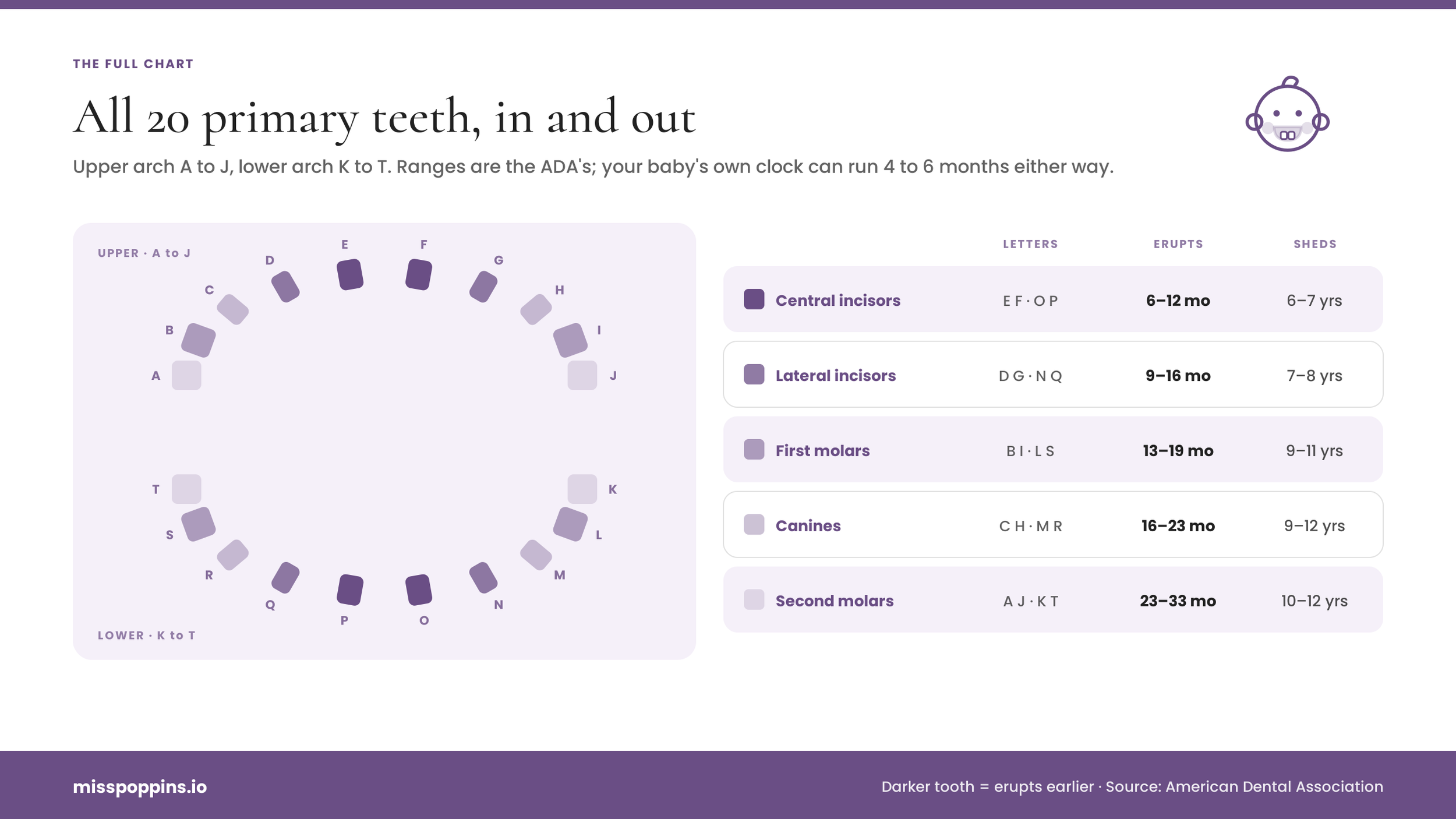
A clinical baby teeth chart maps the exact eruption sequence and shedding timeline for all 20 primary teeth in infants and toddlers between 6 months and 12 years of age. While every infant follows a unique genetic clock, the American Academy of Pediatrics notes that primary dentition typically emerges in symmetrical pairs, starting at the front center of the lower jaw before moving backward toward the molars. Pediatric dentists track this infant teeth diagram using the Universal Numbering System, which assigns capital letters A through T to deciduous teeth, moving clockwise from the upper right second molar (Tooth A) across to the upper left second molar (Tooth J), then dropping to the lower left second molar (Tooth K) and finishing at the lower right second molar (Tooth T).
Pediatric dentists use the "7-4 Rule" as a quick baseline for this teeth schedule for babies. At 7 months of age, the average infant has 0 to 4 visible teeth. Every 4 months after that mark, approximately 4 additional teeth break through the gums: 4 teeth at 11 months, 8 teeth at 15 months, 12 teeth at 19 months, 16 teeth at 23 months, and all 20 primary teeth by 27 months. Variations of 4 to 6 months in either direction remain completely normal. About 1 in 2,000 newborns arrive with natal teeth already visible at birth, while other healthy toddlers celebrate their first birthday with a completely toothless grin.
Download the Printable PDF Teething Eruption Chart & Nighttime Medication Log to tape inside your medicine cabinet, track exact eruption dates, and prevent accidental double-dosing between exhausted partners at 3:00 AM.
Month-by-Month Baby Teeth Schedule: What to Expect
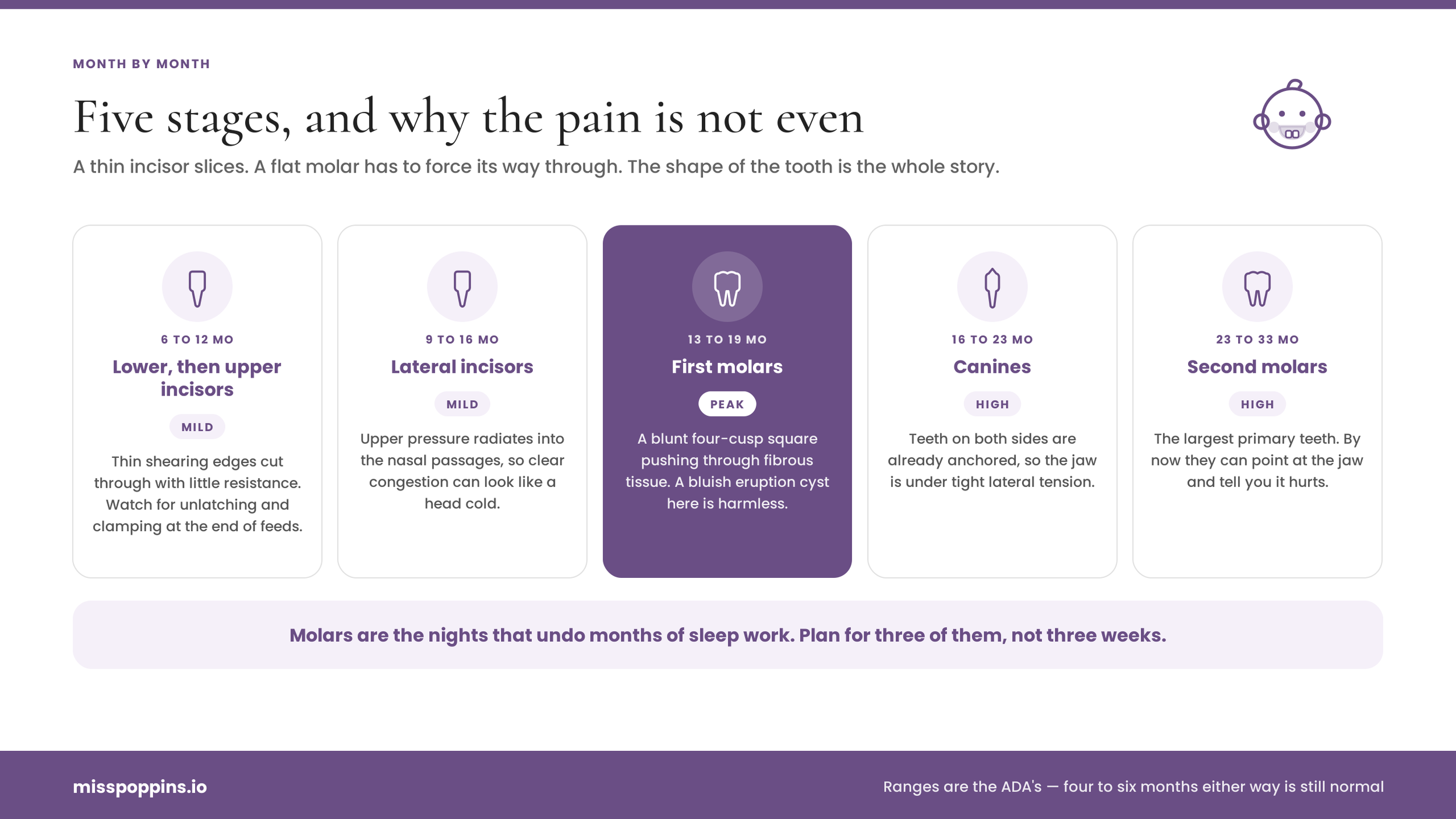
The month-by-month baby teeth schedule outlines five distinct anatomical stages of dental eruption, each triggering specific shifts in infant feeding mechanics, oral-motor posture, and nighttime sleep architecture. Understanding the physical geometry of the emerging tooth explains why a 6-month-old sails through central incisors with mild fussiness, while a 15-month-old wakes up crying from first molars.
4 to 7 Months: Lower Central Incisors (The First Teeth)
Parents asking when do babies start getting teeth typically spot the two bottom front teeth (lower central incisors, Letters O and P) first between 4 and 7 months of age. Central incisors feature thin, razor-like horizontal edges designed for shearing food. Because that narrow blade slices through the gum tissue with minimal surface resistance, physical pain stays relatively mild. You will see a transition from passive drooling to frantic, targeted gnawing on crib rails, highchair straps, and cold metal spoons.
This first stage of the infant teeth schedule directly overlaps with typical 6-month developmental milestones when lower central incisors emerge, alongside developing fine motor grasp milestones supporting independent use of teethers. During nursing or bottle feeds, warm milk increases blood flow to the swollen mandibular ridge. Your baby may unlatch repeatedly, clamp down on the nipple to create counter-pressure, or refuse the breast entirely until you numb the lower gumline with a chilled wet washcloth for two minutes prior to feeding.
8 to 12 Months: Upper Incisors (The "Bunny Teeth")
Between 8 and 12 months on the baby teeth timeline, the upper central incisors (Letters E and F) descend, rapidly followed by the upper and lower lateral incisors (Letters D, G, N, and Q) between 9 and 16 months. Upper central incisors are wider and thicker than lower teeth. As they push downward through the maxillary bone, pressure radiates up into the nasal passages, frequently causing clear nasal congestion that mimics a mild head cold.
Once all four upper incisors lock into place, your infant's smile takes on the classic "bunny teeth" appearance. Biting becomes a major behavioral hurdle during this window on the teeth chart babies follow. An 10-month-old cannot actually bite while actively sucking because the tongue covers the lower gum ridge during a proper latch. Biting happens at the very end of a feed when swallow rates slow down and the baby tests their new upper enamel against the lower jaw. Watch your baby's jaw tempo closely and unlatch them the second active swallowing stops.
13 to 19 Months: The First Molars (The Pain Peak)
The 13-to-19-month window on the milk teeth schedule marks the arrival of the upper and lower first molars (Letters B, I, L, and S), which represent the absolute peak of teething discomfort. Unlike incisors that slice through tissue like a thin knife, a first molar is a wide, blunt square with four distinct cusps. Pushing a flat table of enamel through tough fibrous gum tissue requires significant mechanical force. You may notice a bluish-purple fluid-filled bubble over the molar site called an eruption cyst (or eruption hematoma). While alarming to see during a diaper-change wrestling match, eruption cysts are harmless pockets of blood and fluid that rupture naturally as the tooth crowns.
Daytime distractions keep toddlers busy, so molar pain hits hardest after dark when cortisol levels drop and blood pools in the head while lying flat. Crusted oatmeal gets rejected at breakfast because chewing solid textures bruises the swollen gum flap hanging over the half-erupted molar. Offer chilled smooth purees, cold yogurt, or smoothie popsicles, and review our guide on troubleshooting sleep disruptions triggered by erupting molars so three bad nights of molar pain do not undo months of independent sleep habits.
16 to 23 Months: Canines (Cuspids)
From 16 to 23 months on the infant tooth eruption schedule, the upper and lower canines (cuspids, Letters C, H, M, and R) push into the open gaps between the lateral incisors and the first molars. Historically nicknamed "eyeteeth" because the roots of the upper canines extend deep into the upper jawbone toward the orbital socket, these teeth feature sharp, conical points built for tearing fibrous foods.
Because the adjacent incisors and first molars have already anchored the gum tissue on both sides, canine eruption creates tight lateral tension across the jaw. Toddlers in this phase frequently rub their cheekbones, reject crunchy crackers, and wake up whimpering during light REM sleep cycles around 4:00 AM. Maintain strict boundaries around nighttime pacifier habits during canine eruption by monitoring pacifier usage to avoid long-term dental alignment changes like an anterior open bite.
23 to 33 Months: Second Molars (The Final Phase)
The final milestone on the toddler teeth chart occurs between 23 and 33 months when the massive lower and upper second molars (Letters K, T, A, and J) anchor the very back of the jaw. Second molars are the largest teeth in the primary dentition. By the time a 2-year-old hits this stage of the toddler teething schedule, they possess the verbal vocabulary to point directly to their jaw and tell you, "My mouth hurts," or "My ear hurts."
Chewing resistance peaks again here. A 28-month-old who happily ate grilled chicken last Tuesday may suddenly spit out meat and demand pouches for four days straight. Keep mealtime pressure at zero, serve soft scrambled eggs or chilled tofu cubes, and give them a thick silicone molar tube they can reach into the back corners of their jaw to bite down on safely.
Tracking a teething chart is straightforward until a pair of first molars derails your 14-month-old's daycare nap schedule, triggers 3:00 AM split nights, and leaves you and your partner debating whether to abandon sleep boundaries. Explore Development & Behavior Coaches / Book a Pediatric Milestone Specialist today to get a customized, day-by-day sleep and behavioral adjustment plan that protects your child's rest through every eruption phase.
The Reddit Reality Check: What Parents Actually Experience
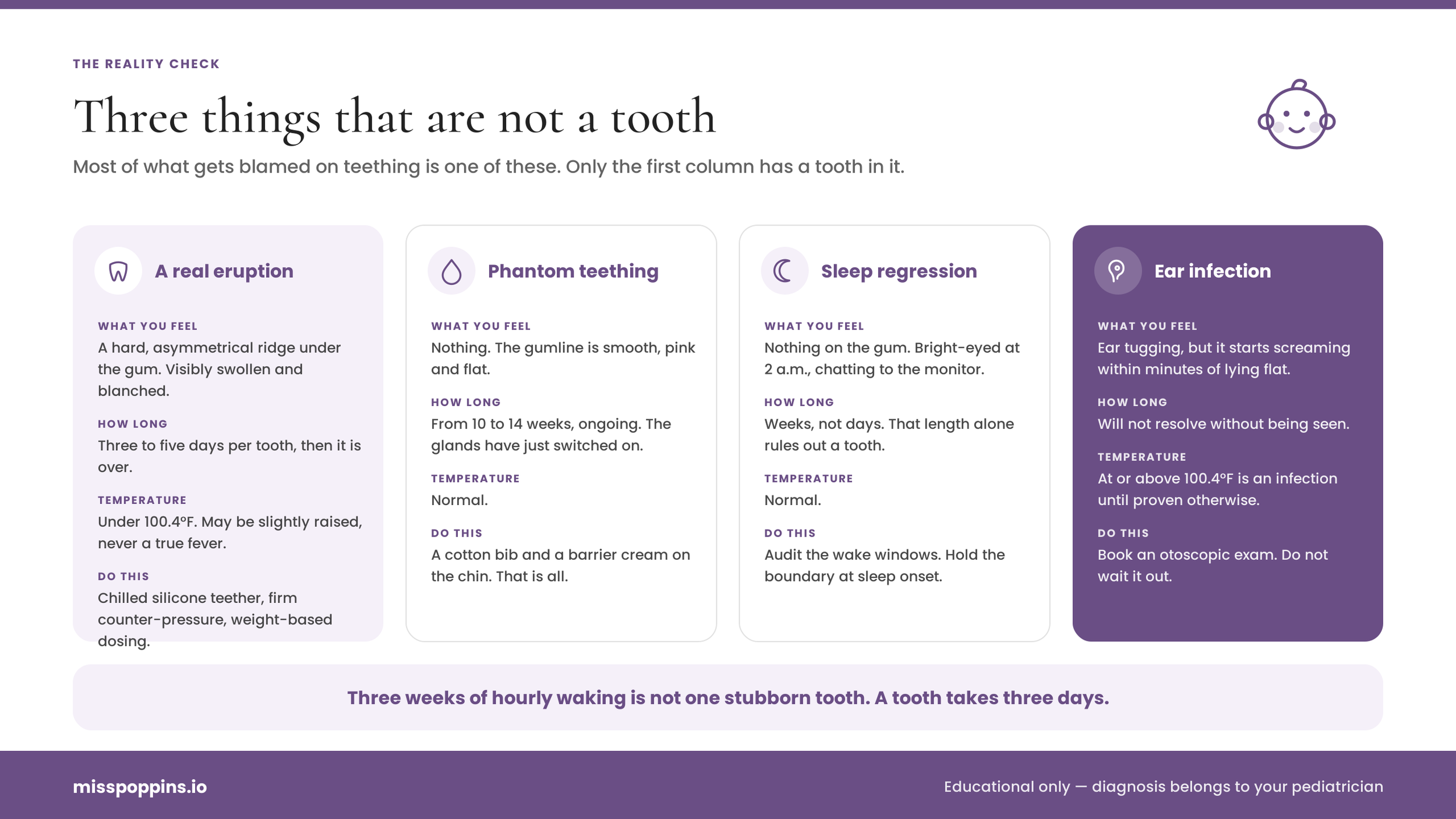
Infant teething symptoms generate massive confusion among exhausted parents because normal developmental milestones between 3 and 18 months closely mimic the physical signs of an erupting tooth. Scroll through r/NewParents or parenting threads on X at midnight, and you will see thousands of caregivers blaming six straight months of broken sleep on a single stubborn incisor. Clinical pediatric evidence tells a very different story from late-night forum folklore.
The "Phantom Teething" Phenomenon at 3 Months
Every parenting group has the running joke of "phantom teething," where parents swear their 12-week-old is cutting a tooth because the baby suddenly drowns their onesie in saliva and shoves their entire fist into their mouth. In 99% of infants, a 3-month-old is not teething. At 10 to 14 weeks of age, the parotid and submandibular salivary glands turn on at full capacity to prepare the digestive tract for solid foods later in infancy, while the oral-motor swallow reflex lags behind. Simultaneously, babies discover hand-to-mouth coordination and explore their world through oral sensory receptors. Drooling and fist-chewing at 3 months represent healthy neurological maturation, not an early tooth.
Sleep Regressions vs. Teething Pain
Distinguishing a neurological sleep regression from acute dental pain requires looking at the 72-hour clock. A true tooth eruption bothers an infant for 3 to 5 days right as the sharp enamel crown splits the periodontal membrane. If your 4-month-old or 8-month-old has woken up every 60 minutes for three consecutive weeks, teething is not the culprit.
During a sleep regression, babies wake up between sleep cycles because their brain is reorganizing sleep architecture or compelling them to practice rolling, sitting, or pulling to stand against the crib bars. A baby in teething pain exhibits localized distress during daytime meals, has a visibly swollen gum ridge, and settles once soothing measures take effect. A baby in a sleep regression is bright-eyed at 2:00 AM, chatting to the baby monitor camera, and calms the instant you pick them up or feed them back to sleep.
The Ear Infection Confusion
Pediatricians constantly warn parents about what is mistaken for teething, and acute middle ear infections top the list. The trigeminal nerve (Cranial Nerve V) and the glossopharyngeal nerve supply sensory pathways to both the lower jaw and the ear canal. When a molar pushes through the jawbone, referred nerve pain travels up toward the ear, causing toddlers to tug on their earlobes.
However, an ear infection produces the exact same ear-pulling behavior alongside one critical clinical divider: positional pressure and fever. According to the American Academy of Pediatrics, true teething may slightly elevate body temperature up to 100.0°F due to localized gingival inflammation, but a temperature at or above 100.4°F (38.0°C) is an infection until proven otherwise. If your baby screams within five minutes of being laid flat on their crib mattress and runs a fever, book a pediatric ear check immediately.
First-Party Coaching Insight from Our Senior Pediatric Parenting Strategist: "In our 1-on-1 coaching sessions, the single biggest blind spot we see is the 'sibling room-share panic response.' When a 15-month-old cuts their first molars while sharing a bedroom with a 3-year-old toddler, parents often rush in with a warm milk bottle at the very first whimper so the crying does not wake the older child. Within four nights, the molar has broken through and the gum pain is gone, but the 15-month-old has locked in a brand-new habitual 1:30 AM bottle association. Instead of introducing midnight calories, temporarily move a portable sound machine directly beside the older sibling's bed, administer weight-appropriate pain relief 30 minutes before bedtime during the 72-hour eruption window, and use hands-on crib-side soothing so you never have to untangle a reverse-cycling feeding habit next week."
Immediate Relief: The 3-3-3 Rule and Managing Teething Pain
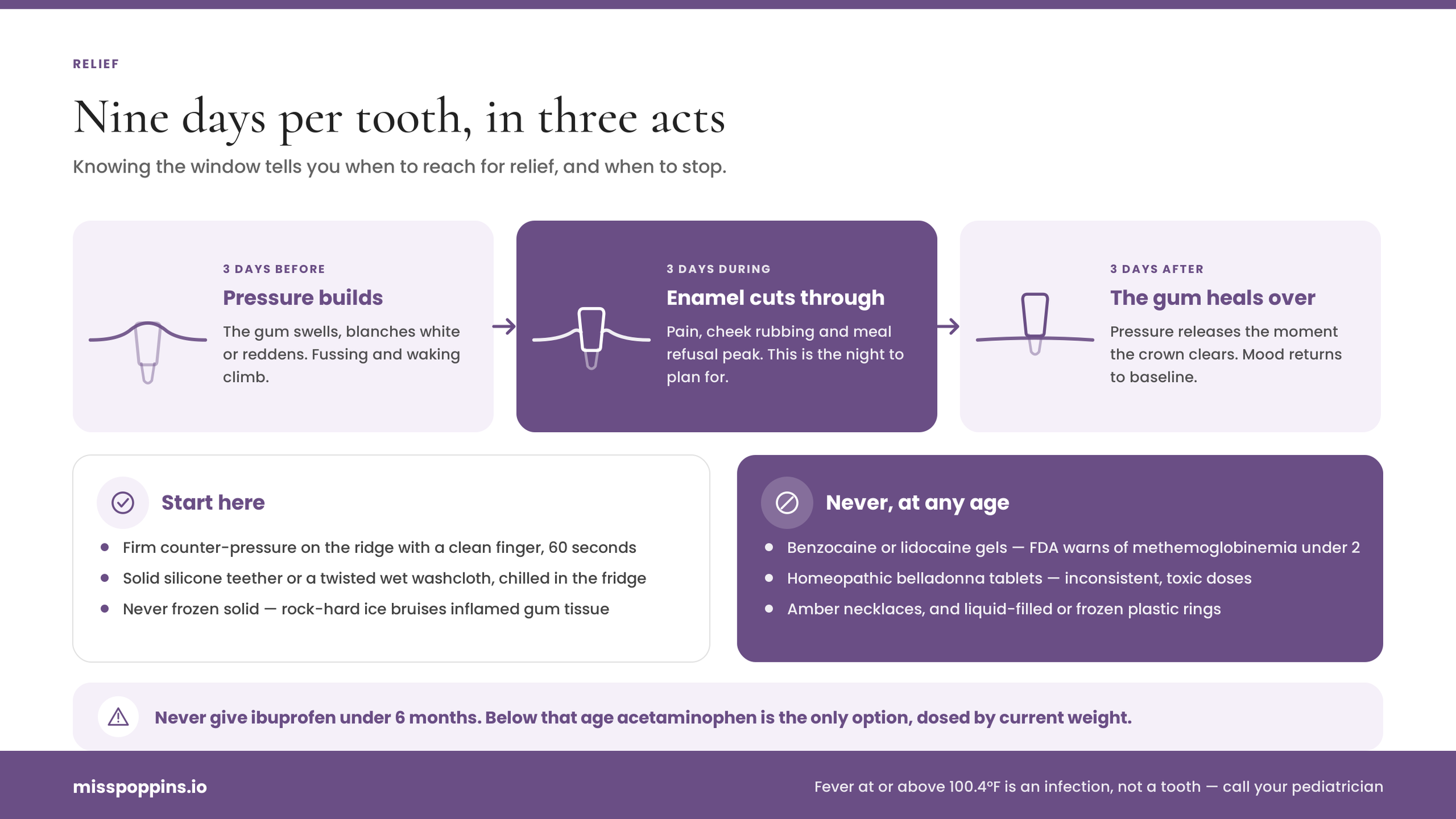
The 3-3-3 rule for baby teething pain relief gives parents an objective 9-day observational boundary to manage acute gum inflammation without over-medicating their child. When you know the exact biological window of an erupting tooth, you can deploy targeted physical and pharmacological comfort during peak inflammation and step back once the gum tissue heals.
The 3-3-3 Rule for Teeth Explained
Pediatric dental educators use the 3-3-3 rule to break down a single tooth's eruption into three 72-hour phases:
3 Days Before Eruption: Localized gum tissue swells, blanches white, or turns bright red as the crown presses upward from beneath the mucous membrane. Fussiness and night waking build during these 72 hours.
3 Days During Eruption: The enamel edge physically perforates the gum tissue. Pain, cheek rubbing, and meal refusal peak during this 3-day window.
3 Days After Eruption: Once the crown clears the surface, upward mechanical pressure releases immediately. The split gum edges recede and heal over 72 hours, returning your baby's mood and sleep to baseline.
Before reaching into the medicine cabinet, start with non-medicated soothing techniques for sore, swollen gums. Apply firm, steady counter-pressure directly on the swollen gum ridge for 60 seconds using a clean bare finger. Hand your infant a solid, textured silicone teething ring chilled in the refrigerator, or let them gnaw on a clean, wet terrycloth washcloth that has been twisted and chilled for 20 minutes. Never freeze teething rings solid in the freezer; rock-hard ice bruises inflamed gum tissue and can cause frostbite on delicate oral mucosa.
Tylenol vs. Motrin: Community Consensus and Pediatric Advice
When chilled washcloths fail at bedtime during the peak 72-hour eruption cut, targeted over-the-counter medication can save your baby's night. Across parent communities and pediatric clinics alike, Ibuprofen (Motrin, Advil) is widely favored over Acetaminophen (Tylenol) for night wake-ups in older infants for two pharmacological reasons: Ibuprofen is an NSAID that directly targets prostaglandin-driven gum inflammation, and a single dose lasts 6 to 8 hours compared to Tylenol's 4-to-6-hour window.
However, you must obey the strict clinical age boundary set by the American Academy of Pediatrics: never administer Ibuprofen to an infant under 6 months of age. In babies younger than 6 months, immature kidneys cannot safely process NSAIDs, especially if drooling or reduced milk intake causes mild dehydration. For infants under 6 months, Acetaminophen is the only appropriate medication, and only after verifying the exact milliliter (mL) dosage by current body weight with your pediatrician.
What NOT to Do During Teething
Walk past the "natural teething relief" aisle at the pharmacy and avoid four dangerous products flagged by federal safety regulators:
No Benzocaine or Lidocaine Numbs Gels: The U.S. Food and Drug Administration (FDA) warns parents never to use over-the-counter benzocaine gels (such as Orajel) or prescription viscous lidocaine on infants under age 2. Benzocaine can trigger methemoglobinemia, a life-threatening blood disorder that drastically reduces oxygen delivery to tissues, while topical numbing washes down the throat in seconds and numbs the gag reflex.
No Homeopathic Belladonna Tablets: Unregulated homeopathic teething tablets and gels have been found by the FDA to contain inconsistent, toxic levels of Atropa belladonna (deadly nightshade), linked to infant seizures, lethargy, and breathing difficulties.
No Amber Teething Necklaces: Baltic amber bead necklaces release zero clinically measurable pain relievers through the skin and pose severe strangulation and choking hazards inside the crib.
No Liquid-Filled or Frozen Plastic Rings: Sharp primary incisors can puncture liquid-filled plastic teethers, leaking non-sterile fluid into your baby's mouth.
Non-Clinical Boundary & When to Call Your Pediatrician: MissPoppins parenting coaches provide non-clinical educational and behavioral support and do not diagnose medical or dental conditions. Contact your pediatrician immediately if your child displays any of these clinical red flags, which are never caused by normal teething:
A rectal or temporal temperature at or above 100.4°F (38.0°C).
Watery diarrhea, projectile vomiting, or fewer than 4 wet diapers in 24 hours.
Unconsolable lethargy, facial swelling, or pus draining from the gumline.
Airway stridor, wheezing, snoring, or difficulty swallowing liquids.
Protecting the Milk Teeth Schedule: Early Pediatric Dental Care
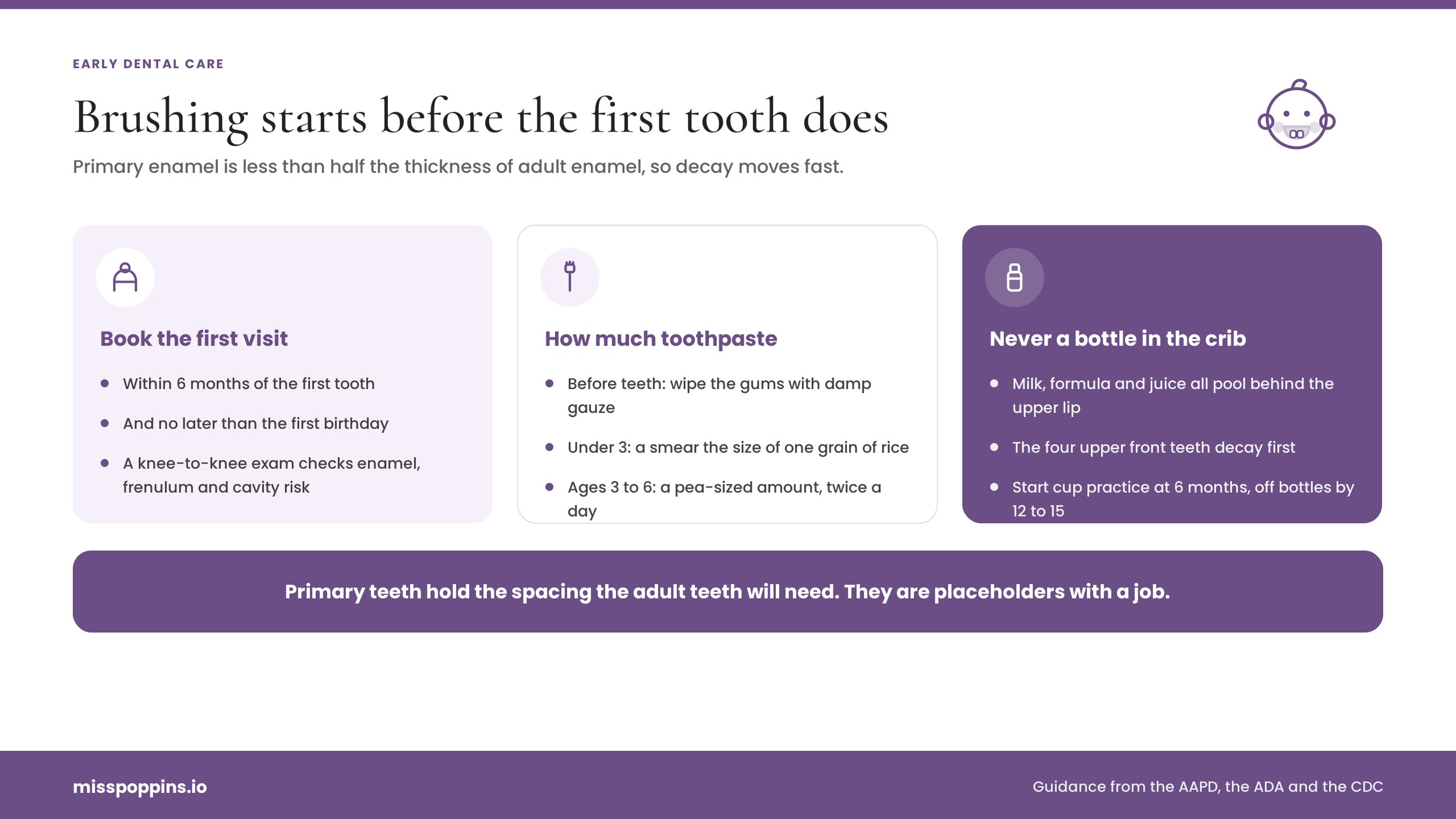
Early pediatric dental care begins the exact day your infant's first lower central incisor breaks through the gumline, long before all 20 primary teeth complete their eruption schedule. Primary teeth preserve the exact anatomical spacing in the jawbone required for permanent adult teeth and allow your toddler to chew nutrient-dense proteins and vegetables properly.
When to Schedule the First Dentist Appointment
Both the American Academy of Pediatric Dentistry and the Centers for Disease Control and Prevention (CDC) advise parents to establish a dental home within 6 months of the first tooth erupting, or no later than the child's first birthday. Combine this milestone with your regular 1-year checkup checklist by scheduling baby's first dentist visit by age one. During this quick "knee-to-knee" exam, a pediatric dentist checks enamel mineralization, evaluates frenulum (lip or tongue tie) attachment, assesses cavity risk, and applies a protective fluoride varnish if needed.
Infant Dental Hygiene Practices
Even before Tooth O or P appears at 6 months, wipe your baby's gums after morning and bedtime feeds using a clean, damp gauze pad to clear residual milk sugars. The day the first tooth emerges, switch to a soft-bristled infant toothbrush twice a day. Per guidelines from the CDC and the American Dental Association, use a tiny smear of fluoride toothpaste the size of a single grain of rice for children under age 3, and increase to a pea-sized amount from ages 3 to 6.
Because enamel on primary teeth is less than half as thick as adult enamel, dental caries progress rapidly. Review our complete guide on preventive baby teeth care and cavity protection guidelines, and start cup training to protect primary front teeth from liquid pooling at 6 months so your child transitions fully off bottles by 12 to 15 months. Never put an infant into the crib with a bottle of breastmilk, formula, cow's milk, or juice; overnight sugar pooling around the upper incisors causes rapid Early Childhood Caries (bottle rot).
Get a Personalized Teething, Feeding & Sleep Plan with MissPoppins
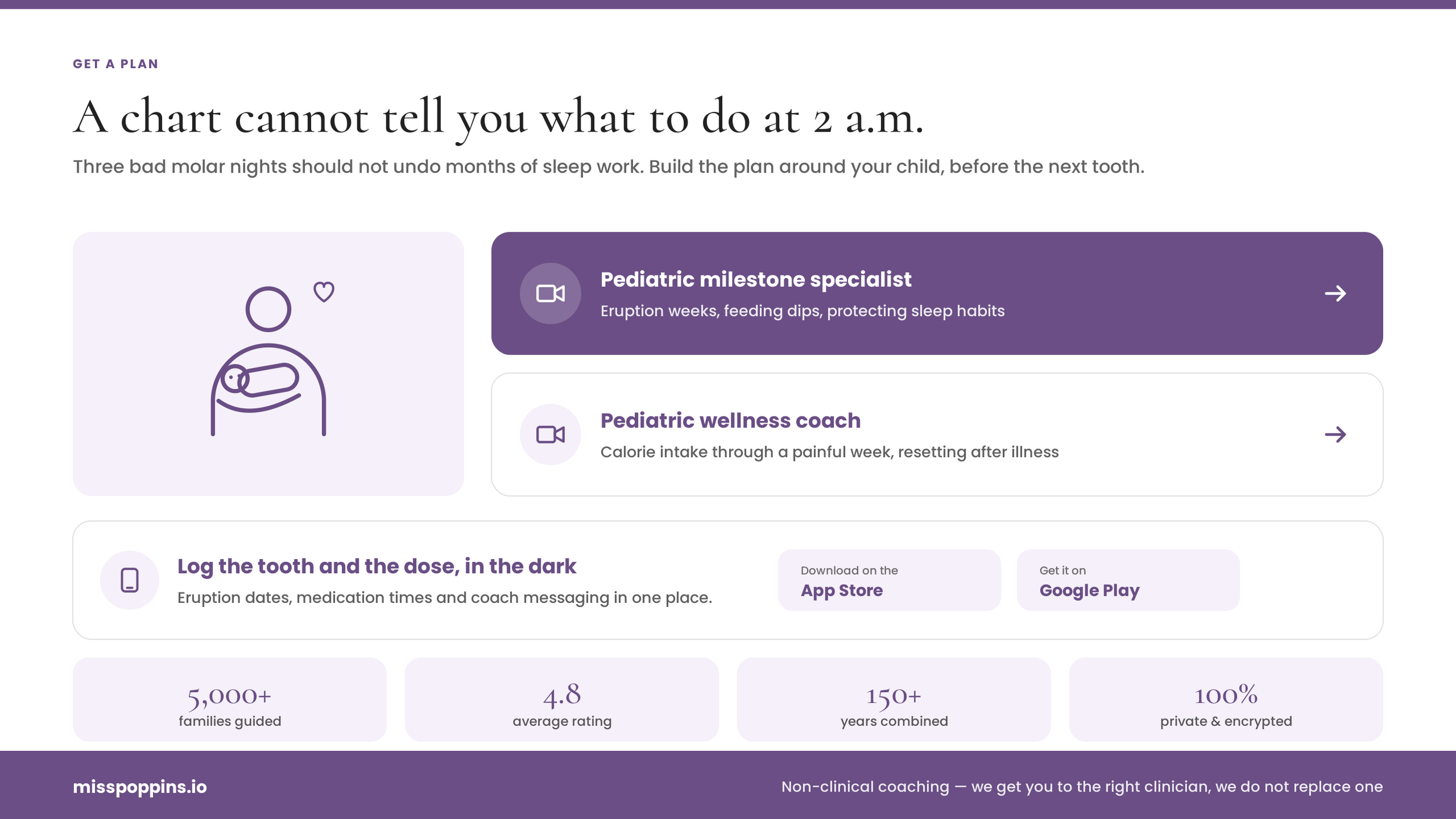
Generic internet charts stop being helpful the second a newly erupted molar derails a 14-month-old's feeding schedule. You do not have to piece together conflicting advice at 2:00 AM.
Book a 1-on-1 consultation with MissPoppins to work directly with vetted, certified parenting specialists. We build custom routines around your baby's exact temperament and current developmental stage.
Why Families Trust MissPoppins:
5,000+ families guided with a 4.8-star average platform rating.
150+ years of combined experience across infant sleep, lactation, nutrition, and toddler behavior.
100% private, encrypted sessions for every video consultation and text check-in.
Instant mobile access directly through our secure platform.
Take control of your child's schedule tonight. Download the MissPoppins app on iOS and Google Play to access your care team instantly.
Whether you need to protect daily calorie intake during a painful week or reset bedtime habits after an illness, book your session below for calm, immediate guidance.
Infant Teething FAQ
What is the normal teething schedule for babies?
6 to 33 months is the normal teething schedule for babies. Lower central incisors erupt first between 6 and 10 months, followed by upper incisors, first molars, canines, and second molars, resulting in 20 primary teeth before age 3.
What are the worst days of teething?
24 to 72 hours directly before the tooth crown pierces the gum tissue are the worst days of teething. Upward pressure creates peak gingival inflammation during this three-day window, and discomfort drops rapidly once the enamel edge breaks through.
Is it okay to let baby sleep more when teething?
Yes, letting a teething baby sleep an extra 30 to 45 minutes during daytime naps is safe and restorative. Localized gum inflammation and fragmented nighttime sleep increase fatigue, provided your infant has no fever above 100.4°F or dehydration.
What is mistaken for teething?
3-month salivary gland maturation, the 4-month sleep regression, and middle ear infections are most commonly mistaken for teething. If your baby runs a fever at or above 100.4°F or screams when laid flat, contact your pediatrician immediately.
Which teeth usually rot first?
4 upper front teeth (maxillary incisors, Letters D, E, F, and G) usually rot first in infants and toddlers. Early Childhood Caries occur when milk or juice pools behind the upper lip during overnight bottle or sippy cup feeds.
Is it okay to give my baby Tylenol for teething every night?
No, giving your baby Tylenol every night for teething is unsafe. Continuous nightly dosing can mask an undiagnosed ear infection, stress immature liver pathways, and exceed the true 72-hour eruption window. Consult your pediatrician for pain lasting beyond three nights.
What causes brown stains on baby teeth?
3 primary culprits cause brown stains on baby teeth: liquid iron supplements, chromogenic oral bacteria, or early enamel demineralization from tooth decay. Wipe your infant's teeth with a damp cloth immediately after administering iron drops and consult a pediatric dentist.