

Written by Rosangela Braganca, a postpartum and newborn specialist who has spent 38+ years caring for newborns and supporting families with infant sleep, lactation, and postpartum routines.
Tummy time builds the neck, shoulder, and core strength babies need to lift their heads, roll over, and crawl. Start in the first days home with tummy time on your chest, then move to short floor sessions once the umbilical cord stump has fallen off and healed. Early sessions may last only seconds. By about 2 months, aim for 15 to 30 minutes a day in total.
7 Benefits of Tummy Time
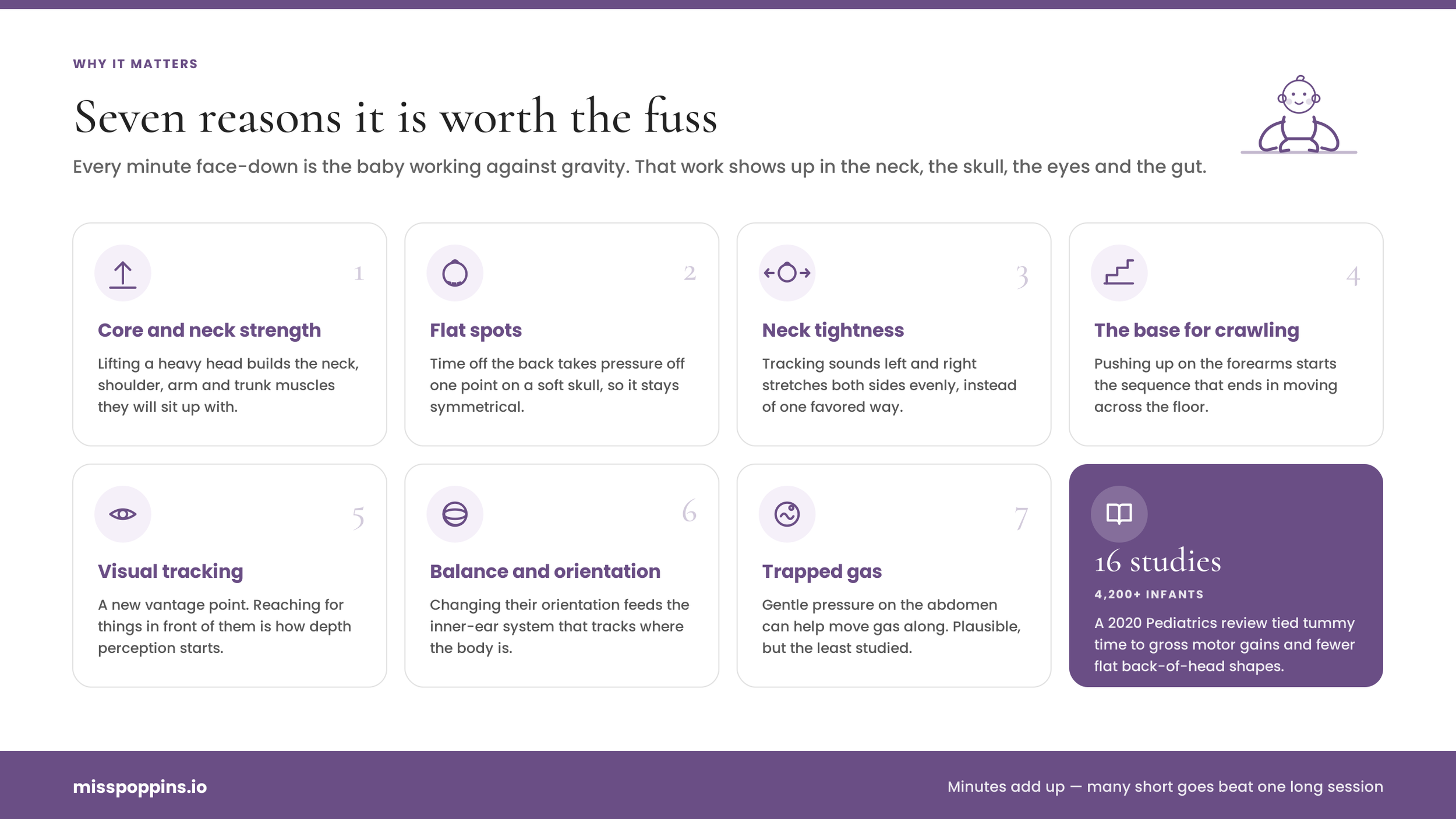
A newborn on their tummy starts working several muscle groups at once. In the first weeks you'll see quick changes in your baby's strength. Knowing the normal newborn signs and what to expect week one helps you set realistic goals for early floor play.
1. Core and Neck Muscle Strength
Infants work against gravity to lift their heavy heads off the mat. This resistance builds strength in the neck, shoulders, arms, and trunk. These are the same muscles your baby will use to sit up, first with support and later on their own.
2. Plagiocephaly and Brachycephaly Prevention
Infant skulls remain soft and pliable for months. Lying strictly on the back creates a localized pressure point on the rear of the skull. Time spent on the stomach removes this pressure entirely. The skull can then maintain a round and symmetrical shape. Medical professionals call a flat spot positional plagiocephaly, or brachycephaly when it is flat across the back. Frequent supervised floor sessions distribute pressure evenly across the day.
3. Torticollis Prevention
Some infants prefer looking in only one direction. This preference tightens the neck muscles on one specific side. Floor play encourages babies to look left and right to track sounds. This movement stretches the neck muscles evenly. If your baby always turns to one side, mention it to your pediatrician. Gentle stretches or physical therapy work best early.
4. Gross Motor Skill Foundation
Moving independently requires a highly stable trunk. Pushing up on the forearms initiates the sequence for mobility. A 2020 review in Pediatrics looked at 16 studies covering more than 4,200 babies. It linked tummy time with better gross motor and overall development, and with a lower risk of a flat-back head shape (brachycephaly).
5. Visual Tracking and Spatial Awareness
A baby on their back only sees the ceiling and the sides of their crib. Flipping them over completely changes their visual perspective. They learn to gauge distance by reaching for objects placed directly in front of them. This depth perception translates directly to hand and eye coordination.
6. Vestibular System Development
The inner ear controls spatial orientation and balance. Changing the baby's orientation stimulates this sensory system. The brain learns how to process movement and gravity correctly. The infant understands exactly where their body exists in physical space.
7. Digestive System Support
Pressure on the abdomen provides a natural massage. This firm contact helps move trapped gas through the intestines. Regular floor play can help babies pass gas.
When to Start Tummy Time
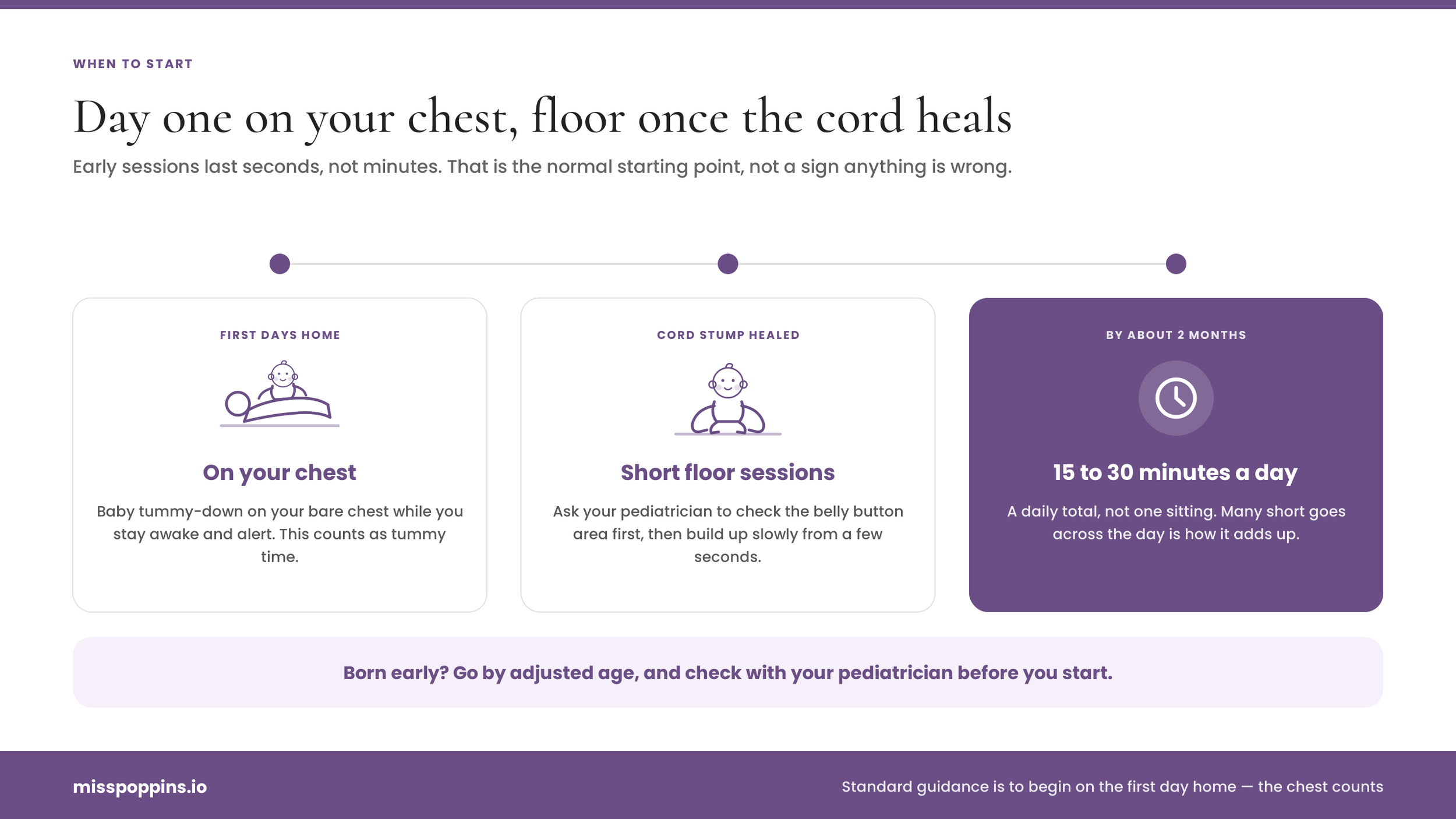
Start in the first days home with tummy time on your chest. Move to short floor sessions once the umbilical cord stump has fallen off and healed. Ask your pediatrician to check the belly button area first. From there, build up slowly. Short, frequent sessions count, and the strength your baby builds now carries into milestones at 6 months and the activities you can do with your 6-month-old.
Real Talk from Parents: The Tummy Time Struggle
A common post on r/newborns goes something like this: a parent's 4-week-old screams face-down into the mat after 30 seconds. They've tried every toy in the house, and they feel like they're torturing their baby to hit an arbitrary milestone.
The good news: 30 seconds at 4 weeks is normal. Holding up a heavy head against gravity is hard work, and a full tummy makes it worse. The clinical benefits often clash directly with a crying infant. The tips below help.
Troubleshooting: What to Do When Your Newborn Hates Tummy Time
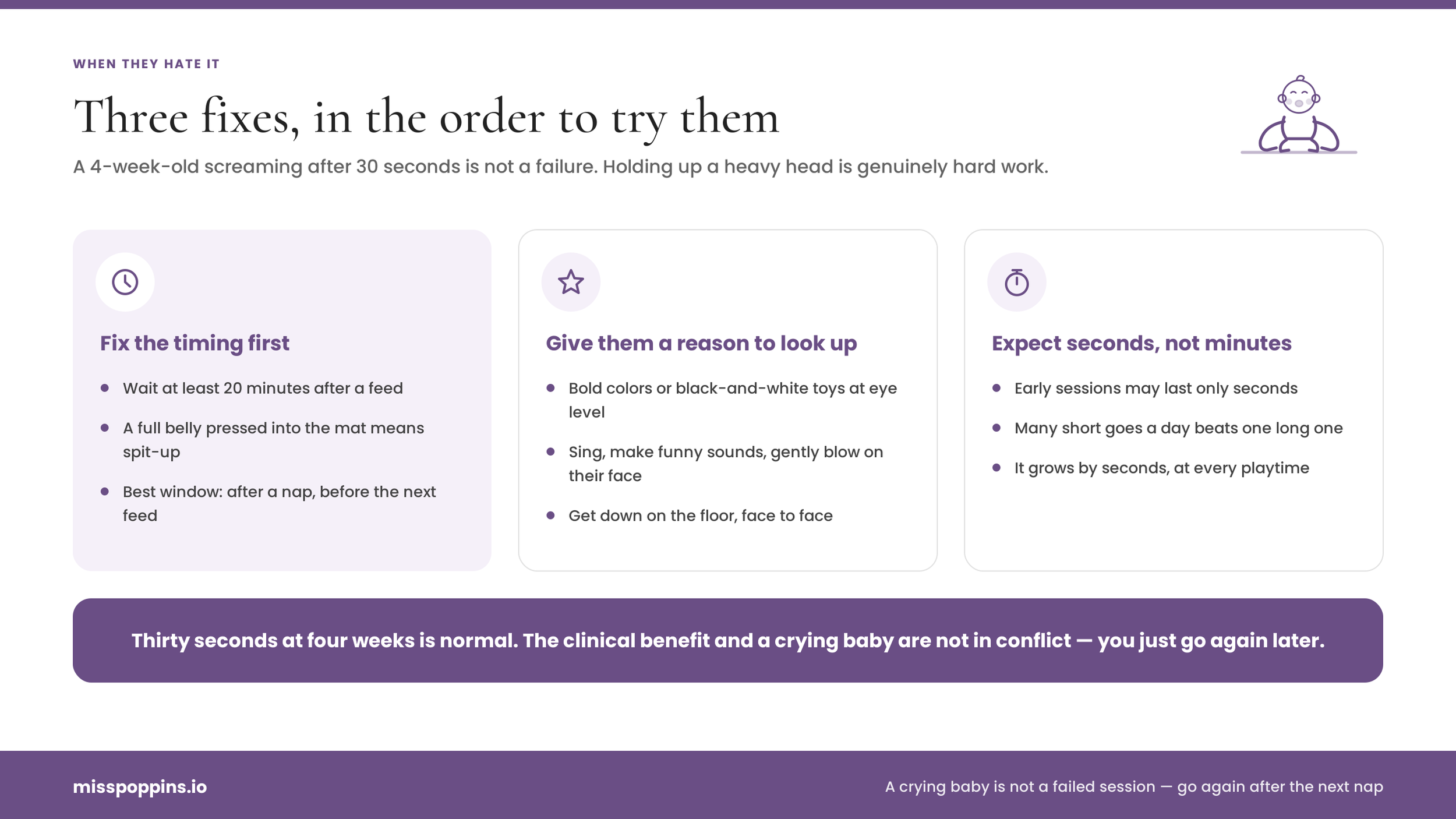
Postpartum and newborn specialist Rosangela Braganca has spent 38+ years caring for newborns and families, and her first fix is timing. Wait at least 20 minutes after a feed, since a full belly pressed into the mat makes spit-up much more likely. The best window is right after a nap and before the next feed.
Then add a distraction to stretch the session, even by a few seconds: bold colors or black-and-white toys at eye level, singing, gently blowing on their face, or making funny sounds. And expect short sessions at first. In Rosangela's experience, early tummy time may last only seconds. It grows when you keep trying many times a day, at every playtime.
Need personalized help? Chat with a certified postpartum and newborn coach on MissPoppins. Book a free 30-minute virtual consultation with Rosangela Braganca to build a tummy time routine that fits your baby.
Where to Do Tummy Time
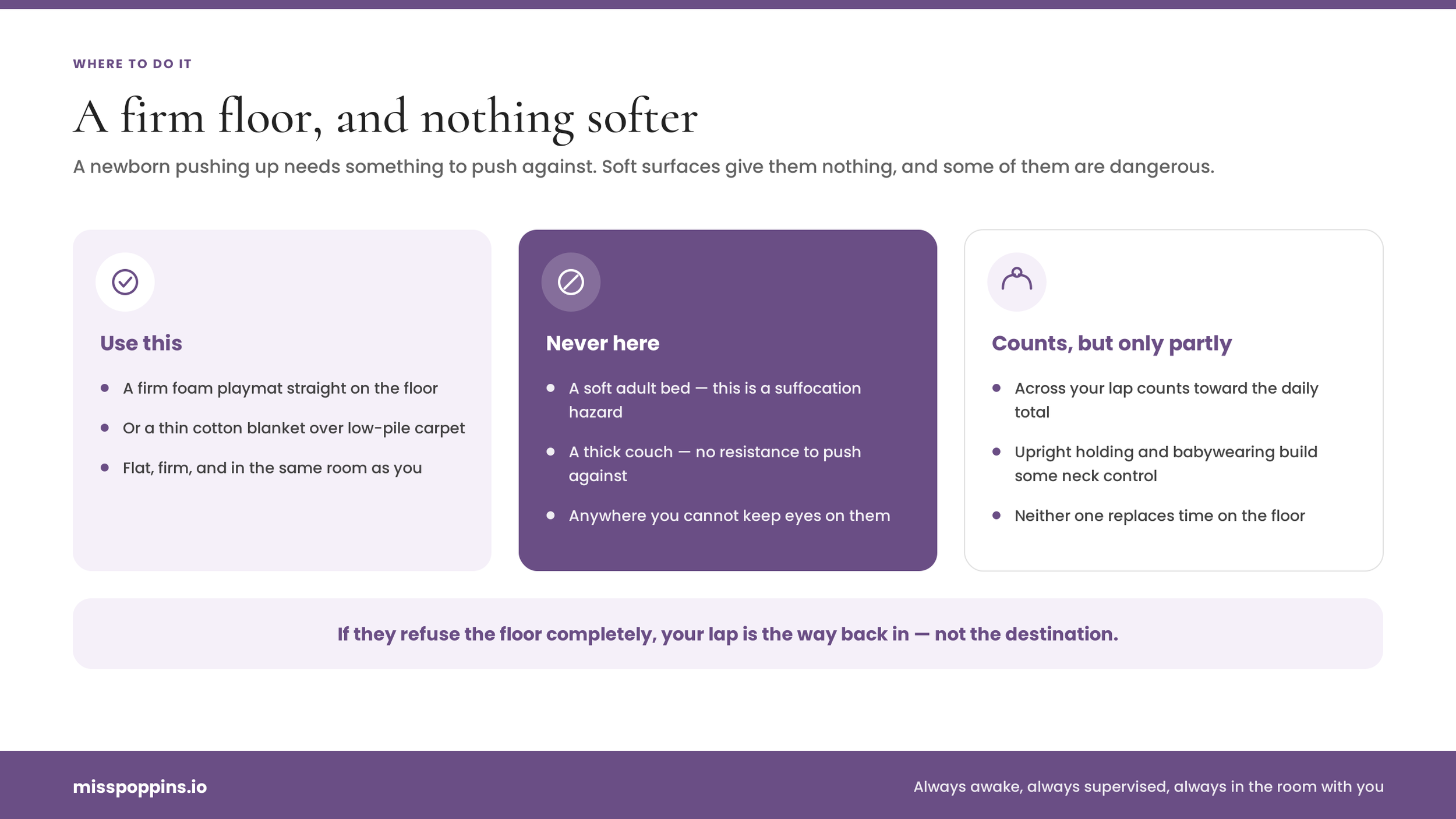
A newborn practicing head lifts needs a firm and safe surface. Soft adult beds pose a suffocation hazard. Thick couches offer zero resistance for pushing up.
Use a firm foam playmat placed directly on the floor. You can also place a thin cotton blanket over a low pile carpet. If your baby refuses the floor completely, use an alternative position. Laying the baby across your lap counts toward their daily minutes. Upright holding and babywearing build some neck control too, but they do not replace floor time.
Tummy Time Versus Safe Sleep Protocols
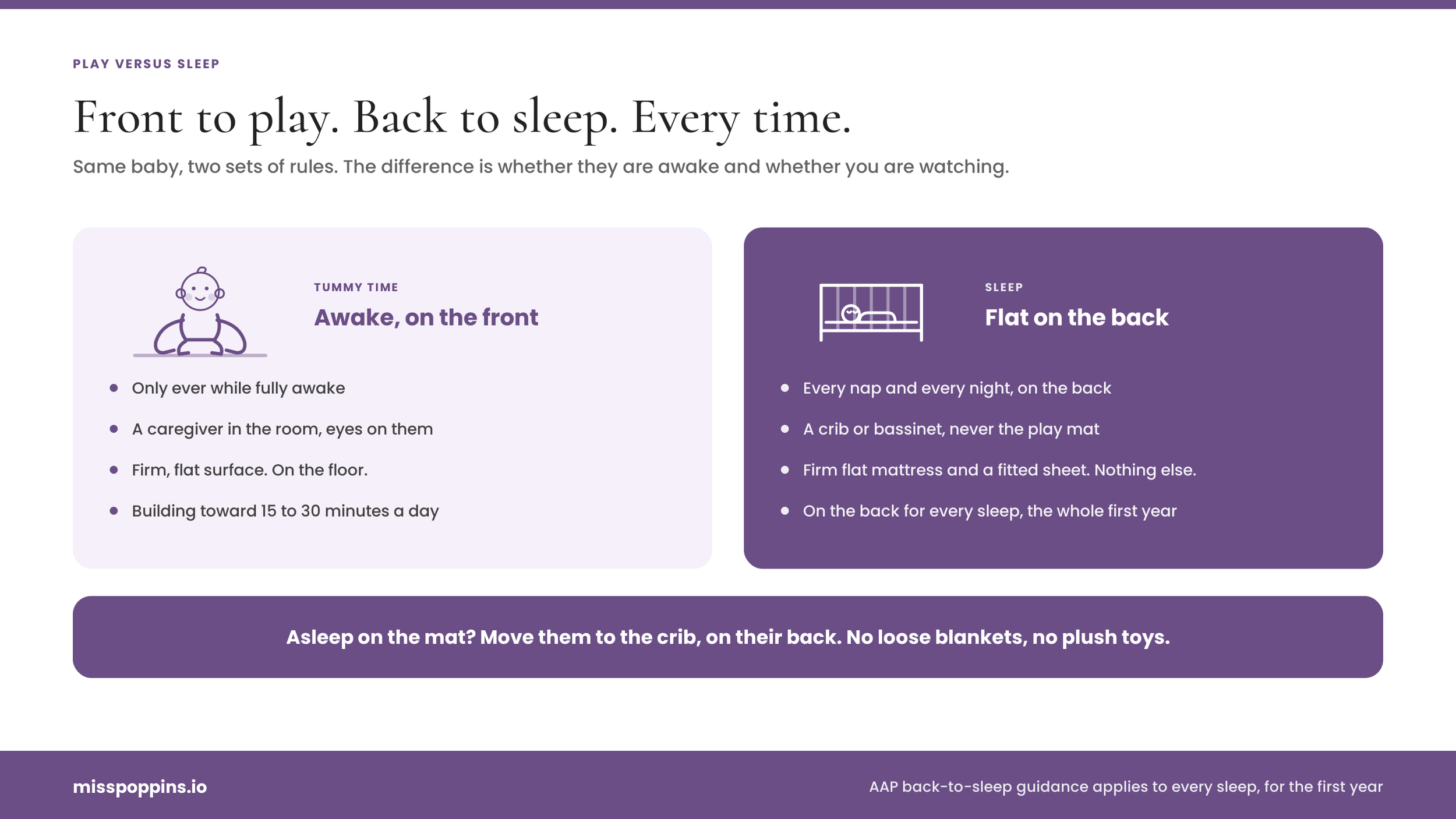
A baby playing on the floor requires different safety rules than a sleeping newborn. The AAP recommends the back-to-sleep rule to reduce the risk of SIDS. You must place your baby flat on their back for every nap and overnight sleep. Our guide to infant sleep on stomach safety explains why tummy sleeping is risky.
Stomach play must always happen while the infant is fully awake. A caregiver must remain in the room with eyes on the baby at all times. If the baby falls asleep on the play mat, you must move them to their crib or bassinet, on their back. A safe sleep environment strictly means a crib or bassinet with a firm, flat mattress and a fitted sheet, nothing else. The NIH Safe to Sleep campaign explains how to keep tummy time and sleep time separate. Keep loose blankets and plush toys completely out of the sleep space.
When to Call Your Pediatrician and MissPoppins Support
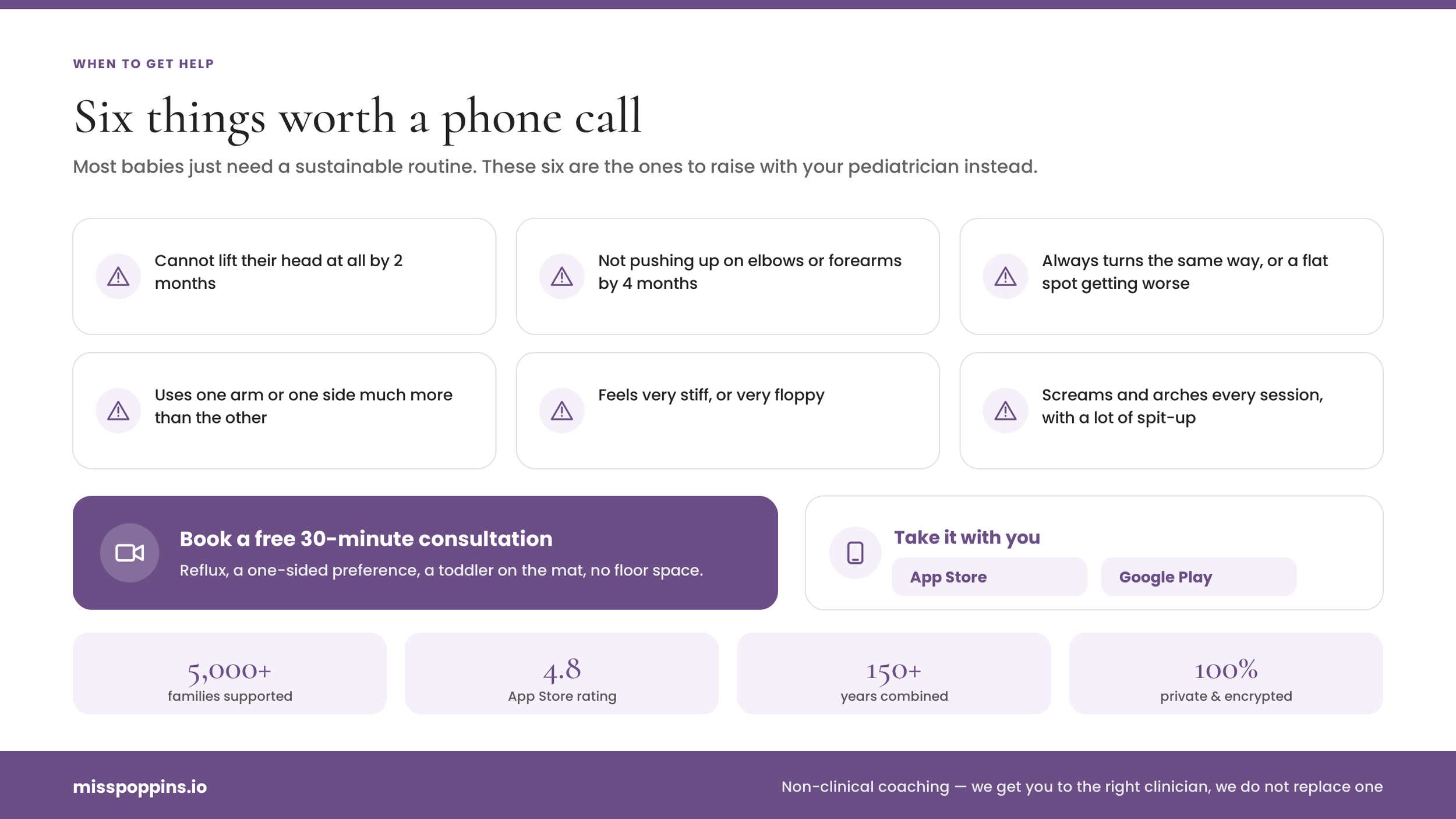
Talk to your pediatrician if your baby:
Can't lift their head at all during tummy time by 2 months
Isn't pushing up on elbows or forearms by 4 months
Always turns or tilts their head to the same side, or has a flat spot that's getting worse
Uses one arm or side of the body much more than the other
Feels very stiff or very floppy
Screams and arches every session and spits up a lot (this can be reflux)
Born early? Go by your baby's adjusted age, and check with your pediatrician before starting.
Most parents simply need a sustainable playbook for daily life.
Over 5,000 families have used MissPoppins, and we're rated 4.8 stars on the App Store.
Our coaches bring 150+ years of combined experience, right to your phone. All sessions are private and encrypted.
MissPoppins coaches understand real-world edge cases. We troubleshoot babies with reflux who spit up every session. We build plans for babies who always turn one way. We plan around toddlers who want to "help" on the mat, and we adapt routines for small apartments with no floor space.
The bottom line: Start on your chest in the first days home, move to the floor once the cord stump heals, and expect seconds before minutes. Aim for 15 to 30 minutes a day by 2 months, always awake and supervised. If your baby fights it, a coach can help.
Download the MissPoppins app on iOS or Google Play.
Frequently Asked Questions
Is tummy time actually necessary?
Yes. Babies sleep on their backs for safety, so awake tummy time is where they build the neck and shoulder strength required for independent mobility. Babies who get very little tummy time may reach early milestones like rolling a little later.
What happens if I don't give my baby tummy time?
Babies who spend most of their awake time on their backs are more likely to get a flat spot on the head. Most flat spots are mild and improve with repositioning and more tummy time as babies grow and start sitting up. A few babies need physical therapy or, less often, a helmet.
Does baby lying on my chest count as tummy time?
Yes. Placing a newborn belly down on your chest is an easy way to start for the first two weeks of life, as long as you are awake and alert. Your face provides built-in visual motivation.
How many minutes should a baby do tummy time?
Start with a few seconds to 3 minutes at a time and build up slowly. Aim for 15 to 30 minutes a day in total by 2 months, and about 30 minutes by 3 months.
Is 2 weeks too late to start tummy time?
No, it is right on time. Many babies' cord stumps fall off in the first two weeks. Start with a few seconds to a minute at a time, several times a day.
Does burping count as tummy time?
Burping tummy-down across your lap counts. Upright burping builds neck control, but it is not tummy time.
Sources: