

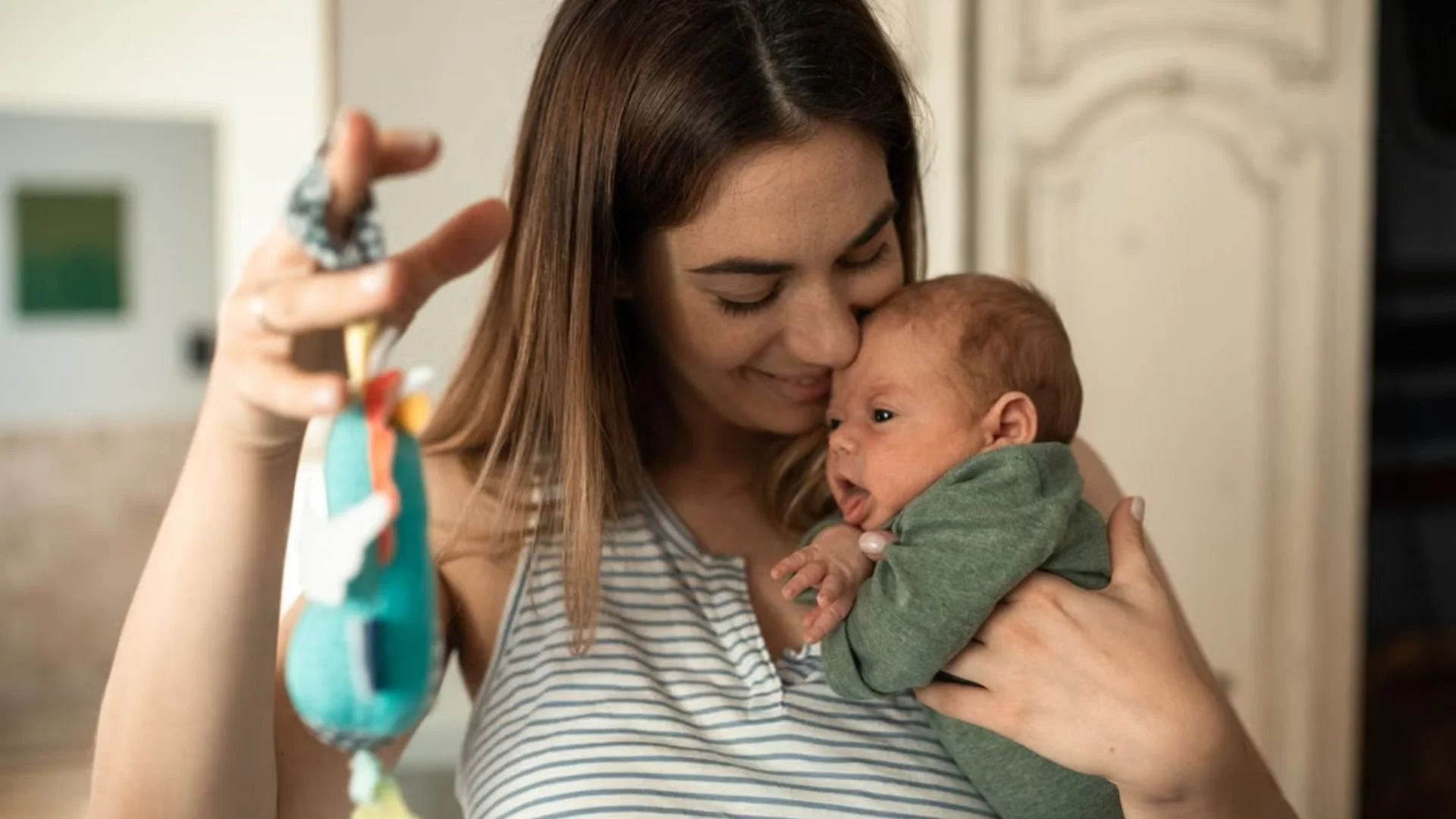
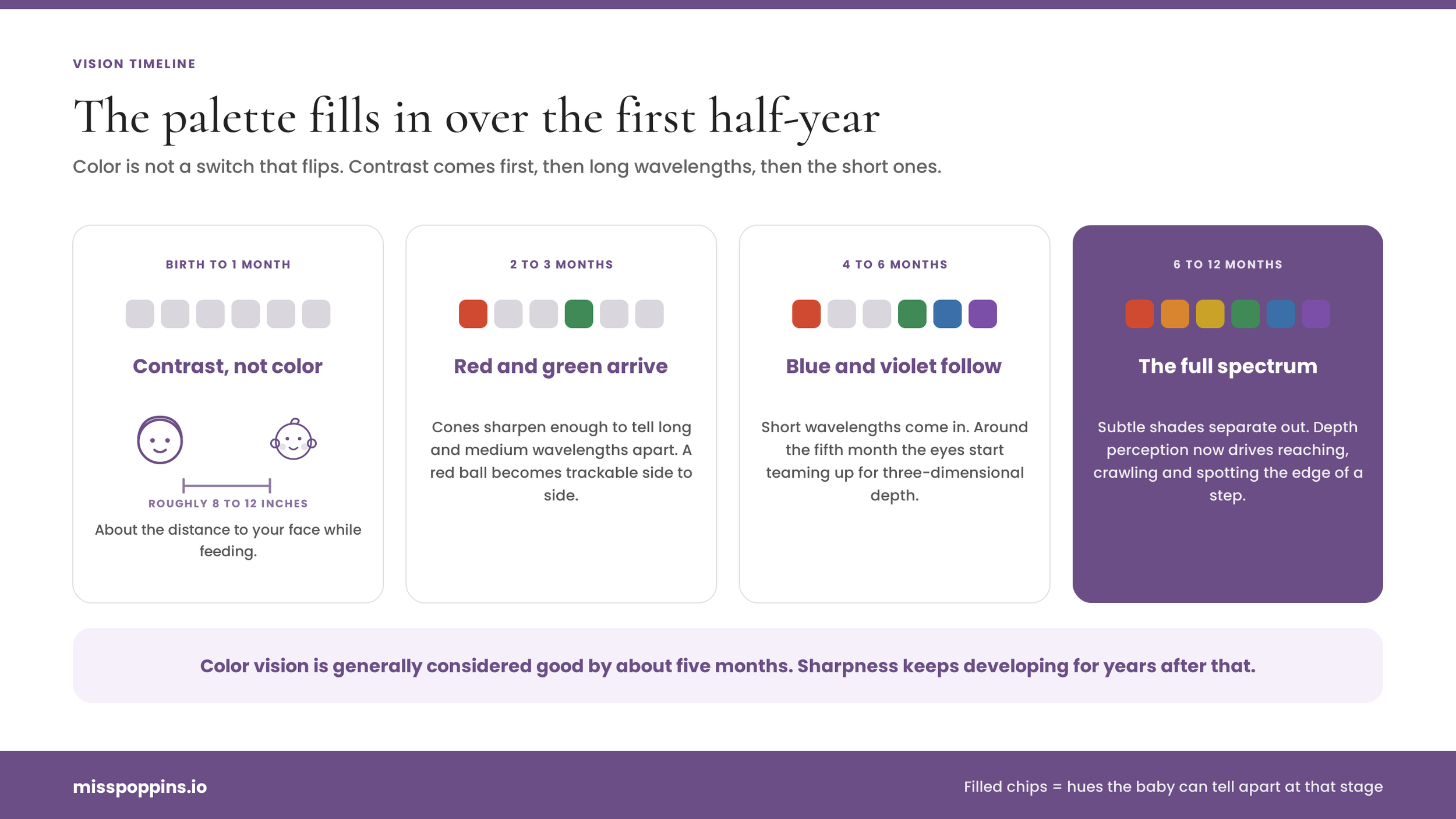
Newborns see strictly in grayscale at birth. Infants begin to perceive red and green color wavelengths by two months of age. Babies see the full color spectrum by six months of age. If your baby fails to track bright objects by 4 months, consult a pediatric ophthalmologist.
The Month-by-Month Infant Vision Development Timeline
An infant's visual cortex develops rapidly during the first year of life. Parents frequently express intense anxiety regarding early visual milestones. You must focus on recognizing normal newborn visual focus and tracking habits in the first weeks. The internet provides a chaotic mess of contradictory milestone charts. A mother scrolling YouTube at 3 AM will inevitably find a video claiming her baby is permanently delayed because they stared at a blank wall for ten minutes. Panic sets in immediately. The algorithm feeds exhausted parents terrifying worst-case scenarios. We will break down the exact biological progression below.
Visual processing demands massive caloric energy. A baby utilizes extreme brain power just to open their eyelids and register light in a bright room. The anatomical hardware exists at birth. The neural software requires months of environmental data to compile properly.
Birth to 1 Month (Black, White, and Grayscale)
Newborn retinas require extreme contrast to register shapes. The anatomical focus distance remains strictly 8 to 12 inches. This physical limitation is entirely by design. This distance matches the exact space between a mother's face and a nursing baby. You can maximize this biological design by engaging facial recognition and eye contact at the newborn 8-to-12 inch focal distance.
Search YouTube for "baby staring at ceiling fan." You will find thousands of frantic videos from parents worried about neurological issues. Babies at this stage simply stare at analog clocks or the sharp edges of window curtains because they seek high-contrast light borders. They do not care about expensive developmental toys. The rods in the retina process low-light conditions efficiently. The cone cells remain entirely dormant.
2 to 3 Months (When Do Newborns See Red and Green?)
An infant's cone cells mature significantly between weeks eight and twelve. Research from the National Institutes of Health confirms this cellular growth allows the perception of long wavelengths like red and medium wavelengths like green. You can test this by placing solid red objects exactly 10 inches from the baby's face during supervised floor time.
Parents have massive success using alert 3-month wake windows for color and visual tracking play. A three-month-old will begin to track a red ball moving horizontally. The neck muscles finally gain enough strength to stabilize the heavy head. This physical stabilization allows the eyes to lock onto a target without the head bobbing wildly. The physical effort exhausts them quickly. You will see them turn their head away abruptly when they reach their sensory limit.
4 to 6 Months (Broad Color Recognition and Tracking)
A four-month-old baby starts distinguishing shorter wavelengths. They can now process shades of blue and purple. Binocular vision activates during this specific window. The two eyes begin working together to form three-dimensional images of the surrounding environment. Pediatricians at the American Academy of Pediatrics monitor this binocular development closely.
The infant brain now calculates distance and trajectory accurately. A baby will spot a colorful toy and calculate the exact required arm extension to strike it. The visual input directly triggers the motor output. This is the exact age when babies begin violently grabbing your reading glasses or dangling earrings. They finally see the bright metallic colors contrasting against your skin.
6 to 12 Months (Full Spectrum and Depth Perception)
An eight-month-old infant refines the ability to see highly subtle shades. A baby's world shifts into vibrant high definition. You will notice these 6-month milestones when color vision and depth perception align with reaching and grasping.
Depth perception drives the physical motivation to grab objects across the room. A crawling baby relies on this depth perception to identify drop-offs near stairs. They accurately judge the distance between the couch and the coffee table. The visual cortex operates at near-adult capacity by the first birthday. They will spot a single dropped Cheerio on a patterned rug from five feet away.
Visual Tracking Troubleshooting Matrix
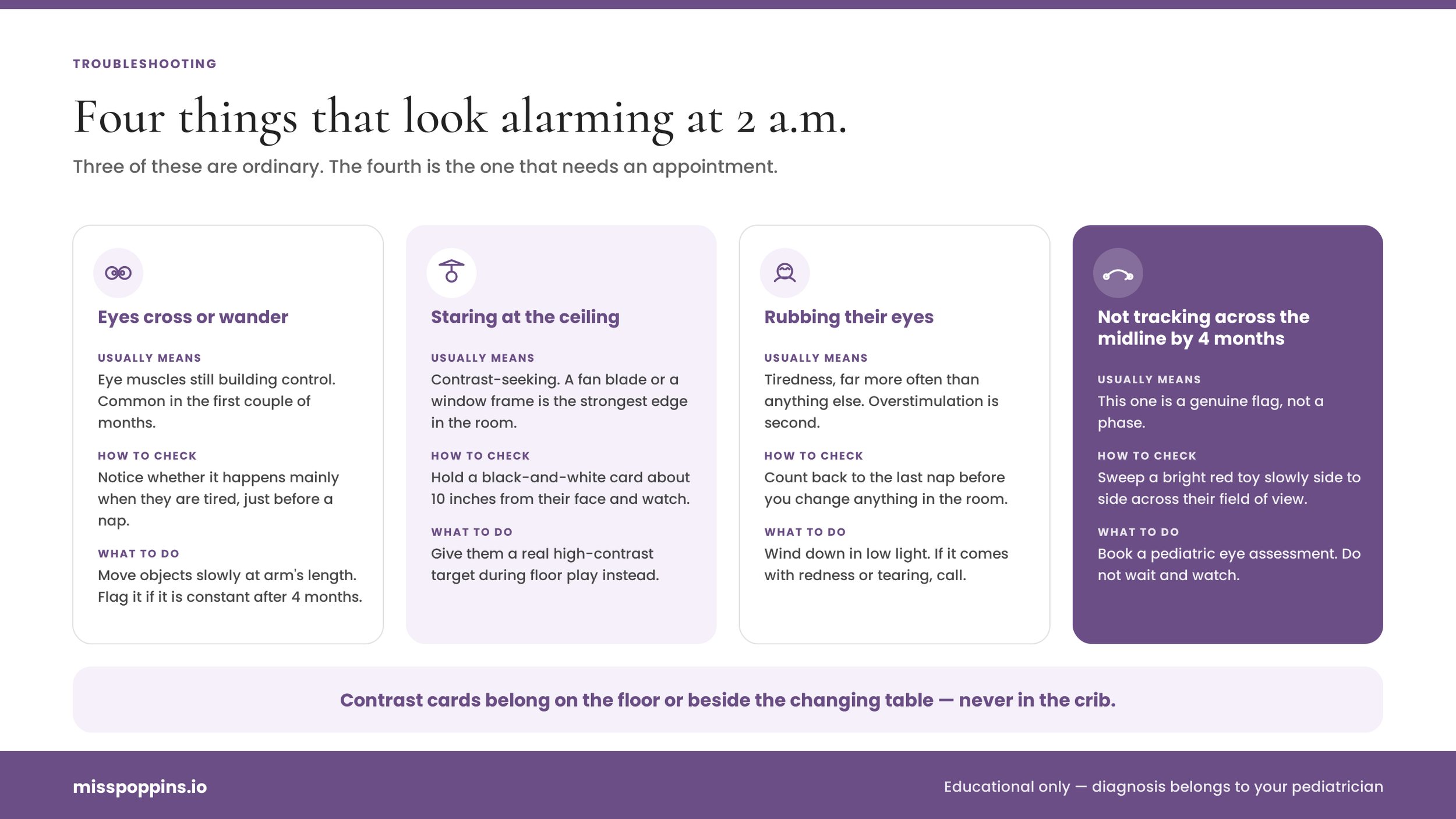
A four-month-old experiencing tracking delays requires immediate clinical observation. Use the troubleshooting points below to assess physical symptoms tonight.
Symptom: The baby crosses their eyes frequently.
Root Cause: This indicates normal weak eye muscles or potential strabismus.
Verification: Check if the crossing happens only when the baby is physically tired right before a nap.
Adjustment: Move objects slowly at a strict 12-inch distance to reduce eye strain.
Symptom: The baby stares blankly at the ceiling.
Root Cause: This is biological contrast-seeking behavior.
Verification: Hold a basic black-and-white graphic card exactly 10 inches away from their face.
Adjustment: Remove pale pastel toys from the crib environment immediately.
Symptom: The baby rubs their eyes aggressively during play.
Root Cause: This signals acute sensory overload.
Verification: Dim the room lighting completely to see if the crying stops.
Adjustment: Implement a 10-minute dark wind-down period before attempting sleep.
Symptom: The baby fails to follow a toy across the midline by 4 months.
Root Cause: This flags a potential neurological or visual processing delay.
Verification: Sweep a bright red toy side to side slowly across their field of vision.
Adjustment: Schedule a formal medical assessment tomorrow morning.
The Reality of High-Contrast Toys (What Parents Actually Say)
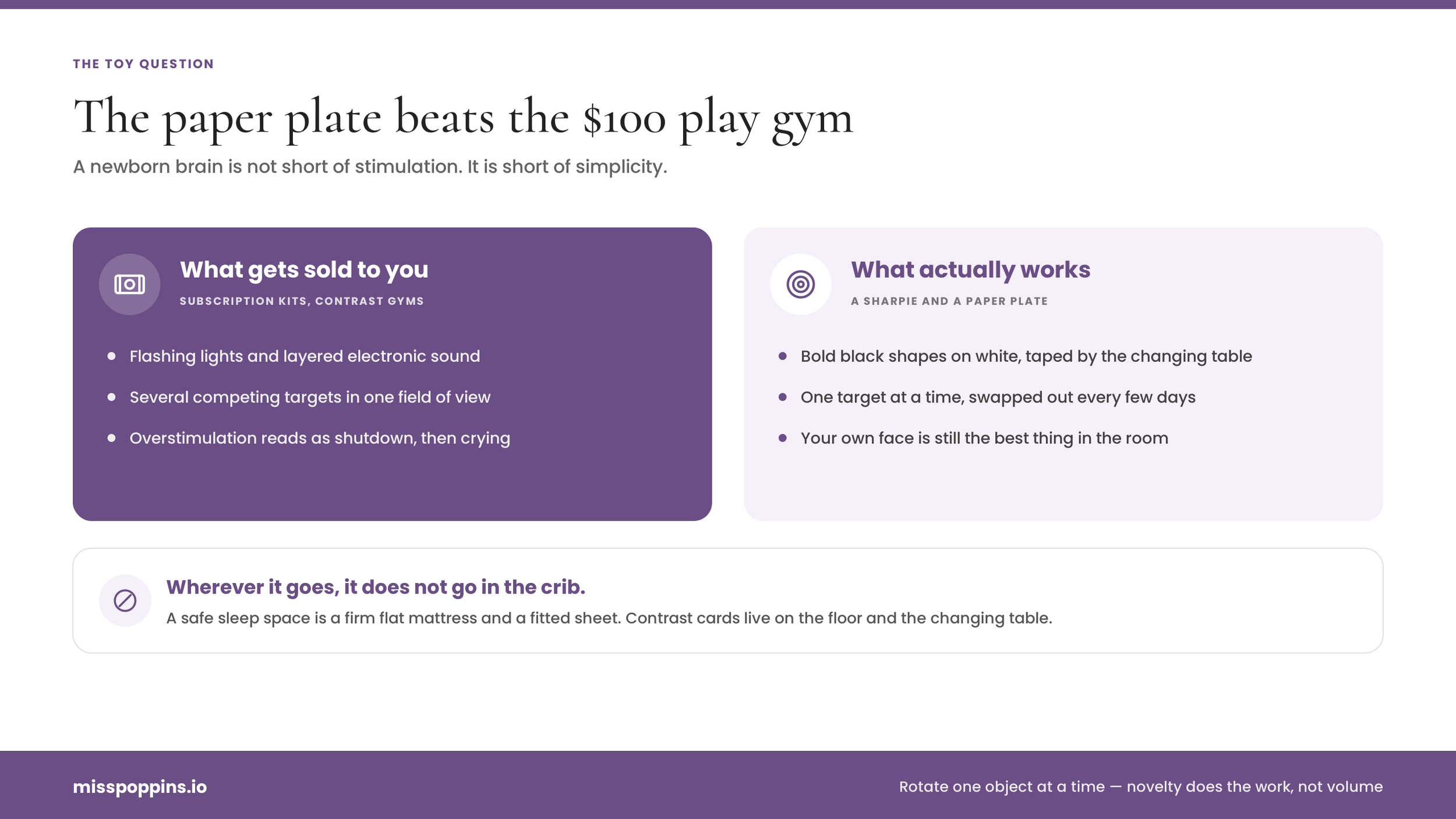
Scroll through r/NewParents on Reddit. You will find thousands of threads debating the value of expensive subscription play kits. Parental guilt drives massive consumer spending on complex infant gadgets. A highly viewed TikTok or YouTube short will aggressively convince you that your baby needs a $100 contrast gym to develop properly. The Reddit consensus reveals a different reality. Newborns are routinely overwhelmed by too much visual stimuli.
Parents report massive success simply taking a black Sharpie marker to a paper plate and taping it next to the changing table. This zero-dollar strategy distracts the baby perfectly during diaper changes. The infant brain craves absolute simplicity. Complex electronic toys with flashing lights cause immediate neurological fatigue.
Toy exhaustion directly mirrors general newborn exhaustion. Do-it-yourself daily scheduling fails in real life due to daycare pushback. Inconsistent partner handoffs ruin carefully planned sleep routines. Explore Postpartum & Newborn Coaches to help exhausted parents build a survivable daily routine. A professional coach maps out the day based on actual metabolic needs.
Actionable Tummy Time Visual Strategies by Age
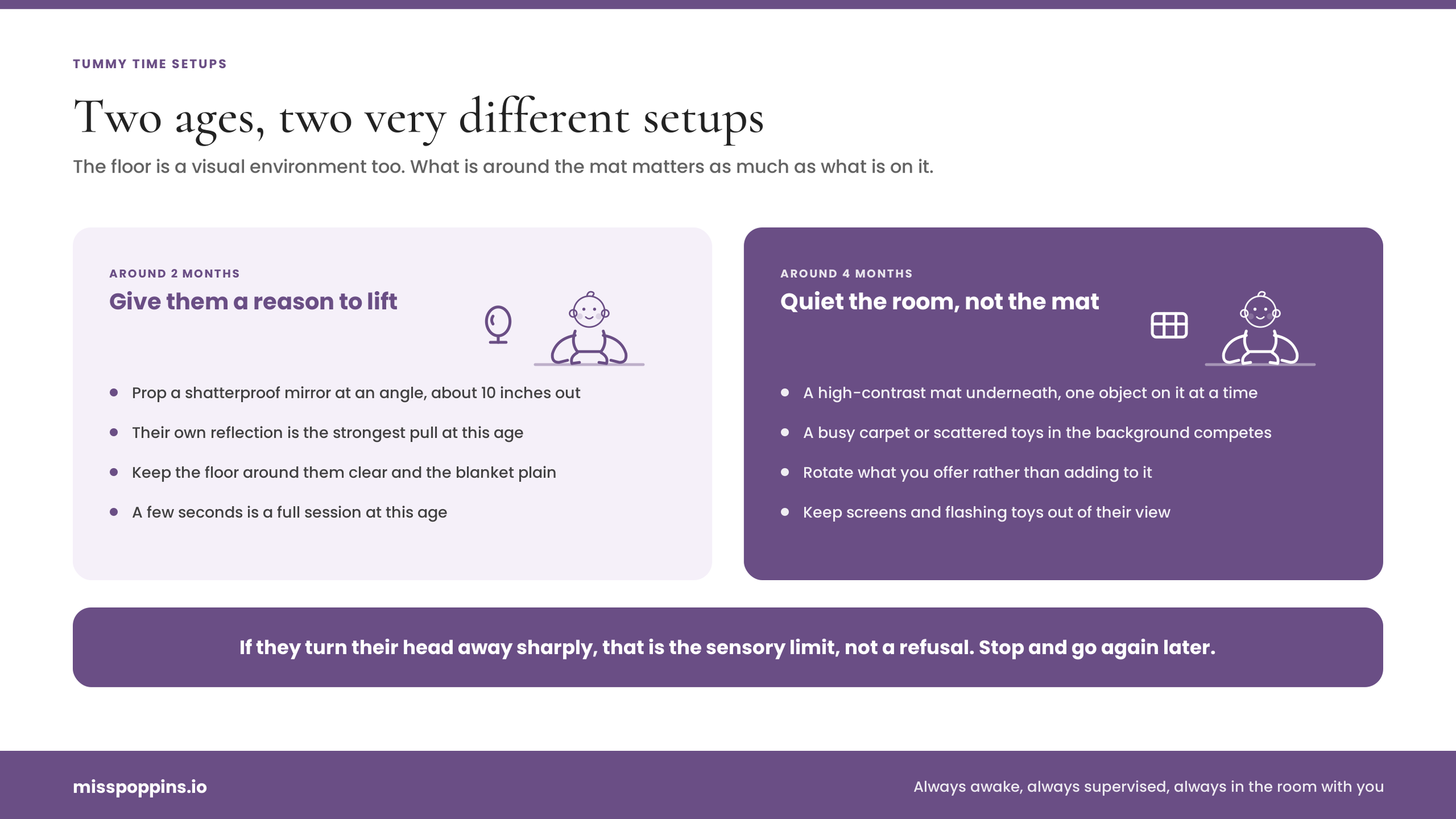
A two-month-old infant needs strict physical boundary setups for tummy time. Prop a shatterproof mirror at a 45-degree angle exactly 10 inches away from their face. This specific angle forces the baby to lift their heavy head. The physical reflection provides massive visual feedback. Keep the surrounding floor completely clear of clutter. A busy carpet pattern or scattered dog toys confuses the developing visual cortex. A solid colored blanket works best.
A four-month-old requires a different approach. Lay them on a high-contrast mat. Keep the surrounding room visually quiet. You must focus on avoiding visual sensory overstimulation from high-intensity screens or bright toys. Too many colors in the peripheral vision will cause the baby to shut down physically and begin crying. Rotate toys daily. Provide one high-contrast object at a time. Physical interaction builds neural pathways faster than passive observation.
What Colors Do Newborns See Best?
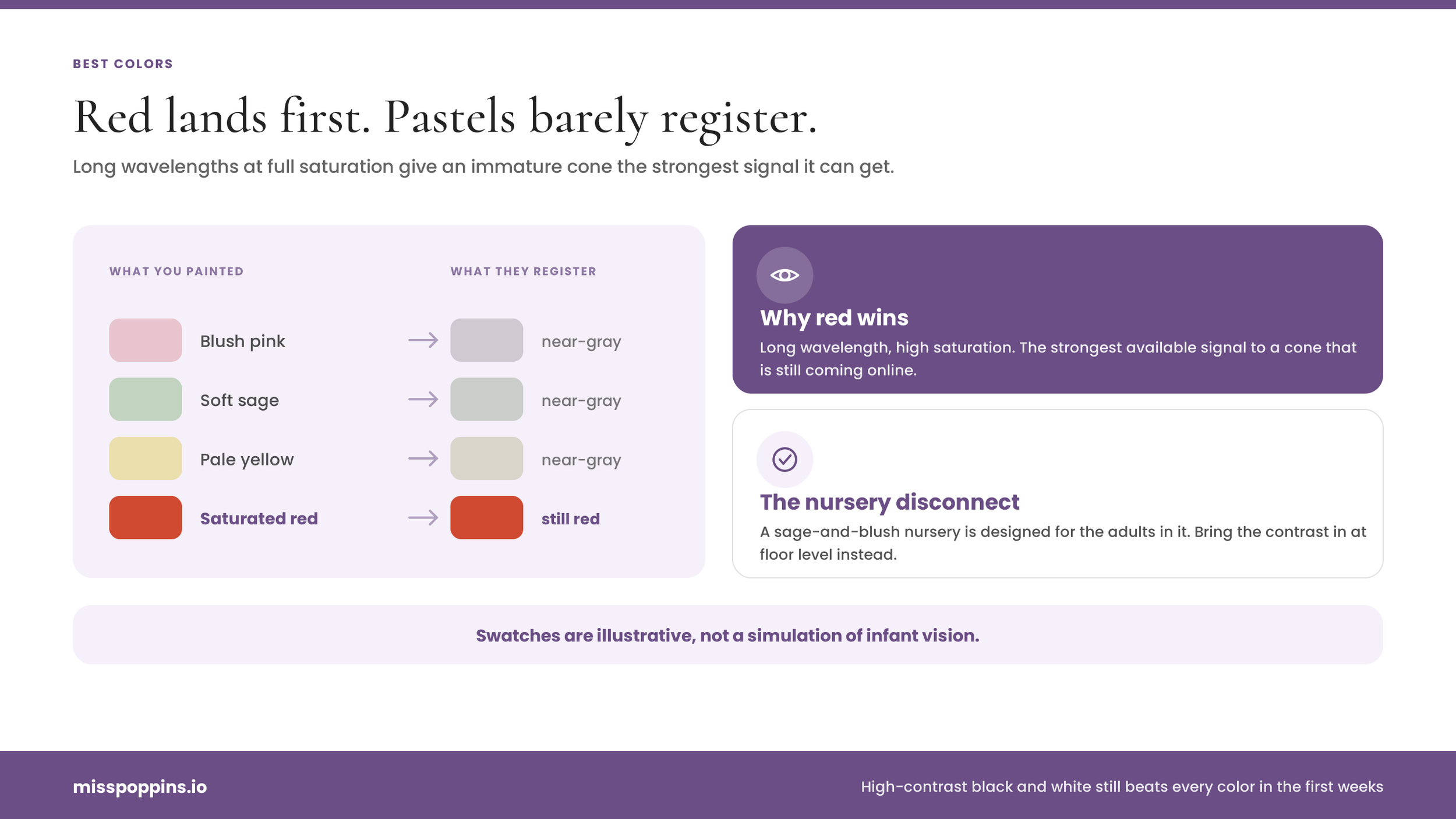
A newborn baby detects red wavelengths with the highest accuracy. Red objects reflect long light waves. These long waves hit the developing retina with intense physical force. Pale yellow and pastel pink objects lack this wavelength intensity. The infant cones require massive stimulation to fire correctly in the early weeks. Red provides that exact necessary biological jolt.
MissPoppins Senior Coaches observe a massive disconnect in modern nursery design. Nurseries painted in soft sage greens or blush pinks look completely gray to a newborn. Parents must intentionally introduce sharp black-and-white contrast cards into the crib area during supervised daylight play. You can also support circadian rhythms by using dim lighting and blackout curtains to support developing circadian cues. The American Academy of Sleep Medicine emphasizes completely dark environments for proper infant sleep drive. As visual acuity sharpens, you will see hand-eye coordination development driving fine-motor milestones. The baby clearly sees the high-contrast object and forces their tiny fist to reach for it.
When to Call Your Pediatrician (Visual Red Flags)
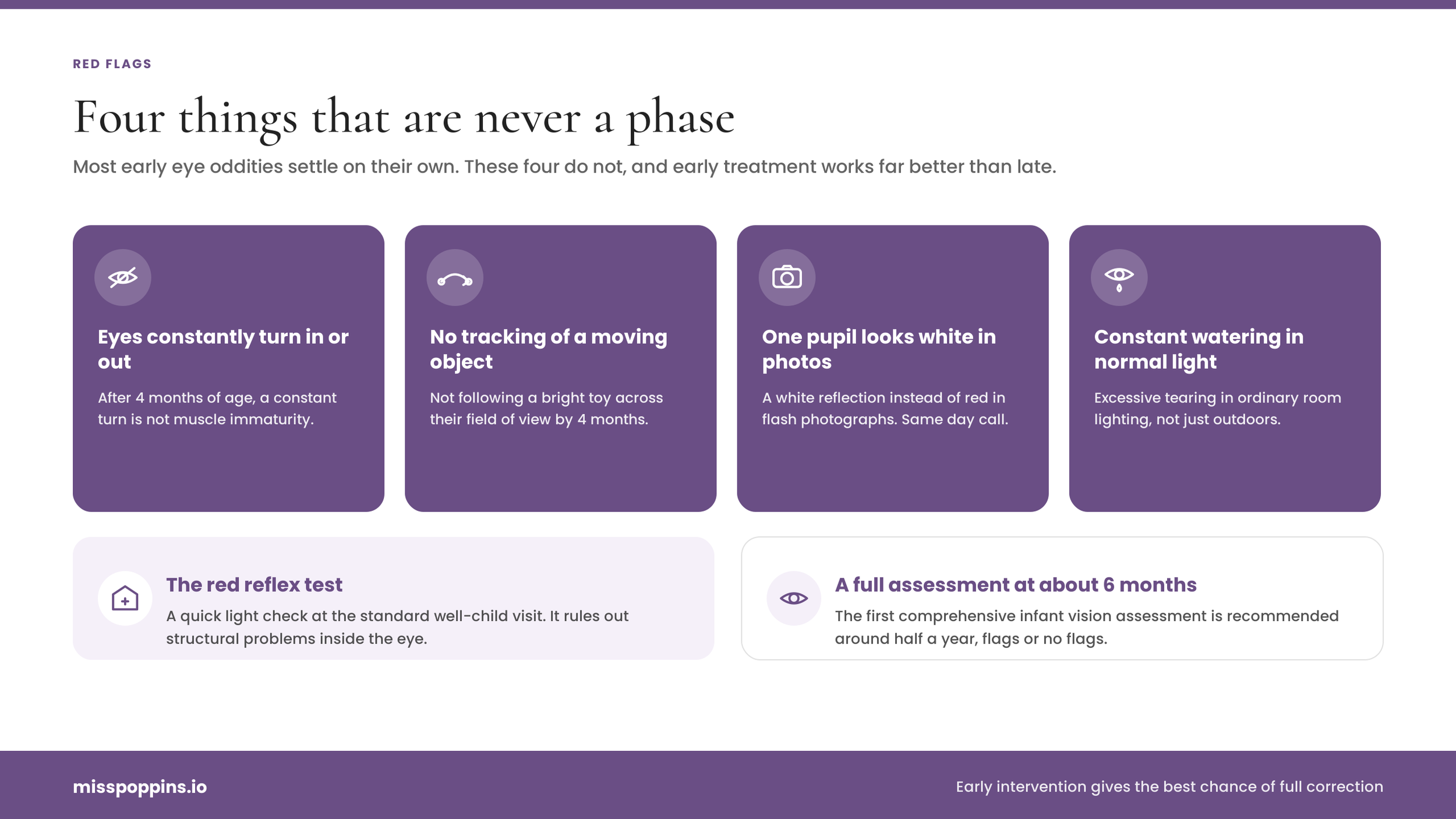
An infant displaying persistent physical symptoms requires medical evaluation. The Centers for Disease Control and Prevention outlines specific developmental markers for early infant health. MissPoppins coaches provide strictly non-clinical educational support. You must contact a medical provider if you observe any of the following concrete red flags.
Eyes constantly turn in or out after 4 months of age.
Baby does not track a moving object by 4 months of age.
One pupil appears consistently white in flash photography.
Excessive tearing occurs constantly in standard room lighting.
Do not delay discussing persistent eye crossing or tracking concerns with your pediatrician. Early intervention provides the highest probability of complete correction. The doctor will perform a red reflex test during the standard well-child visit. This specific light test rules out serious structural anomalies in the eye.
Get a Personalized Sensory & Development Plan with MissPoppins
Generic internet milestone charts stop being helpful the second your baby stares blankly at a ceiling fan instead of tracking a red toy. You do not have to piece together conflicting forum advice at 3:00 AM.
Book a 1-on-1 consultation with MissPoppins to work directly with vetted, certified parenting specialists. We build custom routines around your baby's exact sensory needs and current visual development stage.
Why Families Trust MissPoppins:
5,000+ families guided with a 4.8-star average platform rating.
150+ years of combined experience across infant development, sensory processing, newborn sleep, and postpartum care.
100% private, encrypted sessions for every video consultation and text check-in.
Instant mobile access directly through our secure platform.
Stop crowdsourcing your baby's health from unverified social media threads tonight. Download the MissPoppins app on iOS and Google Play to access your care team instantly.
Whether you need to assess tracking delays or establish a visually engaging tummy time routine, book your session below for calm, immediate guidance.
Frequently Asked Questions
When do babies get their eye color after birth?
Melanin production continues for months. Permanent iris color usually locks in between 6 and 9 months. Genetic variables heavily influence the final shade of blue, green, brown, or hazel. Observe the hue changes closely during the second half of the first year.
Can my 1-week-old see color?
No. A 1-week-old sees strictly in black, white, and gray. The visual cortex cannot process color wavelengths yet. Retinas require extreme light and dark contrast to register objects. Bright red items remain completely invisible to infants at this specific developmental stage.
How far can a 3-week-old see?
Exactly 8 to 12 inches. Anything past this distance is a complete blur. This precise focal length aligns perfectly with the distance to a parent's face during feeding. Objects placed across the room remain entirely out of focus for a three-week-old baby.
What age do babies start seeing colors clearly?
By 5 to 6 months of age. Infants possess near-adult color vision at this stage. They successfully distinguish between subtle shades like red and orange. Their maturing neural pathways process the full visual spectrum rapidly during these middle infancy months.
Do baby monitors with color tracking features work for newborn vision?
No. Color monitors benefit the parents' monitoring capability entirely. The infant cannot perceive the colored lights or screens from across the room. Visual processing at this stage requires extreme proximity. You are buying the technology for your own peace of mind.
When can I tell my newborn's eye color permanently?
Around the 9-month mark. Look for the final genetic eye color shift at this specific age. If the eyes are still bright blue at one year, they will likely stay blue. Darker brown pigmentation usually establishes itself much earlier in the developmental timeline.