
Sensory Overstimulation in Children: Why It Happens and How to Help

Written by Melissa Duncan, a former classroom teacher and home visitor with 21+ years supporting early childhood development and family behavioral coaching.
Introduction
The birthday party is in full swing. Kids are screaming, music is blasting, and your child has stopped responding. They cover their ears, go rigid, or bolt for the door. Everyone else seems fine, so you wonder: what is different about my child?
Sensory overstimulation in children happens when the brain receives more sensory input than it can process at once. It is not a behavioral choice or a sign of weakness. It is a neurological response, and it affects between 5% and 16% of children in the United States, according to UCLA Health pediatric neurologist Dr. Lauren Waldron.
This guide explains what sensory overload actually is, how to recognize the signs, what to do in the moment, and when to seek professional support.
What Sensory Overstimulation Actually Means
Sensory overstimulation is not about being dramatic or difficult. It is a processing problem: the brain cannot organize the volume of information flooding in from the environment.
More Than Five Senses
Most parents think of five senses: sight, hearing, taste, touch, and smell. But the brain actually processes at least seven. Occupational therapist A. Jean Ayres, PhD, who pioneered sensory integration research in the 1970s, identified two additional systems that play a critical role in how children experience the world:
Vestibular sense: Detects balance, spatial orientation, and movement through space
Proprioceptive sense: Tracks body position, muscle tension, and joint pressure
Interoception: Some researchers also recognize this sense, which monitors internal signals like hunger, heart rate, and temperature (Kelly Mahler, OTD)
Every environment sends input through all of these channels simultaneously. A child at a grocery store is processing fluorescent lighting, background music, the hum of refrigerators, cold air, the texture of their shirt, the motion of the cart, and the visual clutter of thousands of products all at the same time.
When the brain can handle the load, these signals integrate smoothly. When it cannot, the result is sensory overload. As Nancy Peske, coauthor of Raising a Sensory Smart Child, explains to the Child Mind Institute: "It's like a traffic jam in your head, with conflicting signals quickly coming from all directions, so that you don't know how to make sense of it all."
A 2023 study published in Frontiers in Neuroscience confirmed that children with sensory processing difficulties have measurable differences in brain structure, establishing a biological basis for what parents observe in daily life. This is not a behavioral issue. It is how the child's nervous system is wired.
Signs Your Child May Be Overstimulated
Sensory overload triggers the same survival responses the brain uses for physical threats. Understanding these three patterns helps parents recognize what is happening and respond effectively.
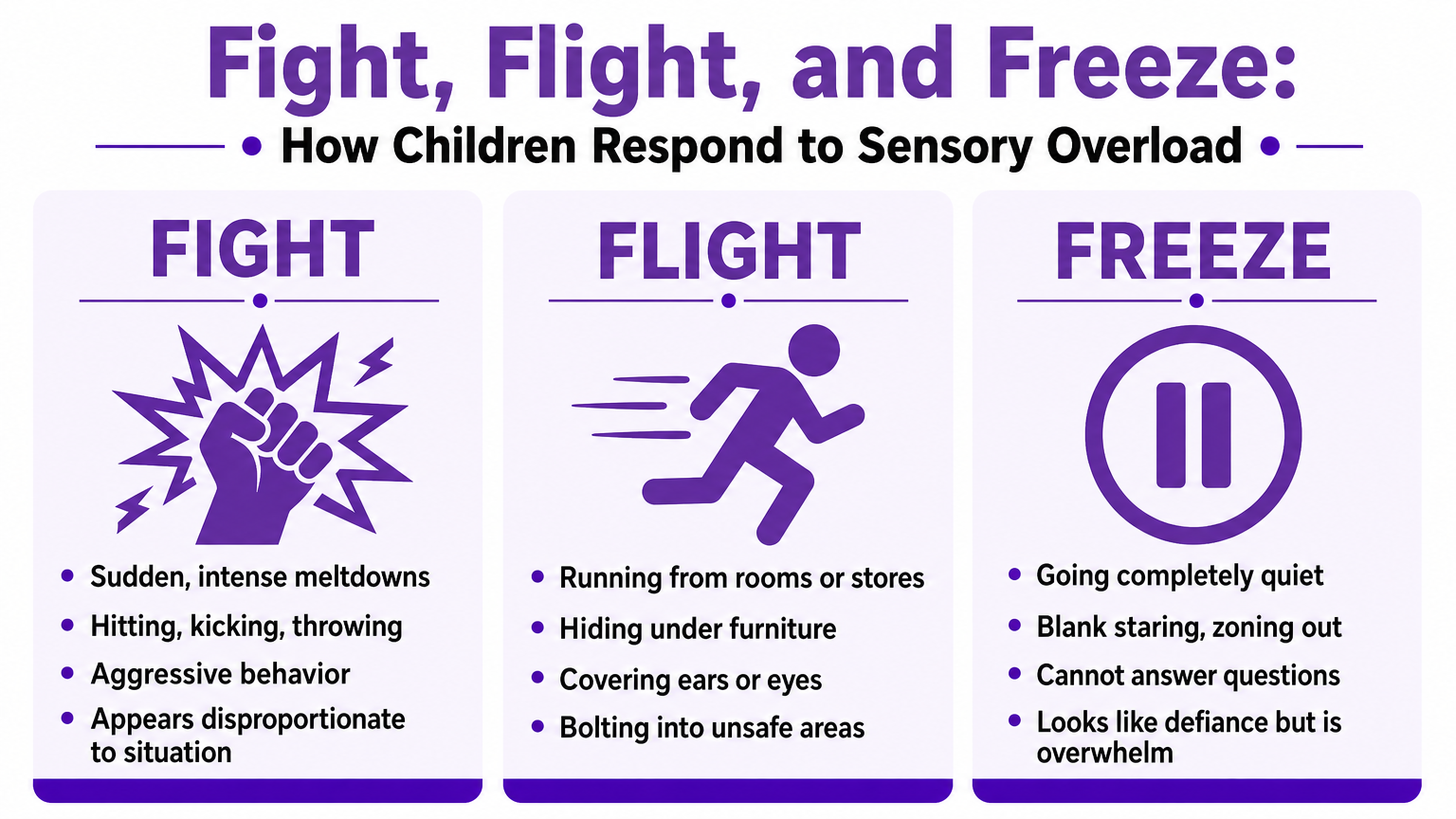
Fight, Flight, and Freeze
The Fight Response
A child in fight mode looks like they are having a tantrum, but the cause is neurological, not emotional. Signs include:
Sudden, intense meltdowns that escalate with no obvious trigger
Hitting, kicking, throwing objects, or screaming
Aggressive behavior that seems disproportionate to the situation, sometimes overlapping with impulsive behaviors
The "trigger" is invisible because it is sensory input that other people filter out without effort. Peske describes these episodes as a neurological "panic" response to everyday sensations that most people take for granted.
The Flight Response
Children in flight mode are trying to escape the input. They may:
Run from a room, a store, or a group activity without warning
Hide under furniture, behind a parent, or in a corner
Cover their ears, squeeze their eyes shut, or pull away from physical contact
Bolt across parking lots or into streets, creating safety risks parents do not expect
The Freeze Response
This is the response the target question asks about directly: the child who "shuts down." In freeze mode, the nervous system is so overwhelmed that it pauses. Parents see:
Going completely quiet in a previously engaged child
Blank staring or "zoning out" mid-conversation
Inability to answer simple questions or follow instructions
Withdrawal that looks like defiance or disinterest but is actually overwhelm
Freeze is the most commonly misunderstood response because it looks passive. A child standing silently in a loud cafeteria may appear calm, but their brain is in overload.
Sensory Meltdown vs. Tantrum: How to Tell the Difference
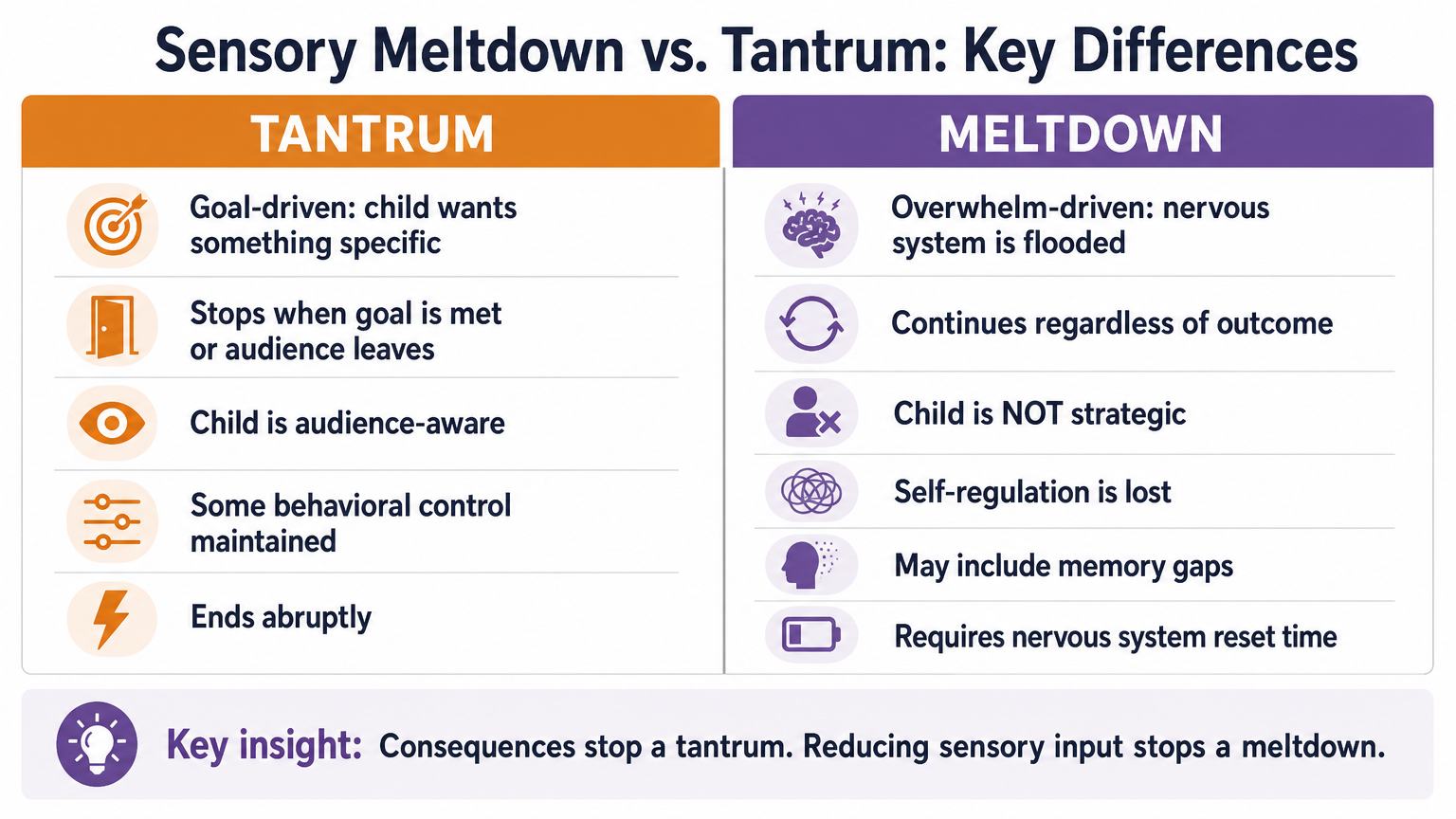
Sensory Meltdown vs. Tantrum
This distinction changes how parents respond, so getting it right matters.
A tantrum is goal-driven. The child wants something specific: a toy, a snack, more screen time. When they get it, or when the audience leaves, the behavior typically stops. The child maintains some awareness of their surroundings and adjusts their behavior based on who is watching.
A sensory meltdown is overwhelm-driven. The child's nervous system is flooded, and they have lost the ability to self-regulate. Key differences:
Meltdowns continue regardless of outcome. Getting what they want does not stop the episode.
Meltdowns are not strategic. The child is not trying to manipulate. They cannot control the response.
Meltdowns may include memory gaps. Children in full sensory overload often cannot recall the episode clearly afterward.
Recovery takes time. Unlike a tantrum, which can end abruptly, a meltdown requires the nervous system to physically reset.
The response strategy differs completely. Consequences, reasoning, or negotiation will not stop a sensory meltdown. Reducing sensory input will. A behavior coaching specialist can help parents distinguish between the two and adjust their response approach.
Common Triggers and Environments
Sensory overload rarely comes from a single source. It builds as inputs stack across multiple sensory channels.
Grocery stores combine fluorescent lighting, background music, visual clutter from thousands of products, temperature changes between sections, and crowds moving unpredictably. For a child with sensory sensitivities, a routine shopping trip can become unbearable within minutes.
Birthday parties and playgrounds bring unpredictable noise, physical contact from other children, strong smells from food, visual stimulation from decorations, and social pressure to participate. The combination of sensory input and performance expectation makes these events particularly challenging.
School settings create daily exposure to high-input environments. Families navigating these challenges can explore school accommodations for neurodivergent children for practical strategies. Cafeterias layer loud talking, food smells, and flickering overhead lights. Assemblies compress hundreds of children into confined spaces. Transitions between classes add time pressure and hallway crowding.
Home triggers often go unnoticed: accumulated screen time, sibling noise, clothing tags or seams against skin, food textures, and the hum of appliances. Even how a child's room environment affects their sleep ties into sensory load. A child who seems fine at breakfast may be approaching overload by dinnertime because inputs have been compounding all day.
The critical insight for parents is that triggers are cumulative. A child might handle a noisy classroom or a crowded store in isolation but fall apart at the next transition when both have stacked within the same afternoon.
What to Do When Your Child Is Overwhelmed Right Now
When a child is in sensory overload, less is more. Every additional input, including well-intentioned reassurance, adds to the problem.
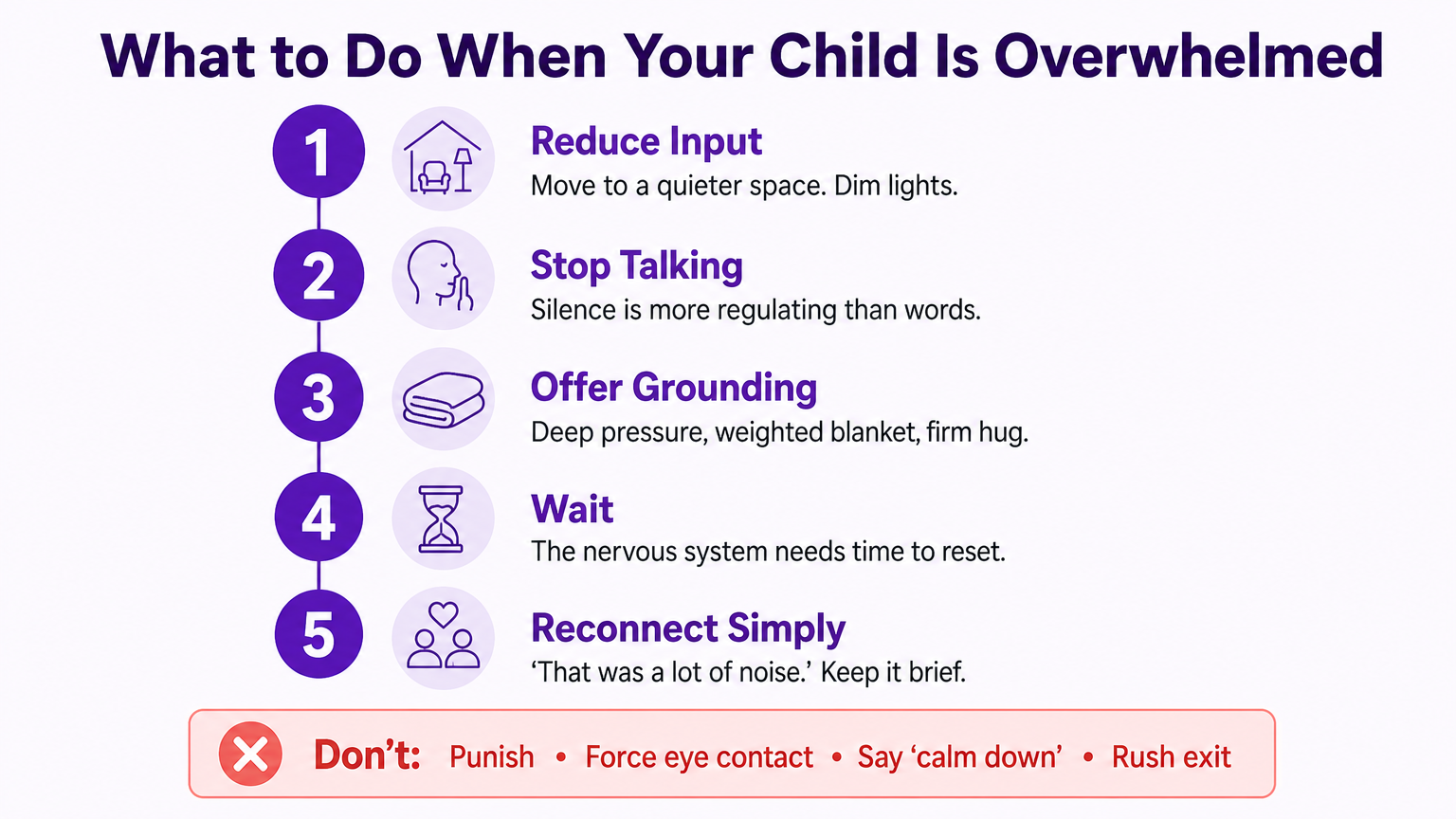
What to do when your child is overwhelmed
Step 1: Reduce input immediately. Move to a quieter space if possible. Dim lights, lower your voice, and minimize movement around the child. The goal is to remove sensory sources, not to fix the child's response.
Step 2: Stop talking. This is counterintuitive for parents who want to comfort. But verbal input during overload is more noise the brain has to process. A calm, quiet presence, what experts call co-regulation, is more regulating than words.
Step 3: Offer grounding input. Deep pressure can help the nervous system recalibrate. A firm hug (if the child welcomes it), a weighted blanket, or something textured to hold can provide organizing input that counters the chaos.
Step 4: Wait. The nervous system needs time to reset. Recovery is not instant. Rushing a child back into the environment before they are ready restarts the cycle.
Step 5: Reconnect simply. Once the child is visibly calmer, a brief, validating statement works best: "That was a lot of noise" or "I can see that was hard." Avoid over-processing the event. Skip "Why did you do that?" and "You need to learn to handle this."
What not to do:
Do not punish the behavior. Sensory overload is not a choice.
Do not force eye contact. It adds another input demand.
Do not say "calm down." It provides no useful information to a flooded nervous system.
Do not remove the child dramatically. A rushed exit adds more stimulation (movement, attention, urgency).
Every child's sensory profile is different, and what works for one child may not work for another. A child development coach who specializes in neurodiversity can help parents build a personalized response plan based on their child's specific triggers and calming strategies.
How to Prepare for Overwhelming Environments
Prevention reduces the frequency and intensity of sensory overload episodes. These strategies help parents plan ahead rather than react in crisis.
Preview the environment. Before arriving, describe what the child will see, hear, smell, and feel. "The restaurant will be loud. There will be lots of people talking. The lights might be bright." Predictability reduces the brain's processing burden.
Set a time limit and share it. "We're going to stay for 30 minutes." A clear endpoint gives the child a framework and a reason to tolerate short-term discomfort.
Bring sensory tools. Noise-reducing headphones, a fidget item, sunglasses for bright spaces, or a familiar comfort object can give the child a way to self-regulate in real time.
Plan exit routes. Before you arrive, identify the quiet spaces. Where is the bathroom? Is there an outdoor area? Can you sit near the door? Knowing the escape plan in advance means you can act quickly without adding stress.
Build in recovery time. Avoid scheduling high-input events back-to-back. A birthday party followed by a family dinner is a setup for overload. Allow decompression time between demanding environments.
Use gradual exposure. Short, structured visits build tolerance over time. Research on outdoor play benefits also shows that nature serves as a powerful sensory regulation environment. Five calm minutes at the store this week becomes ten minutes next week. The goal is to expand capacity without pushing past the breaking point.
When to Talk to a Professional
Every child has sensory preferences. Some dislike loud noises. Others refuse certain food textures. Preferences alone are not a concern.
The question is whether those preferences have become persistent patterns that interfere with daily life. Dr. Lauren Waldron at UCLA Health identifies key warning signs that suggest a child's sensory responses have moved beyond typical preferences:
Extreme behavioral reactions to specific sensory exposures, such as severe tantrums or panic attacks in public places or during activities like hair washing
Sensory-seeking behavior such as crashing into things, mouthing non-food items, or staring at lights
Difficulty distinguishing sensory signals like wearing a winter coat in summer heat or not noticing when food has spoiled
Dr. Waldron notes that these behaviors need to form a persistent pattern affecting multiple areas of daily life, not just a single setting or trigger, to warrant professional evaluation.
When these three factors converge, professional evaluation is worth pursuing.
How common is this? UCLA Health reports that 5% to 16% of U.S. children have symptoms consistent with sensory processing difficulties. Among children with neurodevelopmental conditions like autism or ADHD, that figure jumps to 60% to 90%.
What about a diagnosis? Sensory processing disorder (SPD) is recognized clinically, but it is not listed as a standalone diagnosis in the DSM-5. Sensory sensitivity was, however, added to the autism spectrum disorder diagnostic criteria in 2013, reflecting growing clinical recognition that sensory processing differences are real and measurable.
What evaluation looks like: An occupational therapist (OT) typically conducts a sensory profile assessment using sensory processing assessment tools including standardized questionnaires and observation. A developmental pediatrician may also be involved if broader neurodevelopmental concerns exist.
What support looks like: The STAR Institute's treatment model prioritizes arousal regulation first, then relationships and engagement, and finally sensory integration. Notably, STAR dedicates one of every five to six sessions to parent education alone, reinforcing that coaching parents is a core part of effective treatment.
For many families, the gap between recognizing sensory challenges and getting an OT evaluation spans weeks or months of waitlists. A neurodiversity specialist or child development coach can provide practical strategies and support during that waiting period, helping parents respond effectively right now rather than pausing until the next available appointment.
Frequently Asked Questions
Can a Child Have Sensory Overload Without Autism or ADHD?
Yes. While sensory challenges are more common in neurodivergent children, UCLA Health data shows that 5% to 16% of children without any neurodevelopmental diagnosis experience sensory processing difficulties. Sensory overload is about how the brain processes input, not about any specific condition.
Does Sensory Overload Get Better With Age?
Many children develop stronger self-regulation skills as their nervous systems mature, but the underlying sensory profile typically stays consistent. Early support through occupational therapy or parent coaching helps children build coping strategies that make daily life more manageable over time.
What Kind of Professional Helps With Sensory Issues in Children?
Occupational therapists are the primary specialists for sensory processing challenges and conduct formal assessments. Child development coaches and neurodiversity specialists can also help families build daily strategies, especially while waiting for OT evaluation availability.
Is Sensory Processing Disorder a Real Diagnosis?
SPD is recognized by clinicians and used in occupational therapy practice, but it does not appear as a standalone diagnosis in the DSM-5. Sensory sensitivity is, however, included in the diagnostic criteria for autism spectrum disorder as of 2013.
How Can I Tell if My Child Is Overstimulated or Just Tired?
Overstimulation typically has an identifiable environmental trigger and produces fight, flight, or freeze responses. Tiredness builds gradually over time and usually responds to rest. Sensory overload requires reducing input first, and rest alone will not resolve an active episode.
Key Takeaways
Sensory overstimulation in children is a neurological processing issue, not a behavioral problem, and it affects 5% to 16% of children.
Overload triggers three survival responses: fight (meltdowns), flight (bolting or hiding), and freeze (shutting down or going silent).
In-the-moment help means reducing input, not adding more: move to quiet, stop talking, offer deep pressure, and wait.
Prevention works: preview environments, bring sensory tools, set time limits, and build in recovery time.
Seek professional guidance when sensory reactions are persistent across settings, extreme in intensity, and interfering with daily functioning.
Conclusion
Your child is not being difficult. Their nervous system is processing the world differently, and the reactions you see, whether meltdowns, bolting, or shutting down, are survival responses to a brain under pressure.
Three actions make the biggest difference: learn to recognize the signs early, respond with calm and reduced input rather than consequences, and seek professional guidance when patterns persist across multiple areas of your child's life.
Looking for answers is the right first step. You do not have to figure this out alone.