
How to Choose Developmentally Appropriate Activities for Your Child's Actual Abilities

Written by Melissa Duncan, a former classroom teacher and home visitor with 21+ years supporting early childhood development and family behavioral coaching.
Every parent has been there. You buy an activity set labeled "for ages 2-3," and your child is either bored within seconds or melting down in frustration. The problem is not the child. The problem is that age-based activity charts assume all children develop at the same rate, and they do not.
Developmental variation within any age group is wide. The CDC acknowledged this when it revised its milestone checklists in February 2022 for the first time in nearly two decades, shifting benchmarks from what 50% of children can do to what 75% or more can do by a certain age. That single change confirmed what developmental specialists have long known: age is a rough guideline, not a prescription.
This article offers a practical framework for choosing developmentally appropriate activities. Parents will learn how to observe what their child can already do, match activities to that actual level, and scaffold support so the activity stretches their child just enough to grow.
What "Developmentally Appropriate" Actually Means (And Why Age Charts Fall Short)
The terms "age-appropriate" and "developmentally appropriate" sound interchangeable. They are not. Huckleberry Care's analysis of the distinction between developmental and age-based approaches is one of the few resources to address this directly.
Age-appropriate describes activities designed for the average child at a given chronological age. A toy labeled "3+" assumes a set of skills that a typical three-year-old has reached. Most activity recommendations by age group, including those from the Red Cross, organize guidance this way. Developmentally appropriate means something different: activities matched to what a specific child can currently do, regardless of how old they are.
The gap between these two definitions matters more than most parents realize. Consider two three-year-olds. One already speaks in full sentences and loves storytelling games. The other is still building two-word phrases and needs language activities focused on vocabulary expansion. Handing both children the same "age 3" activity ignores their actual abilities.
Why the Zone of Proximal Development Changes Everything
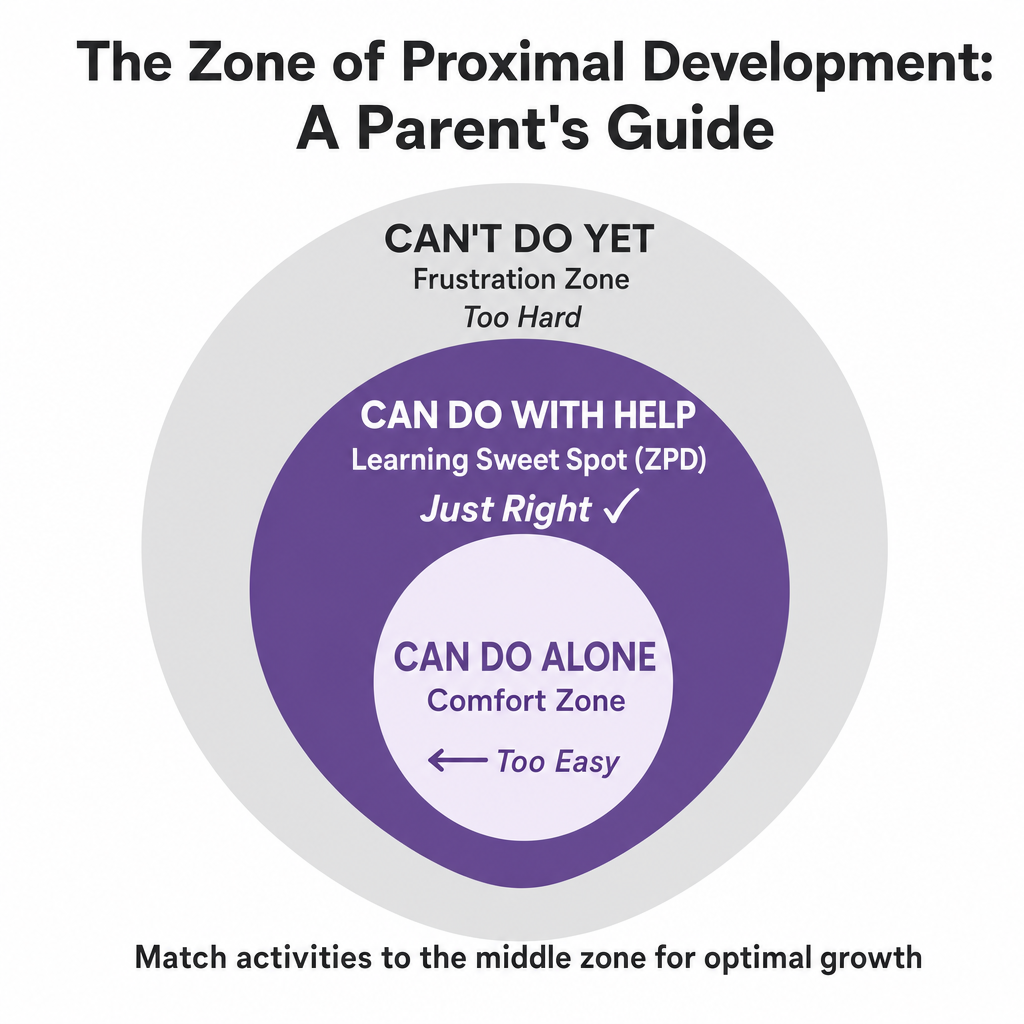
The Zone of Proximal Development: A Parent’s Guide
Psychologist Lev Vygotsky introduced a concept in the 1930s that gives parents a better framework: the Zone of Proximal Development, or ZPD. According to Simply Psychology (2025), the ZPD describes the gap between what a learner can do independently and what they can achieve with guidance. It represents where learning is most effective. Early childhood learning research from NWEA confirms this is especially critical in the first years, when brain architecture is forming at its fastest rate.
In plain parenting terms, the ZPD is the sweet spot between "too easy" and "too hard." It is the place just beyond what a child can do alone but achievable with a little help from a parent or caregiver.
Research supports this. In a 1990 study by Freund, children ages 3-5 who received scaffolded help from their mothers on a furniture-sorting task performed significantly better on a subsequent, more complex task than children who worked independently. Guided play within the ZPD outperformed unstructured discovery learning.
The ZPD is also different for every child. According to developmental psychology research, individual aptitude and experience shape each child's zone, and that zone shifts over time as new skills are mastered. Activities should be chosen with input from parents, who know their children best.
MissPoppins early development specialists use this framework daily when advising parents on activity selection. Rather than starting with a child's birthday, they start with what the child can currently do.
How to Observe What Your Child Is Ready For: 5 Readiness Cues
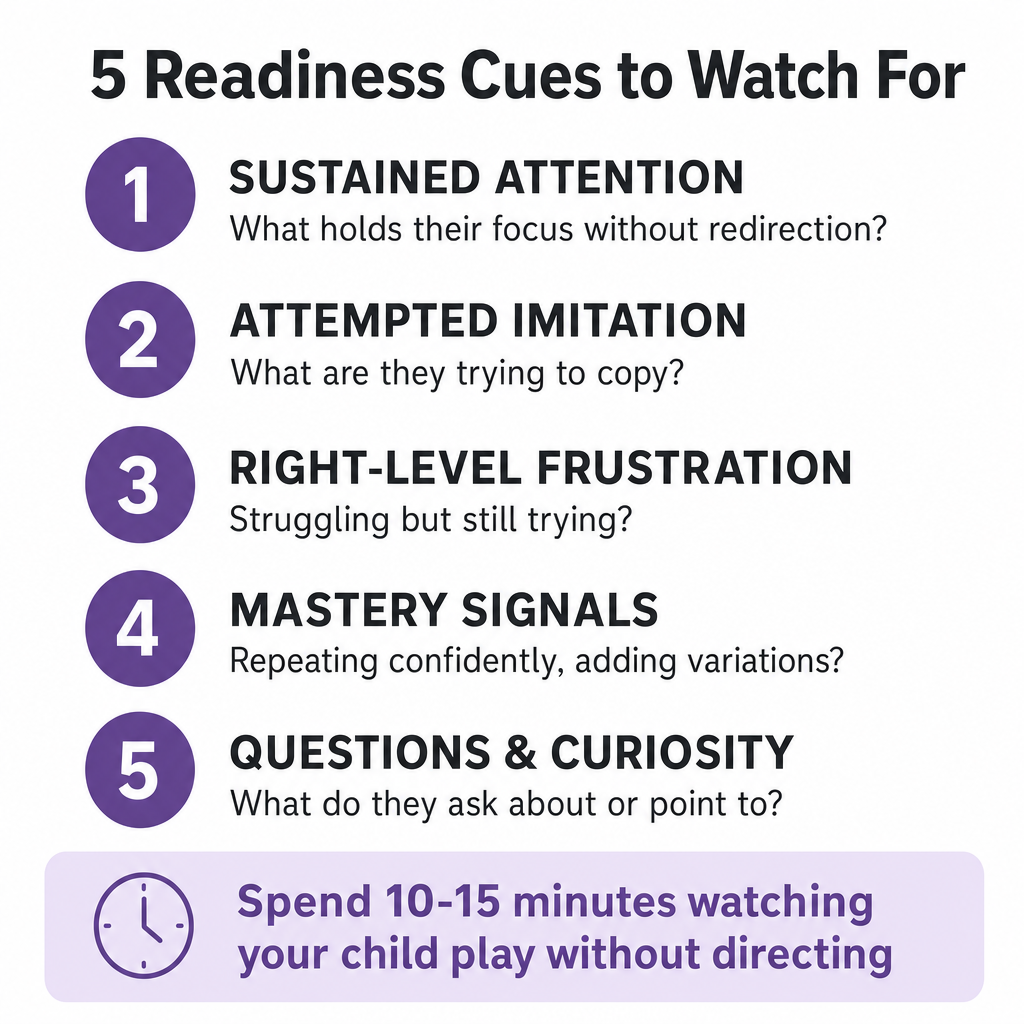
5 Readiness Cues to Watch For
The ZPD framework only works if parents can identify where their child's zone actually sits. That starts with observation. Spending 10-15 minutes simply watching a child play, without directing, reveals patterns that no age chart can capture.
Here are five readiness cues to look for:
1. Sustained Attention
What holds a child's interest for more than a few minutes without adult redirection? If a toddler spends ten minutes sorting blocks by color but loses interest in a shape-matching puzzle within seconds, the sorting skill is in their comfort zone and shape-matching may be in (or near) their ZPD. Pay attention to which activities draw the child back after a break. Repeated return to an activity signals genuine developmental engagement, not just novelty.
2. Attempted Imitation
What is the child trying to copy from older siblings, peers, or adults? A toddler who watches an older sibling use scissors and then tries to snip paper is signaling readiness for fine motor activities at the cutting level, even if the age label on the scissors says "4+."
3. Frustration at the Right Level
Mild frustration with a task signals it sits in the ZPD. The child struggles but keeps trying, sometimes asking for help. Meltdowns, on the other hand, signal the task is too far beyond their current ability. According to Simply Psychology (2025), reading these learner cues, including hesitations, partial understandings, and emotional responses, is essential for effective scaffolding.
4. Mastery Signals
When a child repeats a skill confidently and starts adding variations, they are ready for the next level. A toddler who stacks blocks predictably and then begins knocking them down in new patterns or building new shapes has mastered stacking and is ready for more complex construction tasks.
5. Questions and Curiosity
What a child asks about or points to reveals their developmental frontier. Repeated questions about how something works ("Why does the water go down?") indicate cognitive readiness for cause-and-effect experiments at a higher level. For pre-verbal children, watch where they point, what they reach for, and what they bring to a caregiver. These gestures carry the same diagnostic value as spoken questions. Learn more about how nonverbal children communicate through body language and cues.
MissPoppins development specialists can model this observation technique during a coaching session, helping parents learn to read their own child's cues in real time.
Matching Activities to Your Child's Developmental Stage
Once parents can identify readiness cues, the next step is matching activities to specific developmental domains. The key is thinking in progressions, not age brackets. Below are examples across four core areas. For additional concrete activity ideas organized by age, see UNICEF's activity recommendations for babies and toddlers.
Physical Development (Fine and Gross Motor)
Children build physical skills in a predictable sequence, but the timeline varies widely.
Fine motor progression: Tearing paper (beginning) > using child-safe scissors (developing) > cutting along a printed line (proficient)
Gross motor progression: Assisted walking (beginning) > independent walking on flat ground (developing) > walking on uneven surfaces or balance beams (proficient)
How to spot readiness for the next level: If a child tears paper easily and starts trying to fold or cut it, they are signaling readiness for scissors with supervision. For gross motor skills, watch whether a child who walks confidently on flat surfaces starts seeking out curbs, low walls, or uneven ground. That exploration is a readiness cue for balance-focused activities.
Cognitive and Problem-Solving
Cognitive activities should match a child's current problem-solving capacity, not their age group. Parents navigating screen time and healthy development choices should also consider how digital activities compare to hands-on cognitive play.
Cause-and-effect progression: Simple cause-and-effect toys (push a button, something pops up) > basic puzzles with 2-3 pieces > multi-step puzzles with 6+ pieces
Pattern recognition progression: Sorting by one attribute, such as color > sorting by two attributes, such as color and shape > creating original patterns
Research from the Harvard Center on the Developing Child shows that serve-and-return interactions during cognitive play strengthen brain architecture. When a parent responds meaningfully to a child's babbles, gestures, or attempts during a puzzle, more than 1 million new neural connections form every second in the early years. The quality of interaction during the activity matters as much as the activity itself.
Language and Communication
Language development follows a progression from sounds to sentences, and activities should meet the child where they are. Parents looking for deeper guidance on language development strategies can explore how different communication styles affect a child's progress.
Babbling and gestures: Narrate what the child is doing ("You're stacking the red block!") to build vocabulary through exposure
Single words: Expand by adding one word to what the child says ("Ball" becomes "Big ball" or "Roll ball")
Two-word phrases to simple sentences: Ask open-ended questions ("What do you think happens next?") instead of yes/no prompts
When speech development seems delayed relative to peers, a speech therapist can assess the child's specific needs and guide activity selection. This is not about comparing children to a chart. It is about understanding whether the child's language ZPD needs specialized support to progress.
A practical tip for language activities: follow the child's lead in conversation topics. If they are fascinated by trucks, use trucks as the context for vocabulary building, sentence expansion, and question-asking. Interest drives engagement, and engagement drives language growth.
Social-Emotional
Social-emotional development often does not align with other domains. A child who is advanced in language may still be in the parallel play stage, and that is normal. Parents noticing behavioral challenges in children should consider whether the behavior reflects a mismatch between the activity's social demands and the child's current stage.
Parallel play: Children play side by side without direct interaction. Activities like sensory bins, individual coloring pages, or sand and water tables work well at this stage
Interactive play with turn-taking: Board games with simple rules, rolling a ball back and forth, building a block tower together, or taking turns feeding a stuffed animal
Cooperative play with rules: Group games with shared goals, pretend scenarios with assigned roles, or team-based art projects where each child contributes a piece
Parents sometimes worry when a child who talks well still prefers parallel play. This mismatch between domains is expected. Pushing a child into cooperative play before they are socially ready can cause withdrawal rather than growth.
MissPoppins connects parents with domain-specific specialists, including speech therapists, motor development experts, and neurodiversity specialists, for personalized activity plans tailored to a child's specific developmental profile.
The Scaffolding Technique: How Your Involvement Shapes the Activity
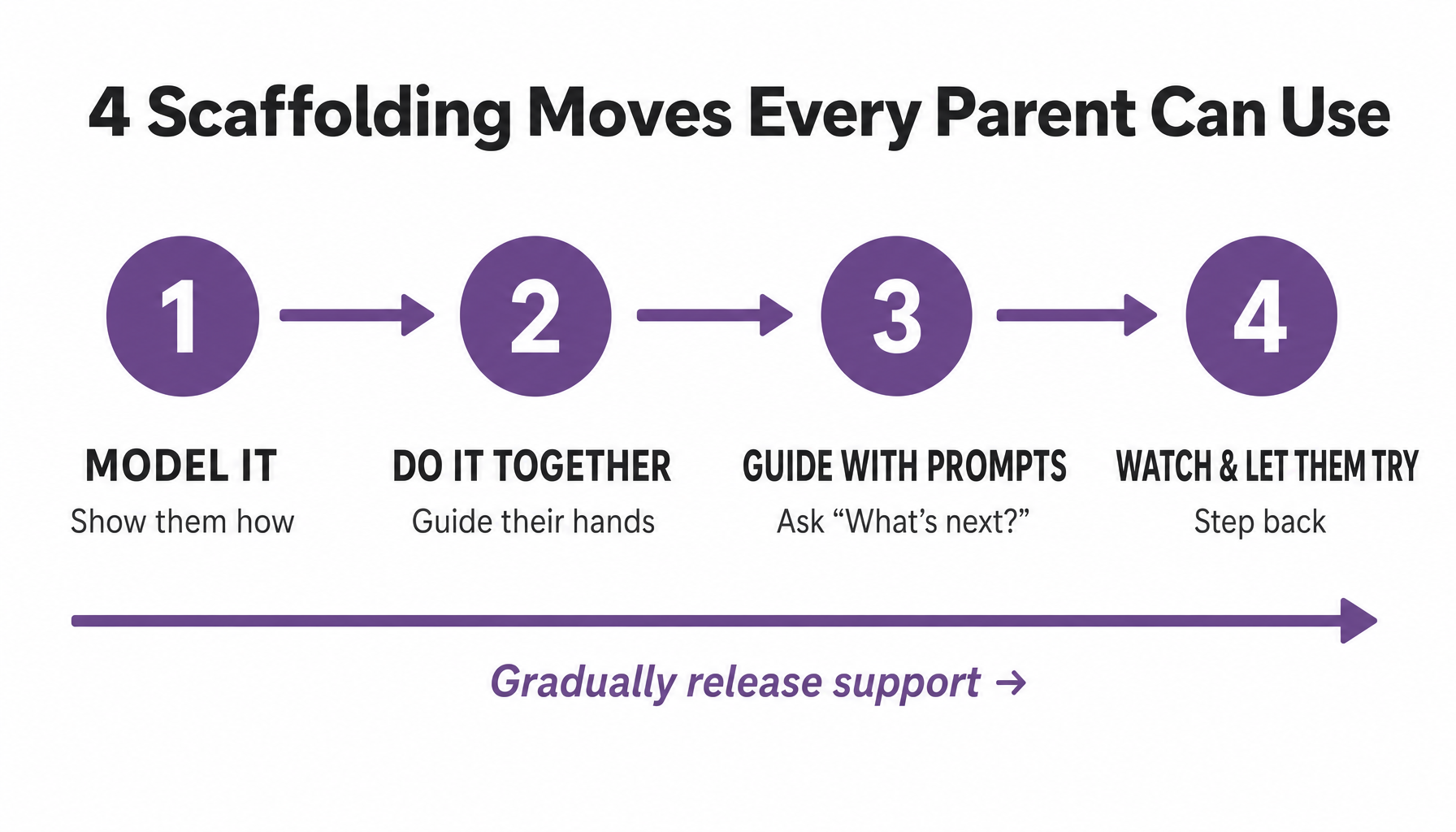
4 Scaffolding techniques every parent should know
Choosing the right activity is only half the equation. How a parent participates during the activity determines whether the child actually learns from it.
Scaffolding, in parent-friendly terms, is the temporary support provided so a child can succeed at something just beyond their current ability. The parent then gradually pulls back as the child masters the skill. Think of it like training wheels: they let the child experience riding before they can balance independently, and they come off once the skill is solid.
Four Practical Scaffolding Moves
Model it first: Show the child how the activity works before asking them to try
Do it together: Complete the task side by side, guiding the child's hands or narrating each step
Guide with prompts: Ask questions like "What comes next?" or "Where does this piece go?" instead of providing the answer
Watch and let them try alone: Step back once the child shows confidence, intervening only when they ask for help
According to Simply Psychology (2025), effective scaffolding includes modeling, providing hints and prompts, breaking complex tasks into smaller steps, and using visual aids. It is a dynamic process that changes based on the child's progress.
The Water-Pouring Example
A practical illustration comes from Lillio's early childhood education research. A two-year-old learning to pour water from a small pitcher cannot do it alone and spills. With a teacher guiding their hands to tilt the pitcher slowly, they succeed. Over time, the adult just steadies the pitcher. Eventually, the adult only watches. The skill was inside the child's ZPD all along; it just needed the right level of support to emerge.
Common Mistakes to Avoid
Too much scaffolding: Doing the task for the child removes the learning opportunity
Too little scaffolding: Leaving the child alone before they are ready leads to frustration and disengagement
One-size-fits-all interaction: Using the same level of involvement for every activity, regardless of difficulty
It is also worth noting that scaffolding approaches vary by culture. According to Simply Psychology (2025), some families use directive teaching (leading step by step), while others let the child lead with gentle guidance. Both approaches work when matched to the child's cues.
MissPoppins Montessori and early education coaches can demonstrate these techniques in real time during sessions, helping parents find the scaffolding style that fits their family.
When to Adjust: Signs an Activity Is Too Easy or Too Hard
Even with careful observation, parents will sometimes misjudge the difficulty level. Here is a quick diagnostic for calibrating activities in real time.
Signs the Activity Is Too Easy
The child completes it without effort or visible concentration
They lose interest quickly and move on
They start modifying or disrupting the activity out of boredom
Signs the Activity Is Too Hard
Frequent meltdowns or emotional shutdowns (for strategies, see managing toddler meltdowns)
The child refuses to try or says "I can't"
They need constant adult intervention to complete each step
Signs the Activity Is in the Sweet Spot
Focused effort with occasional pauses to think
The child asks for help sometimes but tries independently first
Visible satisfaction on completion, such as smiling or showing a parent the result
They want to do it again
When to Consider Professional Support
If activities consistently feel wrong across multiple types and domains, a developmental assessment may help clarify where a child's strengths and growth areas sit. Understanding the difference between a parent coach vs. therapist can help parents choose the right type of support. Parents should consider involving a specialist when they notice:
Persistent frustration across multiple activity types, not just one domain
Regression in previously mastered skills, such as a child who stops using words they once used regularly
Concerns about neurodivergent development patterns, such as strong abilities in one area paired with significant challenges in another
A child who seems consistently ahead or behind peers in ways that make typical age-based resources unhelpful
MissPoppins neurodiversity and development specialists can assess a child's developmental profile and create personalized activity plans that match their actual abilities.
Frequently Asked Questions
What Are Developmentally Appropriate Activities for Children?
Developmentally appropriate activities are tasks matched to what a child can currently do, not what their age suggests they should do. They fall within the child's Zone of Proximal Development, challenging enough to promote growth but achievable with some support.
How Can Parents Choose Appropriate Activities for Their Child's Development?
Parents can observe five readiness cues (sustained attention, attempted imitation, mild frustration, mastery signals, and curiosity) to identify their child's current level, then select activities that stretch slightly beyond that baseline.
What Is the Difference Between Age-Appropriate and Developmentally Appropriate?
Age-appropriate activities are designed for the average child at a given age. Developmentally appropriate activities are matched to a specific child's actual abilities, which may be ahead of, behind, or different from age-based expectations.
When Should I Be Concerned About My Child's Development?
Consider seeking a professional assessment if a child shows persistent frustration across many activity types, loses skills they previously had, or develops very differently from peers across multiple domains. The CDC's updated milestone checklists (2022) are a useful starting reference, but a certified specialist can provide personalized guidance.
Conclusion
Choosing the right activities for a child does not start with an age chart. It starts with watching the child.
The framework is straightforward: observe readiness cues to understand what a child can currently do, match activities to their actual developmental level rather than their birthday, and scaffold support so each activity sits in the zone where real learning happens.
There is no single "right" activity for any age. There is only the right activity for a specific child at a specific moment. As skills grow, the activities grow with them.
For parents who want personalized guidance, MissPoppins connects families with certified development specialists who can observe a child's abilities and create a tailored activity plan. Same-day appointments are available, sessions are private and virtual, and every coach is certified in their specialty.