

Toddler Social-Emotional Development: Why Emotional Skills Matter More Than Early Academics

Written by Maria Larrotta, M.S. in Early Childhood Education, who has worked in early care and education since 2011 supporting toddler development and behavior.
Between the flashcard apps, the letter-tracing worksheets, and the neighbor whose two-year-old "already knows her ABCs," it is easy for parents to wonder whether their toddler is falling behind. The quiet worry underneath is a real question: should you be drilling academics, or focusing on feelings? The evidence points to a clear answer. In the toddler years, emotional and social skills are the foundation that early academics are built on, not a competing priority. This guide explains what toddler social-emotional development actually is, what the research says about emotional skills versus academics, how the milestones unfold from 12 to 36 months, and what parents can do at home.
Key Takeaways
Social-emotional skills are the foundation for later academic success, not a trade-off against it.
A landmark 2011 meta-analysis published in Child Development tied social-emotional learning to an 11-percentile-point academic gain.
Toddlers physically cannot self-regulate yet because the prefrontal cortex is still developing into young adulthood.
The CASEL 5 competencies give parents a simple framework for what "emotional skills" really means.
Everyday "serve and return" moments build these skills more effectively than drilling.
What Is Toddler Social-Emotional Development?
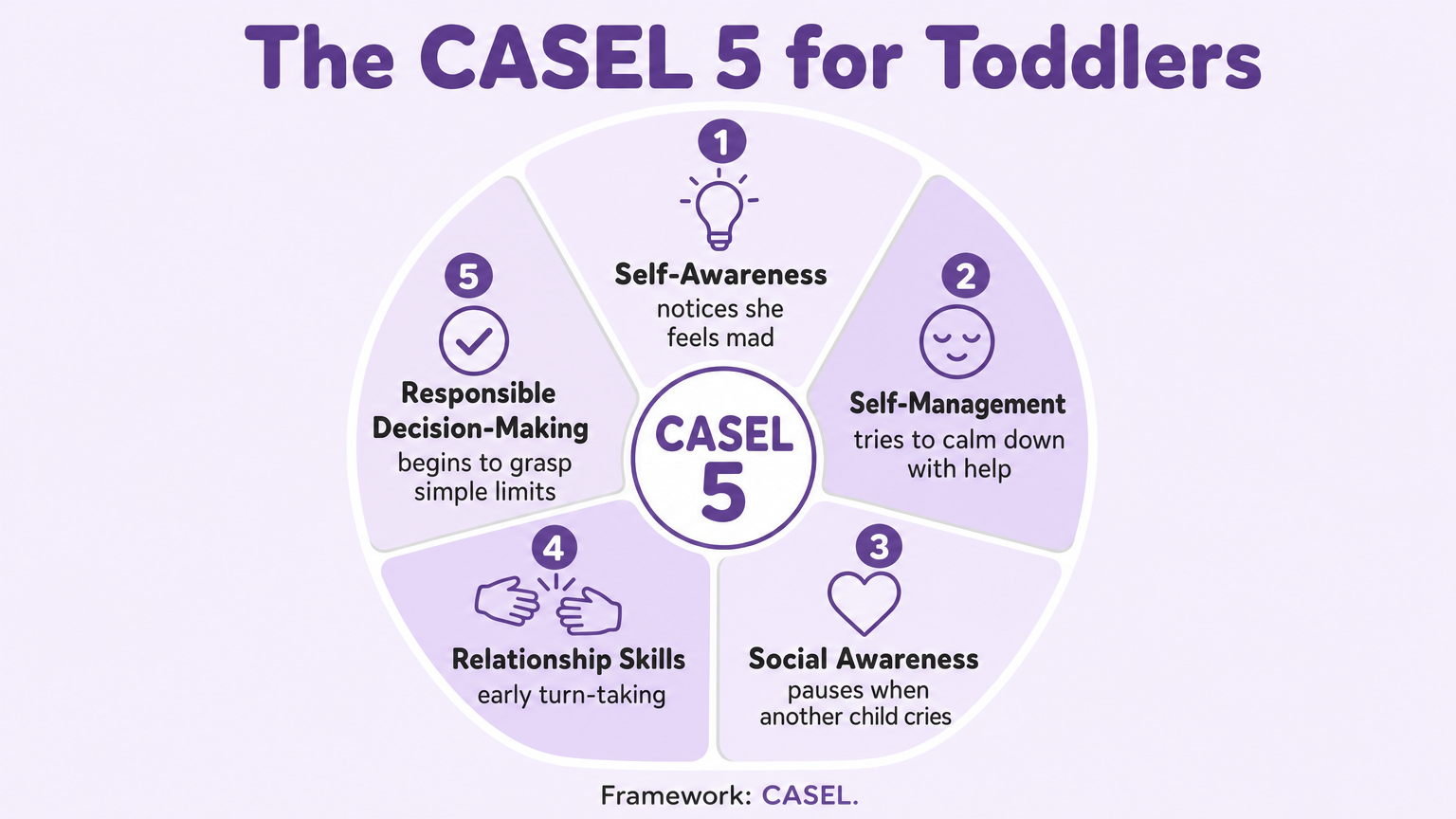
The CASEL 5 for Toddlers
Toddler social-emotional development describes how young children begin to understand and manage their feelings, form relationships, and interact with the people around them. It covers two connected strands. The social strand is about relating to others: sharing attention, taking turns, and noticing how other people feel. The emotional strand is about the inner world: recognizing feelings, and slowly learning to manage them. These strands grow together, because a child learns to regulate emotions largely inside relationships with caring adults.
A helpful framework comes from CASEL, the Collaborative for Academic, Social, and Emotional Learning, which organizes these abilities into five core competencies known as the CASEL 5: self-awareness, self-management, social awareness, relationship skills, and responsible decision-making. Translated to toddler level, they look ordinary. Self-awareness is a child starting to notice she feels mad. Self-management is a first attempt to calm down with help. Social awareness is pausing when another child cries. Relationship skills show up in early turn-taking, and responsible decision-making appears as a toddler begins to grasp simple limits.
These competencies do not arrive on a fixed date. Social-emotional development is a gradual process, not a checklist a child passes or fails. The milestones later in this article describe typical ranges, not deadlines. What matters most is the steady, everyday practice that builds these skills over time, which is exactly where the foundation for later learning is laid.
Academics or Emotional Skills: What Should You Really Focus On?
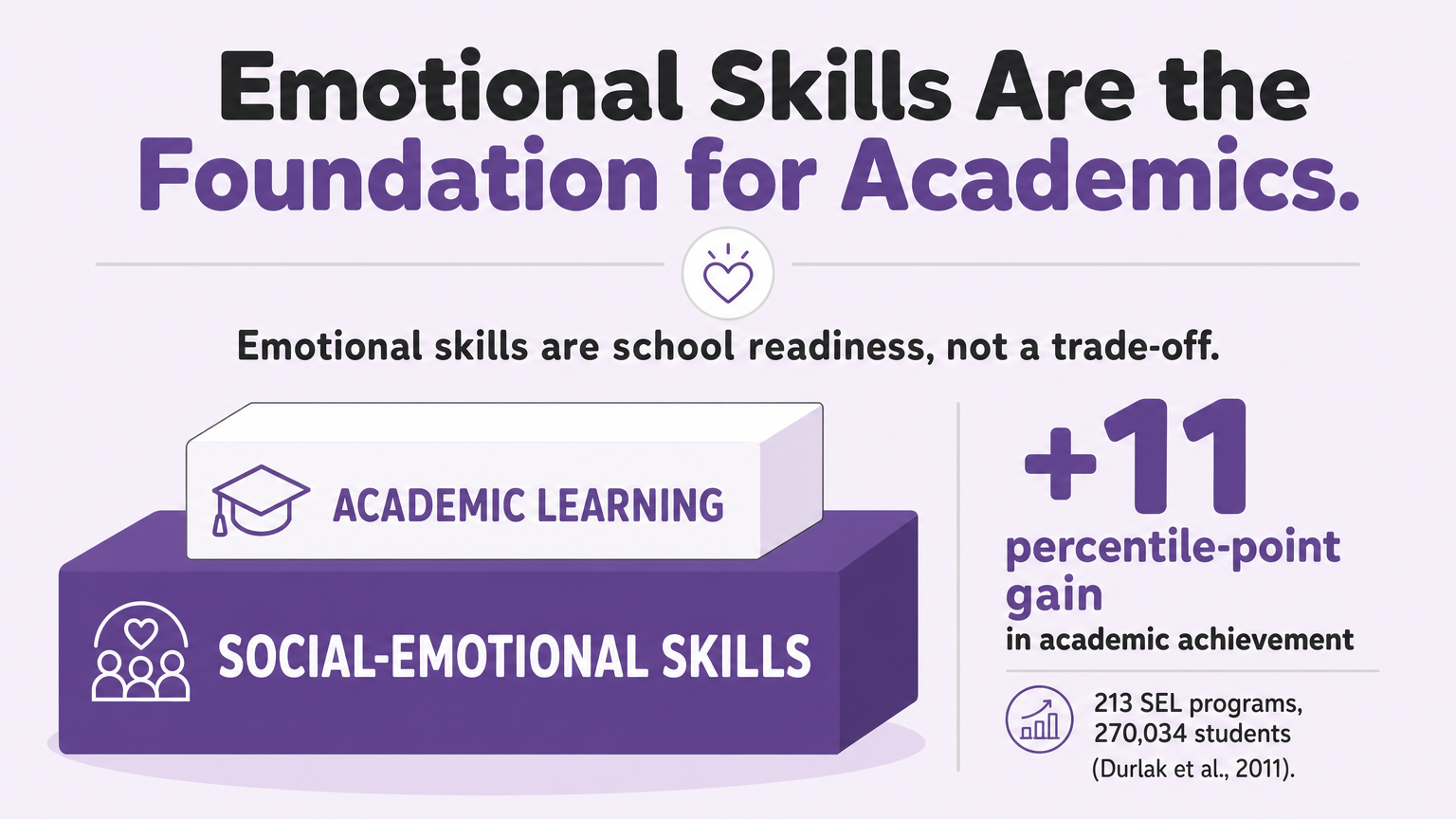
Emotional Skills are the Foundation for Academics
Parents are often told their toddler needs an early academic edge, as if letters and numbers were racing against feelings and friendships for a place in the schedule. The research suggests this is a false choice. Emotional skills are not the opposite of school readiness. They are school readiness.
The most cited evidence comes from a 2011 meta-analysis published in Child Development by Durlak and colleagues, which reviewed 213 school-based social-emotional learning programs involving 270,034 students. Participants showed significantly improved social and emotional skills, attitudes, and behavior, along with academic performance that reflected an 11-percentile-point gain in achievement. In other words, teaching children to understand and manage emotions did not come at the expense of academics. It raised them.
That advantage appears to last. A 2015 study in the American Journal of Public Health by Jones, Greenberg, and Crowley found that children's social competence in kindergarten statistically predicted key outcomes in education, employment, criminal activity, substance use, and mental health measured years later. The authors note that social interactions, attention, and self-control affect a child's readiness for learning. A 2018 CASEL research summary, drawing on work by Mahoney, Durlak, and Weissberg, reports that the academic benefit of social-emotional learning persists, with participants averaging roughly 13 percentile points higher in academic performance and benefits documented up to 18 years later.
The reframe is simple. Self-regulation, sustained attention, and the ability to cooperate are what let a child actually use academic instruction when it arrives. A four-year-old who can manage frustration and follow a group activity is positioned to learn letters far more easily than one who cannot yet settle. None of this means banishing books or numbers. It means embedding them in play, conversation, and connection rather than drilling them.
Why Toddlers Can't "Just Calm Down": The Brain Science
When a toddler melts down over the wrong color cup, it can look like defiance. Biology tells a gentler story. The prefrontal cortex, the part of the brain responsible for impulse control and emotional regulation, is generally not fully developed until young adulthood. As Bright Horizons notes in its 2025 overview of toddler social-emotional development, self-regulation is a genuinely shaky skill for young minds. A tantrum is usually a signal of an immature regulation system, not a character flaw or a discipline failure.
This is why co-regulation comes before self-regulation. Before a child can calm herself, she borrows calm from a steady adult. Practitioners at organizations such as Zero to Three describe this as a caregiver "lending" regulation to a dysregulated toddler until the child can eventually manage on her own. A parent who stays calm during the storm is not giving in. That parent is modeling and supplying the very skill the child is still building.
The mechanism that grows this capacity has a name. The Harvard University Center on the Developing Child calls it "serve and return". When a child gestures, babbles, or points, and an attentive adult responds in kind, these back-and-forth exchanges build the brain architecture that supports early language and social skills, which in turn form the foundation for the more complex thinking that comes later. The everyday responsiveness of a caregiver, repeated thousands of times, is quietly wiring the brain for both emotional balance and future learning.
Social-Emotional Milestones From 12 to 36 Months
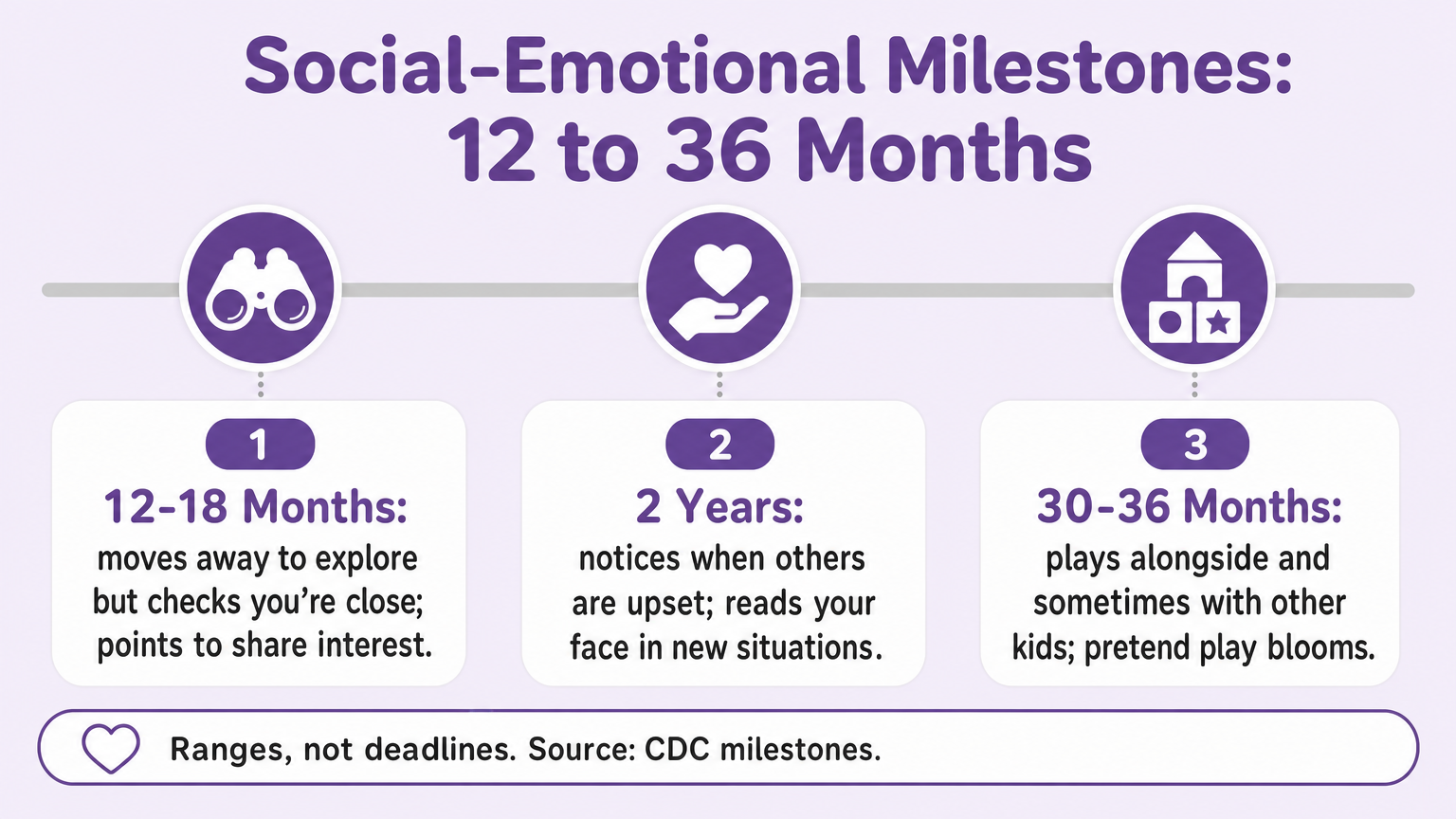
Social-Emotional Milestones
Milestones are best understood as ranges, not deadlines. Children vary widely, and reaching a skill a little early or late is often well within typical development. The following arc, drawn from the CDC's milestone guidance, gives parents a sense of the direction of travel.
Around 12 to 18 Months
At this stage, connection and exploration begin to balance each other. According to the CDC's milestones for 18 months, most children will move away from a caregiver to explore, but look back to make sure that adult is still close by. Toddlers point to share interest in something they find exciting, and they may show early empathy cues, such as reacting to another person's distress.
Around 2 Years (24 Months)
By age 2, social awareness becomes visible. The CDC's milestones for 2 years note that most children notice when others are hurt or upset, pausing or looking sad when someone is crying. They also begin to look at a caregiver's face to gauge how to react in an unfamiliar situation, using the adult as a reference point for whether something is safe or worrying.
Around 30 to 36 Months
Play grows more social in the third year. The CDC's milestones for 30 months indicate that most children play next to other children and sometimes play with them, and can follow simple routines when told. Pretend play blossoms here. A Zero to Three example captures it well: two toddlers running a pretend "pizza shop," negotiating an order, "paying," and thanking each other, practicing turn-taking, empathy, and language all at once.
How to Build Emotional Skills at Home (Without Flashcards)
The good news for busy parents is that the most effective tools are already part of daily life. These moves build emotional skills through connection rather than drills.
Name feelings in the moment. Link body sensations to feeling words, as Bright Horizons suggests: "I see your face is red and your hands are in fists. Are you feeling mad?" This builds the vocabulary that lets toddlers talk about feelings instead of acting them out.
Practice serve and return in ordinary routines. Meals, bath time, and play are full of chances to respond to a child's babble, gesture, or question. The Harvard Center on the Developing Child frames this responsive back-and-forth as the core mechanism that builds the brain.
Let play lead. Pretend play and turn-taking teach empathy and negotiation more effectively than worksheets, as Zero to Three's pretend-play examples show. A child learns to share by sharing, not by being told about it.
Co-regulate first, coach later.Stay calm during a meltdown and offer steadiness rather than a lesson. Once the child is settled, that is the moment to gently talk through what happened.
Model the behavior you want. Toddlers learn regulation largely by watching adults. How a parent handles frustration is one of the most powerful lessons a child receives.
Parents who want to tailor these strategies to their own child do not have to figure it out alone. A certified MissPoppins behavior or child-development coach can help translate this research into moves that fit one family's specific situation.
When to Seek Support
Most of the variation parents notice is normal. Milestones are ranges, and a wide span of behavior falls comfortably within typical development. At the same time, routine check-ins are worthwhile. The American Academy of Pediatrics recommends developmental screening with standardized tools at 9, 18, and 30 months, with autism screening at 18 and 24 months, or whenever there is a concern.
A few signs are worth discussing with a professional:
A loss of skills a child previously had.
Little to no interest in interacting with others by around age 2 to 3.
Tantrums that are far beyond age-typical intensity or frequency, especially if they are not easing over time.
If any of these apply, a pediatrician or a certified coach can help. Support like this is meant to be low-friction, private, and reassuring, giving parents an expert read on whether what they are seeing is typical or worth a closer look.
Conclusion
For a toddler, emotional skills are the foundation of later academic success, not the alternative to it. The research is consistent: children who learn to understand feelings, regulate with help, and connect with others are the children who go on to learn well in school. The best "curriculum" at this age is not a stack of flashcards. It is connection, play, and co-regulation, repeated in the ordinary moments of daily life. If you are feeling the pressure to do more, the most valuable thing you can offer is often the simplest, and help is available when you want a partner in it.
Frequently Asked Questions
Should I focus on academics or emotional skills for my toddler?
Focus on emotional skills first, because they are the foundation academics are built on. A 2011 meta-analysis in Child Development linked social-emotional learning to an 11-percentile-point gain in academic achievement, so the two are not in competition.
Do social-emotional skills affect later school success?
Yes. A 2015 study in the American Journal of Public Health found that kindergarten social competence predicted education, employment, and mental-health outcomes years later, and self-regulation and attention directly shape a child's readiness to learn.
What are social-emotional milestones for a 2-year-old?
According to the CDC's milestones for 2 years, most children notice when others are hurt or upset and look at a caregiver's face to decide how to react in new situations. These are typical ranges, not fixed deadlines.
Are toddler tantrums a sign of poor emotional development?
Usually not. Tantrums are a normal signal of an immature prefrontal cortex, which is not fully developed until young adulthood, and they reflect a regulation system that is still forming rather than misbehavior.
How can I support my toddler's emotional development at home?
Name feelings in the moment, practice responsive "serve and return" interactions during daily routines, let play lead, and stay calm to co-regulate during meltdowns. Modeling steady behavior yourself teaches regulation more than any drill.