
How to Build Sustainable Work Routines for Parents (That Actually Stick)

Written by Amy Pierre-Russo, a Certified Work-Life Harmony Coach with 14+ years of experience in HR and life coaching.
Most working parents know the feeling. Sunday night brings a fresh plan: earlier mornings, focused work blocks, a real dinner, lights out on time. By Wednesday, a sick kid, a late meeting, and an unplanned errand have flattened it. The plan is not the problem. The design is.
The strain is real and measurable. According to the Pew Research Center (2026), 54% of working parents say it is difficult to balance work and family, 70% handle parenting tasks while working, and 59% handle work tasks while with their kids. When routines collapse against that reality, most parents blame themselves.
This guide reframes the goal. The aim is not the perfect schedule. It is a routine that survives real life. You will learn why routines fall apart, what the science says about making habits stick, a step-by-step framework to build one, a flexible weekly template, and how to keep it alive when everything goes sideways.
Why Do Work Routines for Parents Fall Apart?
Routines rarely fail because parents lack discipline. They fail because they are built on shaky ground. Seeing the structural causes is the first step toward work life balance for parents that lasts.
The time math is brutal. According to the U.S. Surgeon General's Advisory (2024), parents now average 33.5 hours per week of employed work, and mothers' work hours rose 28% between 1985 and 2022 (from 20.9 to 26.7 hours per week) while they spent more time on primary childcare than before. There is simply less slack in the day than any tidy schedule assumes.
The mental load drains capacity. Someone has to track the schedules, anticipate needs, and make the constant small decisions that keep a household running. That work is uneven. According to the Pew Research Center (2021), 74% of mothers say they do more to manage children's schedules and activities than their partner. In dual-full-time-income different-sex couples, Pew (2026) found that 52% say the mom does more parenting tasks. This invisible planning consumes the working-memory capacity a routine needs to run.
Stress erodes the willpower routines rely on. According to Buabang et al. in Trends in Cognitive Sciences (2025), under stress, time pressure, and high working-memory load, the brain's goal-directed control weakens and falls back on established habits. In plain terms, willpower-based routines fail exactly when life gets hardest, because that is when willpower is thinnest.
The "perfect day" trap sets a brittle standard. A schedule engineered for an ideal day, with no sick kids and no surprises, breaks at the first disruption. Working parent burnout often starts here, in the gap between the imagined day and the actual one. The struggle is common and structural. It is not a personal failing. But naming the cause is what makes a better design possible.
What Makes a Routine "Sustainable"? The Science of Sticking
A sustainable routine is one built to match how habits actually form, not how we wish they formed. The research points to a method that trades motivation for structure.
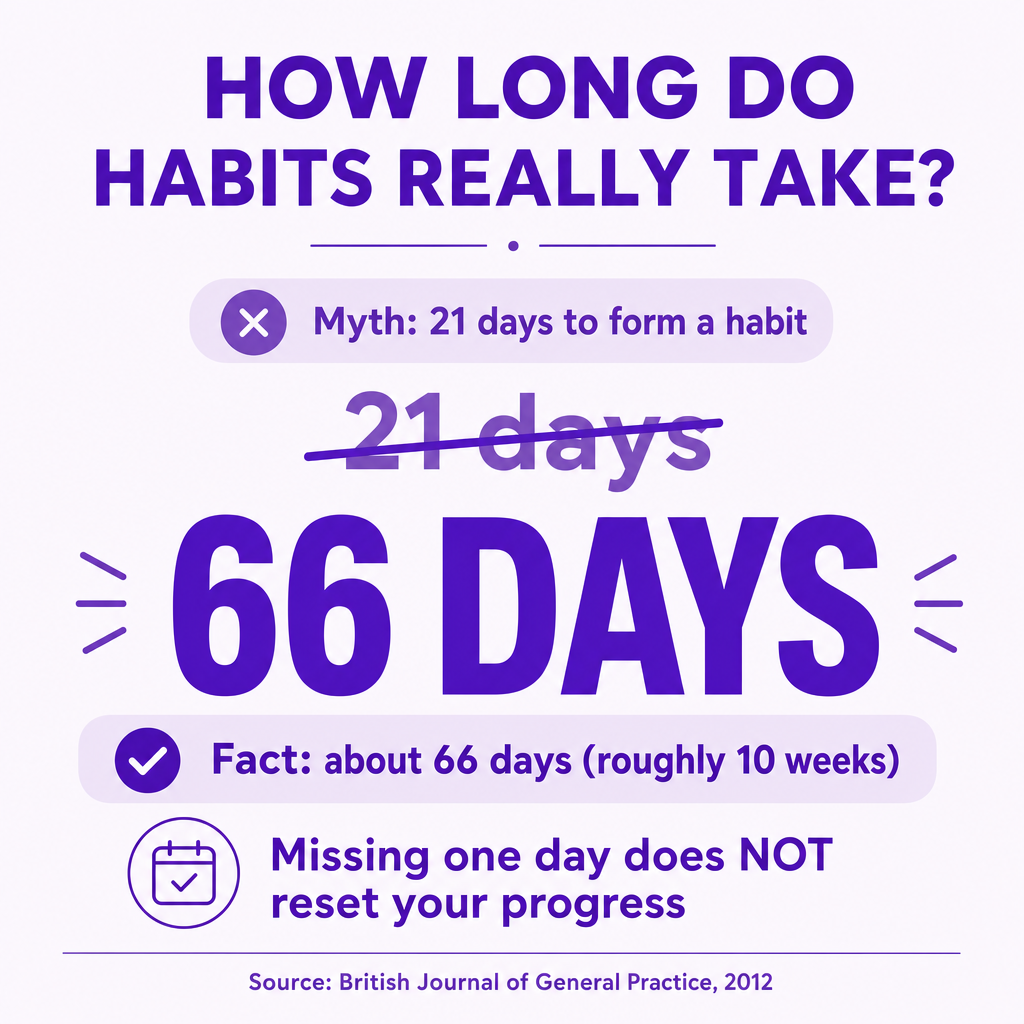
How long do habits really take?
Habits take about 66 days, not 21. The popular "21 days to a habit" figure is a myth. According to Lally and colleagues, writing in the British Journal of General Practice (2012), new healthy behaviors became automatic after an average of 66 days, with wide individual variation. Expecting roughly ten weeks, rather than three, sets a realistic finish line.
Missing one day does not reset your progress. This is the antidote to all-or-nothing guilt. The same 2012 BJGP research found that missing a single day did not derail habit formation. Flexibility is built into how habits form, which means one bad day is a normal data point, not a failure.
Habits attach to cues, not motivation. Habit researchers Phillippa Lally and Benjamin Gardner describe habits forming when a simple action is repeated in a consistent context or cue until it runs automatically. Charles Duhigg frames the same loop as cue, routine, reward in The Power of Habit. Once a routine is tied to a reliable cue, it runs even when you are tired, because it no longer depends on deciding.
Pre-built routines are a fail-safe under stress. According to the Trends in Cognitive Sciences review (2025), when the brain is overwhelmed it defaults to established habits. That reframes the entire goal. Sustainability means designing for your worst day, not your best one, so the structure carries you when your focus does not.
Simple beats elaborate. According to the 2012 BJGP research, simple actions reach automaticity faster than complex routines, and telling people to expect about ten weeks and that it "gets easier" improves adherence. Routine building for parents works best when each piece is small enough to run on autopilot.
How to Build a Work Routine That Actually Sticks (Step by Step)
This is the actionable spine of a work routine that sticks. Five steps, in order, each designed to match the science above. Time management for working parents starts with structure, not effort.
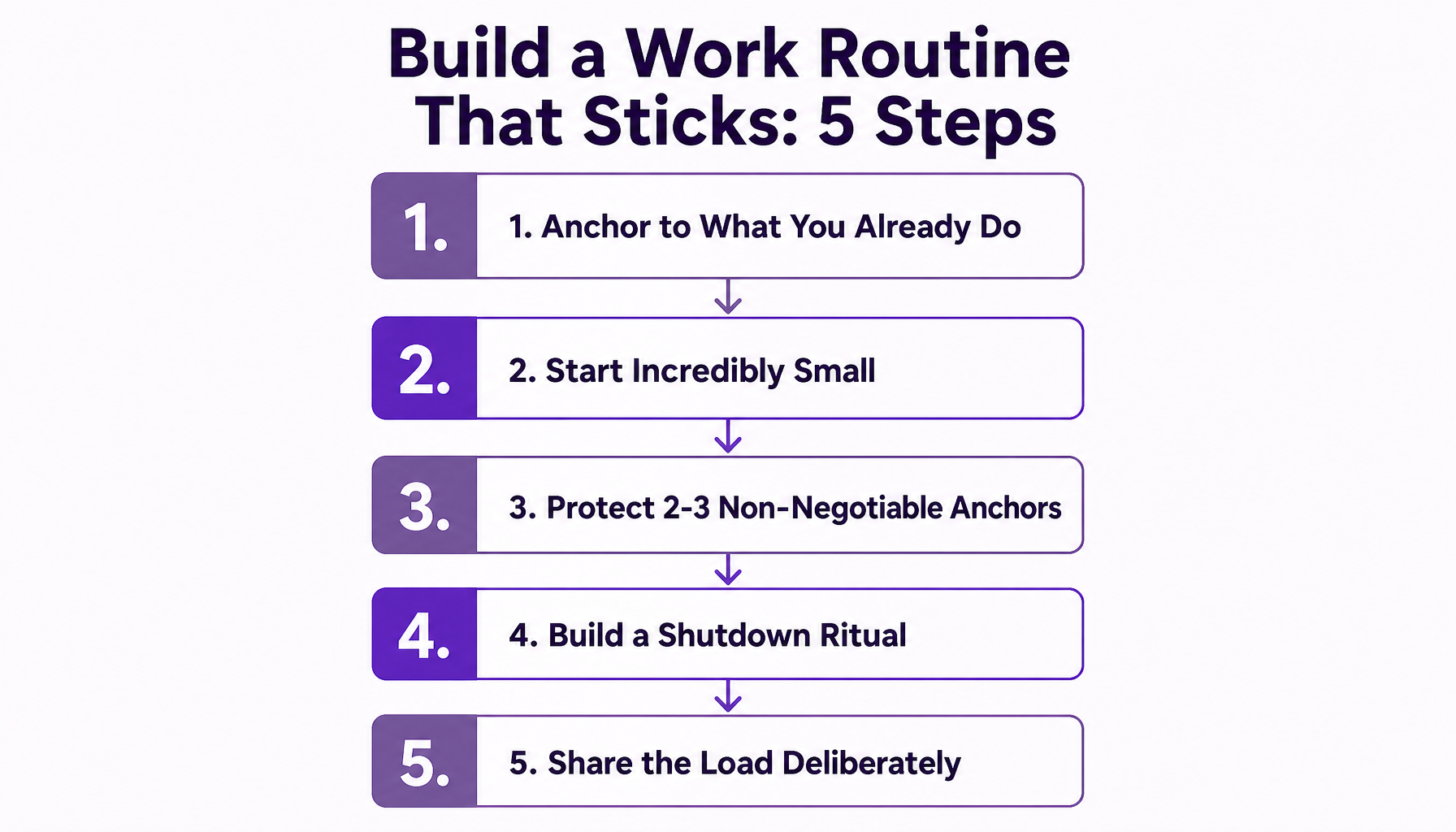
Build a Work Routine That Sticks
Step 1: Anchor to What You Already Do
New habits stick fastest when tied to something you already do without thinking. BJ Fogg of Stanford's Behavior Design Lab teaches the anchor formula in Tiny Habits: "After I [existing habit], I will [new habit]." James Clear popularized the same idea as habit stacking. Tie each routine block to a fixed daily cue you cannot skip: after your first coffee, after daycare drop-off, after you close the laptop. The cue does the remembering for you.
Step 2: Start Incredibly Small
Resist the urge to overhaul your whole life at once. According to the 2012 BJGP research, small, simple actions automate faster, and early wins build the confidence to keep going. Begin with one or two keystone blocks:
A ten-minute end-of-work shutdown ritual.
Lunches or bags packed the night before.
Get those running on autopilot before adding anything else.
Step 3: Protect Two or Three Non-Negotiable Anchors
Every day has a few fixed points that hold everything else in place. Identify yours: childcare hours, a hard stop time for work, a consistent bedtime. Treat these two or three anchors as non-negotiable and build the flexible parts of your day around them. When the rest of the day slides, the anchors keep it from collapsing.
Step 4: Build in a Shutdown Ritual
Work bleeds into family time when there is no clear boundary between them. According to the Pew Research Center (2026), 59% of working parents handle work tasks while with their kids. A short, repeatable shutdown sequence closes the workday on purpose:
Write tomorrow's top three tasks.
Close open tabs and silence notifications.
Say one line out loud, such as "work is done."
The sequence becomes the cue that tells your brain to switch roles.
Step 5: Share the Load Deliberately
A routine that depends on one person doing everything is not sustainable. Make the recurring tasks visible, then divide them with a partner, co-parent, or age-appropriate kids. This directly addresses the imbalance in the data: Pew (2021) found 74% of mothers manage more of the kids' schedules, and Pew (2026) found 52% of dual-earner couples say mom does more parenting. Splitting the mental load, not just the chores, frees the capacity your routine needs. For complex situations, a coach can help design the anchors and the split so the system holds.
A Realistic Weekly Routine Framework (Not an Hour-by-Hour Script)
Rigid hour-by-hour schedules break the moment life deviates. A framework organized by day-part flexes instead. Build your week around five recurring moments rather than a fixed clock:
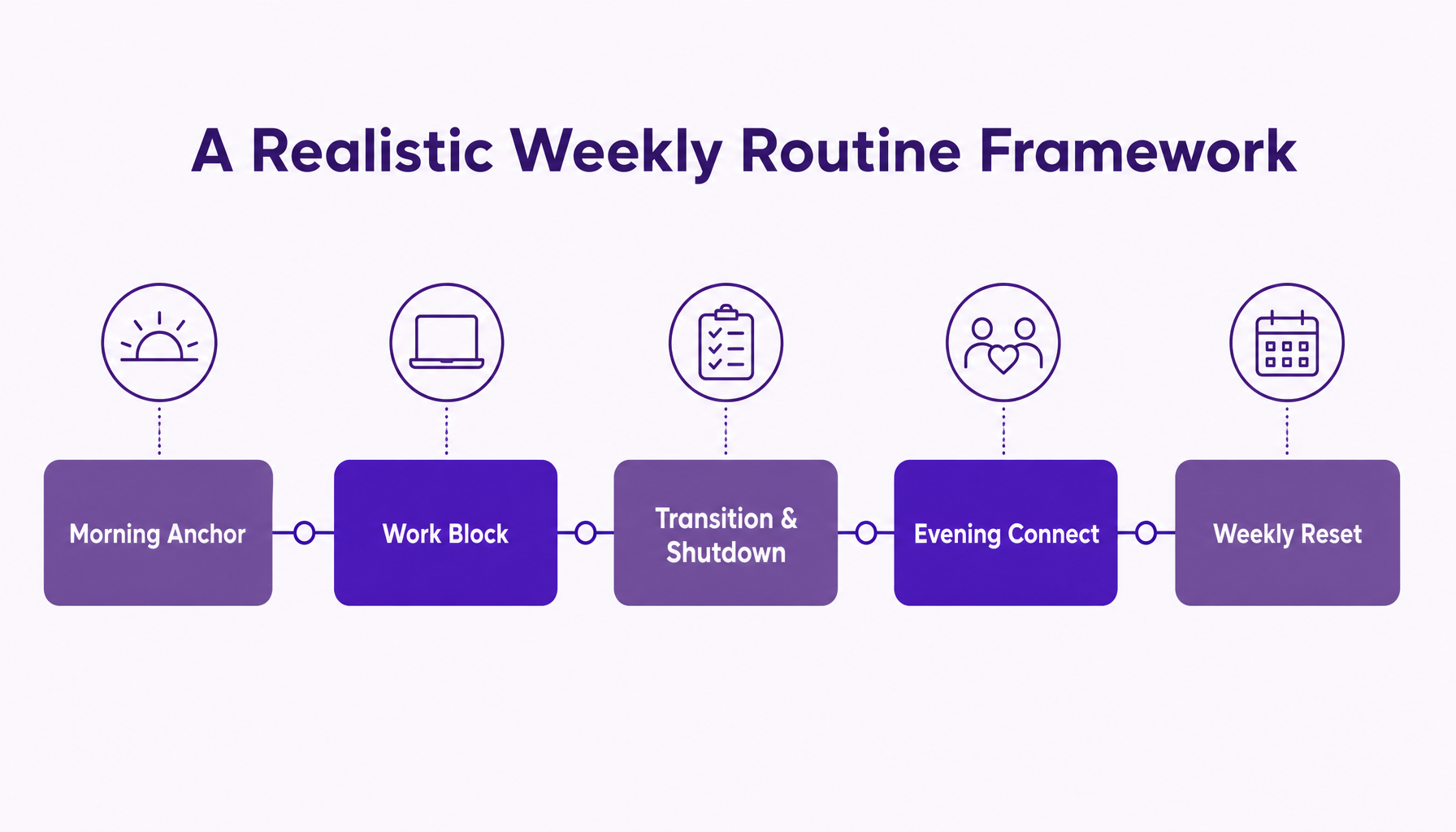
A Realistic Weekly Routine Framework
Morning anchor: one consistent cue that starts the day (coffee, drop-off).
Work block: your protected focus window, guarded by a hard start and stop.
Transition and shutdown: the short ritual that ends work and opens family time.
Evening connect: a predictable window for dinner, bedtime, and presence.
Weekly reset: a 20-minute session to prep the week ahead.
One parent might anchor the morning to daycare drop-off, protect a 9:00 to 3:00 work block, run a ten-minute shutdown at pickup, keep a screen-free dinner, and reset on Sunday evening. Now adapt it to your life. Early birds can front-load the work block; night owls can shift it later. Single parents can lean harder on the weekly reset and shared childcare. Two-working-parent households can alternate who owns the morning and evening anchors.
That weekly reset does real work. According to the U.S. Surgeon General's Advisory (2024), parenting's mental labor consumes working-memory capacity through constant scheduling and decisions. A documented routine, prepped once a week, offloads those decisions so you are not remaking them daily. Expect the framework to evolve, too, as your family moves from newborn to school age.
How to Keep Your Routine Alive When Life Gets Chaotic
Sustainability is proven on the hard weeks, not the smooth ones. The resilience of a routine comes from planning for disruption in advance.
Design a minimum viable routine. For sick days, travel, and deadline crunches, strip the routine down to only its two or three anchors. Dropping everything except the essentials keeps the structure alive so you can rebuild from it, instead of starting over from zero.
Kill the all-or-nothing reset. One missed day is not failure. As the 2012 BJGP research established, missing a single occasion does not meaningfully impair habit formation, and automaticity resumes when you do. Skipping the guilt spiral is itself a skill.
Watch for burnout signals. According to the American Psychological Association (2021), up to about 5 million U.S. parents experience parental burnout each year, and perfectionism and self-imposed pressure raise the risk. The APA also notes that small changes and self-compassion are evidence-based buffers. If you notice persistent exhaustion or detachment, drop the "shoulds" and add support.
Revisit each season. A routine is a living system, not a monument. Reassess it at each new stage or schedule change so it keeps fitting the family you actually have. When resets stop working or burnout signs appear, that is a reasonable moment to bring in a parent or work and career coach.
When to Get Expert Support
Getting help is part of a sustainable system, not a sign it failed. A few signals suggest it is time:
Your routines repeatedly collapse despite honest effort.
Overwhelm is persistent rather than occasional.
A major transition is underway, such as a new baby, a return to work, or multiples.
A coach does specific, practical work: helping you choose the right anchors, offload the mental load, and adapt the routine to your family faster than trial and error alone. MissPoppins connects parents with certified coaches, including work and career, parent life-transition, and family life specialists, through private 1:1 virtual sessions across the full parenting lifecycle.
Key Takeaways
Routines fail from structural overload and stress, not personal weakness.
Habits take about 66 days to stick, and missing one day does not undo your progress.
Anchor new routines to existing cues and start incredibly small.
Build for your worst day with a minimum viable routine, not just your ideal one.
Sharing the load and knowing when to get expert support are part of what makes a routine last.
Frequently Asked Questions
How Do I Build a Work Routine as a Parent That Actually Sticks?
Anchor each new habit to something you already do daily, start with just one or two small blocks, and design for your hardest day rather than your ideal one. Structure and consistent cues carry a routine further than motivation.
How Long Does It Take to Build a Routine That Sticks?
According to Lally and colleagues in the British Journal of General Practice (2012), habits take an average of about 66 days to become automatic, with wide variation. Plan for roughly ten weeks, and remember that a single missed day does not reset the clock.
What Is Depleted Mother Syndrome?
It is a common informal term for the chronic exhaustion and burnout that build when parenting demands outpace a parent's resources over time. According to the American Psychological Association (2021), up to about 5 million U.S. parents experience parental burnout each year, and adding support and self-compassion helps buffer it.
How Do Working Parents Keep a Routine Going When Life Gets Chaotic?
Keep a stripped-down minimum viable routine of only your two or three anchors for the hard days, and skip the all-or-nothing reset when you miss a day. Revisit the routine each season so it keeps fitting your family.
Conclusion
A routine you can keep beats a perfect one you cannot. The reframe is the whole point: sustainable over ideal, resilient over rigid, designed for your worst day so it survives every other one. Flexibility is the feature, not the failure. Start small this week by choosing a single anchor, tying one new block to a cue you already have, and letting it run for ten weeks. If the resets are not holding or the overwhelm will not lift, that is exactly what expert support is for. MissPoppins connects you with certified coaches who can help you design a routine that fits your family and lasts.