
Mentors, Sponsors, and Peers: The Three Relationships That Drive Career Growth
Written by Amy Pierre-Russo, a Certified Work-Life Harmony Coach with 14+ years of experience in HR and life coaching.
Key Takeaways
A mentor advises you, a sponsor advocates for you, and peers support you side by side.
Most workers have a mentor (about 40%) while far fewer have a sponsor (about 23%), and sponsorship is what most often unlocks advancement, according to Gallup (2025).
You benefit from all three relationships, but each one plays a different role at a different moment in your career.
Working parents face a measurable career penalty, which makes advocacy and peer support especially valuable.
You do not have to build this network alone or by chance; you can be intentional about it.
Introduction
The words "mentor" and "sponsor" get used as if they mean the same thing, and peers rarely enter the conversation at all. That confusion has real consequences. The right relationships can change the direction of a career, while the wrong assumption about who does what can leave you working hard and waiting to be noticed. These are not interchangeable roles. A mentor shares what they know, a sponsor uses their influence on your behalf, and peers keep you steady through the day-to-day.
This article breaks down all three relationships: what each one actually does, how they differ, and whether you really need every one of them. It also looks at why this matters more for working parents, who navigate a set of career pressures that advocacy and support can help offset. No one grows a career alone, and understanding your full support system is the first step to building it on purpose.
What's The Difference Between A Mentor And A Sponsor?
The simplest way to tell them apart: a mentor talks to you, and a sponsor talks about you. This framing is echoed across Gallup, Indeed, and Harvard Business Review, and it captures the core distinction cleanly.
A mentor shares knowledge, advice, and guidance. The relationship is mentee-driven, meaning you set the agenda, bring the questions, and decide what to do with the input. It carries low risk for the mentor, because offering guidance costs them little. Foundational mentoring theory from Kathy Kram, in Mentoring at Work, frames this as part of the "career functions" a developmental relationship can provide, alongside exposure and coaching.
A sponsor is different in kind, not just degree. A sponsor is someone with power who advocates for you in rooms you are not in. As economist Sylvia Ann Hewlett, author of Forget a Mentor, Find a Sponsor, describes it, a sponsor is someone influential who advocates on your behalf to get you where you want to go, putting their own name next to your performance (HBR, 2019). Rosalind Chow of Carnegie Mellon sharpens this further, describing sponsorship as "spending one's social capital or using one's influence to advocate for a protégé," and as a "three-way relationship between sponsors, protégés, and an audience" (HBR, 2021).
That last point is what makes sponsorship higher-stakes. The relationship is sponsor-driven, and the sponsor puts their own reputation on the line. Herminia Ibarra and colleagues capture the contrast plainly: mentors advise, while sponsors "advocate for, make visible, and fight to get their protégé to the next level" (HBR, 2010).
Mentor Vs. Sponsor Vs. Peer: A Side-By-Side Comparison
Each relationship answers a different need. The table below compares all three across the dimensions that matter most when you are deciding who to look for.
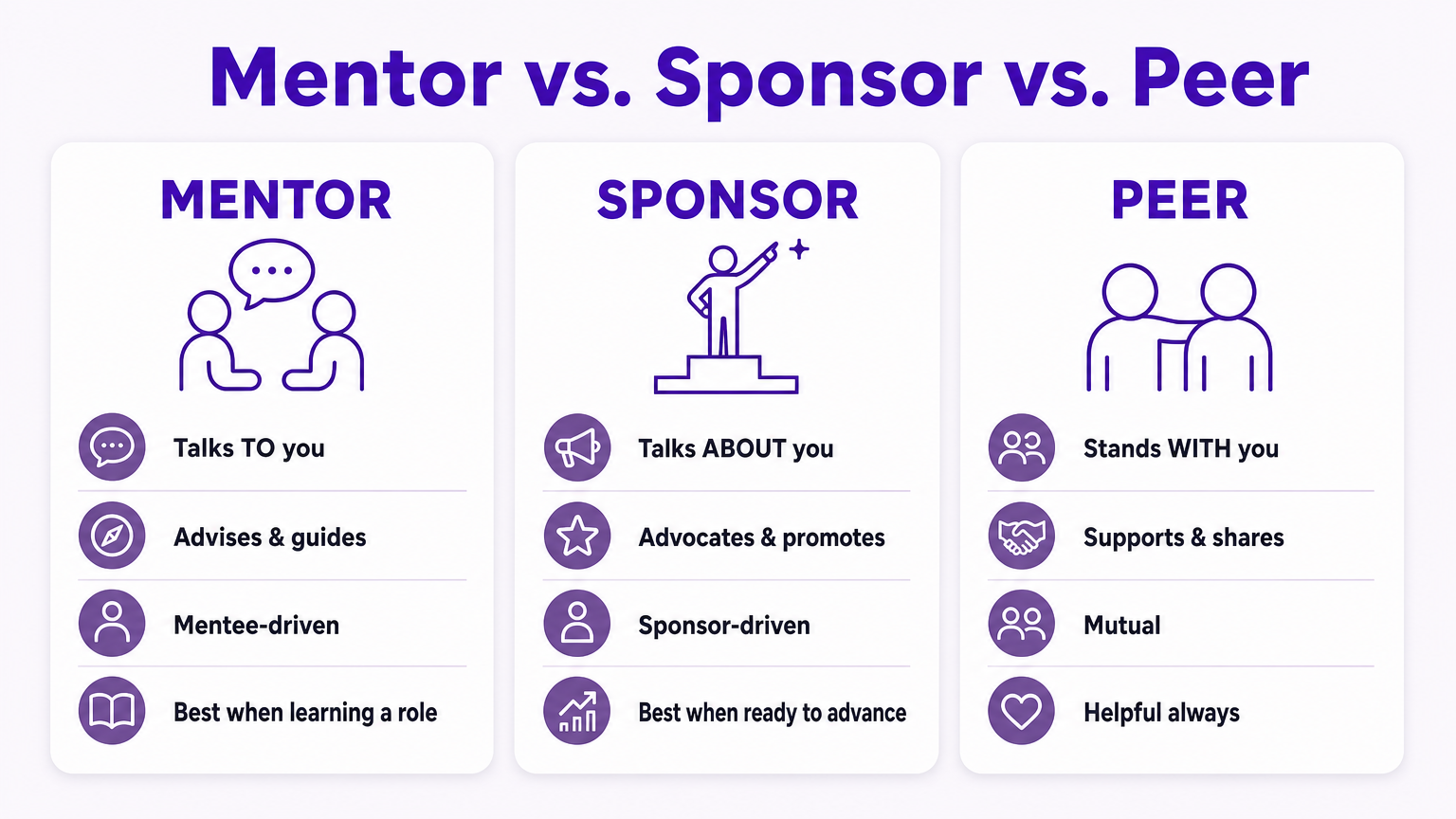
Mentor vs. Sponsor vs. Peer
| Mentor | Sponsor | Peer | |
|---|---|---|---|
| Definition | An advisor who shares knowledge and guidance | An influential person who advocates for you | Someone at your level who supports you directly |
| What they do | Talk to you: coach, advise, answer questions | Talk about you: promote and defend you when you are not there | Trade honest feedback, shared problem-solving, and encouragement |
| Who drives it | Mentee-driven | Sponsor-driven | Mutual |
| Risk to them | Low; guidance costs little | High; they stake their reputation on you | Low and shared |
| Best moment for you | Learning a role or skill | When you are ready for advancement | Always, especially during change or isolation |
| Example | A senior colleague you meet with monthly | A leader who names you for a stretch project | A cohort of parents returning to work together |
Where Do Peers Fit In Career Growth?
Peers are people at your level who offer honest feedback, shared problem-solving, and emotional support, and they fill a role that mentors and sponsors often cannot. Most career advice stops at the mentor-versus-sponsor debate and leaves peers out entirely, which misses a well-documented source of support.
Kathy Kram's research in Mentoring at Work explains why. Developmental relationships provide two kinds of functions: career functions, such as sponsorship, exposure, and coaching, and psychosocial functions, such as role modeling, friendship, and acceptance. Peers excel at the second kind. They normalize the struggles that can otherwise feel isolating, and they do it from a position of genuine understanding because they are living the same stage you are.
Peers also do quiet structural work for your career. They expand your network laterally rather than vertically, and because you are all rising at the same time, today's peer can become tomorrow's sponsor once someone reaches a position of influence. For parents returning to work or feeling cut off after a leave, that lateral support can be the difference between staying and stepping back.
As Gallup notes, "no one climbs the corporate ladder alone" (Gallup, 2025). You were not meant to figure it out by yourself, and peers are the part of the support system you can start building right away, without waiting for someone more senior to notice you first.
Do You Need Both A Mentor And A Sponsor? (And A Peer Network?)
Yes. They solve different problems, so one rarely substitutes for another. A useful way to hold it: mentors build you, sponsors move you, and peers sustain you. Relying on just one leaves a real gap in the other two.
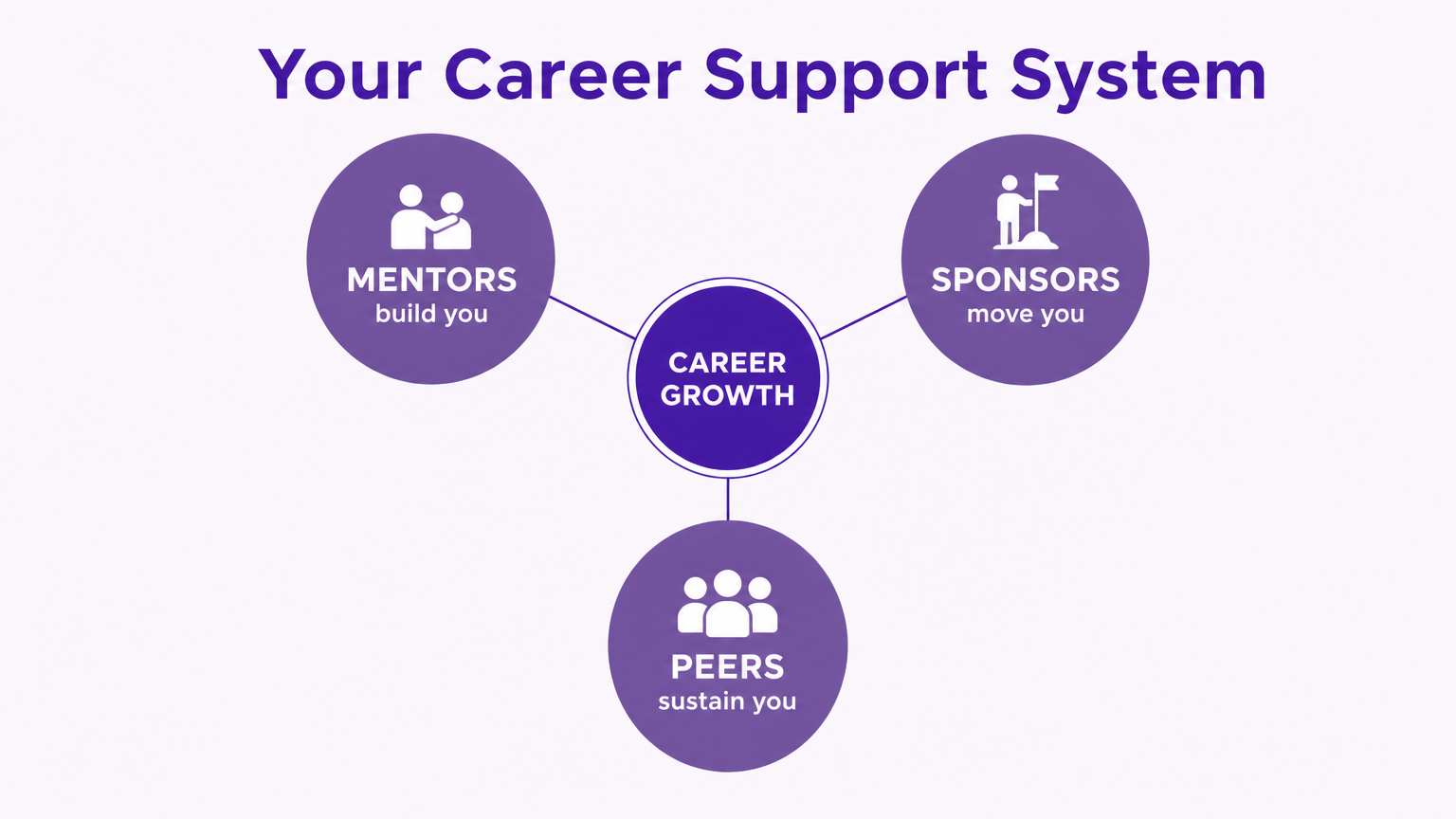
Your Career Support System
The data makes the case that mentoring alone is not enough. Ibarra and colleagues found that women are "over-mentored and under-sponsored," and named sponsorship the "missing ingredient" that mentoring, on its own, has not supplied (HBR, 2010). In other words, advice is valuable, but advocacy is what tends to correlate with advancement. Gallup's numbers reinforce the scarcity of that advocacy: only 40% of employees report having a mentor at work, and just 23% report having a sponsor (Gallup, 2025).
The value of each relationship also shifts with timing. A mentor matters most when you are learning a new role or skill and need someone to talk things through with. A sponsor matters most when you are ready for advancement and need someone with influence to make the case for you. Peers matter throughout, and their steadying support is easy to underrate until a hard stretch arrives.
The payoff of these relationships shows up in the data. Gallup found that employees with a mentor are twice as likely to strongly agree they have had opportunities to learn and grow in the past year, and twice as likely to be engaged (Gallup, 2025). The formality of the relationship matters too: employees with formal mentors are 58% more likely, and those with formal sponsors 48% more likely, to strongly agree their workplace gives everyone an equal opportunity to advance (Gallup, 2025). Even the "building" relationship, in other words, pays off in ways worth having on its own.
Why This Matters More For Working Parents
For working parents, the stakes of advocacy and support are higher, because the career penalty they face is measurable. Nationally, employed mothers were paid just 62.5 cents per dollar paid to fathers in 2022, according to the Institute for Women's Policy Research (IWPR, 2024). For full-time, year-round workers, the figure was 71.4 cents. The same IWPR analysis reports that the motherhood penalty accounts for nearly 80% of the gender pay gap, and that mothers are less likely to be hired and promoted than women without children.
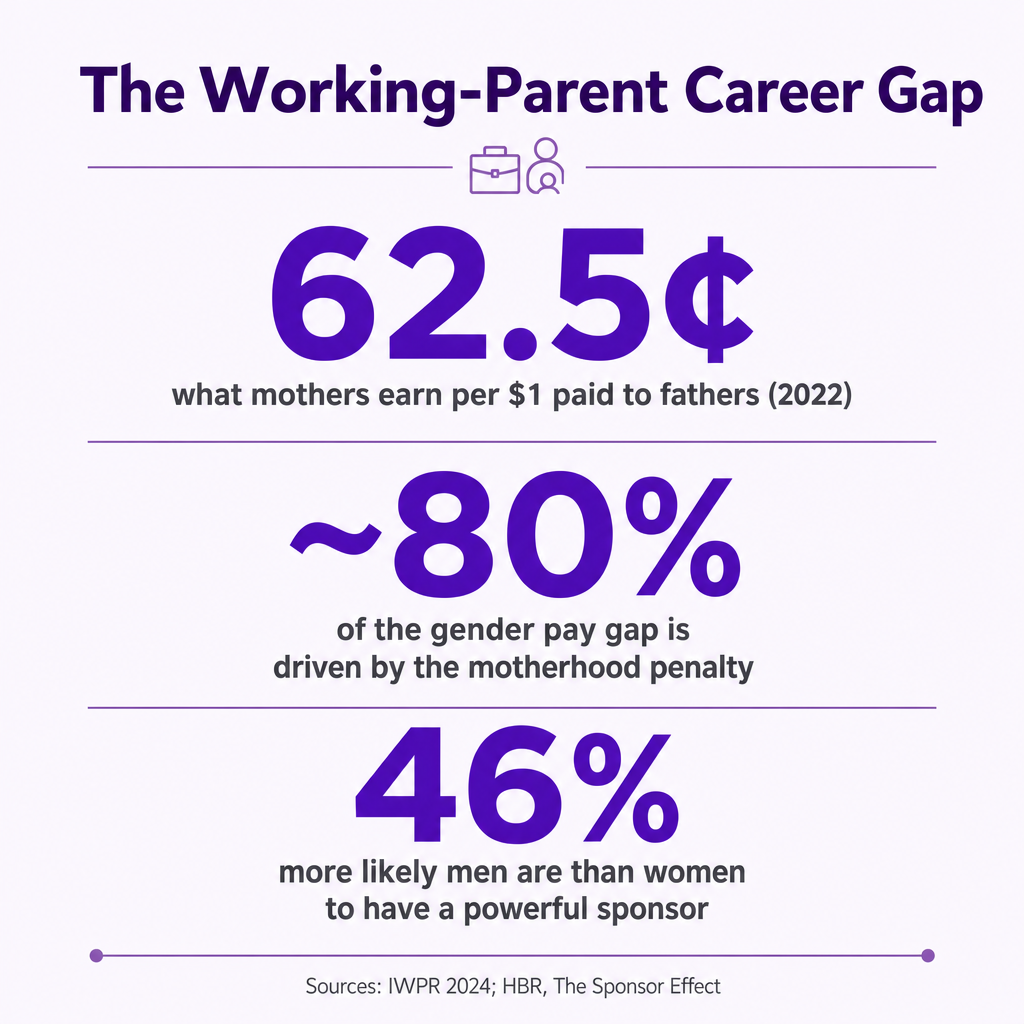
The Working Parent Career Gap
That disadvantage is often structural rather than personal. An audit study by Correll, Benard, and Paik, cited by IWPR, found that mothers were rated lower on perceived competence and recommended for lower starting salaries than identical candidates without children, while fathers were not penalized and sometimes benefited. This is exactly the kind of bias an individual cannot simply out-work.
The sponsorship gap compounds the problem. Harvard Business Review's "The Sponsor Effect" reported that men are 46% more likely than women to have a powerful sponsor, and that with a sponsor, 68% of women report satisfaction with their rate of advancement (Hewlett et al., HBR, 2010).
Advocacy can help close these gaps in practice, not just in theory. Unilever's Senior Leadership Mentoring Program, studied by INSEAD's Herminia Ibarra, paired roughly 22 women within 18 to 24 months of a promotion with outcome-oriented mentors and development plans. Six women from the first cohort were promoted, and the program expanded from there. A sponsor's advocacy can counteract the bias parents cannot control, and peers can reduce the isolation of returning from leave. This is also where a career or work-transition coach can help a parent turn all of this into a concrete plan. Through its Parent Support specialties, MissPoppins offers work/career coaching and life-transitions coaching for exactly these moments.
How To Find A Mentor, A Sponsor, And Peers
Building this support system is a set of deliberate moves, not a matter of luck. Each relationship is found and nurtured differently.
How To Find A Mentor
Look for someone whose path or values you respect, then start with a small, specific ask rather than a broad request to "be your mentor." Make it easy to say yes, for example by asking for one 20-minute conversation about a decision you are weighing. From there, nurture the relationship over time by following up, acting on the advice, and reporting back on how it went.
How To Earn A Sponsor
Sponsorship is earned, not requested. Because a sponsor stakes their reputation on you, they need evidence first, so deliver visible, reliable results and make sure the right people see them. Make your goals known to people with influence, so an advocate knows where to point their support. A mentor can become a sponsor once trust is built and they have seen what you can do.
How To Build A Peer Network
Seek out people at your stage, both inside and outside your organization, and trade honesty and support in both directions. Peer relationships work when they are mutual, so offer the same feedback and encouragement you hope to receive. Parent-specific communities and coaching circles count here, and they can be an especially natural fit if you are navigating work and family at the same time.
Practical Next Steps
Use this checklist to move from understanding the roles to building them:
Map who you already have. List the mentors, sponsors, and peers currently in your corner, and note which of the three is strongest.
Name the gap. Identify which relationship is missing or thin, since that is where to focus first.
Make one specific ask this month. Request a short conversation with a potential mentor, or share a concrete goal with someone influential.
Keep a "wins" list. Track measurable results so your value is visible to anyone who might advocate for you.
Join one peer space. Commit to a single community, cohort, or circle where people at your stage trade support.
Consider a coach for transitions. If you are navigating a change like a return to work, a career or work-transition coach can help you build the plan.
Frequently Asked Questions
What is the difference between a mentor and a sponsor?
A mentor talks to you by sharing advice and guidance, while a sponsor talks about you by using their influence to advocate for your advancement.
Do I need both a mentor and a sponsor?
Yes, because they solve different problems: a mentor helps you grow your skills, and a sponsor helps you get promoted. One rarely replaces the other.
Can a mentor become a sponsor?
Yes. Once a mentor has built trust with you and seen your results firsthand, they may start advocating for you, which turns the relationship into sponsorship.
What is the difference between a coach, a mentor, and a sponsor?
A coach targets a specific goal over a limited time and is often external, a mentor offers ongoing general guidance, and a sponsor advocates for you within your organization.
How is a peer different from a mentor?
A peer is someone at your own level who offers mutual support and shared problem-solving, whereas a mentor is usually more experienced and guides you from a step ahead.
How do working parents build these relationships with limited time?
Start with small, specific asks and one peer community rather than a large network, and consider a coach who can help you make focused progress in less time.
Conclusion
Career growth is not built on a single relationship. Mentors build you with advice, sponsors move you with advocacy, and peers sustain you with support that only someone at your level can give. Most people have some of this and not all of it, and the gap is rarely a matter of effort. The encouraging part is that you can build this village on purpose instead of leaving it to chance. For working parents facing added pressures, that intentional approach matters even more, and you do not have to plan it alone. If you are navigating a career move or a return to work, a MissPoppins coach can help you map the relationships you need and the steps to build them.