

Responsive Parenting Boundaries: How to Set Limits With Your Toddler Without Yelling

Written by Maria Larrotta, M.S. in Early Childhood Education, who has worked in early care and education since 2011 supporting toddler development and behavior.
Key Takeaways
Responsive parenting is not permissive; clear, firm boundaries are one of its cornerstones.
Toddlers cannot self-regulate yet, so they borrow a caregiver's calm through co-regulation, which is why staying regulated matters more than the exact words used.
The American Academy of Pediatrics finds yelling and harsh verbal discipline are both ineffective and harmful, even from otherwise warm parents.
A boundary held calmly and consistently tends to resolve faster over time than one enforced with anger.
If the same battles escalate daily despite a calm, consistent approach, a certified parenting coach can help build a plan.
Introduction
It is 2am, the toddler is screaming for the third time, and the same question surfaces: how can a parent be firm without being harsh, and gentle without being a pushover? Firm can feel mean. Gentle can feel permissive. Many parents end up swinging between the two and feeling guilty either way.
The reframe that resolves this tension is simple: firm and kind live on the same spectrum, not opposite ends of it. Responsive parenting boundaries are not about whether a parent sets limits. They are about how those limits get held. This guide covers what responsive parenting actually is, why toddlers melt down when limits arrive, what the research says about yelling, and a step-by-step way to set boundaries without yelling. It also includes ready-to-use toddler scripts and a clear guide to knowing when to get extra help.
The reader's underlying question: can a parent be firm and gentle at the same time? Yes, and the sections below show how.
Is Responsive Parenting the Same as Permissive Parenting?
No. This is the myth worth clearing up first, because everything else depends on it.
Responsive parenting, sometimes called gentle parenting, combines empathy and respect with structure. Boundaries are a cornerstone of the approach, not an exception to it. As Sarah Ockwell-Smith, author of The Gentle Parenting Book, describes it, this style "tries to strike a balance" with limits: not too many, not too few. The "responsive" part describes the delivery of a limit, not the absence of one.
It helps to picture three broad parenting styles side by side:
Authoritarian: high control with too many rigid rules and low warmth.
Permissive: high warmth with too few consistent limits.
Gentle or authoritative: high warmth paired with firm, consistent limits.
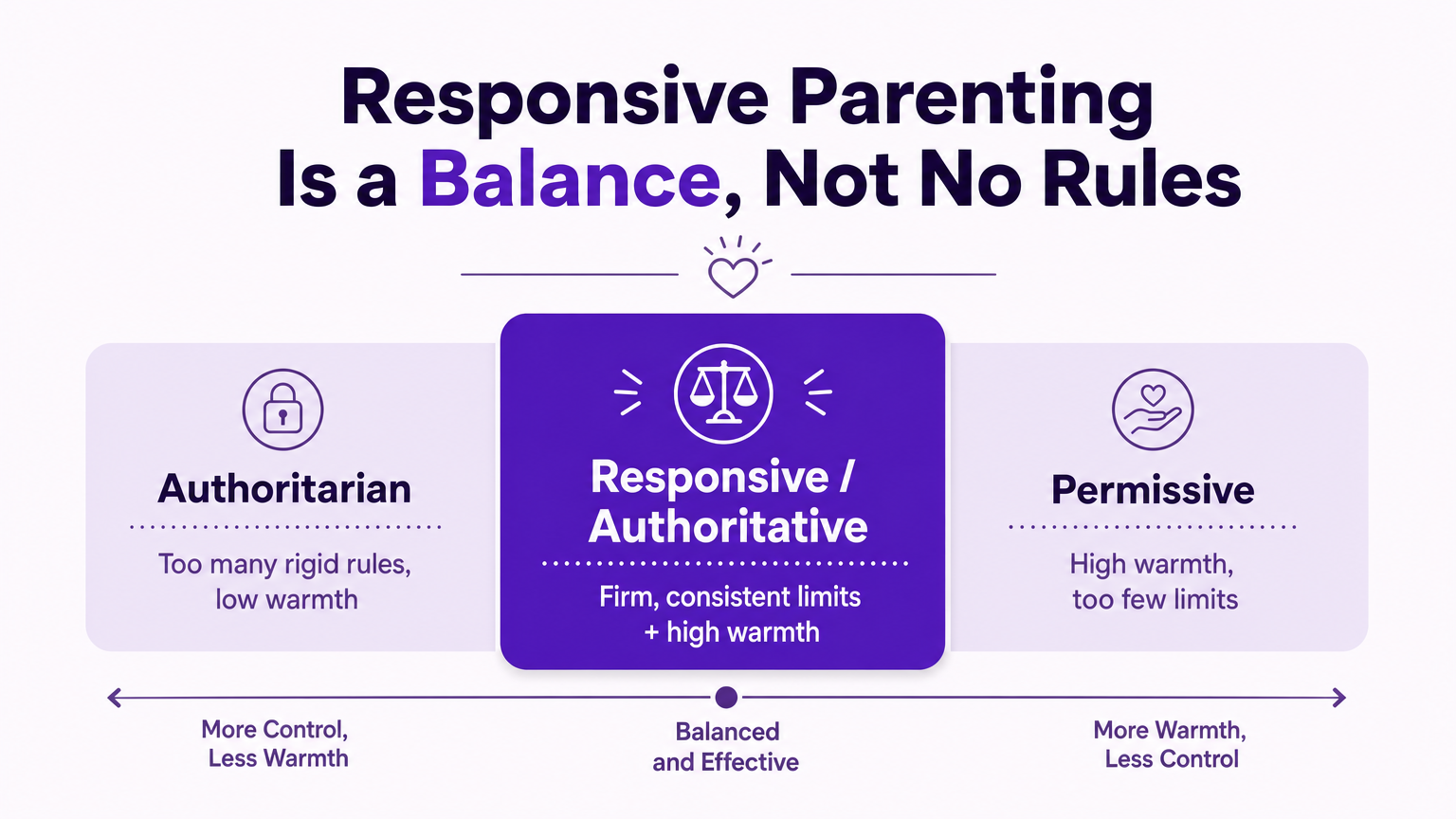
Responsive Parenting Is a Balance, Not No Rules
That balanced middle is not a new invention. Developmental psychologist Diana Baumrind's classic parenting-styles research associated the authoritative style, meaning high warmth combined with firm and consistent limits, with the best child outcomes. It is the empirical parent of the idea that firm and kind belong together.
So responsive parenting does not mean no rules. It means clear rules, delivered with respect. Finding that balanced middle, rather than swinging between strict and permissive, is exactly the kind of thing a MissPoppins coach can help a parent work through.
Why Toddlers Cannot "Just Calm Down" (and Why That Changes Everything)
A toddler's ability to self-regulate is still under construction. Between ages one and three, the brain systems that manage big emotions are immature, which means a toddler genuinely cannot self-soothe on command.
This is where co-regulation matters. ZERO TO THREE, in its resource "Your Calm Is Their Calm" (updated June 2025), defines co-regulation as when "caregiving adults help a child manage emotions by providing attuned, responsive support." Young children, the organization explains, "can't self-soothe yet... they borrow our calm." They "don't learn to regulate by being told to 'calm down.' They learn by being calmed with."
That single fact reshapes the whole approach. If a toddler borrows a parent's calm, then the parent's regulated state is the intervention, not the words.
Tantrums, in this light, are not manipulation. According to ZERO TO THREE's "Toddler Tantrums 101" (updated April 2024), "tantrums and pushing the limits signal a leap in your child's development" and are "opportunities for a child to learn" about rules, feelings, and self-regulation. Psychologist Ross Greene, creator of the Collaborative and Proactive Solutions model and author of The Explosive Child, captures the same idea in five words on his Lives in the Balance resource site: "Kids do well if they can." Challenging behavior reflects lagging skills, not willful defiance.
This is also why "calm down!" and yelling tend to backfire. A distressed toddler cannot process demands or match a raised voice with the composure the parent is asking for. The escalation simply feeds the child's own dysregulation.
The reader's question, "why does my toddler melt down when I set a limit," has a reassuring answer: the meltdown is a normal developmental signal, not a sign the parent is doing something wrong.
Why Yelling Doesn't Work (What the Research Says)
Setting limits "without yelling" is not just a nice ideal. Research points to it being the more effective choice.
The American Academy of Pediatrics is direct on this point. On HealthyChildren.org (updated November 2018), the AAP states that "spanking, slapping and other forms of physical punishment don't work well to correct a child's behavior. The same holds true for yelling at or shaming a child. Beyond being ineffective, harsh physical and verbal punishments can also damage a child's long-term physical and mental health."
A common assumption is that a warm, loving relationship offsets the occasional blow-up. The evidence does not support that. The AAP notes that "harsh verbal discipline, even by parents who are otherwise warm and loving, can lead to more misbehavior and mental health problems in children," a conclusion reinforced in its 2018 policy statement "Effective Discipline to Raise Healthy Children".
The peer-reviewed backing comes from a longitudinal study of 976 U.S. families with adolescents by Wang and Kenny, published in Child Development in 2013. Harsh verbal discipline, meaning yelling, shouting, and humiliating words, at age 13 predicted increased conduct problems and depressive symptoms. Notably, high parental warmth did not buffer the effect.
If that feels uncomfortably familiar, the same study offers context: "nearly half of the mothers and fathers reported that they had directed harsh verbal discipline at their adolescent children in the past year." Yelling is best understood as a signal that a parent needs regulation support, not as a character flaw.
How to Set a Boundary Without Yelling: A 5-Step Approach
This is the operational core: what to do, in order, in the moment.
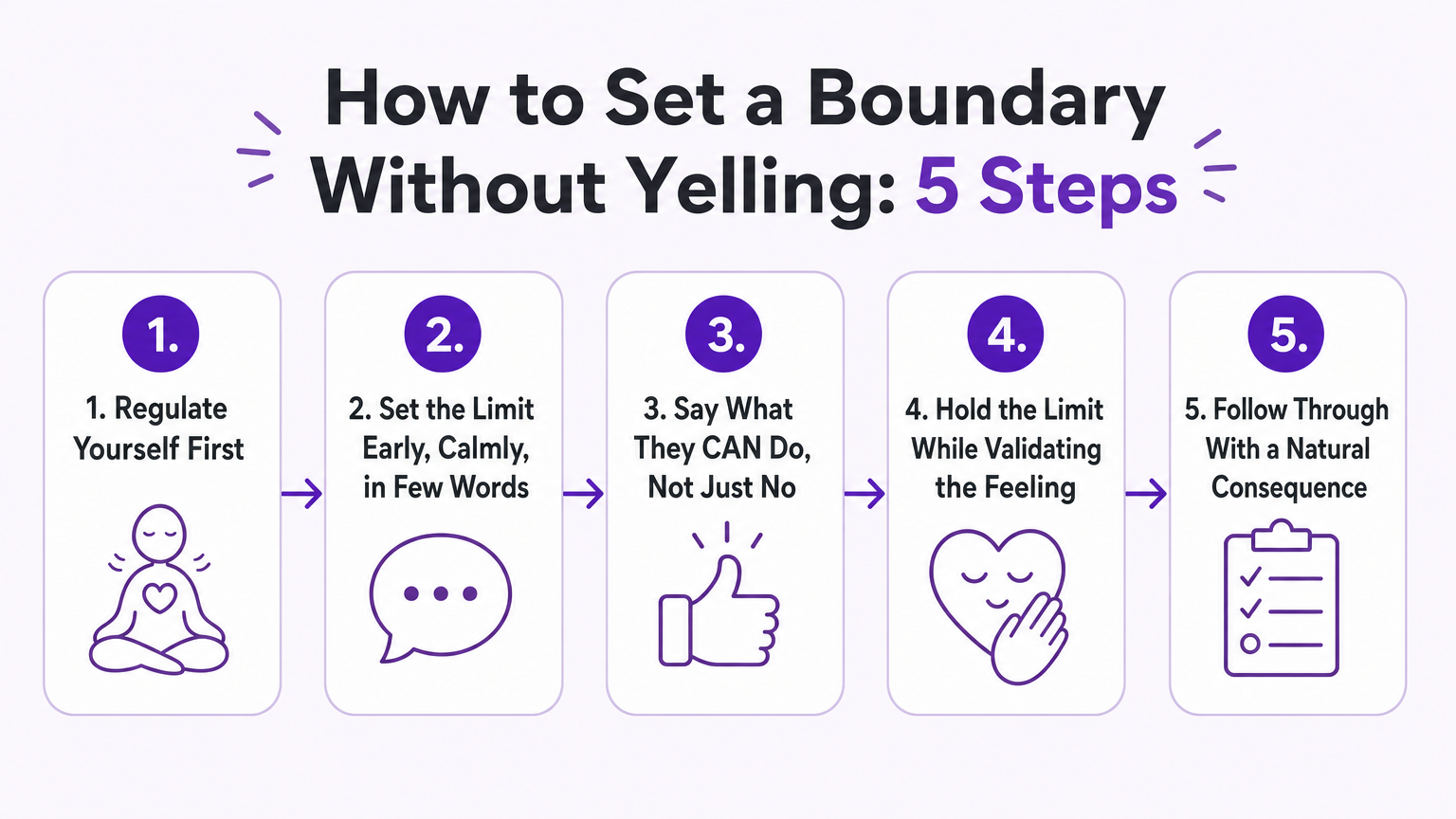
How to Set a Boundary Without Yelling: 5 Steps
1. Regulate Yourself First
The parent's calm is the intervention. Before responding, take a breath or a brief parent time-out. Child Mind Institute clinicians Vasco Lopes, PsyD, and Steven Dickstein, MD, note a useful reason to pause: "your IQ drops about 30 percent when you are angry." A regulated adult can think clearly and give the toddler something steady to borrow.
2. Set the Limit Early, Calmly, and in Few Words
Set limits before resentment builds. Author and podcast host Janet Lansbury describes having "the confidence to set and hold limits early, before I get annoyed or resentful," and doing so "calmly, directly, honestly, non-punitively." The AAP echoes the low-key delivery, advising parents to remind a child of a limit "in as few words, and with as little emotion, as possible."
3. Say What They Can Do, Not Just "No"
Redirect toward the acceptable behavior. Instead of "Stop jumping on the couch!", try: "I see you want to jump. The couch is not for jumping, but you can jump on the floor or a soft mat." This teaches rather than only forbids.
4. Hold the Limit While Validating the Feeling
Feelings are allowed; the behavior still has a limit. A simple script works: "You really wanted the cookie. It's not snack time. I'm right here." ZERO TO THREE frames this as honoring the feeling while holding the limit, which lets the child feel understood without the boundary moving.
5. Follow Through With a Natural or Logical Consequence
Consequences are calm, related, and consistent, not punishment. The AAP's healthy-discipline framework advises parents to "calmly and firmly explain the consequences," then "be prepared to follow through" and "don't give in." A consequence connected to the behavior teaches the logical result far better than an angry outburst.
These five steps are the kind of concrete, in-the-moment guidance a MissPoppins behavioral coach can walk a parent through for their specific child.
Toddler Boundary Scripts for Common Flashpoints
Sometimes the hardest part is finding the words in the moment. Here are calm, ready-to-use scripts for common toddler flashpoints. Each includes the situation, what to say, and the follow-through.
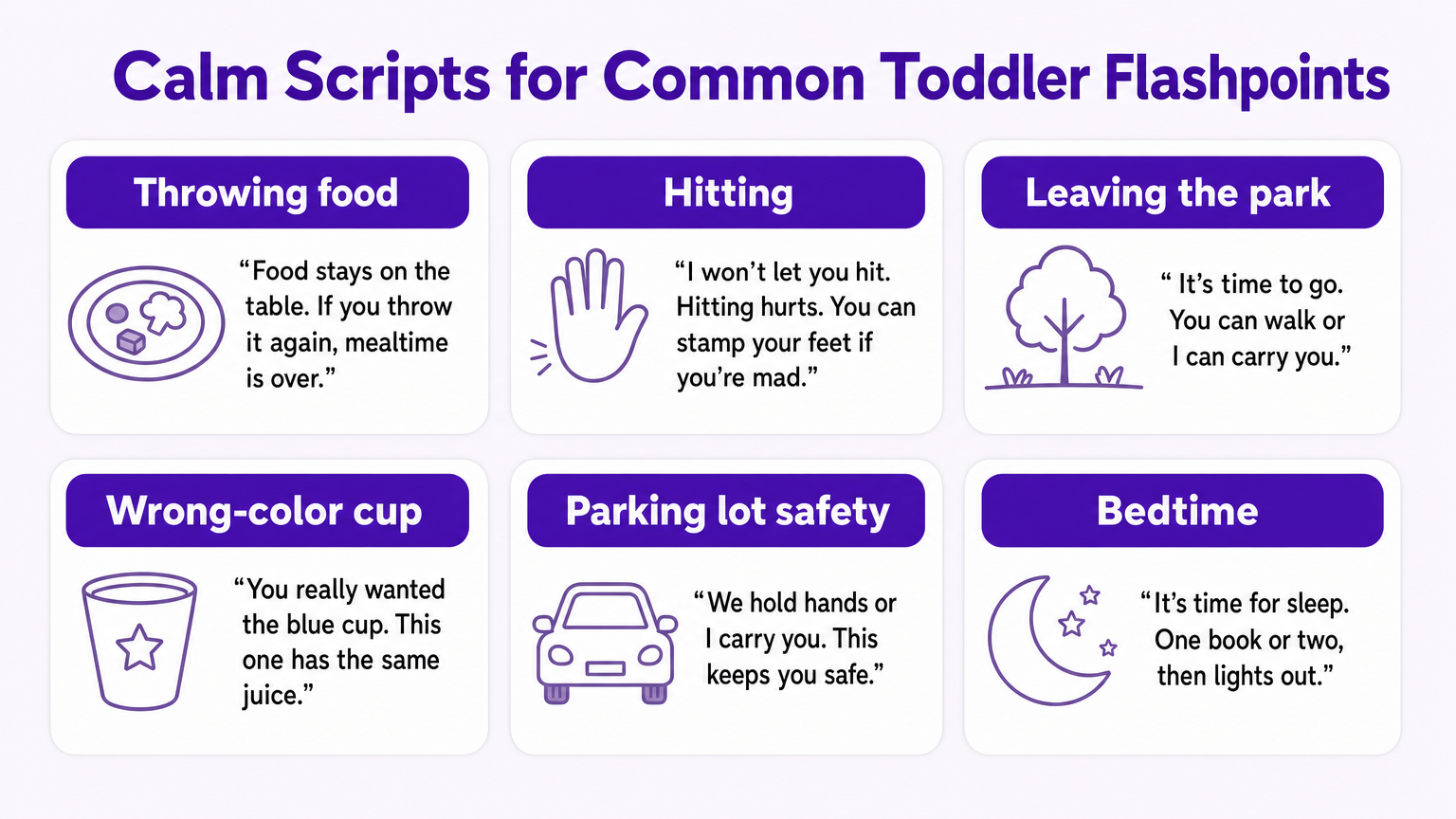
Calm Scripts for Common Toddler Flashpoints
Throwing food: Say, "Food stays on the table. If you throw it again, mealtime is over." Follow through by calmly ending the meal if it continues, with no shaming.
Hitting or biting: Say, "I won't let you hit. Hitting hurts. You can stamp your feet if you're mad." Move within reach to gently stop the hitting while naming the feeling.
Refusing to leave the park (transitions): Give a warning, then say, "It's time to go. You can walk or I can carry you." Offer the choice once, then follow through kindly.
The wrong-color cup meltdown: Say, "You really wanted the blue cup. The blue one is dirty right now. This one has the same juice." Acknowledge the disappointment and hold the limit.
Refusing to hold hands in a parking lot (safety): Say, "In the parking lot, we hold hands or I carry you. This one keeps you safe." Non-negotiable safety limits are held every time.
Bedtime resistance: Say, "It's time for sleep. You can pick one book or two, then lights out." Keep the routine and the phrasing the same each night.
"But What If My Child Cries?" Holding the Line With Empathy
For many parents, tears are the moment they cave. It helps to know that crying is not evidence a parent did something wrong.
As Sarah Ockwell-Smith puts it, "Crying is not the problem, it's what you do when the child cries that matters." The task is to stay present without rushing to fix, distract, or shush the feeling away. The limit stays; the parent stays connected beside it. Her three keys are worth memorizing: stay calm, stay consistent, stay connected.
Over time, children "relax against a boundary." Janet Lansbury describes a mother who held a calm limit through her 2.5-year-old's nightly protest: the first night the child cried about 15 minutes, the second night about 5 minutes, and then the child settled. The pattern illustrates a reassuring truth: a calmly held limit tends to resolve faster over time, not slower.
So yes, it is okay if a toddler cries when a boundary holds. The crying is a release, and the steadiness beside it is what teaches.
When to Get Extra Support
Most boundary struggles are developmentally typical. According to Today's Parent (April 2026), typical toddler defiance tends to occur "a few times a week," follows predictable triggers such as the stretch before naps or bedtime and hunger, and each episode lasts roughly 15 to 30 minutes.
Some patterns are worth a closer look. Near-daily episodes, outbursts lasting longer than an hour, or defiance with no predictable trigger can signal something beyond typical toddler behavior. These are not reasons to panic, but they are reasons to get informed support.
When a calm, consistent approach is not moving things, a certified parenting or behavioral coach can build a plan tailored to one family's situation. MissPoppins connects parents with certified coaches across 36+ specialties through on-demand 1:1 virtual sessions, with a free intro consultation and no waitlist. The service is available in the United States and Canada.
Practical Tips / Next Steps
A short checklist to start using today:
Pick the boundaries that truly matter. Focus on safety and core values, and let the small stuff go so limits stay enforceable.
Anticipate triggers. The AAP recommends heading off tantrums with well-timed naps and meals, since tired and hungry toddlers melt down fastest.
Regulate yourself before you speak. A breath or brief pause resets the parent's calm, which is what the child borrows.
Use the same short phrasing every time. Consistency across all caregivers helps a toddler learn the limit faster.
Repair when you slip. Responsive parenting allows for imperfection; a calm reconnection after a hard moment models accountability.
The goal is not perfection. It is a small set of clear limits, held calmly and consistently, most of the time.
Conclusion
Firm and kind are not opposites. The aim of responsive parenting boundaries is not a child who never cries; it is a parent who stays steady while the limit holds. Every parent slips sometimes, and that is fine. The work is to repair and keep going, using short, consistent phrasing and a regulated voice.
Setting limits without yelling is a skill that strengthens with practice, and no parent has to build it alone. When a family wants a partner in the process, MissPoppins connects parents with a certified coach who turns co-regulation and boundary-setting into concrete, in-the-moment guidance.
Frequently Asked Questions
Is responsive parenting the same as permissive parenting?
No; responsive parenting pairs warmth with clear, firm limits, whereas permissive parenting lacks consistent boundaries.
How do I set boundaries with my toddler without yelling?
Regulate yourself first, state the limit calmly in a few words, and follow through with a natural consequence rather than raising your voice.
Is it OK if my toddler cries when I hold a boundary?
Yes; crying is a normal release of feeling, and what matters is that you stay calm and connected while the limit stays in place.
Does yelling at my toddler actually cause harm?
Research and the AAP find harsh verbal discipline is both ineffective and linked to more behavior problems, even from otherwise warm parents.
How many rules should a toddler have?
Keep boundaries to a realistic minimum focused on safety and the values that matter most, so you can enforce them consistently.
When should I get help with my toddler's behavior?
If the same battles escalate daily, last over an hour, or feel unmanageable despite a calm and consistent approach, a certified parenting coach can help.