

The 18 Month Sleep Regression: 6 Signs & How to Handle It

The 18-month sleep regression is a temporary phase where a previously great sleeper suddenly boycotts naps, fights bedtime, and wakes up repeatedly at night. It happens because of massive brain development, new independence, and separation anxiety. It usually begins anywhere from 14 to 20 months of age. Expect the disruption to last a few weeks, and hold your boundaries to get through it.
You are watching the baby monitor. The clock on your phone says it is two in the morning. Your toddler is wide awake, standing up, rattling the crib rails, and shouting the word "no" into the dark room.
Just last month, this exact same child slept eleven hours straight.
You are probably sitting there wondering what you broke. Did you feed them dinner too late? Did you use the wrong sound machine setting? The answer is absolutely nothing. You did nothing wrong.
Welcome to the 18-month sleep regression. It is an exhausting but completely normal biological phase. Your baby has officially turned into a toddler with their own strong opinions about bedtime. Let's look at exactly what is keeping them awake, how to know for sure that it is a regression, and the exact steps you can take to get your family resting again.
Is the 18-Month Sleep Regression Actually a Medical Condition?

This is the biggest secret in pediatric sleep. "Sleep regression" is not a medical diagnosis. You will not find the term in a clinical textbook.
When researchers look at massive sets of infant sleep data, they do not see uniform, clean drops in sleep quality at exact monthly milestones. Instead, the term is a phrase parents and consultants use to describe something very real happening in your home. The medical label might not exist, but the 2:00 AM crib-rattling absolutely does.
These disruptions are actually signs of cognitive leaps. When we talk about sleep regression ages (like the 4-month, 8-month, or 12-month marks), we are really just tracking predictable periods of intense brain development. You can read more about how this timeline works in our guide on common causes of sleep regressions by age.
What Exactly Is the 18-Month Sleep Regression?
While we call it the 18-month regression, this sleep disruption typically hits families anywhere between 14 and 20 months of age. It is a distinct period where a child who previously settled down easily suddenly refuses to sleep.
Unlike the 4-month regression (which is a permanent change in how a baby's sleep cycles work), the 18-month regression is purely behavioral and developmental. Your toddler's body still knows exactly how to sleep. Their brain is simply too busy to let them do it. They are learning to walk confidently, absorbing language at a staggering rate, and realizing they have the power to say no.
Why Does It Happen Now?
The reason your kid is awake has very little to do with the crib itself.
The Language Explosion: They are absorbing dozens of words daily. Their brains are running a constant sorting program in the background. Winding down is almost impossible when your mind is racing.
A Taste of Power: Your child just realized they are a separate person from you. They have free will. Refusing to sleep is a highly effective way to test their new authority.
Separation Anxiety: You likely dealt with this when they were an infant, but it almost always returns now. They understand you are out in the living room, and they desperately want to join you.
6 Undeniable Signs of the 18-Month Sleep Regression
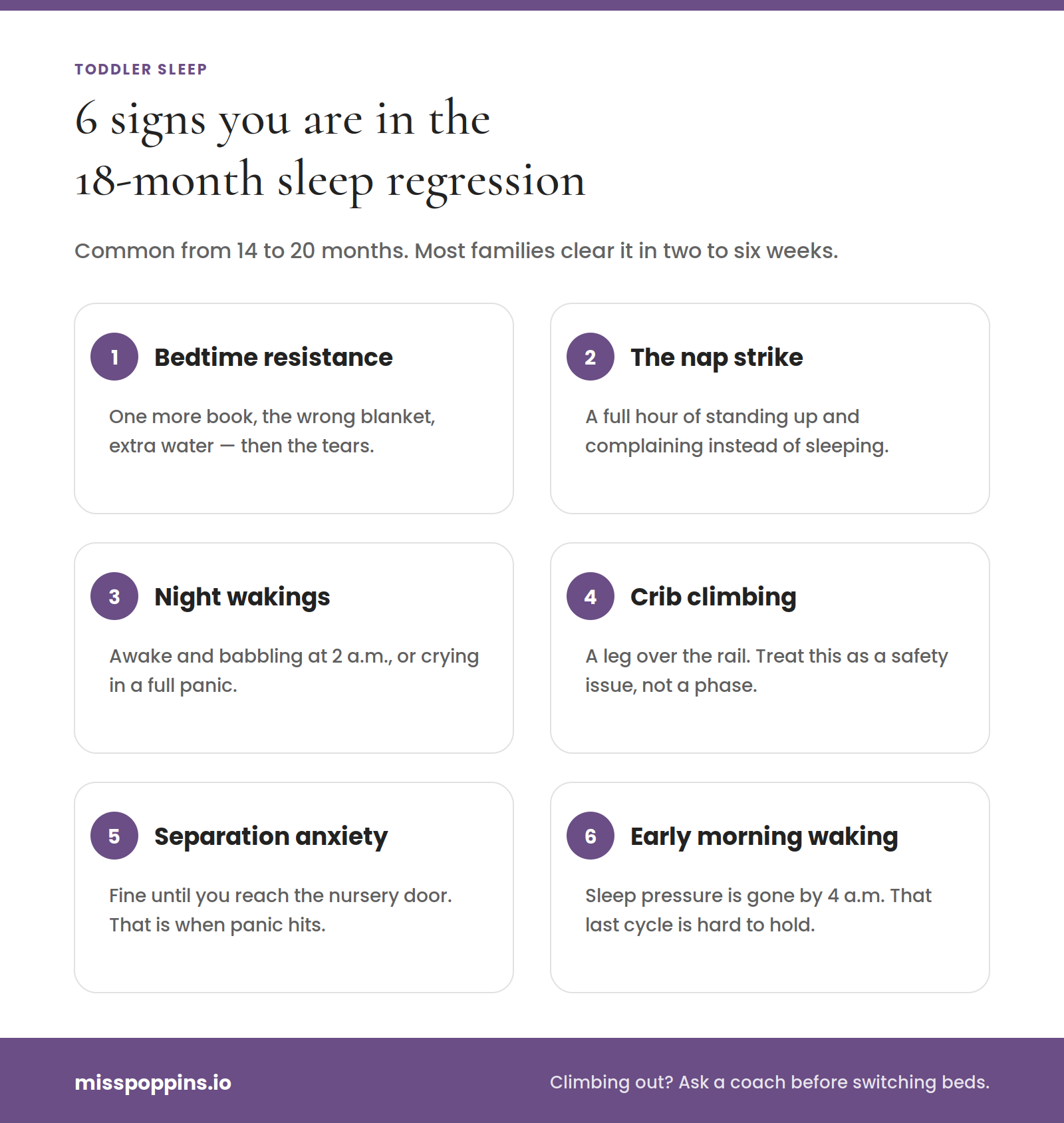
If you are wondering if your 16 or 18-month-old is in the thick of this phase, look for these specific behaviors.
1. Sudden and Intense Bedtime Resistance
Instead of a smooth routine, you now have a stalling expert. They demand the blue blanket instead of the green one. They need extra water. The moment you try to actually leave the room, the tears start.
2. The Infamous “Nap Strike”
Daytime sleep becomes a battleground. They might spend a full hour standing up in the crib complaining. To build up their physical tiredness, try wearing them out with activities you can do with your 18-month-old baby.
The Daycare Conflict: If your child is in daycare, you might notice a clash here. Daycares usually enforce a strict, single midday nap. If your toddler is still trying to take two naps at home on the weekends, this inconsistency will fuel the regression.
3. Frequent Night Wakings
Midnight parties are back. You might find them wide awake and babbling to their stuffed animals, or they might wake up in a total panic crying for you.
4. Crib Climbing (A New Safety Risk)
Right around 18 months is when many toddlers realize they are tall enough to hook a leg over the crib rail. This is a massive safety hazard. A competitor might tell you to just switch to a toddler bed immediately, but we advise caution. Moving to a toddler bed right now gives them total freedom when they lack impulse control. Try putting them in a sleep sack first. It restricts their leg mobility enough to prevent climbing while keeping them safely in the crib.
5. Peaking Separation Anxiety
They are laughing and playing with you right up until you walk toward the nursery door. That is when the panic hits. They simply cannot regulate their emotions well enough yet to handle you leaving them alone.
6. Unusually Early Morning Wakings
Sleep pressure is completely gone by 4:00 AM. Connecting that final sleep cycle is incredibly hard for them right now.
Regression vs. Reality: What Else Could It Be?
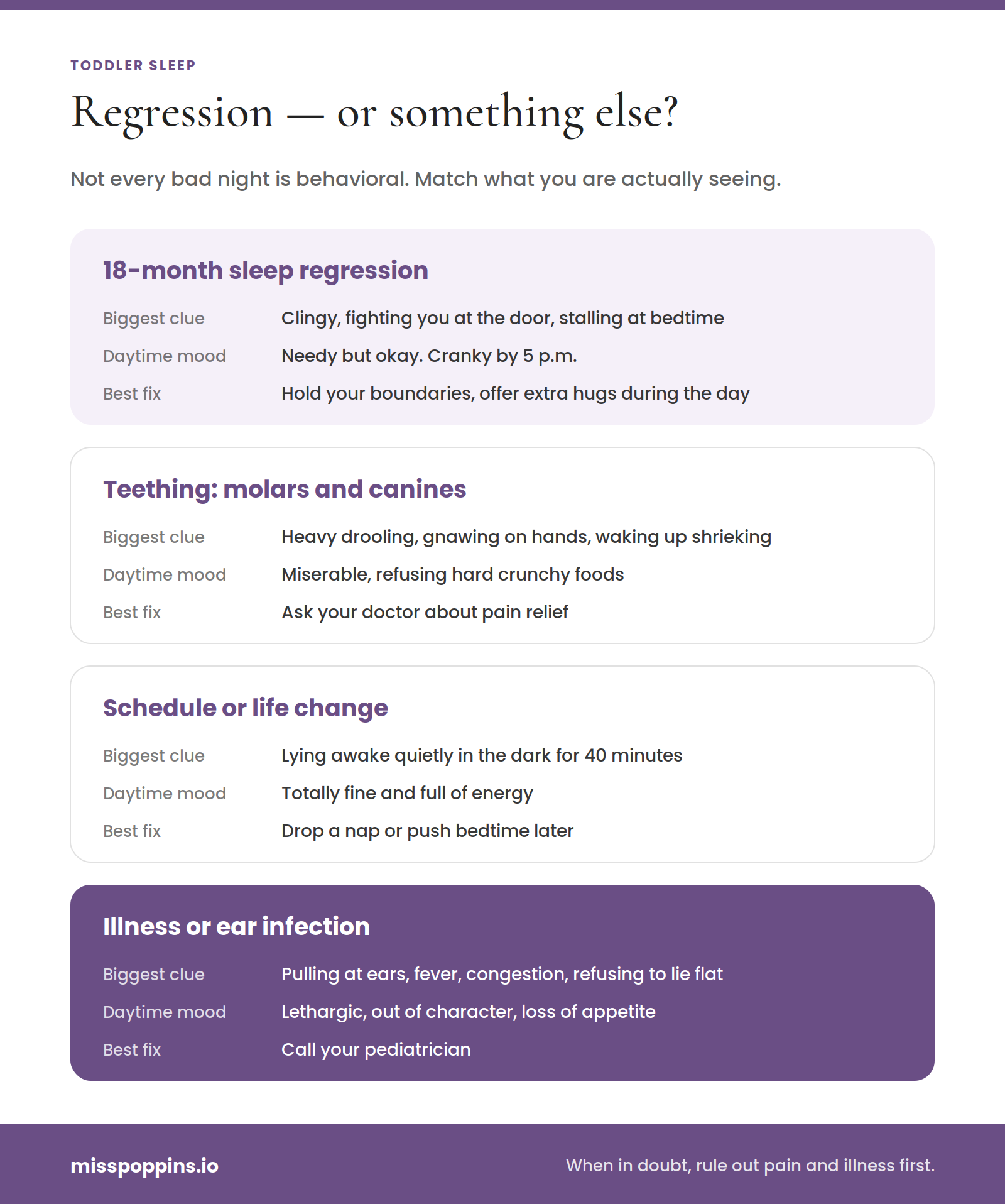
Not every bad night is a behavioral phase. Sometimes, things just hurt. Or their schedule is a mess. Here is how to tell the difference.
How Long Does the 18-Month Sleep Regression Actually Last?
Sleep consultants generally describe this regression as lasting anywhere from two to six weeks. How you react matters more than anything. Hold the line, and it ends faster.
When to Call the Pediatrician: If the sleep disruption lasts well beyond six weeks, shows absolutely zero signs of improving, or comes with signs of illness, pain, or breathing problems at night (like snoring or gasping), check with your pediatrician.
Actionable Solutions: How to Protect Your Sleep
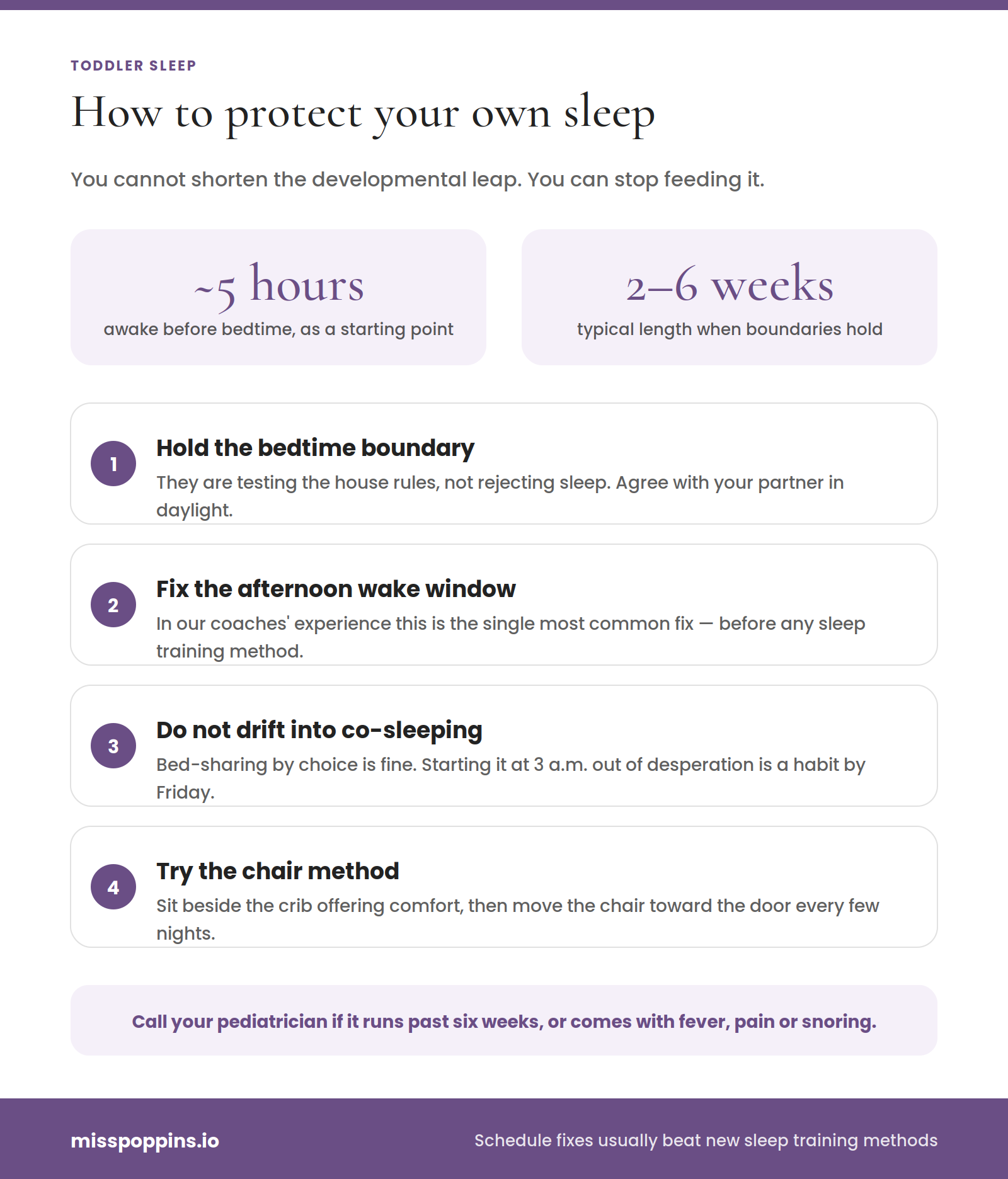
You need a survival plan. Here is how to support your kid without burning yourself out.
Keep Your Bedtime Boundaries Firm
They are testing the structural integrity of your house rules. You must show them the crib is safe and sleep is not optional.
The 3:00 AM Partner Disagreement: This boundary testing is incredibly hard on parents. One of you wants to hold the line. The other wants to just bring the toddler into bed so everyone can sleep. This is the actual scene in most houses at 3:00 AM. Get on the same page during the day so you are not arguing in the dark. For advice on navigating this, read our guide on how to set boundaries.
Reassess Their Schedule and Wake Windows
In our coaches' experience, schedule mismatches are the number one driver of toddler wakefulness. A toddler this age needs a starting point of about five solid hours awake before bed.
"Across our sleep coaching sessions with parents of 16 to 20-month-olds, the most common resolution was not a new sleep training method. It was simply fixing the afternoon wake window."
— Sarah Jenkins, Certified Pediatric Sleep Coach at MissPoppins
Need Help Fixing Your Schedule?
Stop guessing in the dark. Talk to a certified sleep coach today to get a customized routine that actually works. Book a Free Call
Rethink the Co-Sleeping Drift
Co-sleeping and bed-sharing are wonderful, normal practices for many families who choose them intentionally. The problem arises when you drift into it out of sheer desperation at 3:00 AM. If you do not actually want to co-sleep long-term, do not start doing it just to survive the regression. Toddlers learn fast. Offer comfort and sit nearby, but let them fall asleep in their own space.
Which Sleep Training Method Works Best?
Gentle, structured methods are your best bet. The "Chair Method" works beautifully. You sit in a chair by the crib, offering comfort, and move the chair closer to the door every few nights. Pair this with predictable bedtime routines for nighttime.
Exhausted? Let MissPoppins Help Your Family Reclaim Your Nights

You do not have to survive this phase completely on your own. When you are too tired to think straight, professional help changes everything.
MissPoppins connects you with certified, non-clinical pediatric sleep coaches who know exactly how toddlers operate. Our experts look at your specific family situation and build a customized plan that actually works. We provide the emotional support and the exact roadmap you need to get your toddler back on track.
5,000+ Families Supported
4.8-Star Average Rating
150+ Years of Combined Coach Experience
100% Vetted & Certified Coaches. Private & Encrypted Sessions.
Take MissPoppins with you anywhere. Download our app for instant access to sleep schedules, coach messaging, and community support.
Download on the App Store | Get it on Google Play
FAQs
Can the 18-month sleep regression cause early morning waking?
Yes. Because sleep pressure is lowest between 4:00 AM and 6:00 AM, any spike in developmental anxiety makes it incredibly hard for a toddler to connect their final sleep cycle.
Is it a regression or is my toddler ready to drop a nap?
If they are 14 to 18 months old and happily lying awake in their crib for an hour during nap time, it is likely a schedule issue. The typical window for transitioning from two naps to one is roughly 13 to 18 months, though some toddlers transition later.
How much sleep does an 18-month-old actually need?
According to the American Academy of Sleep Medicine (AASM) and the AAP, toddlers need 11 to 14 hours of sleep over a full 24-hour cycle.
Should I let my 18-month-old "cry it out"?
Total extinction usually backfires right now because their separation anxiety is so intense. Modified methods with brief check-ins let them know they are safe while still giving them space to settle on their own.
What if my toddler is climbing out of the crib?
Do not immediately transition to a toddler bed unless you have to. Try putting them in a properly fitted sleep sack first. The restricted leg movement is often enough to stop the climbing.