
Written by Mitshella Armand, Certified Newborn Care Specialist, NICU Doula, and Postpartum Doula
Bringing your baby home from the NICU means taking over care without monitors or nurses nearby. Follow your baby's discharge plan for feeds, medicines, and follow-up visits, use corrected age to track a preemie's milestones, and lean on support. Every NICU graduate's needs are different.
The Reality of Bringing Your NICU Baby Home
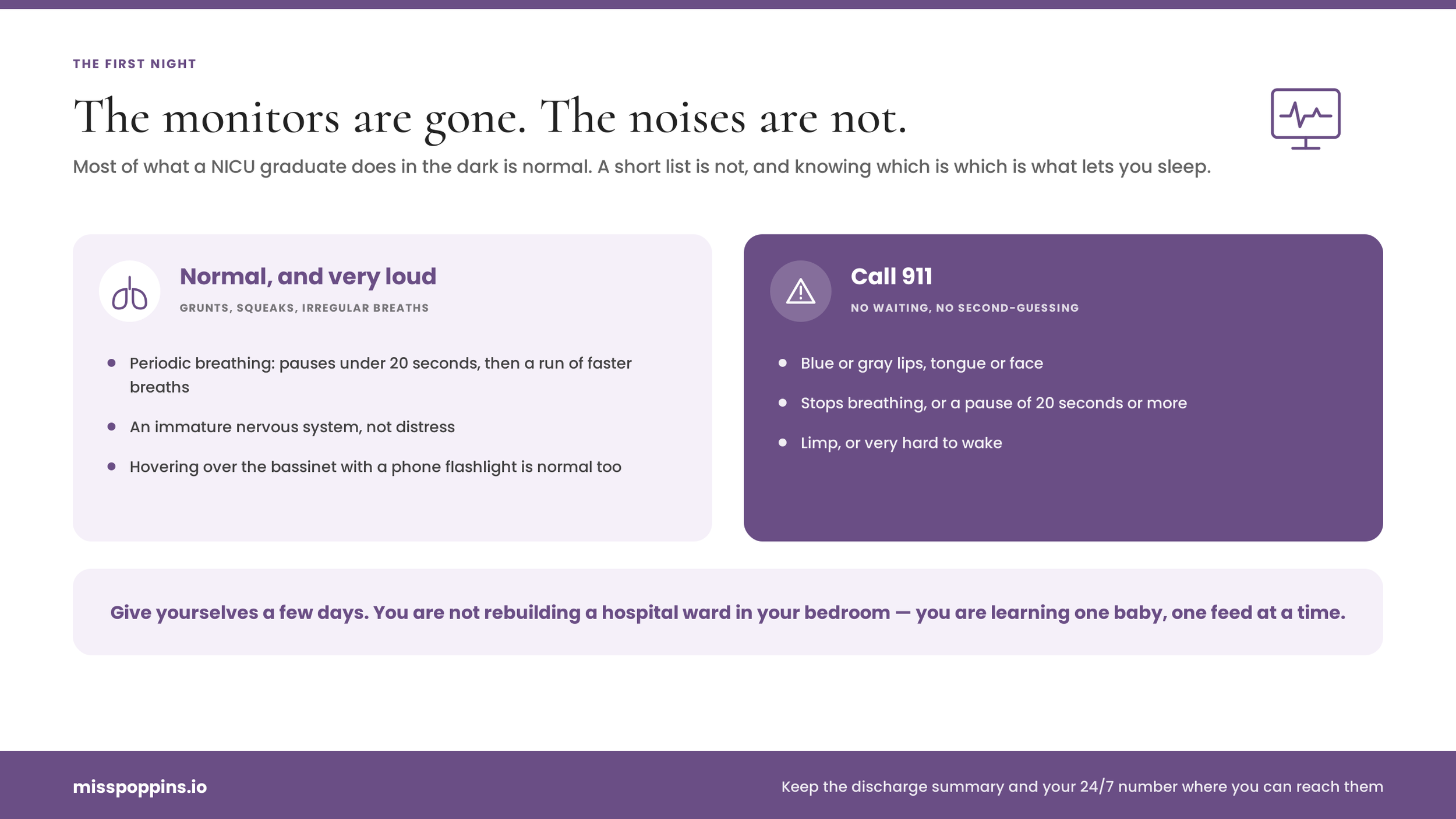
Walking out of the hospital doors with your baby in the car seat is the moment you have waited for since admission day. Yet the first night in your own living room often feels surprisingly surreal. For days, weeks, or even months, a team of nurses and neonatologists stood just a few feet away, and glowing screens tracked every heartbeat and oxygen dip. Now the hallway is dark, the pulse oximeter is gone, and you and your partner are the ones on night shift.
Feeling a wave of nerves alongside your relief is completely normal. Many parents spend the first few nights hovering over the bassinet with a phone flashlight just to watch their baby's chest rise and fall. Learning the normal newborn signs, like the grunts, squeaks, and irregular breathing many babies make, can ease a lot of first-week worry. Preemies often breathe irregularly, with short pauses under 20 seconds followed by a series of faster breaths. This pattern is called periodic breathing, and it is usually a normal part of an immature nervous system rather than a sign of distress.
Give yourself and your baby a few days to settle into the rhythm of home. You are not expected to recreate a hospital ward in your bedroom. Instead, you are learning your baby's unique cues in a calmer space, one feeding and one diaper change at a time.
Your First Weeks at Home: Common Challenges
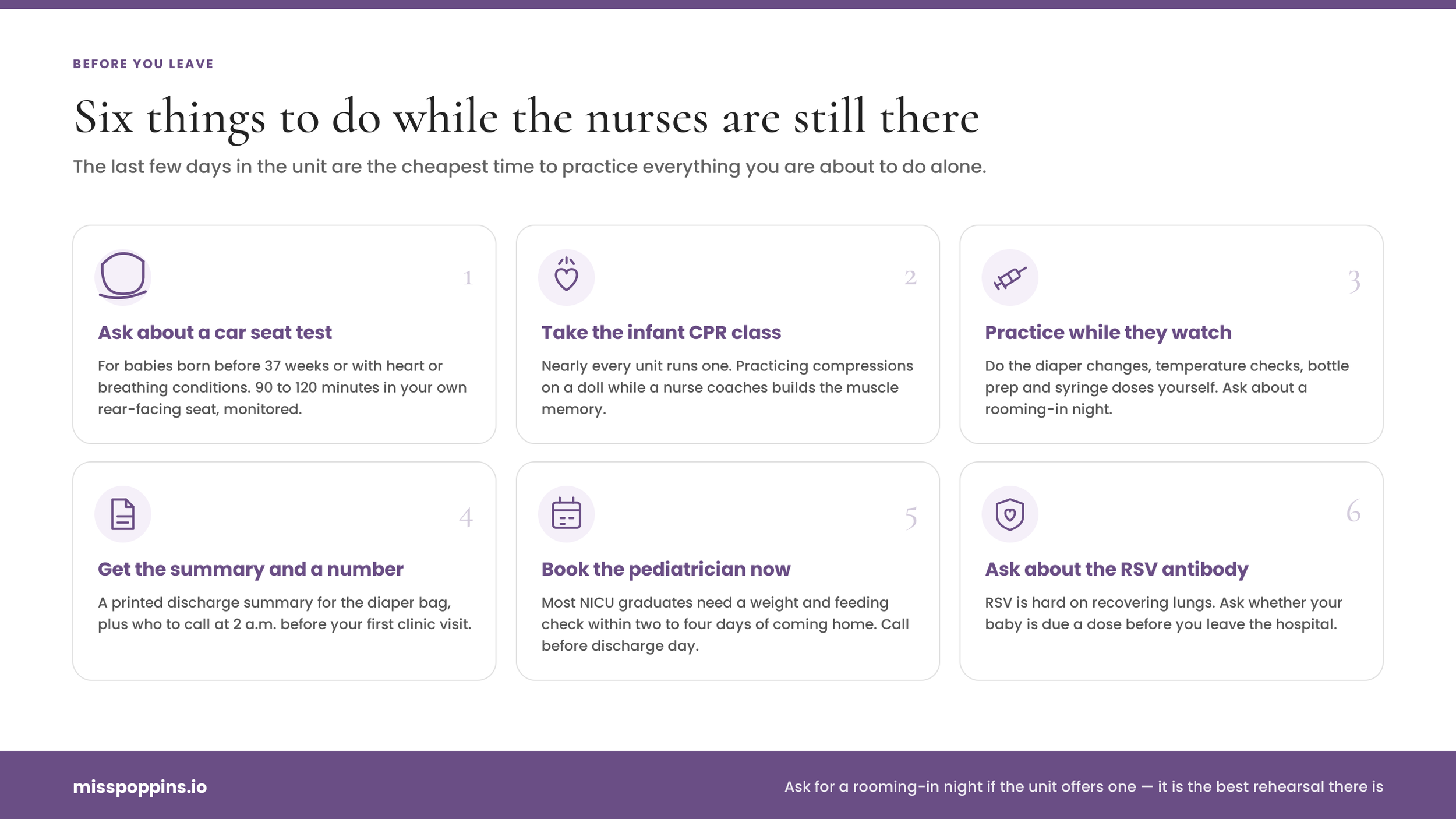
Before You Leave the NICU: Your Discharge Checklist
Most NICU teams begin talking about discharge several days before your baby actually comes home, usually once your little one is keeping their body temperature steady in an open crib, breathing comfortably, and taking feeds consistently. Using those final days in the hospital to practice hands-on care makes the first 48 hours at home much smoother.
Ask about a car seat test: Many hospitals conduct a car seat angle tolerance test for babies born before 37 weeks or those with breathing or heart conditions. You will bring in your own rear-facing infant seat, and the nurses will monitor your baby's heart rate, breathing, and oxygen levels for 90 to 120 minutes while they sit reclined in the seat.
Take an infant CPR class: Nearly every NICU offers an infant CPR and choking class for parents before discharge. Practicing chest compressions on a doll while a nurse coaches you builds muscle memory so you feel prepared for emergencies.
Practice giving medicines and using equipment while nurses watch: Ask to handle all diaper changes, temperature checks, bottle prep, and syringe medications during your final hospital visits. Many units also offer a "rooming-in" night where you care for your baby in a private hospital room with the nurse right down the hall as a safety net.
Get your discharge summary and a 24/7 number to call: Before you walk out, make sure you have a printed copy of your baby's discharge summary for your diaper bag. Ask who you should call if a question comes up at 2:00 AM before your first clinic visit, since some hospitals give you a direct NICU triage line for the first few days.
Book the first pediatrician visit: Call your pediatrician's office as soon as you have a target discharge date. Most NICU graduates need a weight and feeding check within two to four days of coming home.
Ask whether your baby should get an RSV antibody shot (nirsevimab or clesrovimab): Respiratory syncytial virus (RSV) can be hard on recovering lungs. According to the CDC's RSV immunization guidance for infants, the CDC recommends an RSV antibody immunization for babies under 8 months old going into or born during their first RSV season if the mother did not receive the maternal RSV vaccine during pregnancy. Some children between 8 and 19 months who are at higher risk for severe RSV also need a dose entering their second season.
Every NICU Graduate's Journey Home Looks Different
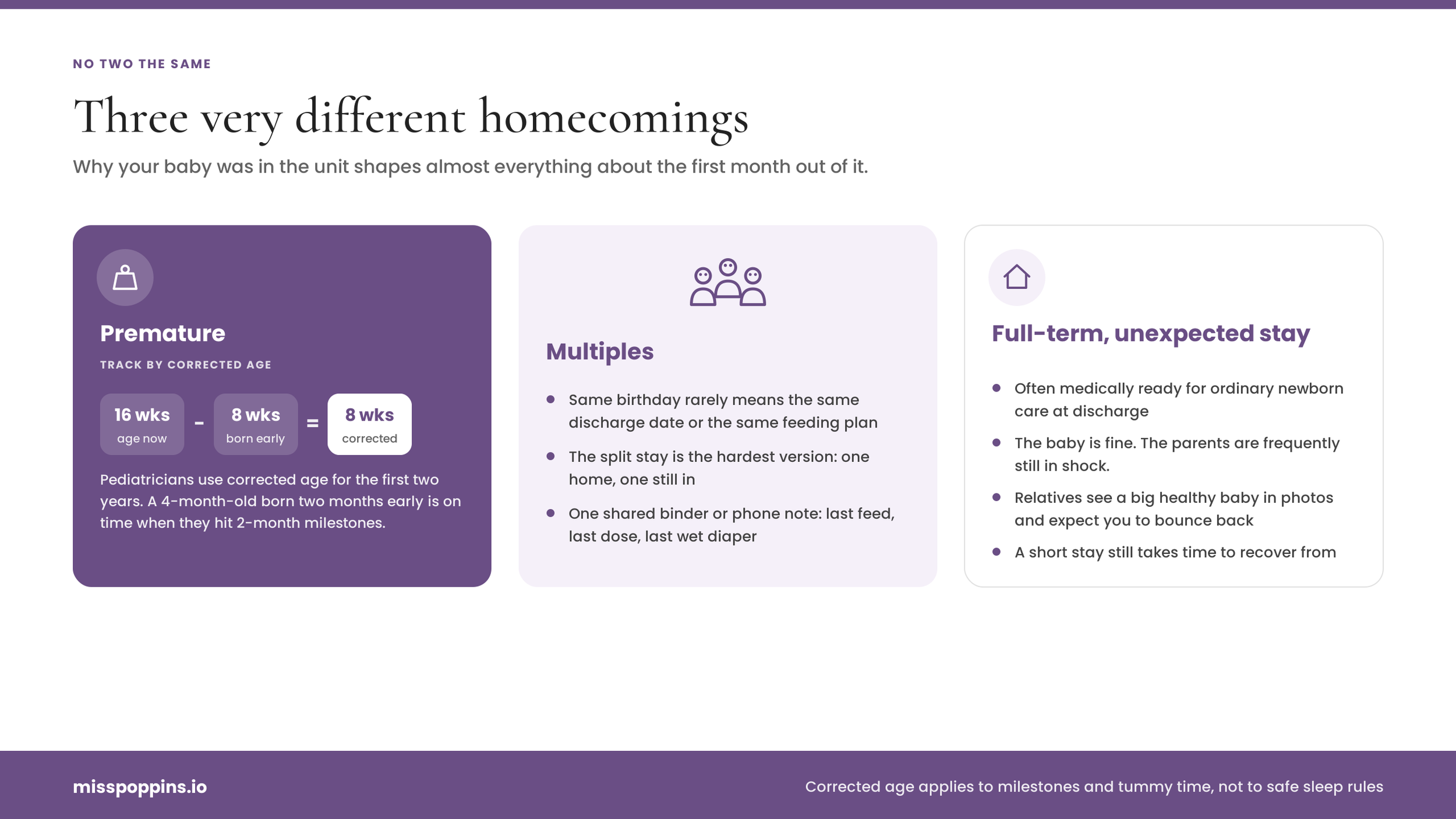
Friends and neighbors often assume that once a baby is discharged from the NICU, the medical chapter is over and life looks just like any other newborn homecoming. Anyone who has spent time scrubbing their hands at a NICU sink knows it is rarely that simple. How your first month at home unfolds depends a lot on why your baby needed extra care in the first place.
Premature Babies: Corrected Age and Development
When your baby arrives weeks or months ahead of their due date, their brain and muscles are still doing the developmental work that would have happened inside the womb. Because of this, comparing a preemie to a full-term baby born on the same calendar day will only leave you feeling discouraged.
Instead, pediatricians track premature babies using their corrected age (sometimes called adjusted age), which is your baby's chronological age minus the number of weeks they were born early. For example, if your baby is 16 weeks old today but arrived 8 weeks early, their corrected age is 8 weeks. According to the AAP's Corrected Age for Preemies guide, doctors and parents use corrected age during the first 2 years of life to evaluate growth, feeding skills, and developmental progress.
That means a 4-month-old who arrived two months early is right on track when they start showing milestones at 2 months old, like holding their head up briefly and offering their first social smiles. The same rule applies when you explore why tummy time matters for neck and shoulder strength: always go by your baby's adjusted age, and check with your pediatrician before starting floor sessions.
Multiples: Different Schedules and Discharge Dates
Bringing home twins or triplets from the NICU is a major logistical feat. Even when babies share a birthday, they rarely share the exact same needs at discharge. One twin may come home nursing at the breast, while the other needs fortified breast milk or a higher-calorie formula on a timed schedule. Even tougher is the split stay, when one baby is ready to come home while a sibling still needs another week or two of hospital care.
If you are splitting your days between your living room and the NICU, lean on every bit of practical help offered to you. Keep a shared binder or phone note so both parents and helpers can see when each baby last ate, took medicine, and had a wet diaper. As you work through breastfeeding with multiples or pumping between hospital visits, protect your own physical healing too. Stock up on postpartum physical recovery supplies for healing at home before discharge day. Set up a feeding station with water, snacks, your own medicine, and burp cloths within arm's reach so you aren't climbing stairs in the middle of the night.
Having an experienced set of hands in your corner can transform those early weeks with multiples. As MissPoppins parent Katie D. shared after working with Certified Newborn Care Specialist and NICU Doula Mitshella "Chella" Armand:
"We were so lucky to find Chella and have her by our side for the end of my pregnancy and bringing our triplets home. She's a fierce advocate, a wonderful, funny presence, and a top-notch organizer!" — Katie D.
Full-Term Babies After an Unexpected NICU Stay
Not every NICU family has a preemie. Thousands of full-term babies spend days or weeks in the NICU after birth for breathing support, meconium aspiration, blood sugar monitoring, infection treatment, or jaundice. When these babies come home, they are often medically stable and ready for standard newborn care.
The catch is that while the baby is fine, the parents are often still reeling from the shock. When you planned for a golden-hour delivery and a quiet recovery room, watching your full-term newborn get whisked away to intensive care is terrifying. Relatives may expect you to bounce right back because your baby looks big and healthy in photos, which makes many parents brush off their own fear. Give yourself permission to acknowledge what you went through. Even after a short NICU stay, it takes time for your nervous system to believe that your baby is truly safe in your arms.
Need personalized help?
Chat with a certified newborn care specialist on MissPoppins. Book a free 30-minute virtual consultation with Mitshella Armand to build a homecoming plan that fits your baby and your family.
Feeding, Medications, and Equipment at Home
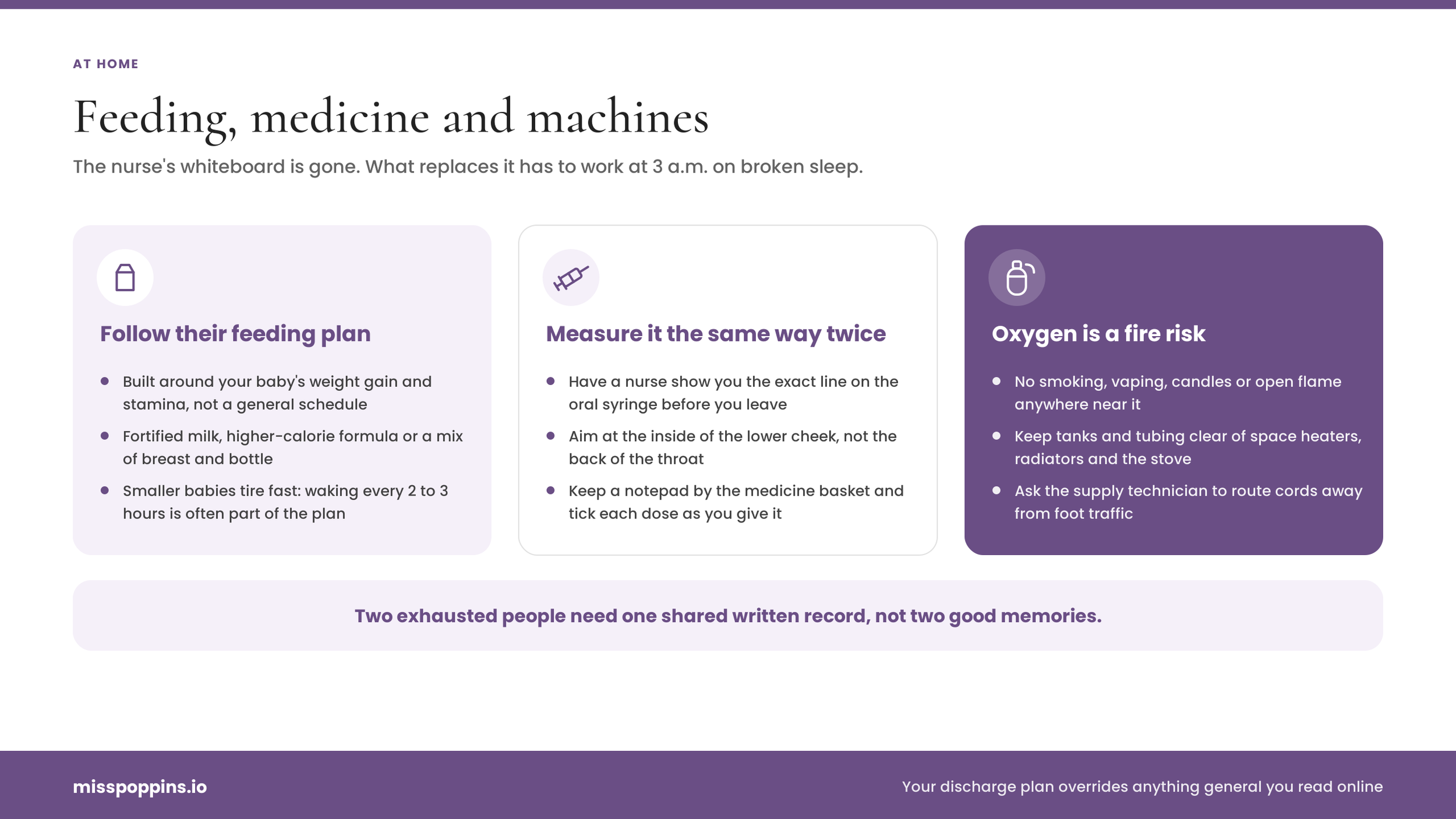
Leaving the hospital means trading the nurse's whiteboard for your own home routine. Keeping things simple and visual prevents small mix-ups when both parents are running on broken sleep.
Following Your Baby's Feeding Plan
Every NICU baby goes home with an individualized feeding plan built around their weight gain and stamina. Some preemies take expressed milk mixed with human milk fortifier, some take a higher-calorie formula, and others combine direct breastfeeding with a few topped-up bottles each day. Because smaller babies can be extra sleepy and burn calories quickly, you may need gentle methods to wake a sleepy baby every 2 to 3 hours, such as unswaddling or changing their diaper mid-feed. Between meals, practicing skin-to-skin contact to stabilize newborn heart rate and body temperature also supports milk supply and helps sleepy feeders wake more calmly for the breast or bottle.
Staying on Track With Medications
If your baby comes home on multivitamins, iron drops, reflux medication, or caffeine, ask the hospital nurse to show you how to measure the exact line on the oral syringe before you leave. Aim the syringe gently toward the inside of your baby's lower cheek rather than the back of the throat so they can swallow comfortably. Since tired nights can blur together, keep a small notepad and pen right next to the medicine basket and check off each dose the moment you give it.
Managing Home Equipment and Oxygen Safety
If your baby needs home oxygen, a feeding pump, or a prescribed apnea monitor, your NICU team arranges equipment and trains you on it before discharge. Ask the medical supply technician to help you place monitors where cords stay tucked away from foot traffic. If your baby comes home on supplemental oxygen, follow strict fire safety habits in your home: allow no smoking, vaping, candles, or open flames anywhere near oxygen, and keep oxygen tanks and tubing well away from space heaters, radiators, and kitchen stoves.
Protecting Your Baby From Germs: Visitors, Vaccines, and RSV
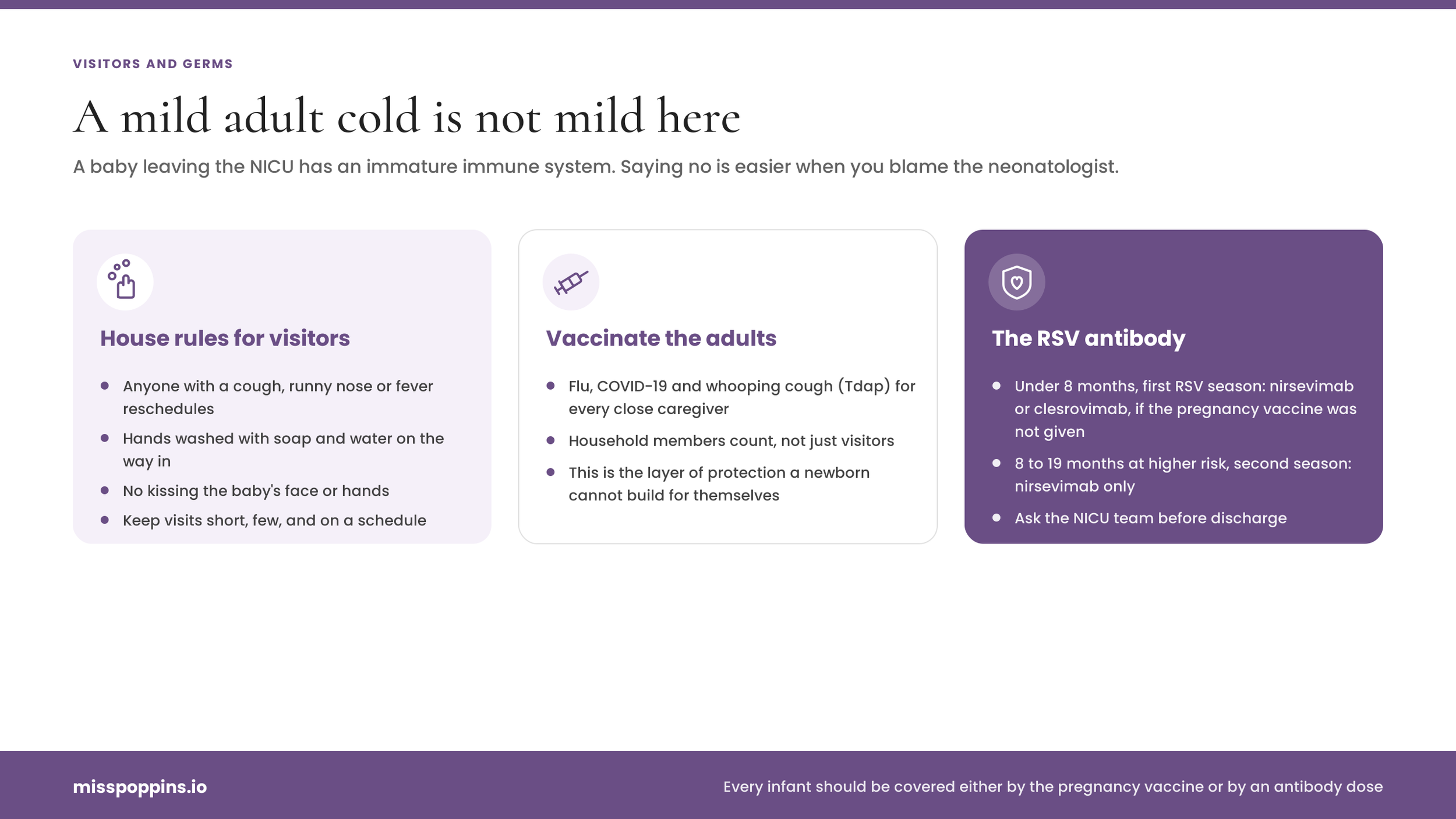
Friends and grandparents are naturally eager to celebrate your baby's homecoming, and turning down visits can feel awkward when people mean well. Still, a newborn leaving the NICU has an immature immune system, and even a mild adult head cold can land a recovering preemie back in the hospital.
According to the AAP's guide on preparing to bring your preemie home, the AAP suggests limiting the number of visitors and setting a visiting schedule. Blaming the doctor is one of the easiest ways to take the social pressure off yourself: "Our neonatologist asked us to keep the house quiet and limit visitors while the baby adjusts." Our guides on how to set boundaries with family and welcoming a grandparent without overstepping offer word-for-word scripts you can text to relatives before discharge day.
When you do welcome a trusted helper into your home, keep a few simple health habits in place:
Ask anyone who has a cough, runny nose, fever, or recent illness exposure to reschedule their visit.
Have every visitor wash their hands thoroughly with soap and water as soon as they walk inside.
Ask guests not to kiss the baby's face or hands, where respiratory droplets easily spread.
Make sure close caregivers and household members are up to date on their flu, COVID-19, and whooping cough (Tdap) vaccines.
Safe Sleep After the NICU
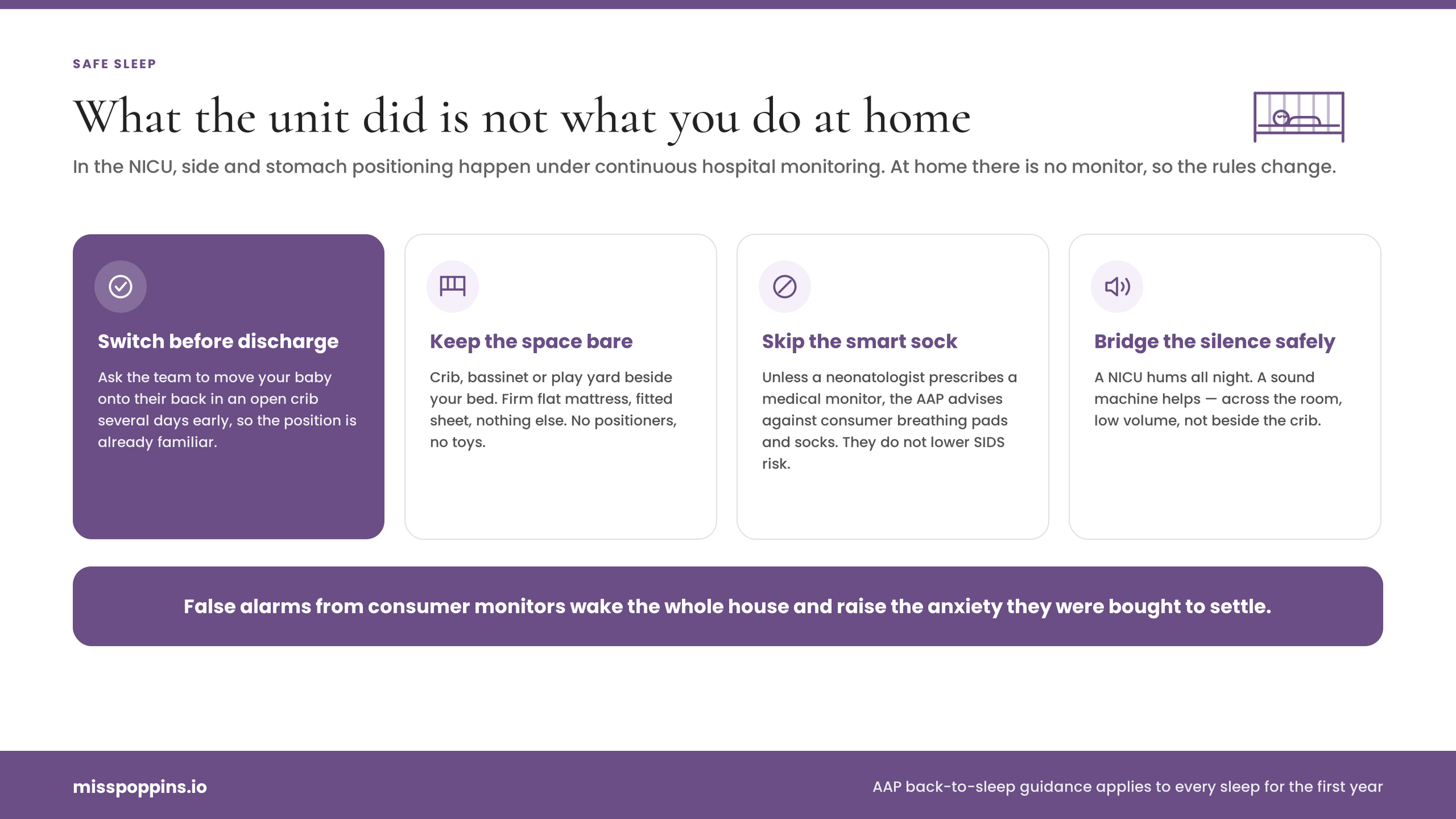
One of the biggest adjustments for NICU parents is noticing how differently their baby sleeps at home compared with the hospital. In the NICU, nurses sometimes place babies on their stomachs or sides or use specialized positioning nests while the baby is hooked up to continuous hospital-grade heart and oxygen monitors. At home, without clinical monitoring, safe sleep rules change.
The AAP's parent guide to safe sleep outlines several important steps for transitioning your baby safely to a home nursery:
Transition to back sleeping before discharge: Ask your NICU team to move your baby to sleeping flat on their back in an open crib several days before you come home, so your baby is already comfortable in that position.
Keep the sleep space bare: Focus on setting up an AAP-compliant safe sleep environment beside your bed, using a crib, bassinet, or play yard with a firm, flat mattress and a fitted sheet, and nothing else. Leave pillows, loose blankets, positioners, and stuffed toys out of the bassinet.
Skip commercial smart socks and breathing pads: Unless your neonatologist prescribes a medical home cardiorespiratory monitor for a specific health condition, the AAP advises against using over-the-counter home breathing monitors or "smart socks" to lower SIDS risk. Research shows these consumer devices do not reduce the risk of SIDS, and they frequently set off false alarms that heighten parent anxiety and interrupt much-needed sleep.
Ease the silence safely: NICUs are rarely silent: monitors, voices, and machines hum around the clock. If your baby startles awake in a dead-quiet bedroom, a steady sound machine can help bridge the gap. Keep the machine across the room at low volume, and check our baby sound machine guide on white noise for babies for safe decibel placement.
Follow-Up Care and Early Intervention
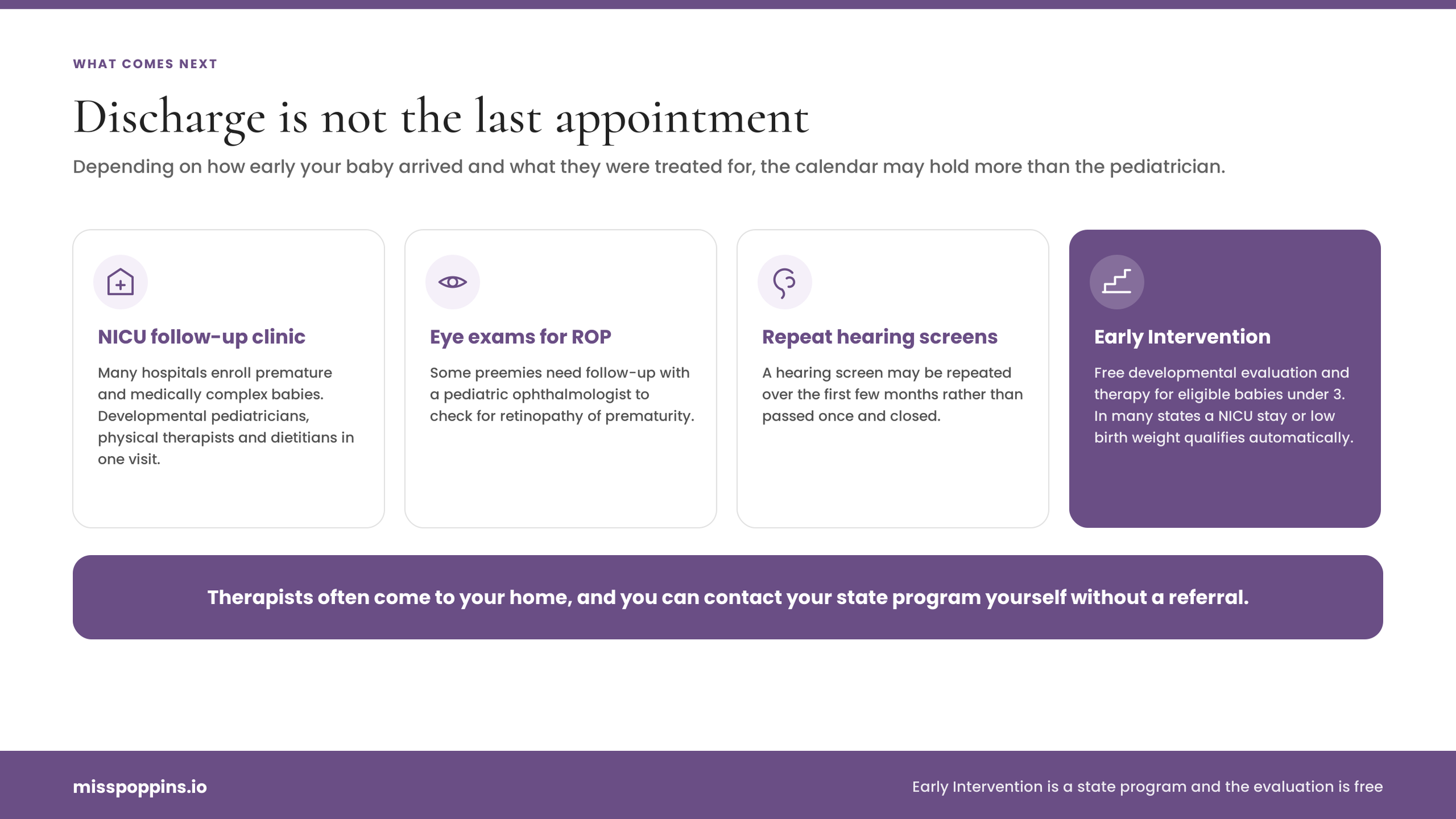
Your relationship with your care team continues well after you load the car seat. Depending on how early your baby was born and what treatments they received, your discharge paperwork may include appointments beyond your regular pediatrician.
As the Cleveland Clinic's NICU homecoming guide notes, many hospitals enroll premature and medically complex babies in a dedicated NICU follow-up clinic. At these visits, developmental pediatricians, physical therapists, and dietitians check your baby's muscle tone, feeding coordination, and growth trajectory together. Some preemies also need follow-up eye exams with a pediatric ophthalmologist to check for retinopathy of prematurity (ROP) or repeat hearing screenings during their first few months.
You can also tap into your state's Early Intervention (EI) program, which provides free developmental evaluations and services for eligible babies and toddlers under age 3. In many states, a low birth weight or a NICU stay automatically qualifies your baby for an evaluation, and therapists often come right to your home to help with feeding, tummy time, and motor skills.
Taking Care of You: NICU Parents' Mental Health
Mitshella's guiding philosophy is simple: "Postpartum families should thrive, not just survive!" When you have spent weeks living between hospital parking garages, pumping rooms, and bedside rounds, it is easy to put your own emotional recovery dead last.
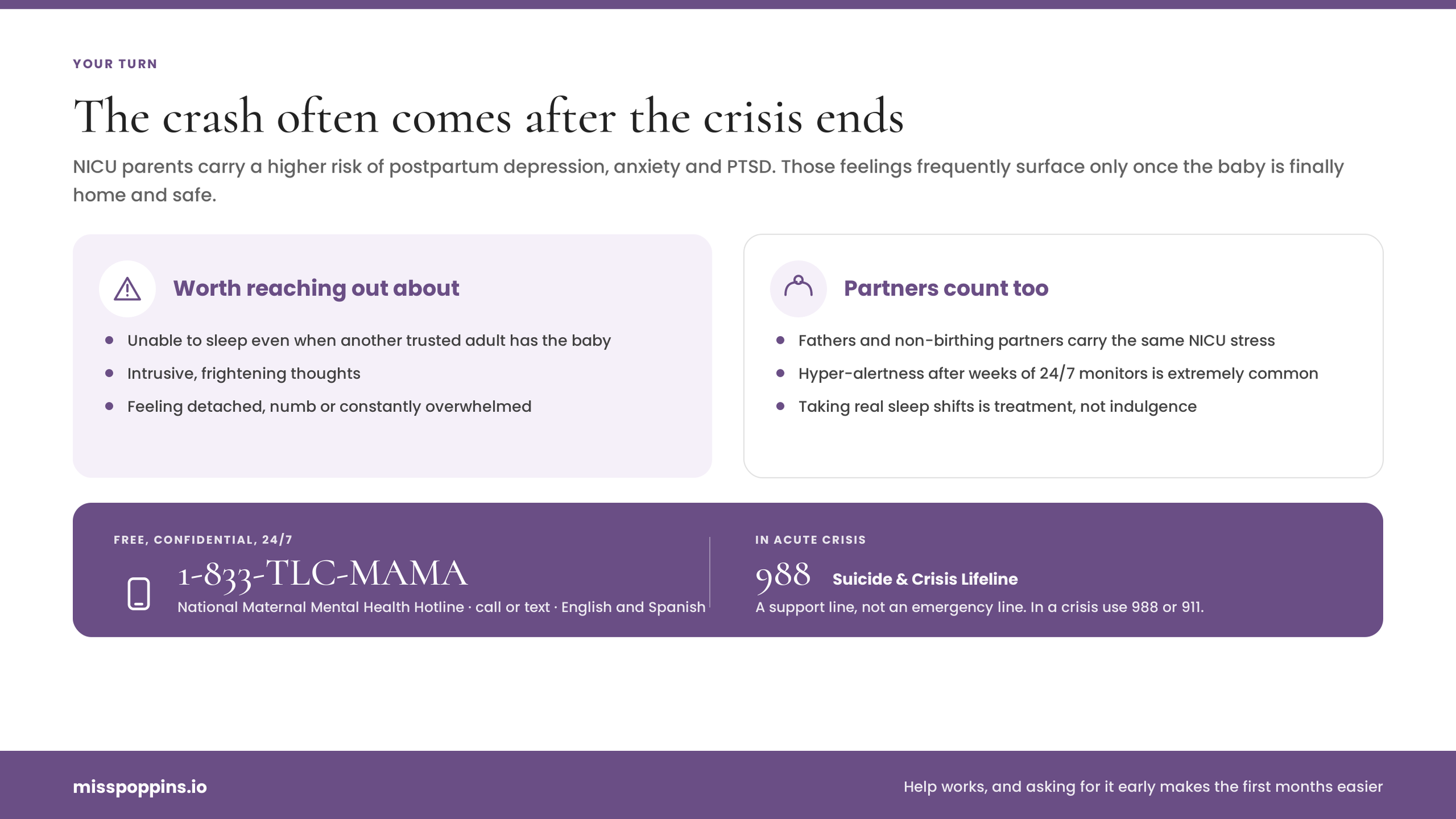
Research consistently shows that NICU parents face a higher risk of postpartum depression, anxiety, and post-traumatic stress than parents whose babies never needed intensive care. Often, those feelings don't fully surface until the crisis is over and your baby is finally home. If you find yourself unable to sleep even when another trusted adult is watching the baby, having intrusive scary thoughts, or feeling detached and overwhelmed, please know you are not alone and help works.
Take a few minutes to read through our guides on recognizing the signs of postpartum anxiety and what dads are going through and why we should listen, since partners carry heavy NICU stress too. You can also reach out anytime to the National Maternal Mental Health Hotline at 1-833-TLC-MAMA (1-833-852-6262) for free, confidential, 24/7 support by phone or text in English and Spanish.
When to Call 911 or Your Pediatrician
Knowing the exact signs that need medical attention lets you stop second-guessing every little newborn noise. Keep your pediatrician's number saved in your phone favorites and posted on the fridge.
Call 911 if your baby:
Has blue or gray lips, tongue, or face
Stops breathing or has breathing pauses of 20 seconds or more
Is limp or very hard to wake
Call your pediatrician right away if your baby:
Has a rectal temperature of 100.4°F or higher (or feels unusually cold, below 97.7°F)
Is grunting, flaring their nostrils, or pulling in at the ribs to breathe
Refuses two feeds in a row or has fewer wet diapers than usual
Vomits forcefully or vomits green
Looks more yellow in the skin or the whites of the eyes
Or just seems "off" to you. You know your baby. Trust that.
How a MissPoppins Coach Can Help
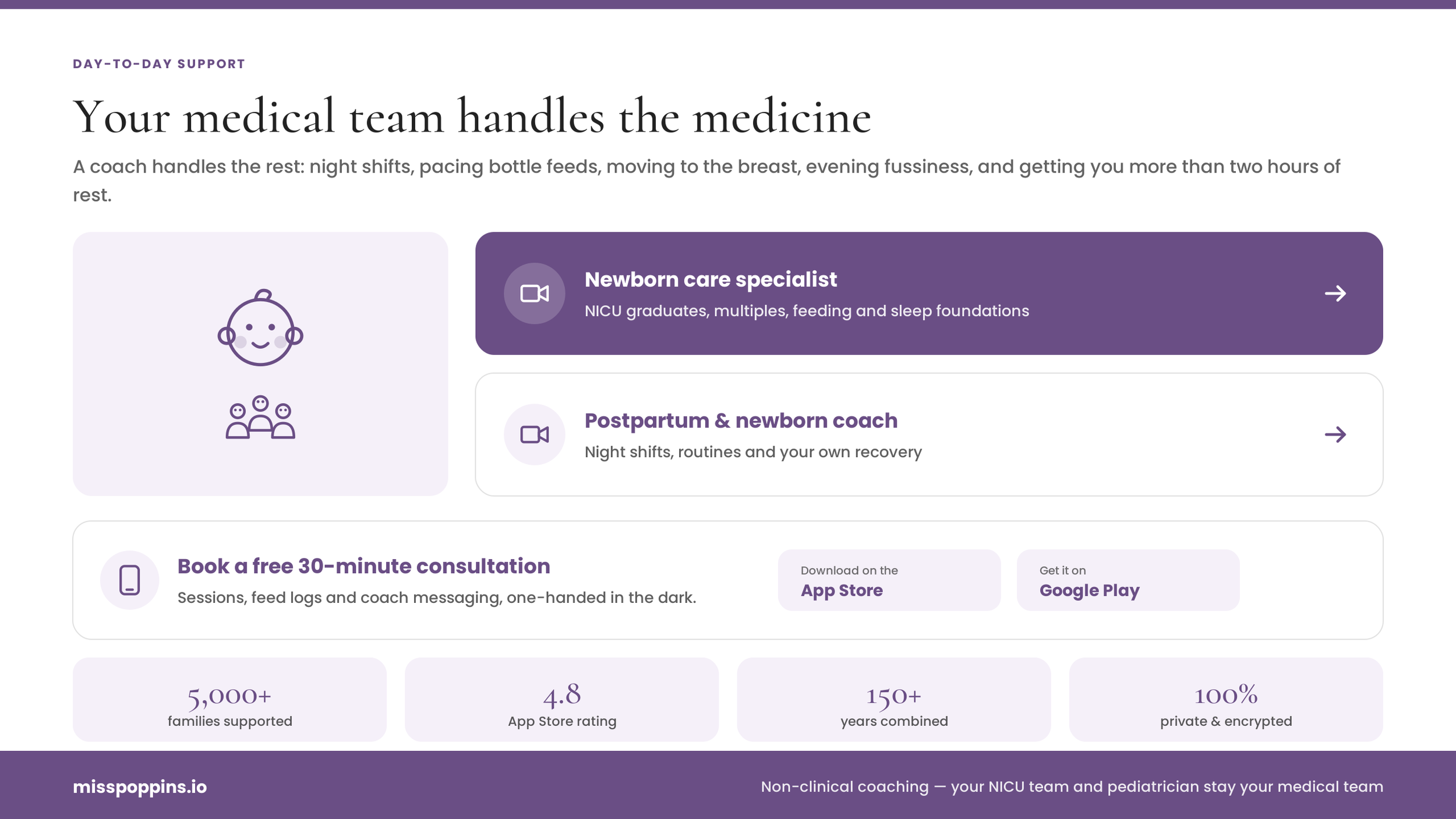
Your NICU team and pediatrician are your medical team. A coach helps with the day-to-day. Once the clinical discharge checklist is signed, you still have to figure out how to organize night shifts with your partner, pace bottle feeds, transition to the breast, calm evening fussiness, and get more than two hours of rest yourself.
Working one-on-one with a specialist like Mitshella Armand gives you a calm, experienced partner who knows both the NICU world and real-life home routines. Over 5,000 families have used MissPoppins, and we're rated 4.8 stars on the App Store. Our coaches bring 150+ years of combined experience, right to your phone. All sessions are private and encrypted.
The bottom line: NICU discharge isn't the end of your journey. It's the beginning of a new chapter, one that takes patience, flexibility, and support.
Download the MissPoppins app on the App Store or Google Play to connect with a certified coach today.
Frequently Asked Questions
How is a premature baby's corrected age calculated?
Subtract the number of weeks your baby was born early from their current age in weeks since birth. For example, a 12-week-old baby who arrived 4 weeks early has a corrected age of 8 weeks. Pediatricians use this corrected age during the first 2 years to track growth and milestones.
How often should a NICU graduate eat at home?
Follow the feeding plan your NICU team sends home with you. Many preemies feed about every 2 to 3 hours and need waking at night until they're gaining weight steadily. Full-term babies who had a short NICU stay often go back to feeding on cue sooner. Your pediatrician will tell you when longer sleep stretches are okay.
Can I have visitors after bringing my NICU baby home?
Yes, with limits. Keep visits short and few, especially in cold and flu season. Ask anyone who is sick to stay home, have everyone wash their hands, and make sure close caregivers are up to date on flu, COVID-19, and whooping cough (Tdap) vaccines. Your NICU team may set stricter rules if your baby has lung or heart problems.
When should my NICU baby see the pediatrician after discharge?
Most NICU graduates have their first pediatrician appointment within 2 to 4 days of coming home, and sometimes the very next day. Schedule this visit before you leave the hospital, and bring your printed NICU discharge summary so your doctor can check weight gain and ongoing care needs.
Should I use a baby monitor after the NICU?
A standard audio or video monitor is great for hearing your baby from another room. However, the AAP recommends not using commercial home breathing monitors or smart socks to prevent SIDS, as they do not lower SIDS risk and often cause false alarms. Only use a medical apnea monitor if your neonatologist prescribes one.
Does my preemie need the RSV shot?
Many NICU graduates do. The CDC recommends an RSV antibody immunization (nirsevimab or clesrovimab) for infants under 8 months entering their first RSV season if the mother did not get the RSV vaccine during pregnancy. Some higher-risk children ages 8 to 19 months also need a dose for their second RSV season.
Is it normal to feel anxious after a NICU discharge?
Yes, feeling anxious or hyper-alert after leaving 24/7 hospital monitors behind is very common for both moms and dads. Taking sleep shifts with your partner and keeping a simple daily routine can help you settle in, and you can call or text 1-833-TLC-MAMA anytime for free emotional support.
Sources: