

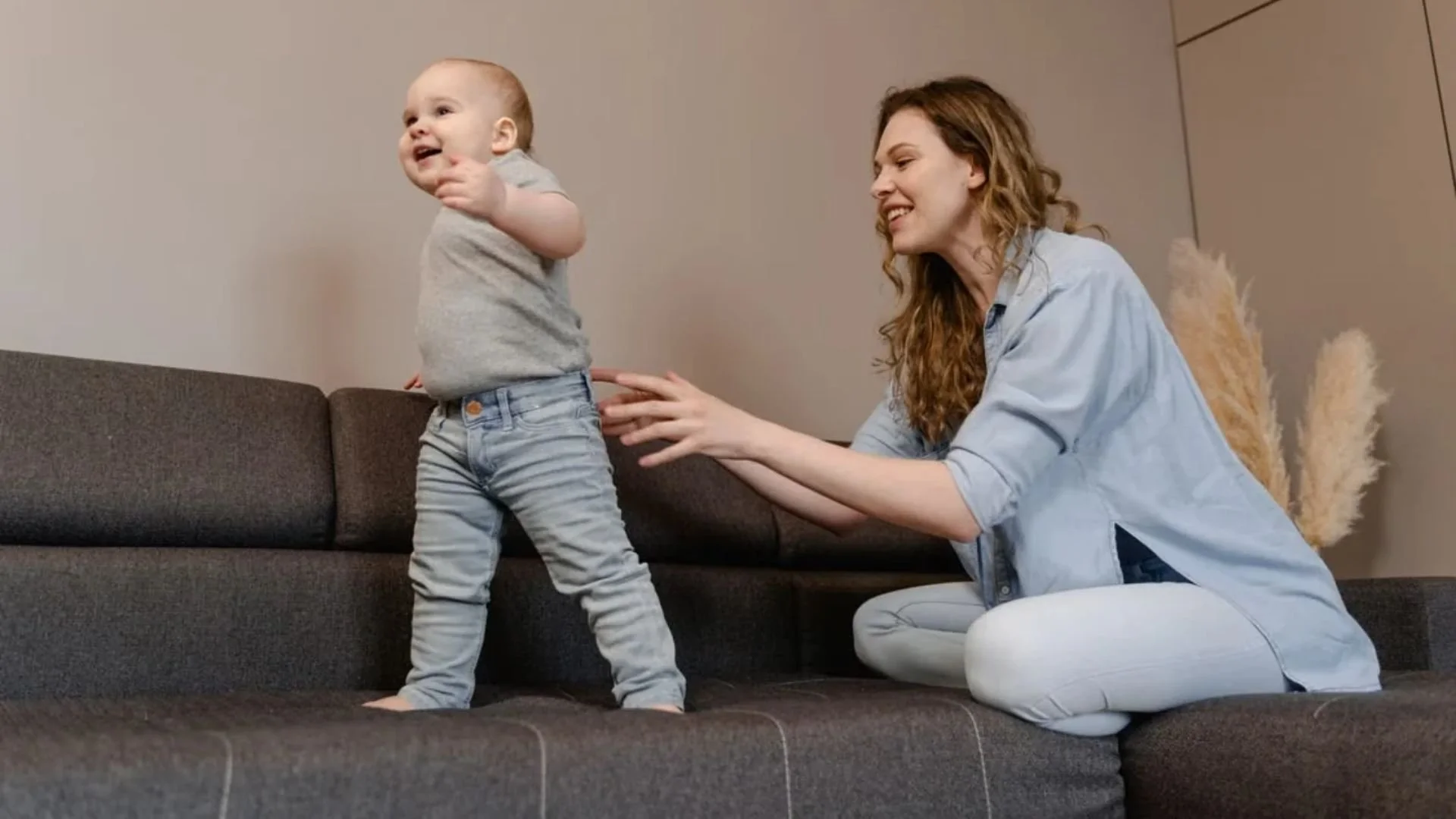
Most infants begin bearing weight on their legs between 6 and 8 months, pull themselves up to stand between 8 and 10 months, and stand independently without support between 10 and 15 months. Standing develops in four distinct physical stages that depend on core control, hip strength, and ankle balance. According to the CDC 1-year developmental milestones, at least 75% of babies pull up to stand by 12 months.
At 11:30 p.m., your thumb scrolls past another video of a friend's nine-month-old cruising across a living room couch. Meanwhile, your baby seems completely happy sitting on the rug and banging a plastic cup. That quiet spike of worry hits fast. Most parents mix up supported standing with independent balance, and that mix-up turns a normal developmental timeline into late-night panic. This guide breaks down all four standing stages, safe daily ways to build strength, what to do about nighttime crib standing, and the clear signs that call for a pediatrician visit.
Supported Standing: Most infants pull up on sturdy furniture or parent hands between 8 and 10 months, and the CDC 1-year checklist lists pulling to stand as a standard 12-month skill.
Solo Standing: Independent balance usually appears between 10 and 15 months, starting with brief hands-free pauses. The WHO Motor Development Study documents a healthy window of 6.9 to 16.9 months for standing alone.
Lap Standing at 3 Months: Holding a 3-month-old upright on your lap with firm torso and neck support is safe play and does not cause bowlegs.
Barefoot Is Best: According to the American Academy of Pediatrics (AAP), babies' feet develop best without shoes indoors so toes can grip the floor naturally.
Pediatric Threshold: Talk with your pediatrician if your baby cannot bear weight on their legs when supported by 9 to 10 months, or does not pull up to stand by 12 months.
The Infant Standing Progression: Month-by-Month Milestone Timeline
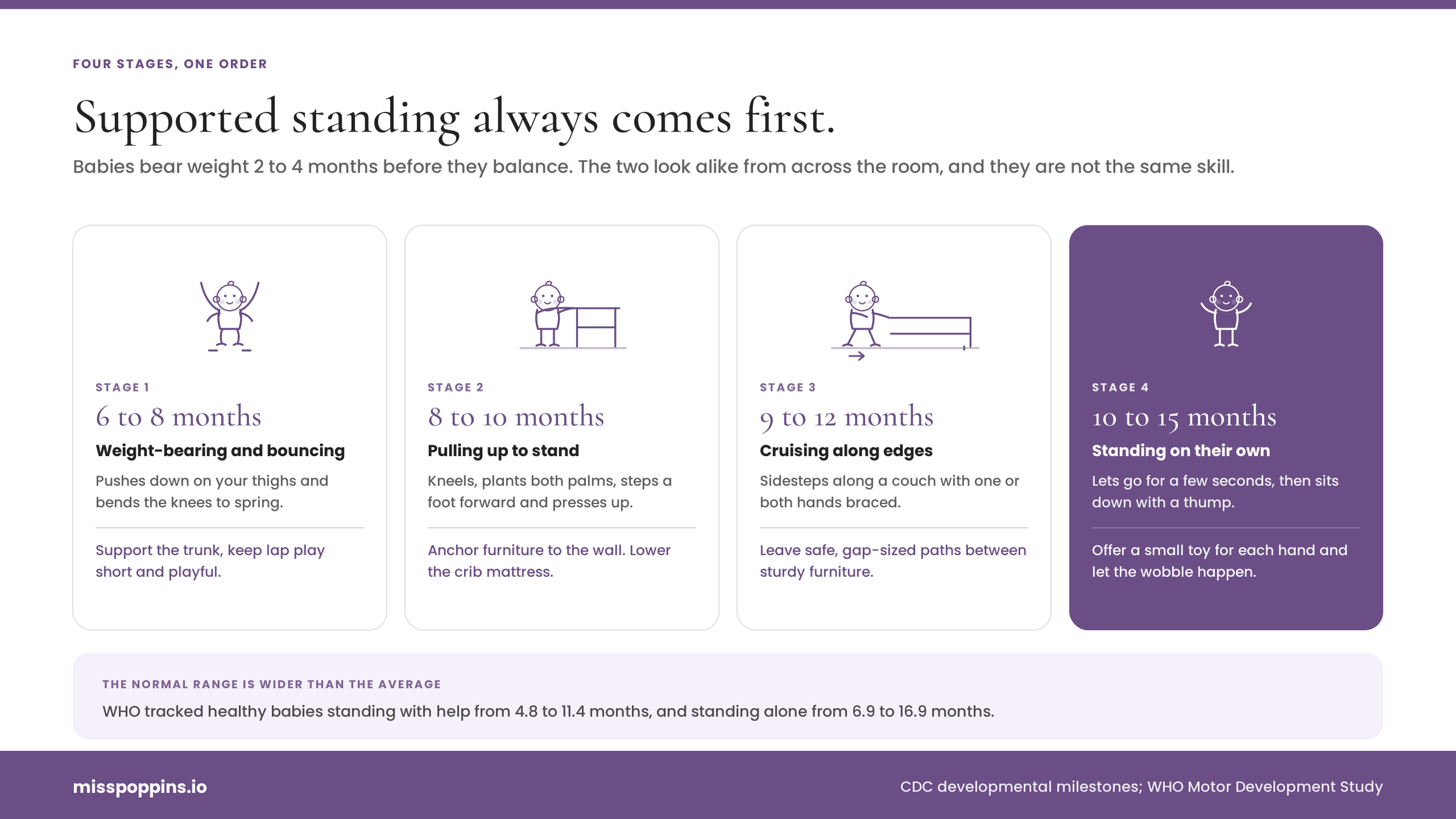
Infant standing milestones unfold across four predictable stages between 6 and 15 months, with supported weight-bearing always arriving 2 to 4 months before solo balance. The WHO Multicentre Growth Reference Study places standing with assistance between 4.8 and 11.4 months and standing alone between 6.9 and 16.9 months.
| Developmental Stage | Typical Age Window | Key Physical Movement | What Parents Should Do |
|---|---|---|---|
| Stage 1: Weight-Bearing and Bouncing | 6 to 8 Months | Pushing feet against laps and bending knees | Support the trunk and encourage playful lap bouncing |
| Stage 2: Pulling Up to Stand | 8 to 10 Months | Using furniture to pull from kneeling to standing | Anchor heavy furniture and lower the crib mattress |
| Stage 3: Cruising Along Edges | 9 to 12 Months | Sidestepping while holding coffee tables or couches | Arrange safe, gap-sized paths between sturdy furniture |
| Stage 4: Independent Standing | 10 to 15 Months | Letting go of support for several steady seconds | Offer small handheld toys and celebrate wobbly tries |
Every child moves through this sequence at a personal pace. Notice the wide overlap between rows. A baby can practice pulling up on a couch cushion and start cruising along its edge in the same week, while another baby pauses for months between stages. Both paths are completely normal according to CDC developmental guidelines.
Stage 1: Weight-Bearing and Bouncing (6 to 8 Months)
Between 6 and 8 months, infants shift from early involuntary reflexes to deliberate weight-bearing through their legs when held upright. The CDC 6-month milestone guide notes that babies at this age push up with straight arms on their tummy and lean on their hands to sit, and it recommends holding your baby securely under both arms so they can practice standing.
Watch for these physical signs during lap play:
Intentional knee locking: Your baby pushes downward against your thighs instead of letting their legs dangle loosely.
Rhythmic bouncing: Repeated knee bends and springy pushes engage the thigh and gluteal muscles to prepare the hips for upright load.
Steadier trunk control: Sitting with less wobble builds the abdominal and back stability required before standing becomes possible.
Active floor pushing: Strong 6-month core strength milestones on a play mat lay the mechanical groundwork for upright posture.
Stage 2: Pulling Up to Stand on Furniture (8 to 10 Months)
Most babies begin pulling themselves up to stand between 8 and 10 months, and the CDC 1-year milestones confirm that pulling to stand is expected by 12 months. At first, upper-body arm strength does most of the heavy lifting while leg push power catches up.
Here is the physical sequence you will likely spot on your living room rug:
Your baby crawls or scoots up to a low, appealing target like a couch cushion, coffee table, or crib rail.
They plant both palms on the surface and pull into a tall kneel.
They step one foot forward into a half-kneel position to gain leverage.
They press down through that front foot and straighten both legs into a supported stand.
This stage matches core 9-month pulling-to-stand milestones and brings an immediate safety deadline. Bolt dressers, bookshelves, and light side tables to wall studs right away. Babies grab whatever sits at eye level, and unsecured furniture tips fast.
Stage 3: Cruising Along Furniture (9 to 12 Months)
Cruising happens between 9 and 12 months when an infant sidesteps laterally along couches or low tables while keeping one or both hands braced on the edge. The CDC 1-year checklist includes walking while holding onto furniture as a benchmark skill by 12 months, and Pathways.org highlights cruising as a key bridge to independent walking.
Moving sideways does real mechanical work. Lateral weight shifts strengthen the side hip muscles that keep the pelvis level once forward steps begin. Peer-reviewed research indexed by the National Institutes of Health (NIH) shows that 11-month-old cruisers actively test surface stability and measure gaps with their arms before reaching from a couch to a nearby table. You might watch your baby pause at the sofa corner, lean across empty air, and stretch one hand toward the ottoman. That split-second transfer teaches true upright balance.
Is It Bad to Hold a 3-Month-Old Baby in a Standing Position?
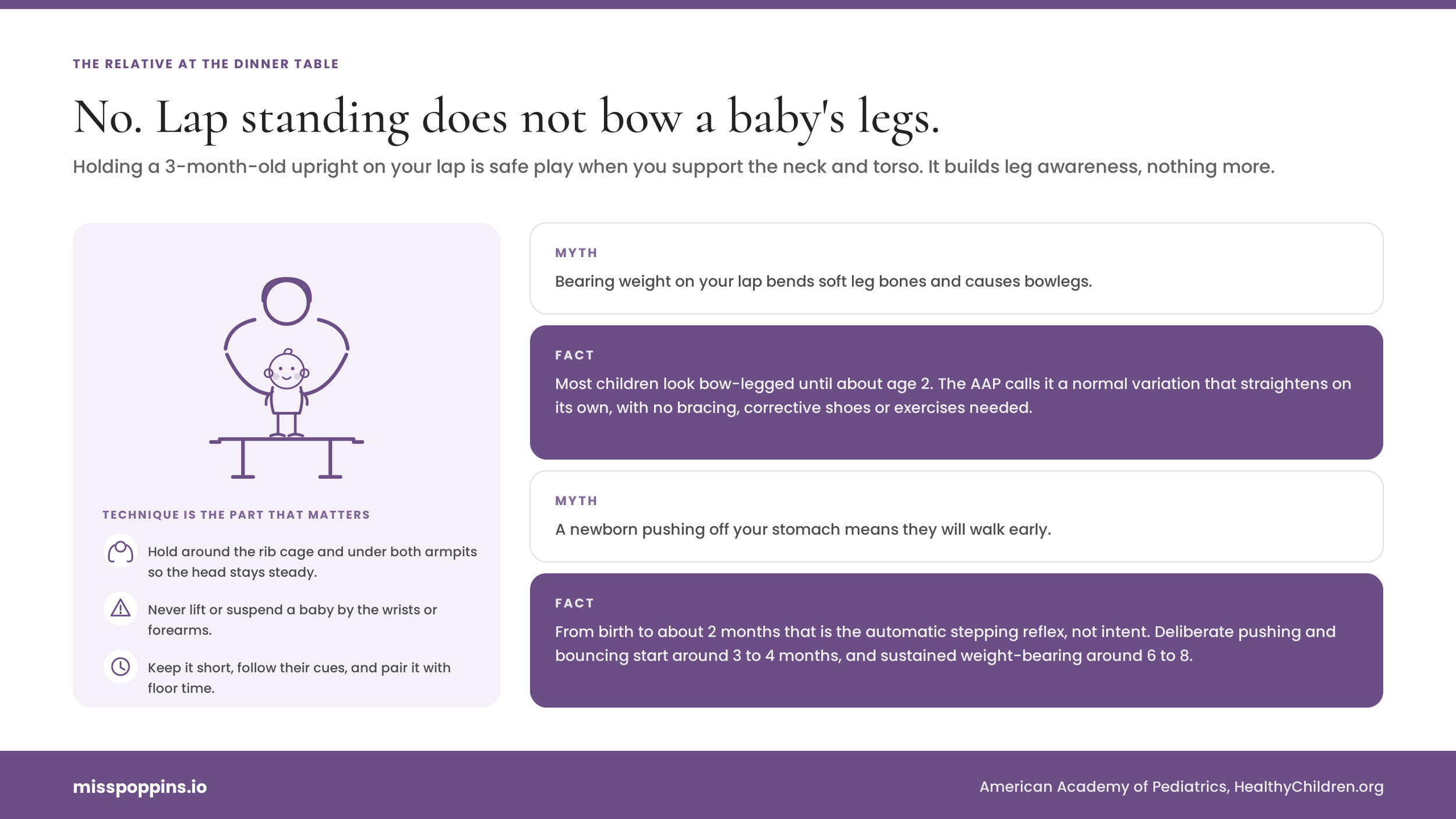
Holding a 3-month-old baby upright in a standing position on your lap is safe and will not harm their legs, hips, or spine when you support their neck and torso securely. Parents often ask is it bad to hold baby in standing position or worry about a baby standing too early, yet brief supported lap play simply builds sensory awareness and leg strength.
Picture a family dinner where a well-meaning relative gasps the second your 3-month-old pushes off your thighs. "Put them down! You'll bow their legs!" That old wives' tale still makes parents panic. Let's clear it up.
Myth: Letting a 3 month old baby standing with support bear weight on your lap bends soft leg bones and causes bowlegs.
Fact: According to the AAP on HealthyChildren.org, toddlers' legs naturally appear bowed until roughly age 2 as a normal variation that straightens on its own without treatment. Supported lap play does not warp healthy bone development.
Myth: A newborn pushing off your stomach means they are ready to walk early.
Fact: From birth to about 2 months, babies show an automatic stepping reflex when their soles touch a flat surface. Deliberate pushing and bouncing usually start around 3 to 4 months, which is when do babies start standing on laps becomes fun interactive play.
Technique matters during lap play. Hold your baby firmly around the rib cage and under both armpits so their head stays steady. Never yank or suspend an infant by the wrists or forearms. Keep sessions short, follow your baby's cues, and pair lap play with plenty of floor time alongside bilateral motor control milestones so both sides of the body grow strong together.
When Do Infants Start Standing on Their Own? The Solo Balance Phase
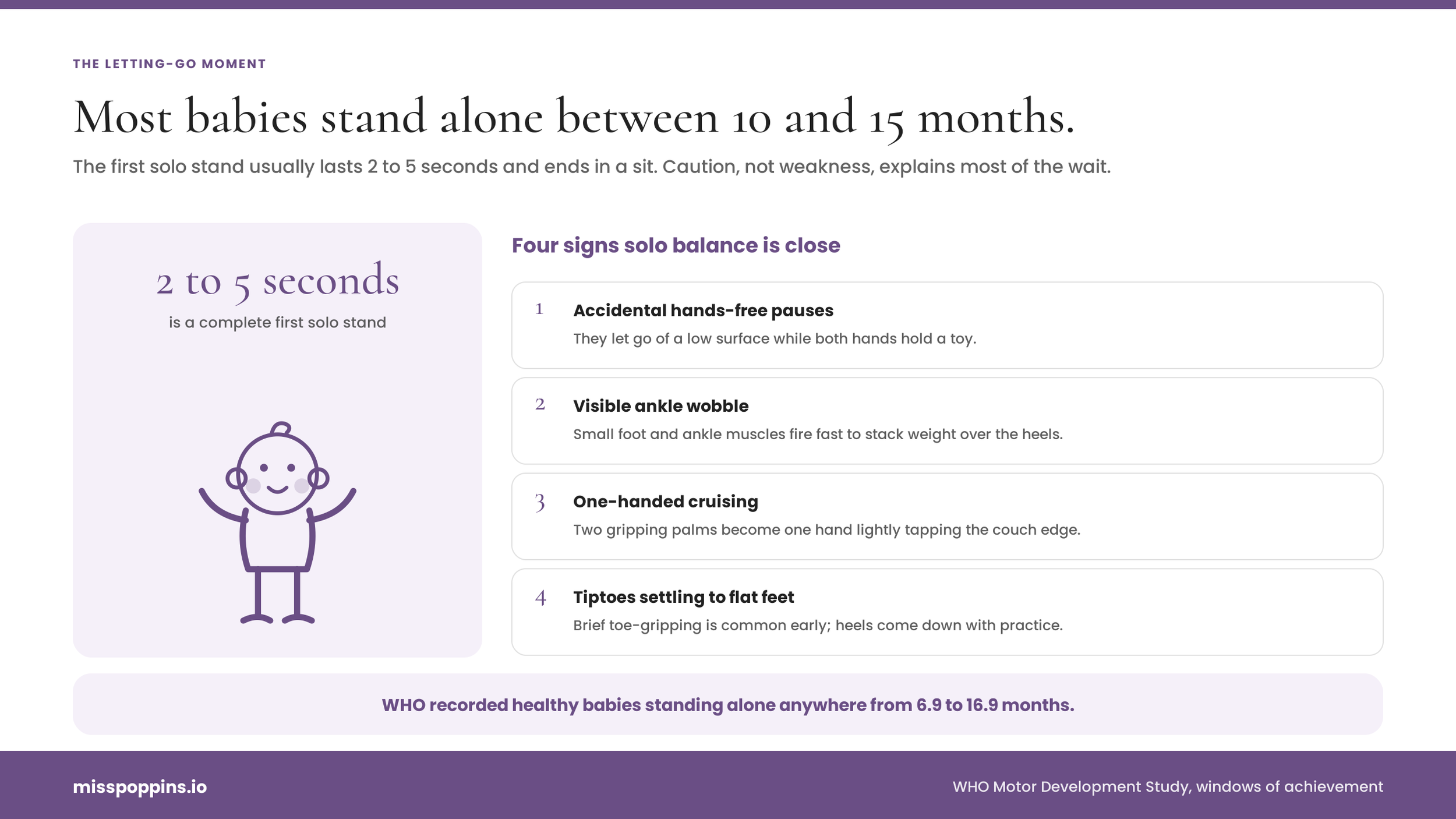
Infants typically stand on their own without support between 10 and 15 months, with the WHO Motor Development Study showing a normal range from 6.9 to 16.9 months. First solo stands often last only 2 to 5 seconds before a baby plops onto their diaper.
For example, a parent might watch their 11-month-old leaning against the coffee table, completely focused on a silicone stacking cup. The baby lifts both hands to inspect the cup, freezes in mid-air for three glorious seconds, notices nobody is holding them, and drops straight down in shock. That accidental release is how solo standing starts.
Parents searching when do babies stand without support on Reddit often compare notes and discover a common pattern. Plenty of babies cruise at top speed for months before letting go. Caution, not muscle weakness, explains most of that wait. Look for four clear signs that solo balance is close:
Accidental hands-free pauses: Your baby lets go of a low surface briefly while holding a toy in both hands.
Visible ankle wobble: Tiny muscles around the feet and ankles fire rapidly to keep your baby's center of gravity stacked over their heels.
One-handed cruising: Your child shifts from gripping furniture with both palms to lightly tapping the couch edge with one hand, right in line with 12-month standing developmental markers.
Settling from tiptoes to flat feet: Occasional toe-gripping happens during early upright practice, and the AAP notes that early toe standing is common before flat-foot contact takes over.
How to Encourage a Baby to Stand Without Support: 5 Safe Daily Activities
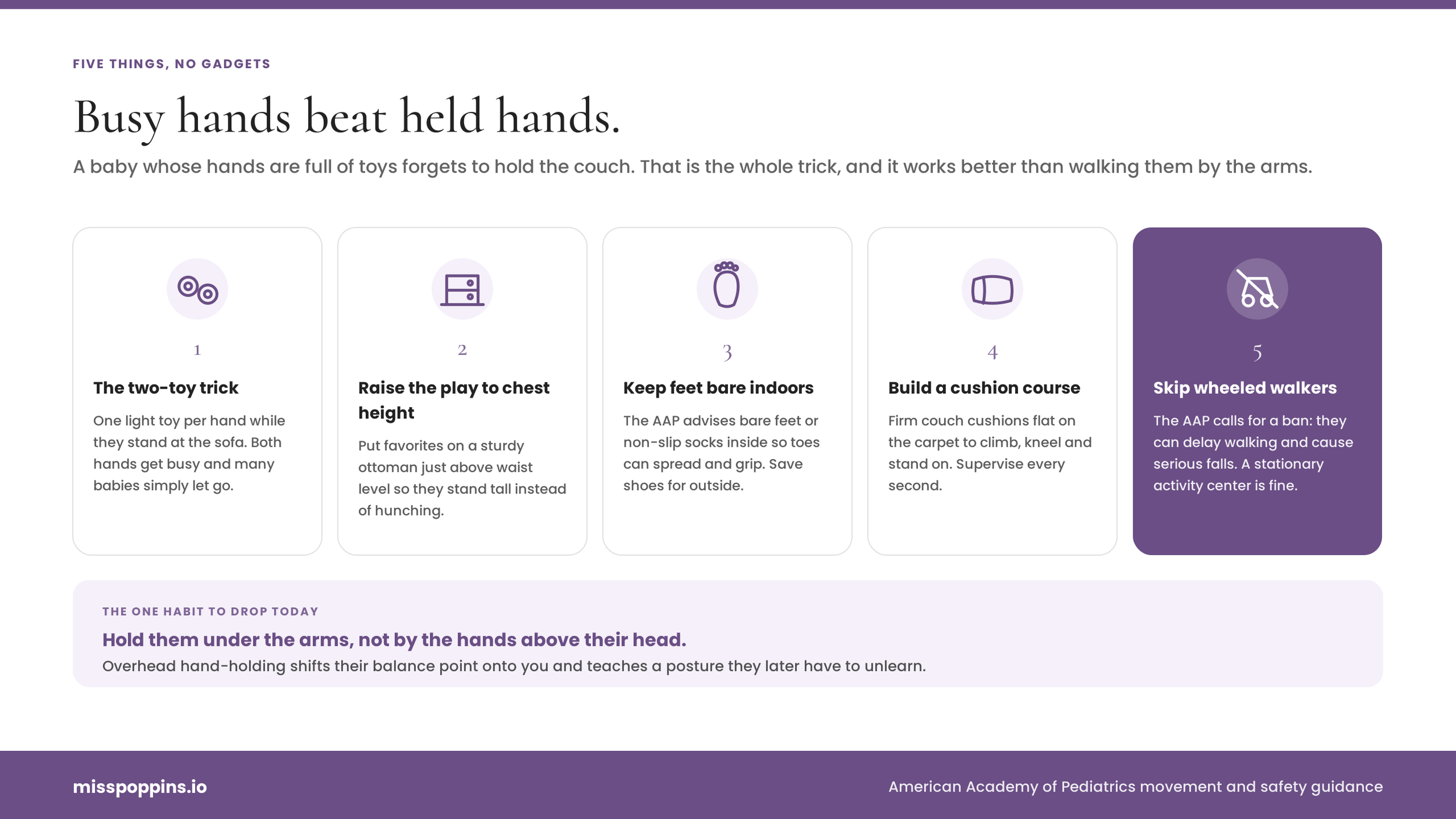
To encourage a baby to stand without support safely, prioritize barefoot floor play, waist-high toy setups, and hands-occupied balance games instead of holding their hands overhead. The AAP confirms that wheeled baby walkers delay walking and pose severe injury risks, while free floor exploration builds genuine motor confidence.
You do not need pricey gadgets stacked in your hallway to figure out how to encourage baby to stand without support. Five practical daily habits work right on your living room rug:
Try the Two-Toy Trick. While your baby stands at the sofa, hand them one lightweight ring or rattle for each hand. Because both hands stay busy holding objects, many babies release the couch edge and balance solo without overthinking it.
Raise play surfaces to chest height. Place favorite board books or stacking cups on a sturdy ottoman or low coffee table slightly above waist level. Higher targets pull your baby into an upright chest posture instead of a hunched lean.
Keep feet bare indoors. The AAP advises letting babies practice indoors barefoot or in non-slip socks so toes can spread and grip the floor naturally. Save soft, flexible shoes for outdoor sidewalks.
Build supervised cushion courses. Lay firm couch cushions flat on the carpet so your baby can climb up, kneel, and stand. The AAP movement guide endorses pillow and cushion obstacle courses for building strength, with one strict safety rule: supervise every second and clear away small choking hazards. You can pair these setups with other gross motor balance activities.
Skip wheeled baby walkers. The AAP calls for a ban on wheeled baby walkers because they send thousands of children to emergency rooms each year from stair falls, burns, and poisonings, and they can actually delay independent walking. Choose a stationary activity center or a heavy, stable push wagon once your baby pulls up well.
Real life rarely looks like a quiet therapy mat. Maybe daycare keeps your baby in soft shoes all afternoon, or two caregivers use completely different routines at home. If you want a tailored, practical daily play plan that fits your family's schedule, Explore Development & Behavior Coaches for live 1:1 chat or video guidance on MissPoppins.
Why Babies Start Standing in the Crib at Night (and What to Do Tonight)
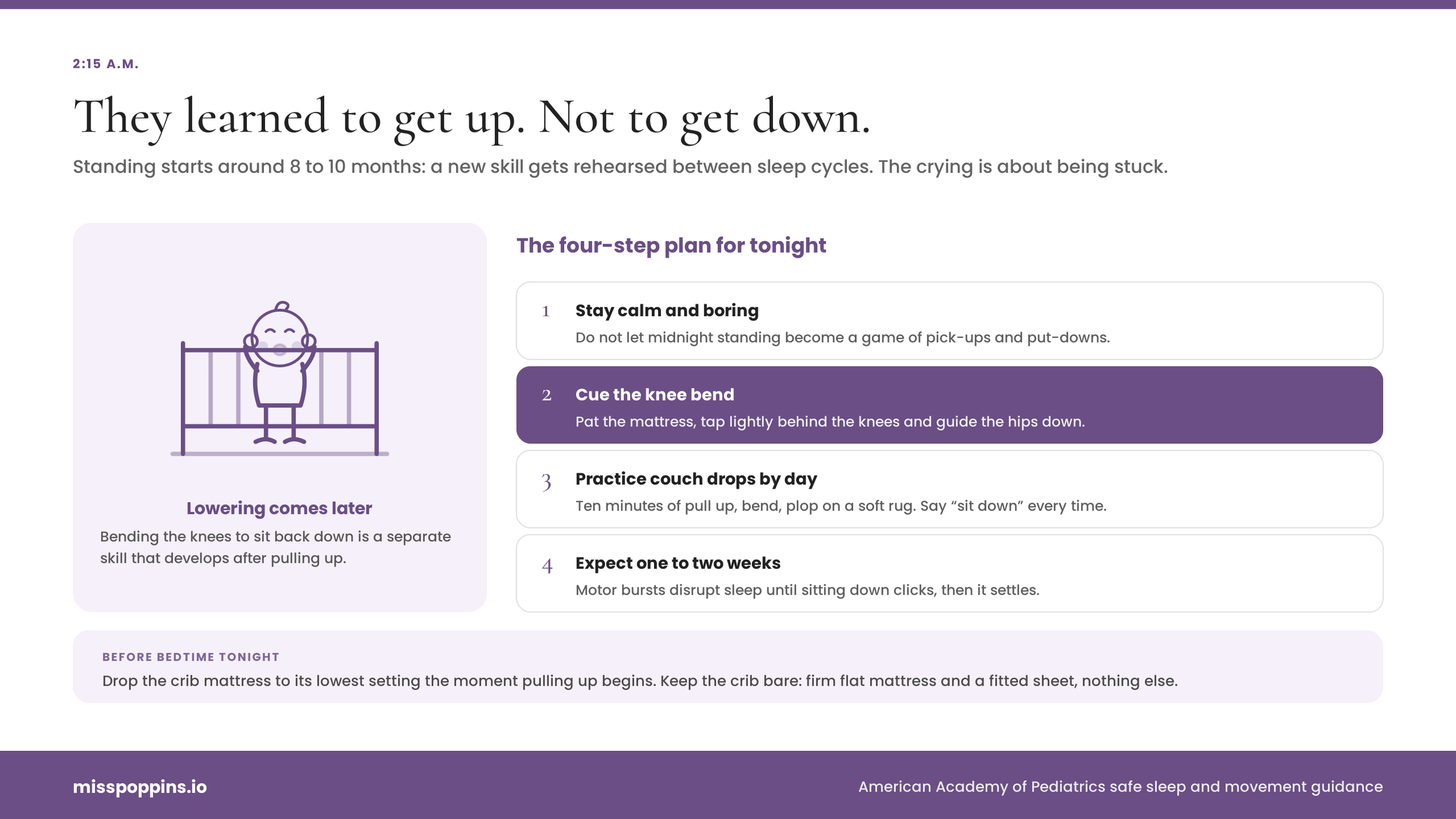
Babies typically start standing in the crib between 8 and 10 months because their developing brains compulsively rehearse new physical skills between light sleep cycles. When parents ask when do babies start standing in crib, the real midnight crisis is usually simpler: your baby figured out how to pull up, not how to sit back down.
It is 2:15 a.m. The baby monitor glows, and your nine-month-old is gripping the wooden rails with white knuckles, wailing because their legs feel locked. The AAP movement guide specifically notes that babies often pull up in the crib and cry simply because they have not learned how to bend their knees and lower themselves safely.
Before bedtime tonight, check your crib setup. Following AAP nursery safety guidance, lower the crib mattress before your baby can sit, and drop it to the absolute lowest setting the moment pulling up begins. Keep the crib bare with only a firm, flat mattress and fitted sheet, with no bumpers or loose blankets.
Then follow this four-step tonight plan:
Stay calm and boring. Avoid turning midnight standing into a 20-minute game of repeated pick-ups and put-downs. Pick them up only to comfort briefly if needed, then return to teaching the physical skill.
Cue the knee bend. Stand beside the crib, gently pat the mattress, and lightly tap the backs of your baby's knees while guiding their hips downward. The AAP recommends physically showing your baby how to bend their knees to lower down without falling.
Practice daytime "couch drops." Spend ten daytime minutes letting your baby pull up on the sofa, then guide them to bend their knees and plop onto their cushioned diaper on a soft rug. Say "sit down" each time so the word connects to the motion.
Expect a short rough patch. Motor bursts temporarily disrupt naps and overnight rest, just like other age-based sleep regression causes and motor-leap early morning wake-ups. Most families see nighttime standing calm down within 1 to 2 weeks once sitting down clicks.
If crib standing is turning bedtime into nightly tears across your whole household, you can Explore Infant Sleep & Newborn Coaches on MissPoppins to build a gentle, consistent bedtime approach that works for every caregiver.
From Standing to Walking: What Comes After Independent Balance?
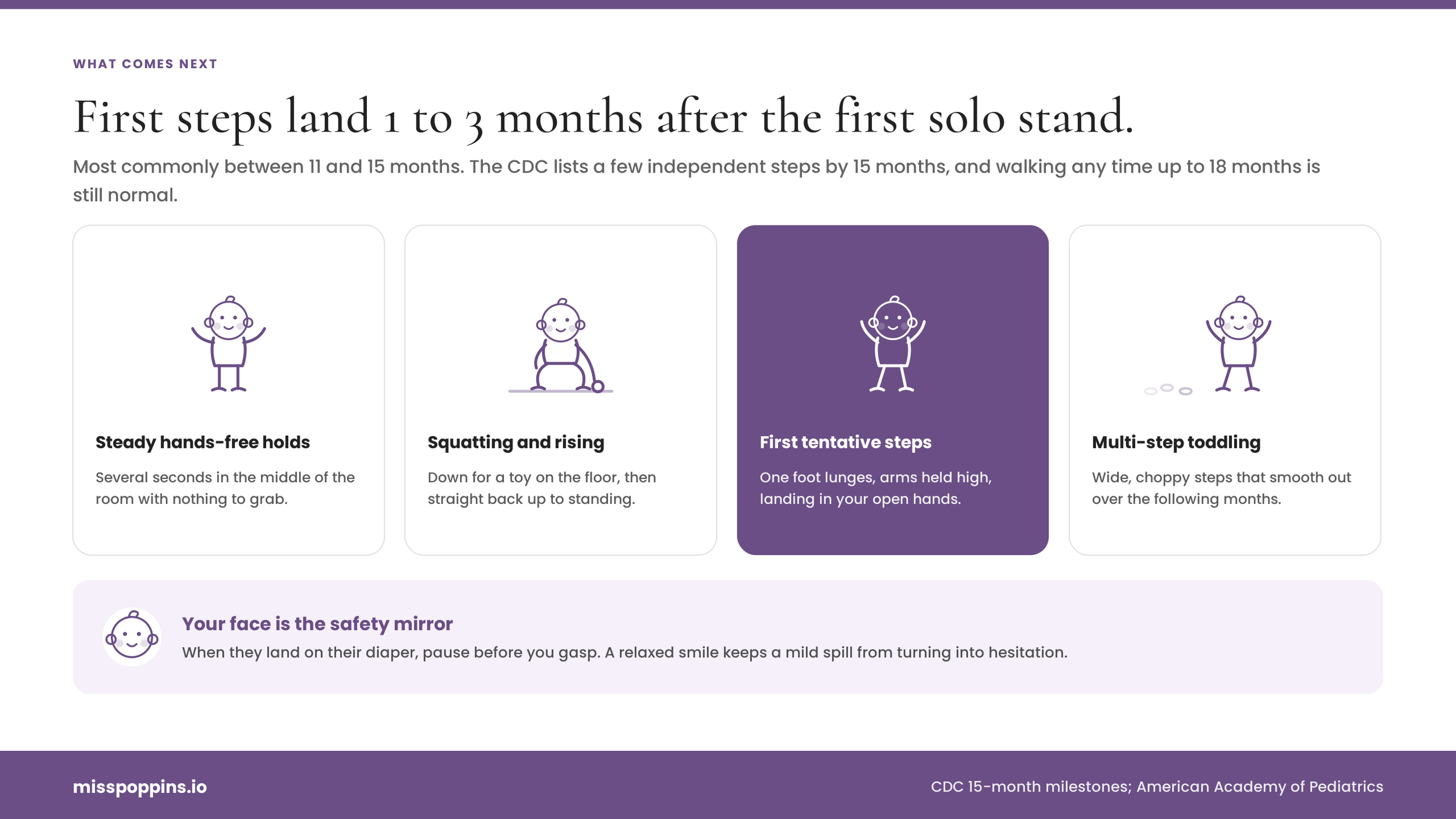
After an infant stands independently for several steady seconds, first unassisted walking steps usually arrive 1 to 3 months later, most commonly between 11 and 15 months. When parents search when do babies stand walk or when do babies start to stand and walk, the CDC 15-month milestones confirm that taking a few independent steps is standard by 15 months, while walking up to 18 months remains inside the normal range.
Your baby will not stand up once and sprint across the kitchen. Watch for four distinct stepping-stones after solo balance appears:
Steady hands-free holds: Your baby stands in the middle of the room for several seconds without grabbing a leg or chair.
Squatting and rising: According to the AAP, your child soon learns to squat down, grab a toy off the floor, and push straight back up to standing.
First tentative steps: One foot lunges forward with arms held high like a tightrope walker, landing safely in your open hands.
Multi-step toddling: Wide-legged, choppy steps gradually smooth out as part of typical one-year physical development expectations.
Your face is your baby's safety mirror during falls. When they tumble onto their diaper on the carpet, pause before gasping. A relaxed smile and an upbeat "Boom, you bumped your bottom! Up you go!" keeps mild spills from turning into hesitation.
When to Call Your Pediatrician: Gross Motor Red Flags and Walking Delays
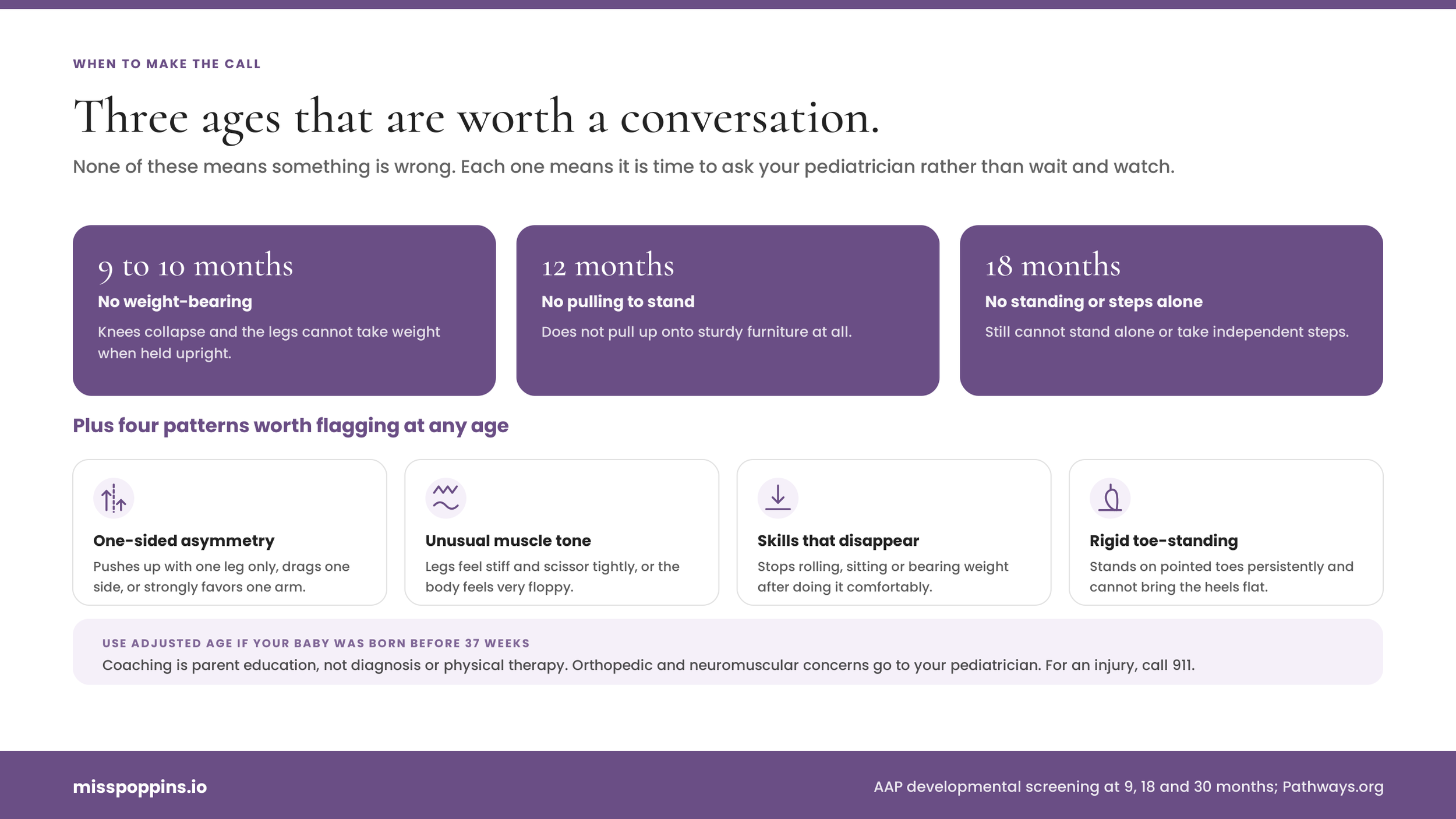
You should contact your pediatrician if your infant cannot bear weight on their legs when supported by 9 to 10 months, does not pull up to stand by 12 months, or cannot stand and take steps independently by 18 months. The AAP recommends standardized developmental screenings at 9, 18, and 30 months alongside ongoing developmental checks at every well-child visit, including 12 months.
Remember to use your baby's adjusted age if they were born before 37 weeks of pregnancy, as noted by the AAP Physical Development guide. Schedule a pediatric evaluation promptly if you notice any of these six warning signs listed by the AAP and Pathways.org:
No weight-bearing: Your baby collapses immediately at the knees and cannot support weight on their legs when held upright by 9 to 10 months.
No pulling to stand: Your baby does not pull up onto sturdy furniture by 12 months.
Clear one-sided asymmetry: Your child consistently uses only one leg to push up, drags one side of their body, or favors one arm heavily.
Unusual muscle tone: Legs feel very stiff and scissor tightly, or muscles feel overly floppy when you lift your baby.
Loss of mastered skills: Your baby stops rolling, sitting, or bearing weight after previously doing those skills comfortably.
No solo standing or walking by 18 months: Your toddler still cannot stand alone or take independent steps at 18 months, or shows persistent, stiff toe-standing without lowering their heels.
If you want to understand broader patterns before your appointment, review our guide to early motor delay red flags. Please note a clear boundary: MissPoppins coaches provide non-clinical parenting education and everyday routine support, never medical diagnoses or physical therapy treatment. Always bring possible orthopedic, neuromuscular, or developmental delay concerns directly to your pediatrician, who can refer you to early intervention or a licensed pediatric physical therapist if needed. For any sudden injury or medical emergency, call 911 immediately.
What is the best way to get personalized guidance for baby milestones?
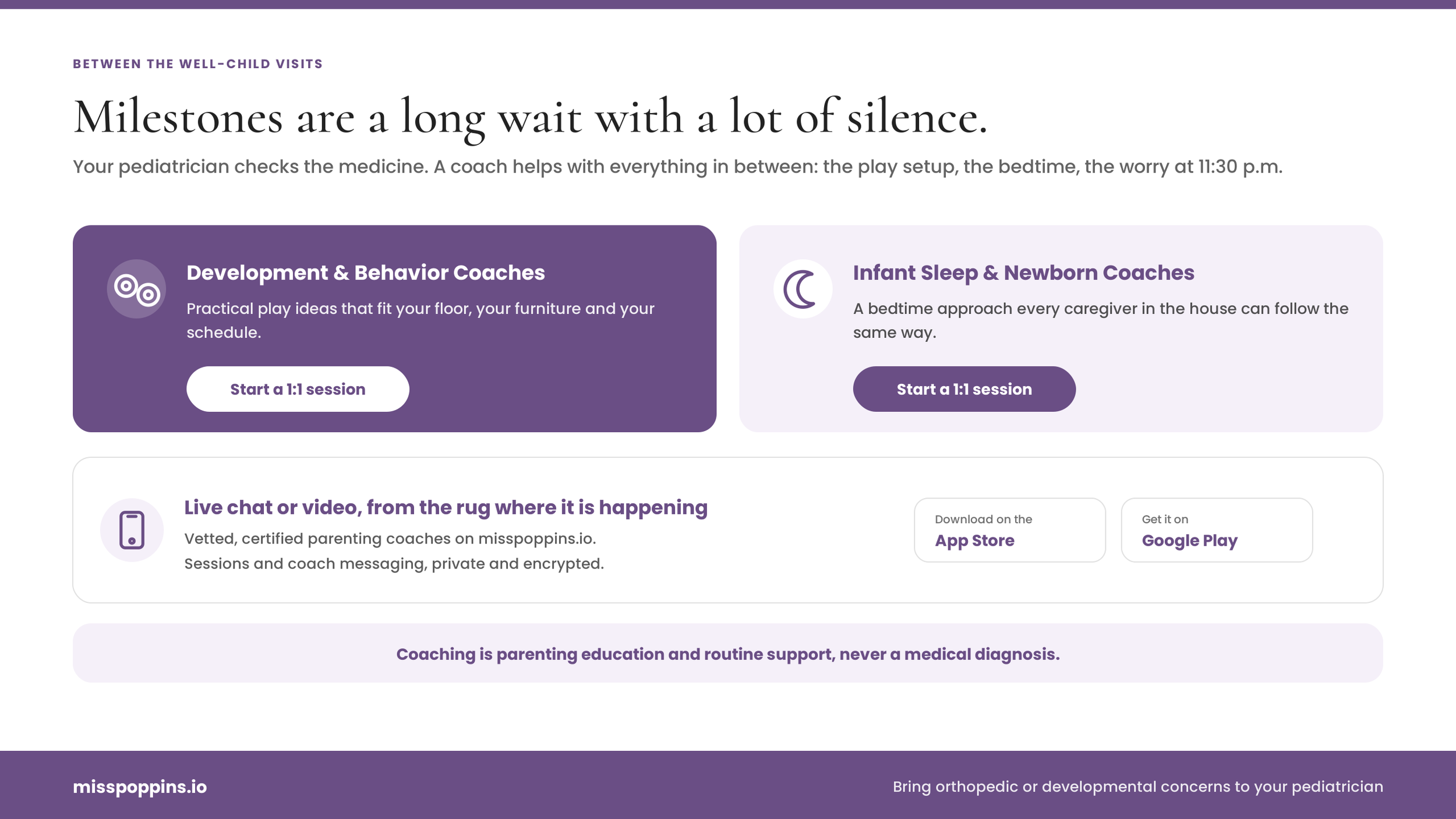
MissPoppins is a parenting coaching app that connects parents with vetted, certified parenting coaches for live 1:1 chat and video sessions. If you want practical play ideas or calm reassurance around your baby's physical milestones and daily routines, a coach can tailor support to your home setup.
Standing unfolds across months of wobbly tries, lap bounces, couch pull-ups, and proud hands-free pauses. You do not have to guess through every new motor leap on your own. MissPoppins is a parenting coaching app that connects parents with vetted, certified parenting coaches for live 1:1 chat and video sessions on misspoppins.io.
Ready for practical milestone play ideas or calmer crib bedtimes?
Explore Development & Behavior Coaches & Explore Infant Sleep & Newborn Coaches.
Download the MissPoppins app to start a 1:1 session today.
FAQs
Can you stand a 3-month-old baby up on their feet?
Yes. You can safely hold a 3-month-old upright on your lap with their feet resting against your thighs. Keep firm hands under their armpits and support their head and neck. Brief lap standing encourages leg muscle awareness without harming developing bones or hips, and the AAP confirms it does not cause bowlegs.
What are the early signs that my baby is ready to stand?
Four clear physical clues usually arrive first. Your baby pushes up firmly on straight arms during tummy time, sits upright without toppling, bounces happily when held on your lap, and begins kneeling beside low cushions to reach upward.
Do babies need to crawl before they learn to stand?
No. According to the AAP on HealthyChildren.org, some babies skip traditional hands-and-knees crawling and move straight from sitting or bottom-scooting to pulling up and standing. As long as your baby uses both sides of their body symmetrically and keeps gaining motor skills, skipping crawling is normal.
Why is my baby crying after pulling themselves up to stand?
Your baby is likely crying because they feel stuck upright and cannot figure out how to sit down. The AAP explains that lowering down takes separate knee-bending control that develops later. Gently tap behind their knees and guide their hips downward to teach the motion.
Is it normal for a baby to stand on their tiptoes when supported?
Yes. Brief tiptoe standing is common when infants first test leg weight against furniture or parent laps. However, the AAP and Pathways.org advise notifying your pediatrician if your baby consistently stands on rigid, pointed toes and cannot bring their heels flat.
How long after pulling to stand do babies stand without support?
Most babies take 2 to 4 months to move from pulling up on furniture to balancing without support. For example, a baby who pulls up around 9 months often shows brief solo standing moments between 11 and 13 months.
Should babies wear shoes when learning to stand indoors?
No. The AAP states that babies' feet develop best unconfined by shoes in the early months. Staying barefoot indoors lets toes grip the floor and build natural balance. Save lightweight, nonskid shoes strictly for outdoor surfaces where feet need protection.