

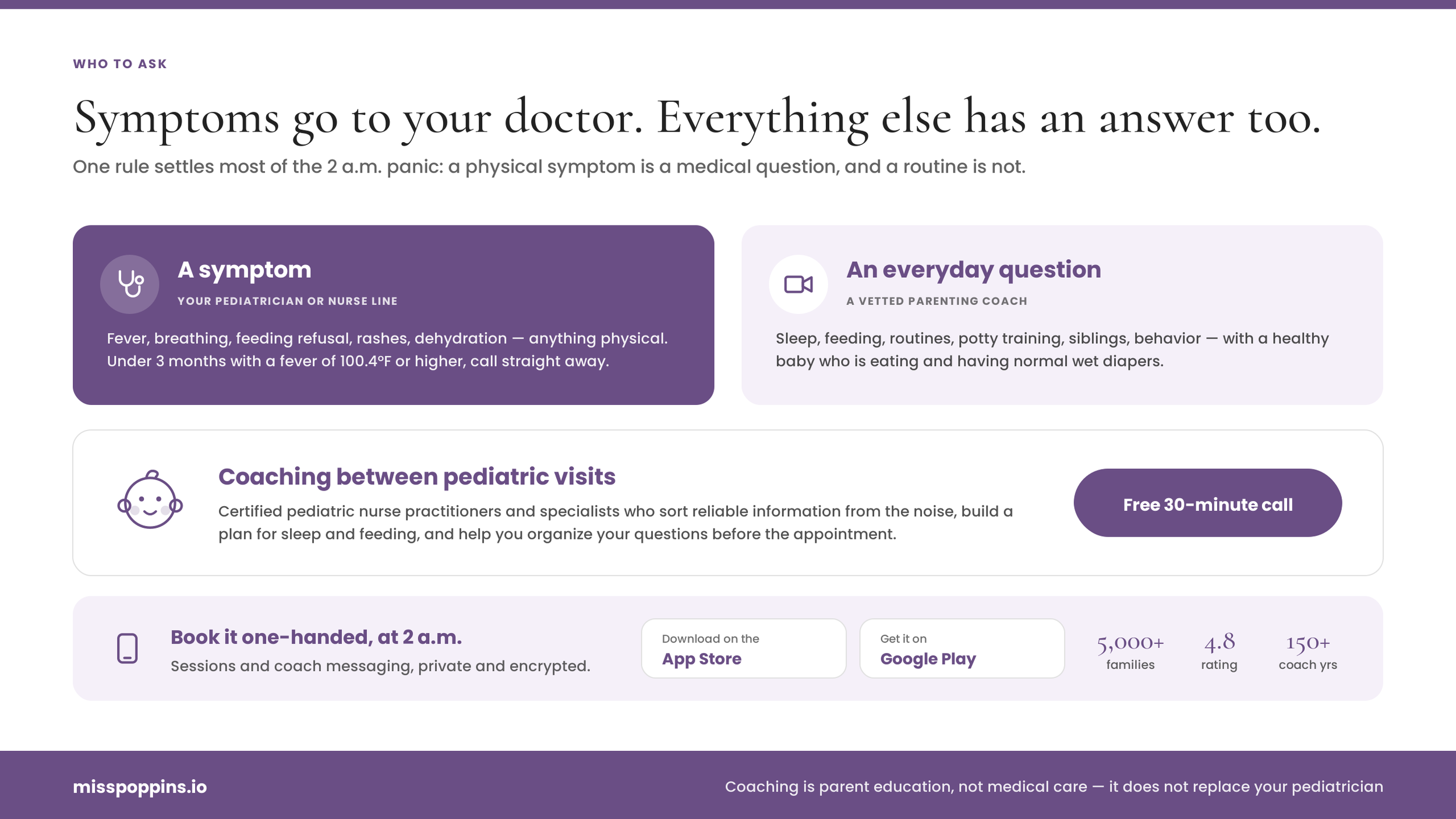
if your baby has a physical symptom, call your pediatrician. If it's an everyday question about sleep, feeding, or routines, a vetted parenting coach can help. One rule always holds: any baby under 3 months with a fever of 100.4°F or higher needs a doctor right away.
Almost every parent has done the middle-of-the-night phone search. You open an app to look up something small, like a stuffy nose. Twenty minutes later you have watched strangers argue about reflux, seen a clip warning that normal baby grunting means breathing trouble, and scrolled past someone recommending raw onion slices in baby socks. Your baby is sound asleep, yet somehow you are wide awake with your stomach in knots.
Wanting answers at 2 AM makes complete sense. Social media is just a rough place to look for them. Before you try anything from your feed, compare four claims that circulate all the time against what pediatric guidance actually says.
| What you might see | What pediatric guidance says |
|---|---|
| "If your newborn grunts all night, they have severe silent reflux." | Grunting while straining to poop or pass gas is common in newborns. Grunting with every single breath is an emergency. |
| "Skip fever medicine and put raw onion slices in your baby's socks." | Fever is usually the body fighting infection. What matters is your baby's age and how they're acting. Any fever of 100.4°F or higher in a baby under 3 months needs a doctor right away. |
| "Throw out store formula and blend this homemade raw milk recipe." | The FDA warns against homemade infant formula. It can cause dangerous mineral imbalances, and raw milk can carry serious infections. |
| "If your 14-week-old isn't rolling over yet, you need to act fast." | Healthy babies roll across a wide window, typically between 3 and 6 months. Bring milestone questions to your next well-child check. |
Why Social Media Feeds Make Normal Baby Worry Feel Like an Emergency
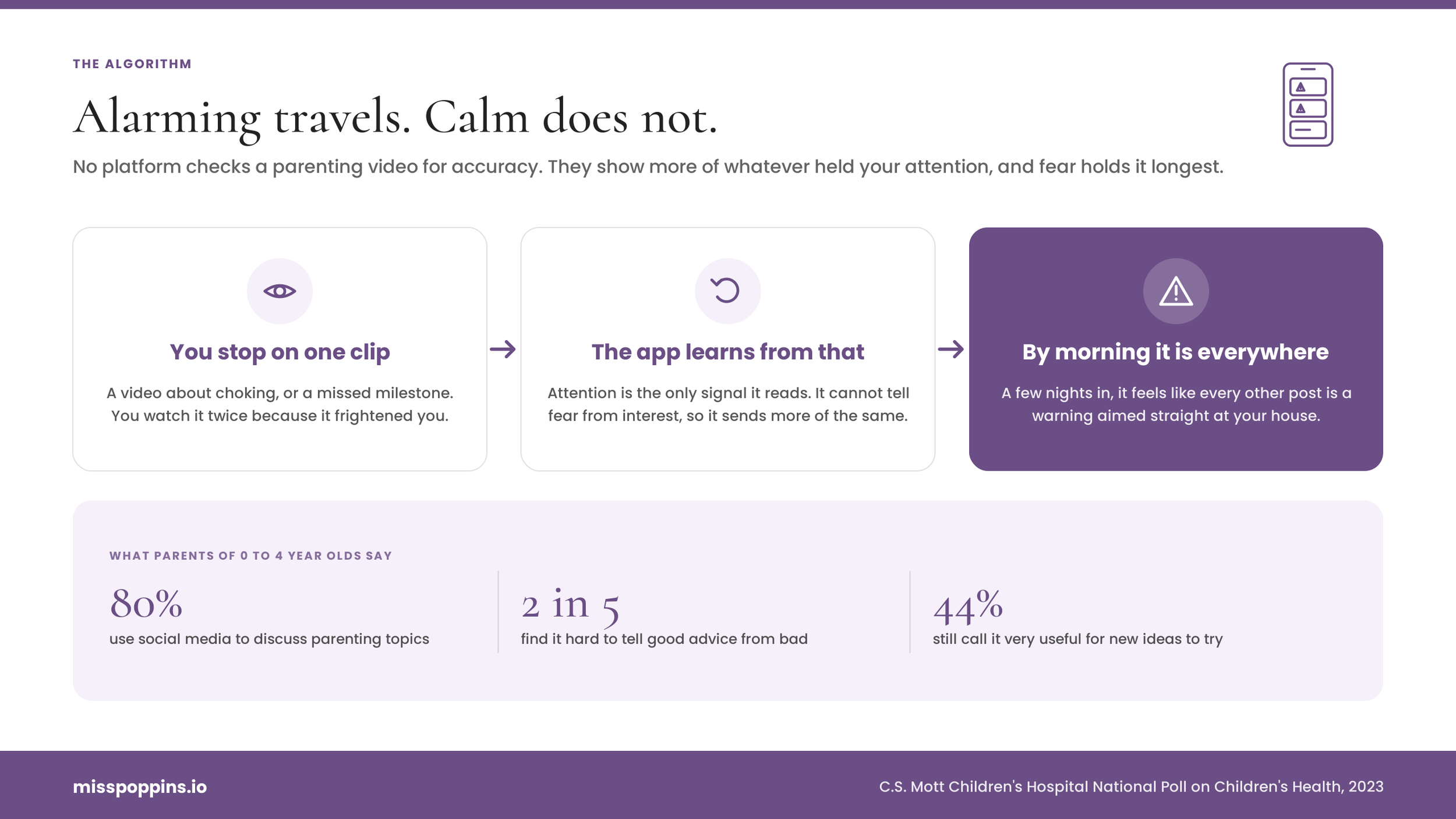
TikTok, Instagram, and Facebook do not check parenting videos for medical accuracy. Those apps show you more of whatever held your attention longest, and alarming videos keep people watching much longer than calm ones.
Stop on one clip about choking or a missed developmental sign, and your feed will start serving up more like it by morning. Give it a few nights, and it feels like every second post is a warning aimed straight at your house.
A 2023 C.S. Mott Children's Hospital poll backs up how messy this gets. Four in five parents of kids ages 0 to 4 said they use social media for parenting topics. Two in five said it is hard to tell good advice from bad online, while nearly half still called social media very useful for finding new ideas to try.
Calm advice rarely goes far on those platforms. A pediatrician explaining that most four-month-olds still wake up at night gets a handful of polite likes, while a post promising to make any newborn sleep ten hours straight gets shared all over the place even though no safe trick works for every baby. Comment sections usually pile onto the confusion. Five parents drop five completely different answers under the same post, and every single one sounds completely sure. Your own instincts can get drowned out fast in that kind of noise.
How Late-Night Scrolling Feeds Postpartum Stress and Exhaustion
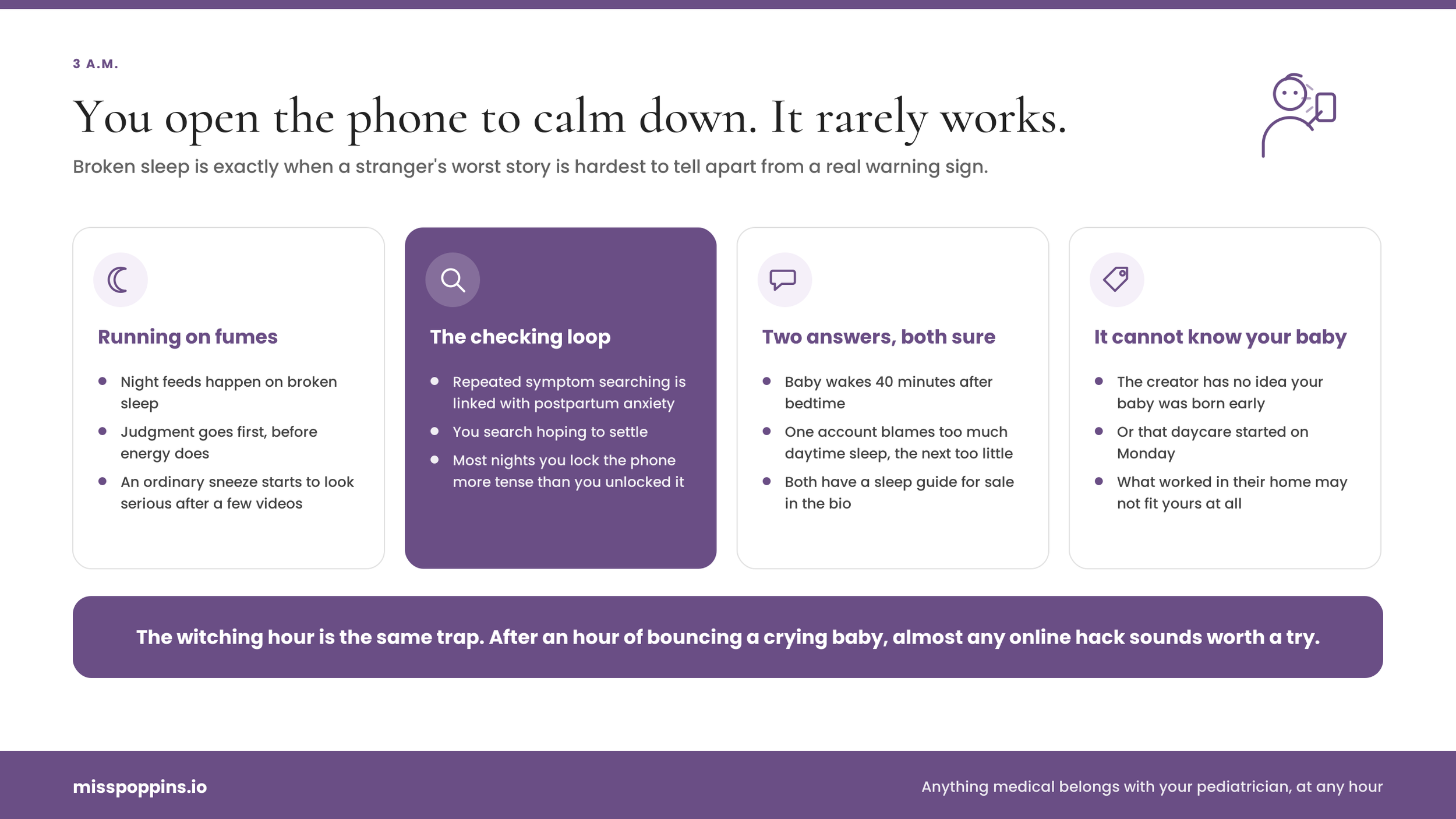
Night feeds happen on broken sleep. When you are running on fumes, it gets much harder to separate a real warning sign from a stranger's scary story, so an ordinary baby sneeze can start looking serious after a few videos.
It wears on your mental health, too. Checking symptoms over and over can be tied to postpartum anxiety, and our guide to the signs of postpartum anxiety explains what to watch for. You search hoping to calm down, and most nights you end up more tense than before you unlocked your phone.
Evening crying is another huge trigger. Plenty of healthy newborns have a fussy stretch in the late afternoon or evening, often called the witching hour. After an hour of bouncing a crying baby around the living room, almost any online hack sounds worth a shot, though our witching hour guide lays out a steadier plan you can actually stick with.
Bedtime plays out the exact same way. Your baby drifts off around 7:30 and pops back awake crying 40 minutes later. One account blames too much daytime sleep, the next blames too little, and both have a sleep guide for sale in their bio. If those early wakeups keep happening, our walkthrough on false starts at bedtime shows what to adjust first.
Short videos also miss the details that change the whole picture. The creator on your screen has no idea if your baby was born early or just started daycare on Monday. What worked in their home may not fit yours at all.
Anything medical belongs with your pediatrician. If your baby is healthy and you want straightforward help with sleep, feeding, or daily routines, you can talk to a pediatric nurse practitioner for one-on-one parent coaching between doctor visits.
Four Questions to Check Any Parenting Post Before You Try It
Before you try something you saw online, run it past these four questions. It takes about a minute.
| Check to run | What to ask yourself | Green light (Pass) | Red flag (Scroll past) |
|---|---|---|---|
| Training and scope | Can you verify their training, and do they stay in their lane? | A licensed clinician for medical questions. A certified specialist (IBCLC, sleep consultant, doula, newborn care specialist) for their area, who sends medical questions to your pediatrician. | No verifiable training, or a non-clinician giving medical, dosing, or diagnosis advice. |
| Sales hook | Are they pushing a product or miracle fix at the end? | Straightforward education with no pressure to buy a secret cure. | Affiliate links, supplements, or fear tactics tied to a checkout page. |
| Evidence base | Is this one parent's experience, or guidance from a group like the AAP? | Grounded in pediatric consensus from groups like the AAP or FDA. | "This worked for my baby, so every parent needs to do it tonight." |
| Downside risk | What happens if this tip turns out to be wrong for my child? | Low-risk routine tweak, like changing the order of bath and books. | Anything affecting breathing, safe sleep, infant nutrition, or medicine dosing. |
Be careful with accounts that put medical labels on normal toddler behavior, too. A short clip can make a rough week of tantrums look like a disorder, or brush off something that genuinely deserves a closer look. When you feel unsure, start with your pediatrician. Our guide to toddler behavior red flags can help you decide what is worth bringing up at your next appointment.
Having a pediatric office you feel comfortable calling makes all of this easier. If you often feel rushed during visits or hold off on calling with questions, read our guide on how to choose the right doctor for your child.
Should You Call 911, Call Your Pediatrician, or Ask a Coach?
When you are worried and unsure who to call, use this guide:
If your baby has blue or gray lips or face, stops breathing or pauses breathing for 20 seconds or more, has a seizure, or can't be woken: Call 911 right away.
If your baby is under 3 months old with a fever of 100.4°F or higher, is working hard to breathe, or is not eating, peeing, or acting like themselves: Call your pediatrician or your clinic's after-hours nurse line right now.
If you notice a mild symptom like a new rash or runny nose and aren't sure whether it needs a same-day visit: Check the AAP Symptom Checker on HealthyChildren.org and call your pediatrician's office if anything still feels off.
If your baby is healthy, eating well, and having normal wet diapers, and you have everyday questions about routines, sleep, or feeding: Close social media and book a 1-on-1 session with a parenting coach to talk through a plan.
The simple rule: symptoms go to your pediatrician, and everyday questions go to a coach.
When to Call 911 or Your Pediatrician Right Away
A sick child needs a medical exam. Parenting coaches offer education and everyday support. They don't diagnose, prescribe treatment, or handle emergencies.
Call 911 immediately if you see:
Blue or gray color around the lips, tongue, or face
Stopping breathing, or breathing pauses lasting 20 seconds or longer
A seizure or uncontrolled rhythmic jerking
A baby or child who cannot be woken up or stays unresponsive
Call your pediatrician or nurse line right away if you see:
Fever in a young infant or worrying behavior: Any rectal temperature of 100.4°F (38.0°C) or higher in a baby under 3 months old needs prompt medical care, and never give fever medicine to a baby under 3 months before a doctor evaluates them. For older babies and toddlers, pay close attention to how they're acting alongside the thermometer reading, and review the AAP guide on when to call the pediatrician for a fever.
Fast or labored breathing: Normal infant breathing speeds vary by age. Call your doctor for breathing faster than 60 breaths per minute in a baby under 2 months old, or faster than 50 breaths per minute in a baby 2 to 12 months old. Also call right away for nostrils flaring wide, skin sucking in between the ribs or under the ribcage, or grunting with every single breath.
Signs of dehydration: Fewer than 4 wet diapers in 24 hours for a baby, no pee for more than 8 hours in an older child, a dry or sticky mouth, crying with no tears, or a soft spot on top of your baby's head that looks sunken.
Unusual sleepiness or weakness: A baby who is very hard to wake for feeds, feels limp or floppy in your arms, won't make eye contact, or cries nonstop in a weak, high-pitched way.
Vomiting and stool warning signs: Repeated forceful vomiting, green (bilious) vomit, or blood in the stool.
If you are torn between waiting for office hours, driving to urgent care, or heading to the ER, the AAP parent guide to urgent care, ER, or pediatrician visits lays out clear examples by symptom. Trust your gut, too. Pediatricians would much rather take a quick phone call and reassure you than have you sit at home worrying alone.
Practical Habits to Break the Midnight Scroll Loop
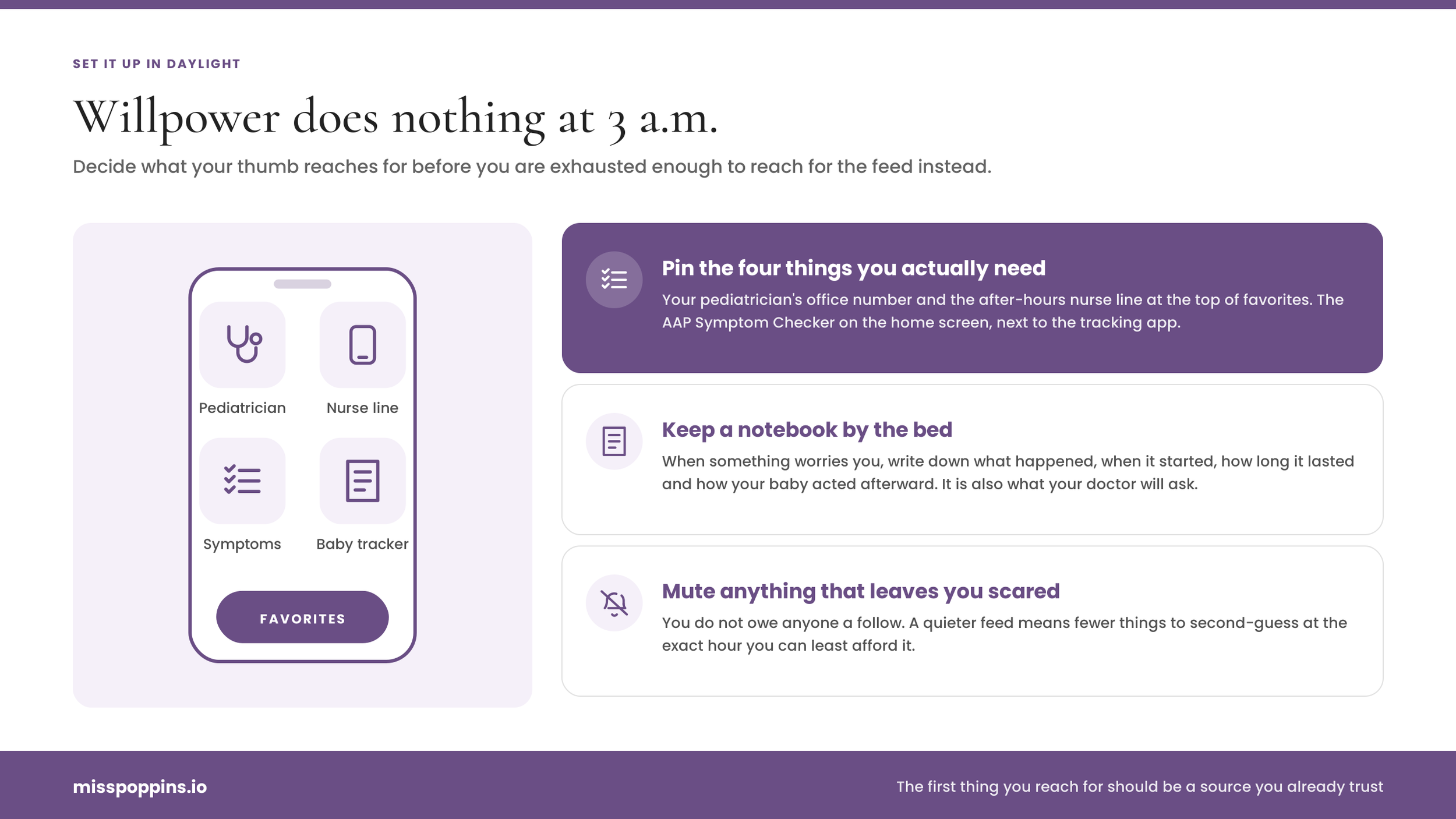
Willpower doesn't do much at 3 AM, so set things up ahead of time.
Save your pediatrician's office number and after-hours nurse line at the top of your phone favorites. Put the AAP Symptom Checker right on your home screen next to your baby tracking app. That way, the first thing you reach for is a source you can trust.
Keep a notebook and pen by your bed. When something worries you, write down what happened, when it started, how long it lasted, and how your baby acted afterward.
Mute or unfollow any account that leaves you feeling guilty or scared. You don't owe anyone a follow, and a quieter feed gives you fewer things to second-guess when you are already working through parenting burnout.
Get Your Questions Answered Between Pediatric Visits, With Cybil Fregia
Cybil Fregia is a certified pediatric nurse practitioner with 30 years of pediatric experience. On MissPoppins, she coaches parents on newborn care, sleep, feeding, potty training, siblings, and behavior.
Cybil helps you sort reliable information from the noise, build a plan for sleep, feeding, and routines, and organize your questions for your pediatrician.
Start with a free 30-minute call: Book directly on Cybil Fregia's MissPoppins profile to talk through what is going on at home and see if working together feels right.
Why families use MissPoppins between doctor visits:
5,000+ families guided across sleep, feeding, newborn care, and toddler routines
4.8 stars on the App Store from parents looking for calm, practical support
150+ years of combined experience across vetted, certified parenting coaches
100% private and encrypted sessions so you can ask honest questions without judgment
Download the MissPoppins app on the App Store or Google Play to connect with a certified coach today.
Frequently Asked Questions
Is it okay to Google my baby's symptoms?
Yes, looking up basic facts on trusted sites like HealthyChildren.org is fine for general background. Skip broad search spirals and social feeds when your child is actually sick, and call your pediatrician's office whenever symptoms worry you.
How do I know if parenting advice on TikTok is reliable?
Check whether the creator has verifiable training and stays within their scope. Reliable accounts cite pediatric guidance like the AAP or FDA, avoid pushing miracle products, and tell you to call your pediatrician for medical symptoms.
What is a nurse triage line?
A nurse triage line is a phone service offered by most pediatric offices and health plans, often available after hours. A pediatric nurse reviews your child's age and symptoms and tells you whether to monitor at home, schedule a visit, or go to the ER.
What's the difference between a parenting coach and a pediatrician?
A pediatrician is a medical doctor who examines your child, diagnoses illness, and prescribes treatment. A parenting coach provides non-clinical parent education and practical plans for everyday routines like sleep, feeding, and behavior between doctor visits.
Why do pediatricians limit screen time for babies and toddlers?
The American Academy of Pediatrics recommends avoiding screens other than video chatting for children under 18 months. For ages 18 to 24 months, stick to high-quality content watched together. For ages 2 to 5 years, limit media to about 1 hour a day so screens don't crowd out play and sleep.
What is the 7-7-7 rule for kids?
The 7-7-7 rule is a popular parenting habit built around giving your child 7 minutes of focused, phone-free one-on-one time 3 times a day: in the morning, after school or work, and at bedtime. It is a connection habit, not a medical guideline.
Sources
American Academy of Pediatrics (HealthyChildren.org): Symptom Checker
American Academy of Pediatrics (HealthyChildren.org): Fever: When to Call the Pediatrician
American Academy of Pediatrics (HealthyChildren.org): Urgent Care, ER or Pediatrician? A Parent Guide
American Academy of Pediatrics (HealthyChildren.org): Kids & Screen Time: How to Use the 5 C's of Media Guidance
U.S. Food and Drug Administration (FDA): FDA Advises Parents and Caregivers to Not Make or Feed Homemade Infant Formula to Infants
C.S. Mott Children's Hospital National Poll on Children's Health: Sharing on Parenting: Getting Advice Through Social Media