

Natural Rubber Latex vs. Silicone Pacifiers
Is natural rubber latex or silicone pacifier safer for their baby? Silicone pacifiers are widely considered safe and are often recommended as a latex-free option. Boston Children’s Hospital lists pacifiers, bottle nipples and similar rubber items as a possible allergy risk for children with latex sensitivity.
One of the main deciding factors between natural rubber latex pacifiers vs silicone pacifiers is allergy sensitivity. The differences between them also include durability, maintenance instructions, environmental friendliness, texture, and heat sensitivity.
Caveats exist when deciding between the two so it’s insightful to learn the pros and cons of natural rubber latex pacifiers and silicone pacifiers.
Is silicone latex free?
Silicone itself is a synthetic material that is inherently latex-free. Although silicone pacifiers are often marketed as hypoallergenic, there could be cross-contamination during manufacturing that can potentially pose a risk for those with severe latex allergy. That being said, it shouldn’t scare you away from purchasing silicone baby products. Reaching out to the pacifier brand of interest would be insightful to learn more about their manufacturing process, additives, and general maintenance.
For a practical consumer guide on the benefits of choosing silicone for your baby products, see MissPoppins, “Here’s Why Silicone Is Recommended for Babies.”
Other benefits of silicone products include:
– High heat resistance. Silicone can handle boiling, sterilizers, and the dishwasher without degrading — something parents rely on for hygiene.
– Non-reactive and stable; silicone is valued because it doesn’t leach microplastics, it doesn’t break down the way plastic does, and it holds up under repeated daily use.
– Durability. Parents don’t have to replace silicone as often; it doesn’t warp, stretch, or get tacky the way natural rubber latex can.
– Consistency in quality. Silicone is manufactured with tighter control, so texture, firmness, and shape stay the same over time (helpful for babies who are picky about feel).
– Easier to clean. It resists odors, stains, and buildup which is a major plus for anyone dealing with constant sterilizing cycles.
– Commonly available in BPA-free and latex-free options. Many brands market silicone as the safest alternative for families managing allergies or just wanting to avoid plastic altogether.
Why do some parents choose natural rubber latex over sillicone?
Some parents prefer natural rubber latex pacifiers because they more closely resemble the feel and flexibility of a nipple. This natural rubber latex is a plant-derived material tapped from the Hevea tree, so many parents describe it as organic in origin; still, anyone worried about latex allergy should proceed with caution. For a comparison of materials and care, see BIBS World, “Natural Rubber Latex vs. Silicone.”
Some moderately granola parents may also consider natural rubber latex as an eco-friendly option. Although safe and functional, silicone isn’t biodegradable. That being said, silicone is considered safer than plastic. According to San Jose Recycles, silicone has limitations in recyclability and loses its quality over time.
On the other hand, latex is considered environmentally friendly (natural not synthetic latex). To determine its true eco-friendly quality, it is important to research any additives, processing concerns, or synthetic fabrication.
For naturalistic parents; rubber is biodegradable under microbial conditions, offering a potential environmental advantage over synthetic polymers like silicone (Shah et al., 2013).
Are latex pacifiers BPA free?
“BPA-free” and “latex-free” are not interchangeable. BPA (bisphenol A) is a chemical found in some plastics; latex is derived from rubber trees. A pacifier can be BPA-free and still contain natural rubber latex, so parents searching “are latex pacifiers BPA free” should check both labels. Many manufacturers now offer products that are both BPA-free and latex-free, most commonly made from silicone.
Cleaning and replacement
How to clean your pacifier can vary depending on its material type. For natural rubber latex pacifiers, avoid prolonged boiling; rinsing with very hot (scalding) water helps clean without degrading the latex. Silicone pacifiers are meant to be boiled for five minutes or microwaved to sterilize. Follow the manufacturer’s instructions and replace pacifiers every four to six weeks or sooner if there are signs of wear.
To get more parenting questions answered on demand, we recommend speaking to any of the experts on the MissPoppins platform. For an easy parent/expert-approved shopping guide, we curated an easy-to-navigate new parent essentials list.
Last Edited: December 6th, 2025
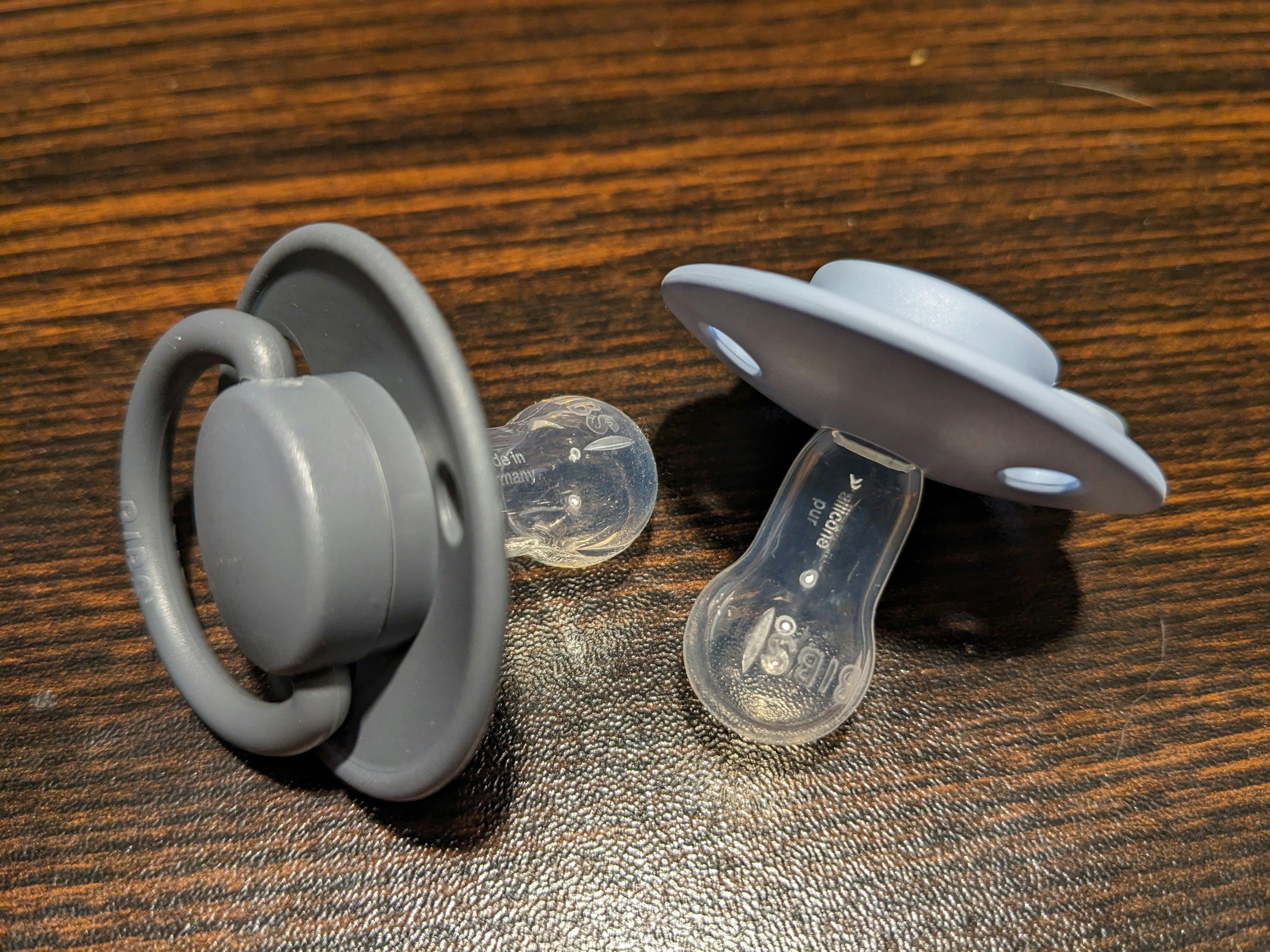
Baby pacifiers