
Nearly 6 in 10 Parents Are Burned Out. Most Are Turning to TikTok Instead of This
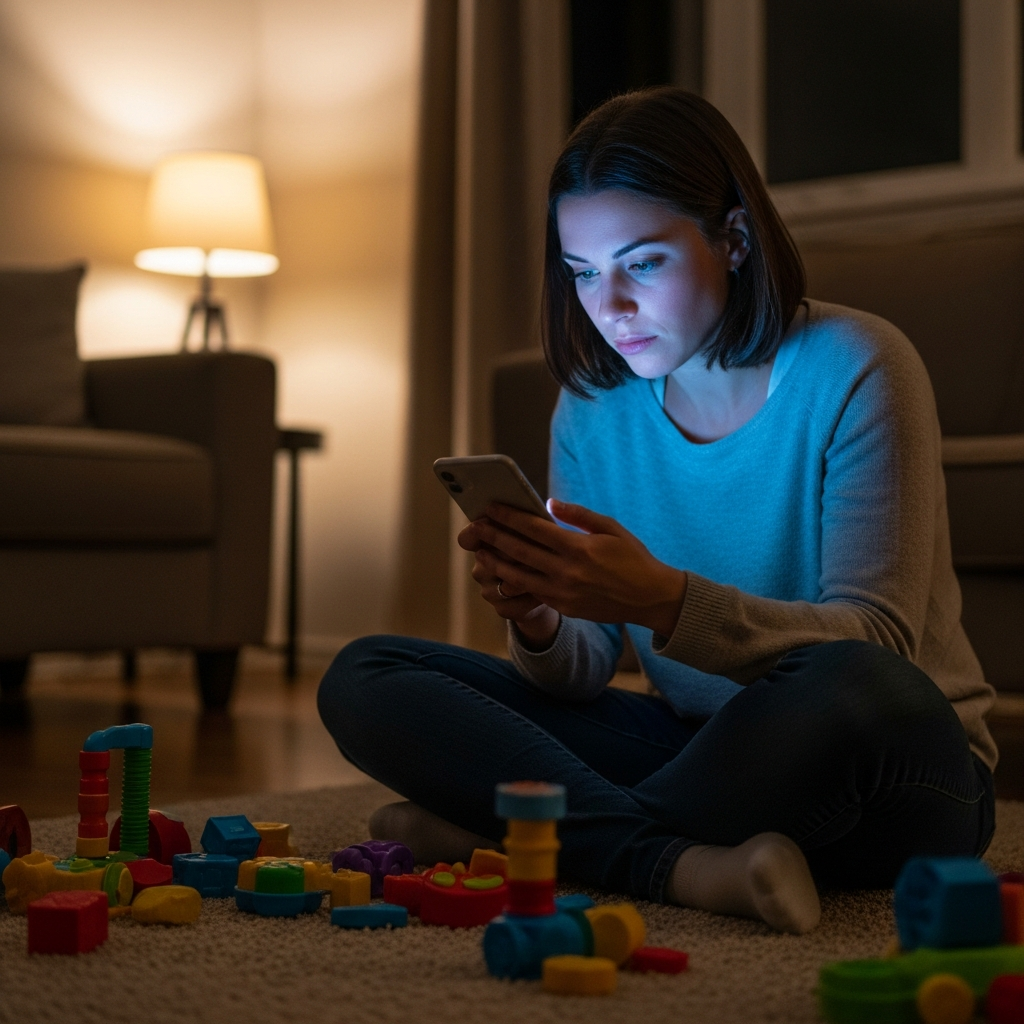
57% percent of parents are burned out.
Not stretched. Not tired. Burned out meeting the clinical criteria for a condition that researchers describe as a state of chronic exhaustion driven specifically by the demands of parenting. That figure comes from a 2024 study out of Ohio State University, where nursing faculty found more than half of all parents they surveyed had crossed the threshold.
And here's what makes that number so striking: it's happening in the most information-rich era in the history of parenting.
There are more parenting books, podcasts, Instagram accounts, TikTok creators, and Reddit threads about raising children than at any point in human history. The American Psychological Association's 2023 Stress in America survey found that 48% of parents now say their stress feels "completely overwhelming" on most days nearly double the 26% reported by non-parents. A separate analysis of 10 years of APA data shows that parents have been consistently more stressed than the rest of the adult population every single year.
So why, in the age of infinite parenting content, are more parents struggling than ever?
Because we've confused having access to information with having access to support. They are not the same thing.
The Information Paradox
When parents need help today, most reach for their phones. A 2024 study in Computers in Human Behavior found that over 85% of American parents report using social media platforms Facebook, YouTube, Instagram, TikTok as a resource for parenting guidance. A survey commissioned by the UK government in October 2025 found that a third of parents explicitly said they rely on social media as their primary source of parenting tips.
The problem isn't that they're looking for help. The problem is what they're finding.
Research from The Kids Research Institute Australia found that nearly half 46% of the most-watched parenting tip videos on TikTok contain information that is either misleading, inaccurate, or contradicts established child development evidence. A review by King's College London found that one in four parents encountered contradictory or confusing advice online (Frey et al., 2023), leaving them not more confident but more uncertain.
Sixty-nine percent of parents of children under four told researchers they felt "overwhelmed by the volume of parenting information" available to them.
More content. More confusion. More stress.
And critically almost none of it personalised to their actual child, their actual situation, or their actual family.
The Help Gap: What Parents Are Doing (And Not Doing)
Here's the other half of the picture. Despite widespread burnout, despite the APA documenting that one in three parents rates their stress at 8, 9, or 10 out of 10, the same research reveals that 60% of parents don't routinely do anything to relax or recharge (The Guardian, 2023).
Not a wellness practice. Not a support group. Not a professional to talk to. Nothing.
Part of this is cultural. Parenting is still treated as something you're supposed to figure out instinctively or quietly, through trial and error, through family advice, through the algorithm. Asking for structured support carries an unspoken implication that you're not coping. That you're failing.
But if 57-65% of parents are burned out, that logic has collapsed. This is not a personal failure. This is a structural one. We expect people to take on one of the most developmentally complex responsibilities a human being can hold raising another human being with no formal preparation, no ongoing professional support, and a feed full of content that may or may not be accurate.
No other high-stakes, developmentally critical role works that way.
What Research Actually Shows Works
Evidence-based parenting interventions have been studied extensively. The results are consistent.
A landmark meta-analysis published in Clinical Child and Family Psychology Review found that structured parenting programmes led to significant reductions in child behavioural problems and measurable improvements in parenting confidence and stress levels. A 2024 systematic review in The Lancet Child & Adolescent Health, led by researchers at Harvard, found that multi-component parenting and mental health interventions improved outcomes for both children and parents across income groups and geographies.
Parent-Child Interaction Therapy (PCIT), one of the most rigorously studied parenting intervention models, shows effectiveness rates of 60–80% for families dealing with persistent child behaviour difficulties. The Triple P Positive Parenting Programme has accumulated decades of evidence across 25 countries showing consistent reductions in parental stress, anxiety, and child conduct problems.
The common thread across all of this research? The intervention is human and personalised. Not a video. Not a thread. A trained professional who understands your specific child, your specific patterns, and builds a plan around them.
That is what a parenting coach does.
So What Is a Parenting Coach, Actually?
A parenting coach is a trained professional who provides structured, one-on-one support to parents navigating the real challenges of raising children. Unlike therapists who focus primarily on clinical mental health conditions parenting coaches work at the practical and behavioural level: helping you understand your child's development, build skills, shift patterns, and respond to what's happening in your family right now.
They are not there because something is wrong with you. They are there because raising children is genuinely hard, the stakes are genuinely high, and personalised guidance produces measurably better outcome than scrolling.
Coaches on platforms like MissPoppins work across every stage: from fertility and pregnancy through the newborn weeks, toddler behaviour, sleep, school transitions, and beyond. The best ones are not there to give you a script they're there to help you understand why your child is doing what they're doing, and what you can do that is specific to them.
That distinction matters. A TikTok video about toddler tantrums is made for everyone. A session with a certified parenting coach is made for your child, your household, and your family dynamics.
The "I Should Be Able to Handle This" Problem
The single biggest reason parents don't seek coaching sooner is the belief that needing support is a sign of failure.
The research says otherwise. A 2024 study published in the European Journal of Applied Positive Psychology found that parenting self-efficacy a parent's belief in their own ability to handle parenting challenges was one of the strongest predictors of parenting satisfaction and child wellbeing. But self-efficacy is not fixed. It's built It improves with feedback, with knowledge, with guided practice. That is precisely what coaching provides.
You would not expect to become a skilled chef by watching cooking videos and hoping for the best. You would not train for a marathon by reading motivational posts. The idea that parenting which is neurologically and emotionally far more complex than either should be mastered through observation alone has no evidence base. It just has cultural weight.
That cultural weight has real costs. It keeps parents isolated, overwhelmed, and reaching for content instead of the personalised guidance that actually moves the needle.
What to Look for in a Parenting Coach
Because the coaching industry is not formally regulated, quality varies. Here's what to look for:
Relevant background. Strong coaches typically hold training in child development, psychology, occupational therapy, nursing, social work, or a recognised parenting coaching certification programme. Ask about their qualifications directly.
A philosophy that fits your family. Parenting coaching approaches range from structured and behavioural to gentle and attachment-based. Neither is universally right — the right fit depends on your child's temperament and your own values.
Speciality match. A coach who works primarily on infant sleep may not be the right choice for a family navigating toddler aggression or postpartum emotional health. Look for specific expertise in your challenge.
Transparency. A good coach will be honest about what they can and can't address, and will refer to other professionals when clinical issues are outside their scope.
A free first call. This is standard practice among reputable coaches. Use it. The relational fit matters as much as the credentials.
What Does a Parenting Coach Cost?
Session rates for certified parenting coaches typically range from £60–£150 in the UK and $75–$200 in the US, depending on credentials and speciality. Multi-session packages generally reduce the per-session cost and are the most common format.
Online coaching platforms like MissPoppins often offer more flexible and accessible pricing structures, including shorter check-in calls and message-based support between sessions — making it more realistic to access consistently rather than just in moments of acute crisis.
The more useful framing, though, is this: the cost of ongoing parental burnout in mental health, in family relationship quality, in child developmental outcomes is substantially higher than the cost of early, proactive support. Research consistently shows that intervening earlier requires fewer sessions and produces better outcomes than waiting until things are in crisis.
Does Online Parenting Coaching Work?
The research on remote coaching and teleparenting support is now extensive enough to be definitive: yes, it works and for many families, the outcomes match or exceed in-person sessions.
A 2024 randomised controlled trial published in the Journal of Autism and Developmental Disorders found that telehealth-delivered parent coaching produced significant improvements in both child and parent outcomes. Online interventions for parents of children with additional needs showed consistent effectiveness in a 2025 meta-analysis published in the Australian Occupational Therapy Journal. A 2024 quasi-experimental study in the Belitung Nursing Journal found coaching methods significantly reduced parenting stress levels, including for high-risk groups like teenage mothers.
The practical advantages for parents are also significant: flexibility, access to specialists regardless of geography, and the ability to work from home during nap time, after bedtime, or in the brief window of calm between school drop-off and the start of the workday.
This Isn't About Being a Better Parent. It's About Not Running on Empty.
The 57% burnout statistic doesn't describe bad parents. It describes parents who are trying hard, often without adequate support, in a culture that tells them they should need less help than they do.
If the information was going to fix this, it already would have. Eighty percent of parents are already online. The content is everywhere. The burnout is still rising.
What changes outcomes is not more content. It's access to a human who knows child development, understands your specific situation, and can help you navigate it in a way that no algorithm can replicate.
That's what MissPoppins is built to provide: vetted, certified coaching professionals across every stage of the parenting journey, available online, starting with a free call.
Book a Free Call as a Parent →
Sources
Ohio State University College of Nursing. (2024, May 8). Pressure to be "perfect" causing burnout for parents. nursing.osu.edu
American Psychological Association. (2023). Stress in America 2023: A nation recovering from collective trauma. apa.org
HHS.gov. (2024, August). Parents under pressure: Parental mental health & well-being advisory. hhs.gov
The Guardian. (2023, May). What is 'parental burnout' and what can you do about it? theguardian.com
Saher, A. et al. (2024). Fathers' use of social media for social comparison. Computers in Human Behavior. ScienceDirect.
The Kids Research Institute Australia. (2025). Analysis of top parenting tip videos on TikTok.
Frey, E. et al. (2023). Cited in: King's College London. Hazards of online advice for parents of young children. kcl.ac.uk
The Independent / UK Government Survey. (October 2025). A third of parents relying on social media for parenting tips.
Al Sager, A. et al. (2024). Effects of multi-component parenting and parental mental health interventions. The Lancet Child & Adolescent Health.
Qu, L. et al. (2024). The efficacy of a telehealth parent coaching program. Journal of Autism and Developmental Disorders.
Devexhiu, N. & Baskurt, A.B. (2024). Enhancing parental wellbeing: character strengths intervention. European Journal of Applied Positive Psychology.
Saleh, A. et al. (2024). Implementation of coaching methods to decrease parenting stress. Belitung Nursing Journal.
Leo, M. et al. (2025). Online interventions for mental health and well-being of parents of children with additional needs. Australian Occupational Therapy Journal.