
Your Baby Isn't "Bad at Sleeping."
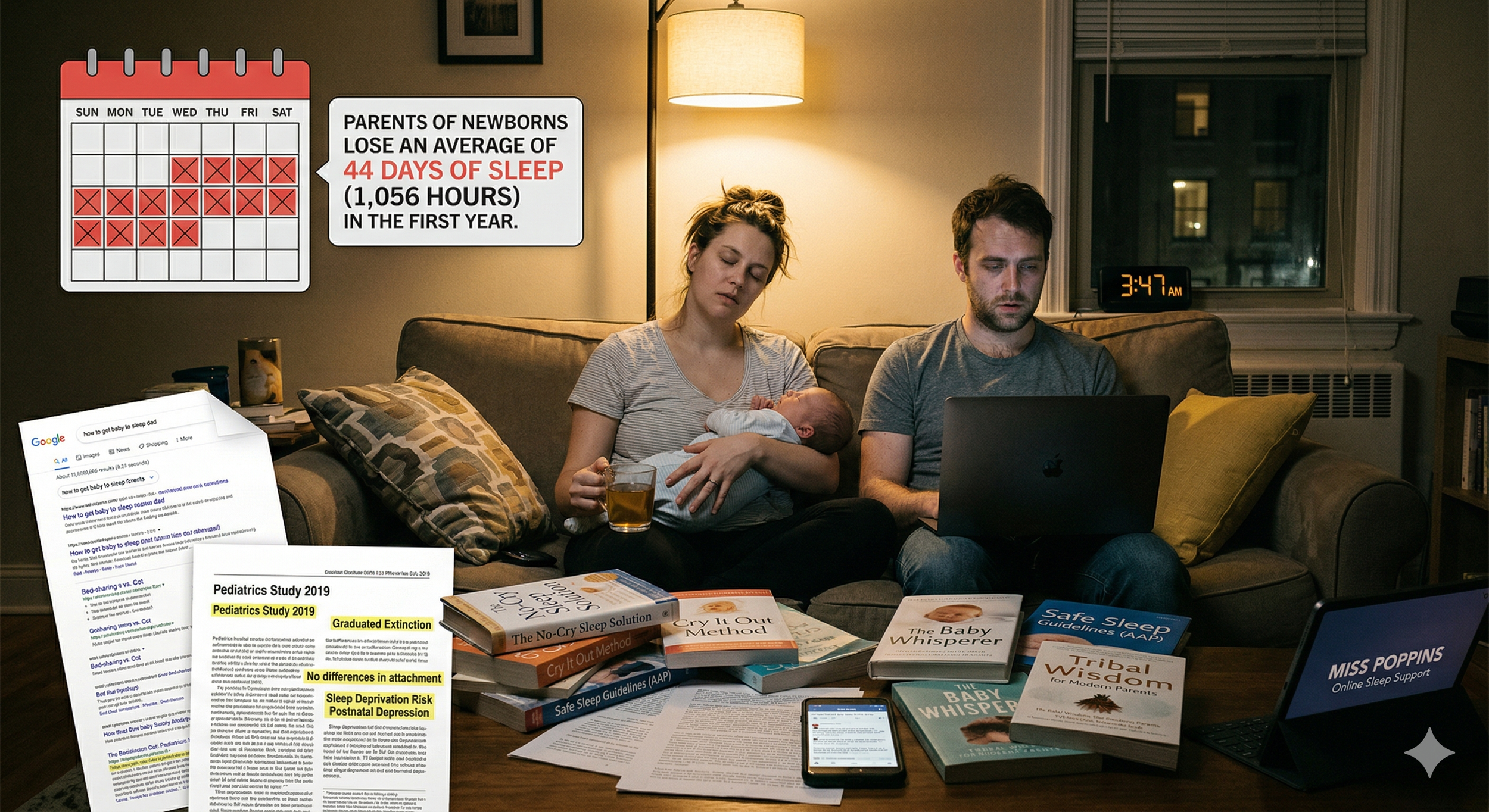
Parents of newborns lose an average of 44 days of sleep in the first year of their baby's life.
Not 44 nights. Forty-four full days.
That’s the equivalent of working a full-time job for two months without a single break.
Forty-four days equals 1,056 hours of lost sleep, spread across broken nights, early mornings, and the kind of exhaustion that makes you forget words mid-sentence.
That figure comes from a widely cited Mattress Advisor analysis tracking sleep patterns across 1,300 new parents. It’s not an outlier.
Researchers at the University of Warwick found that parental sleep quality doesn’t return to pre-baby baseline until six years after the birth of a first child, and that’s for parents who eventually settle into decent sleep.
Here’s what makes this particularly hard
Most parents are simultaneously being buried alive in sleep advice.
The AAP’s updated safe sleep guidelines, based on 159 studies, put the stakes in perspective. Around 3,500 sleep-related infant deaths occur annually in the US, with risk five to ten times higher when bed-sharing with infants under four months.
And then comes the noise.
Cry it out. Don’t cry it out. Responsive settling. Scheduled feeding. Dream feeding. Co-sleeping. Never co-sleep. White noise. No screen light. The EASY routine. The SNOO. The 5 S’s.
Add to that advice from family, conflicting online opinions, and rising search trends like “how to get baby to sleep through the night dad.”
The problem isn’t just volume.
It’s contradiction.
And it’s delivered with enough certainty to make you feel like you’re doing something wrong when it doesn’t work.
Why “Sleep Training” Has Become Such a Loaded Term
“Sleep training” has turned into a polarising topic.
It sits somewhere between controlled crying, which can feel harsh, and gentle methods, which often don’t work fast enough for exhausted families.
Online, it’s framed as a moral question. What kind of parent are you?
But the science is far less dramatic.
A 2019 randomised controlled trial published in Pediatrics compared graduated extinction, bedtime fading, and a control group with no intervention.
At 12 months, there were no differences in infant stress levels, no differences in parent-child attachment, and no differences in emotional or behavioural outcomes.
The conclusion was simple. Parents should choose what works for their family because no single method is universally better or harmful.
What actually made the difference was consistency, timing, and individual fit.
Every baby is different. Every family is different.
A method that worked for someone else may not work for you.
That’s not failure.
That’s context.
The Hidden Cost of Getting Sleep Wrong for Too Long
Most parents treat sleep issues as temporary. Push through, it’ll get better.
Sometimes it does.
But often, the impact runs deeper.
A 2020 meta-analysis in Sleep Medicine Reviews found that poor sleep is one of the strongest predictors of postnatal depression, independent of other risk factors.
For mothers in particular, fragmented sleep disrupts emotional regulation, impairs memory, and increases stress reactivity in ways that carry into the next day.
This isn’t theoretical.
Postpartum depression diagnoses doubled between 2010 and 2021, according to JAMA Network Open, and sleep deprivation is one of the strongest modifiable drivers.
There’s also the relationship impact.
A 2021 study in the Journal of Family Psychology found that persistent infant sleep problems beyond the first four months were linked to higher relationship dissatisfaction and increased conflict.
Not just because of the sleep itself, but because of the cumulative strain, disagreements on approach, and the absence of time that isn’t survival-focused.
For single parents, the picture is even tougher. The U.S. Surgeon General reports that 77 percent experience loneliness, with sleep deprivation amplifying that isolation.
This isn’t about fear.
But “it’ll fix itself” isn’t always the most helpful strategy, especially when support exists.
What a Baby Sleep Coach Online Actually Does
A certified baby sleep coach doesn’t hand you a generic routine.
They assess your baby’s age, temperament, feeding type, current sleep associations, your family structure, your parenting preferences, and your actual capacity right now.
Then they build a plan around your reality.
Not a hypothetical average baby.
That’s the gap most parents run into.
You’re trying to apply generic advice to a very specific human.
Of course it doesn’t always work.
Recent 2024 meta-analyses show no meaningful difference between online and in-person support, with parents often reporting higher satisfaction with virtual coaching.
Working with a baby sleep coach online removes geography completely. Whether you’re in London, rural Ireland, or Glasgow, you can access the same level of support through video consultations and ongoing communication.
The process usually includes a deep-dive assessment, a customised sleep plan, and follow-up adjustments as you implement it.
A good consultant adapts. They don’t just prescribe.
What the Research Says About Professional Sleep Support
Structured sleep coaching produces measurable results.
A 2016 review in Sleep Medicine Reviews found reductions in night waking, faster sleep onset, and increased total sleep duration in infants.
Just as importantly, it also showed improvements in maternal mood and wellbeing.
A 2022 systematic review reached similar conclusions. Tailored, structured support consistently outperformed both no intervention and self-directed approaches, especially when sleep issues had persisted beyond four months.
One thing worth saying clearly.
Not all sleep coaches are equal.
The quality depends on their training, how they assess situations, and how well they tailor their approach.
That’s why working with a certified infant sleep consultant matters.
When to Seek Support (And Why You Shouldn’t Feel Guilty)
There’s no prize for doing this the hard way.
If your baby is four months or older, sleep has been a consistent problem for more than a few weeks, and you’re getting less than five hours of fragmented sleep a night, that’s not something to just wait out.
That level of sleep deprivation is linked to cognitive impairment similar to a blood alcohol level of 0.06 percent.
At that point, this isn’t just parenting.
It’s a health issue.
Seeking support is a rational decision, not an overreaction.
The families who benefit most from sleep coaching aren’t failing.
They’re the ones who’ve tried multiple approaches, received conflicting advice, and want someone to step back and look at the full picture with them.
That’s what a good sleep coach offers.
Not magic.
Clarity.
Ready to stop troubleshooting alone?
Book a free consultation with one of our certified sleep specialists at MissPoppins - https://misspoppins.io/services#services
We work entirely online, so wherever you are, support is available.
Sources
Mattress Advisor (2020). Sleep and New Parenthood Survey
Richter D, et al. (2019). BMJ Open
Gradisar M, et al. (2016). Pediatrics
Moore M, et al. (2017). Journal of Family Psychology
Kempler L, et al. (2016). Sleep Medicine Reviews
Quach J, et al. (2022). Systematic Review
Dennis CL & Ross LE (2005). BIRTH